
Camouflage History
Argentina: Camouflage for Three Climates
One country, roughly 3,700 kilometres from the subtropical border with Brazil to the edge of the Antarctic. Argentina has answered the camouflage question three different ways: with a plain olive combat dress, with patterns tuned to a single climate, and finally with one universal print for the whole army. The third answer won, and the reasons have less to do with field craft than with budgets.
An army that runs from the subtropics to the ice
Argentine territory spans environments that share almost nothing. The province of Misiones is subtropical: humid, densely vegetated, the kind of country where a soldier disappears two metres off the track. The Pampas are open, temperate and agricultural. The Andes run dry and high along the western edge. Patagonia, from the Colorado river southwards, is cold steppe and wind-scoured rock, brown and grey for most of the year. An army recruited, trained and garrisoned across that range has to decide, again and again, whether camouflage is a national problem or a regional one.
Argentina’s answer has changed at least four times since the 1970s, and each change is legible in the photographs: plain green, then specialist prints for elite units, then climate-specific patterns, then a single multi-terrain print across the force.
Olive green, and the Malvinas gap
For most of the Cold War the Argentine Army fought and paraded in plain olive green. Combat dress was a monochrome uniform, and camouflage was a specialist item rather than a general issue. The most detailed open survey of Argentine patterns, the Camopedia country file, records that when the Malvinas/Falklands war broke out in 1982, camouflage clothing in Army hands was essentially reserved for the 601 and 602 commando companies, for Navy combat divers and for Air Force special operations units. The infantry that fought on the islands wore green.
That gap is worth pausing on, because it explains the shape of everything that followed. Argentina did not move from plain uniforms to printed ones because a study recommended it. It moved because units that had seen modern camouflage wanted it, and because surplus and foreign contracts made it affordable in bursts.
The 1980s produced two early woodland designs, both locally developed: a mottled pattern worn by Army and Air Force units, and a blotchier design used by the Naval Infantry until the mid-1990s. Neither was a national issue. They mark the moment camouflage became a marker of role rather than a logistics standard.
A science project that lost on cost
The most interesting Argentine attempt was a science project. In the late 1980s the armed forces research institute, CITEFA, worked with the textile firm Graffa on a jungle print known as mimetizado selva. It was a derivative of the British DPM layout, recoloured for vegetation, and by the accounts that have survived it performed well in the mountainous subtropical northeast, the country around Misiones where the army trains for jungle operations.
It was also expensive to print. Instead of becoming the standard jungle dress, the pattern was produced in small quantities and pushed towards mountain units, some cavalry elements and units preparing for peacekeeping deployments in the mid-1990s. It is one of the clearest cases in South America of a good camouflage idea dying of unit cost rather than of field failure.
A note on the record, because it matters for anyone reading photographs: the jungle pattern is documented in text and in a small number of period images, but openly licensed photographs that clearly show the print are scarce. This article therefore does not illustrate it. It is described, not shown, and readers should treat any strong claim about its exact colourway with caution.
Patagonia gets its own pattern
If the jungle print was the pattern Argentina designed, the Patagonian print is the one it actually issued at scale for a single climate. Known in the open literature as camuflaje patagonico, and sometimes as the Pampa pattern, it is an arid variation of the British DPM idea: medium brown, golden brown and beige disruptive shapes on a sandy background, with the four-colour structure of DPM but almost no green.
The pattern was developed for the Patagonian and Cordilleran zones specifically, and was worn by conventional units stationed there as well as by Army commandos. Argentine collectors also document nationally made helmet covers in the same print, which suggests a deliberate regional issue rather than an ad hoc purchase. In the steppe, with its pale ground and dry scrub, the logic is easy to read: a green-dominant woodland print would have been the wrong answer for nine months of the year.
Patagonia was not the only climate-specific route. Units with desert or special roles also used imported American prints. The six-colour desert pattern, the choc chip of 1990s memory, appears with Air Force tactical support elements, with the 601 and 602 commando units and occasionally with police special operations. The three-colour American desert print was adopted far more widely: with the 601 Air Assault, with commandos, with the Prefectura’s Albatros service, with Air Force units and with regular Army and Naval Infantry elements. The Joint Forces uniform reference documents it in service with the Argentine contingent on UNFICYP, which gives a useful dated anchor for the 1990s and 2000s.

Digital prints, and a foreign-surplus interlude
The next layer was digital. Air Force special operations and the 601 and 602 units wore MARPAT-derived designs, and the Naval Infantry went further, producing temperate and desert MARPAT derivatives locally under the names camuflaje bosque digital and camuflaje desierto digital. At that point the Argentine inventory contained, simultaneously, plain green, two woodland designs, a jungle print, a Patagonian print, two American desert prints and two digital prints.

One curiosity of the period is worth recording because it explains some photographs that circulate without context. After German reunification, stocks of East German rain-pattern camouflage, Strichtarn, were sold off cheaply, and Argentina bought quantities for training use in the early 1990s. It was never a standard Argentine pattern, and it should not be read as one.
2014: one pattern for the whole country
By the early 2010s the logistic argument had become overwhelming. Eight or nine different prints meant eight or nine supply chains, issue rules, repair stocks and procurement files. In 2014 the Army signed a contract with an Asian supplier for a new combat uniform in a multi-terrain print, and the first large delivery arrived in 2015. Spanish defence outlet defensa.com reported the order at around 125,000 uniforms and 40,000 sets of load-bearing webbing, in a 50/50 nylon-cotton ripstop, with a Mao collar, tilted chest pockets and a matching jungle hat.
The new uniform, known as UCAM, belongs to the international family of small-scale multi-terrain prints that spread through the 2000s: dense, multi-scale spotting in pale green, brown and tan, designed to blur at distance in a range of environments rather than to match one. Argentine industry now lists the same uniform in terrain versions, including a jungle variant usually referred to as UCAS, but the multi-terrain print is what the force actually wears, in Patagonia as elsewhere.
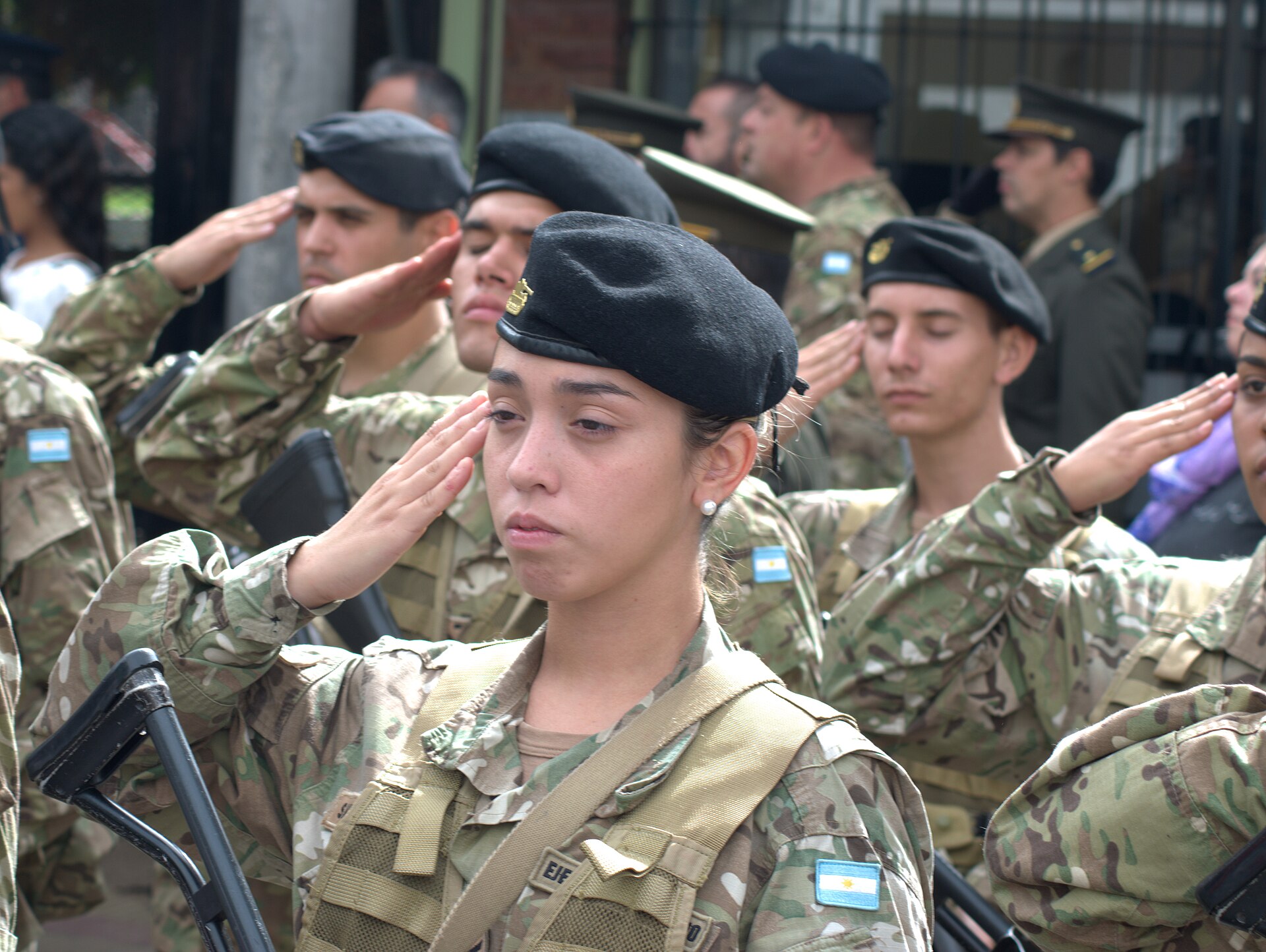

The photographs above carry the point better than any table. The print turns up on a parade ground in Tandil and in the field on the northern border with Bolivia, on soldiers of different corps and different climates, where four separate prints would have been on issue a generation earlier. The climate-specific answer did not disappear because it was wrong. It disappeared because one print is cheaper to buy, store, replace and account for than four.
Reading the three logics
Strip the detail away and Argentina has tried three answers to the same question.
- Monochrome. Olive green, from the 1970s into the 1990s. Cheap, uniform, and blind to terrain. It works until the other side has better camouflage.
- Climate-specific. The jungle print for Misiones, the Patagonian print for the steppe, desert prints for desert roles. The best local performance, the worst logistics, and the most vulnerable to budget cuts.
- Universal. A single multi-terrain print from 2014 onwards. Slightly worse in every specific environment, vastly better as a system.
The Argentine case is a useful corrective to the way camouflage is usually discussed. Enthusiasts argue about which pattern blends better; armies argue about which pattern they can supply. When a country chooses a universal print, it is not claiming that the print is optimal in the jungle and in the steppe. It is claiming that the difference in performance is smaller than the cost of carrying four separate stocks, and that a soldier with the standard uniform is better off than a soldier waiting for the right one.
Telling them apart
For collectors and for readers trying to date a photograph, the four families that matter are visually distinct once you know what to look for.
- Camuflaje patagonico. DPM structure, four colours, sandy base with medium brown, golden brown and beige, little or no green. Looks like a desert DPM because that is what it is.
- American three-colour desert. Three colours only, larger soft shapes, no DPM layering, a distinct coffee-stain look.
- American six-colour desert. Sand, brown and green ground with black and white flecks. Busy at close range, pale at distance.
- UCAM. Dense small-scale spotting in pale green, tan and brown, no large shapes, designed to blur rather than to imitate foliage.

The digital Naval Infantry prints are the easiest of all to separate: pixel edges are unmistakable, and the temperate and desert versions are clearly a pair.
What survives
Argentina’s camouflage history is often told as a list of patterns. It is better read as a sequence of procurement decisions, each one answering a budget question rather than a field problem. The jungle print and the Patagonian print were both sound ideas; one was too expensive to make and the other was too expensive to keep as a separate stock. The universal print that replaced them is the compromise that a mid-sized army with a very long border can actually sustain.
The older prints have not vanished from the record, and they still turn up in photographs, in reserve stocks and in the hands of collectors. The Argentina country page gathers the patterns associated with the country in modern apparel, made to order.
Dates in this article follow the most detailed open survey of Argentine patterns and period press reports. Contract values, exact issue dates for the Patagonian print and production quantities of the jungle print are not published, and are treated here as approximate.
