
Camouflage History
Finnish M62 and M91: Finland Before M05
Finland’s woodland camouflage did not begin with the M05. Two earlier issues, the M62 and the M91, carried the Finnish field uniform through four decades, and the second of them is the one English-language writing most often mistakes for the start of the story. The photographic record makes the point faster than the text does: these two garments share a drawing, and what separates them is the cut, the consistency of the printing, and the decade they belonged to.
That is the argument, and a deliberately narrow one. The M05, Finland’s current four-colour pattern, introduced from 2007, appears here only as the destination; MegaCamo’s separate account of it covers the pattern itself. What follows is the earlier half: how a small northern army worked out what camouflage its own forest required, at a time when almost nobody outside Finland was watching.
The army that fought in grey
Until the early 1960s Finland never issued a printed camouflage uniform. The field clothing of the army was a service uniform in greykenttäharmaa, the field grey that Finnish sources trace from 1918 to the early 1990s, worn over or instead of a wool service dress, the sarkapuku. Where camouflage existed it was seasonal and improvised rather than printed: the white snow suit of the Winter War of 1939-1940, which Finnish accounts describe as the country’s first field camouflage clothing and, in their own vocabulary, as the first maastopuku.
The distinction matters for everything that follows. A snow suit answers one problem, and answers it by removing colour rather than arranging it. A printed pattern has to answer the other three seasons, and it has to be reproducible in a factory.
The uniform the M62 replaced was plain, and that is the part to pause on. A reader who only meets Finnish camouflage through its spotted prints tends to assume the army was always patterned. It was not.
The first maastopuku: the M62
The M62 entered service in the early 1960s and stayed in issue far longer than most conscripts who wore it would have guessed, Camopedia places it in the field well into the late 2000s. Its construction is a blotch layout: larger soft shapes in two darker tones laid over a lighter ground, in the way the reference literature describes it. In Finnish the generic term is maastokuvio, “terrain pattern”, and the print is normally discussed in Finnish usage as the maastopuku m/62 the field uniform of the 1962 model.
That last point is the first trap in the English-language literature, and it is a naming trap rather than a pattern problem. In Finland, maastopuku m/62 names a garment. In English, “M62” has become the name of a drawing, and surplus listings routinely use “M62 pattern” and “M62 uniform” as if the two were identical. An army designation model-numbered 62 is not the same thing as a registered pattern: no design registry code for the M62 is on record, and this matters later when the M91 is compared with it.
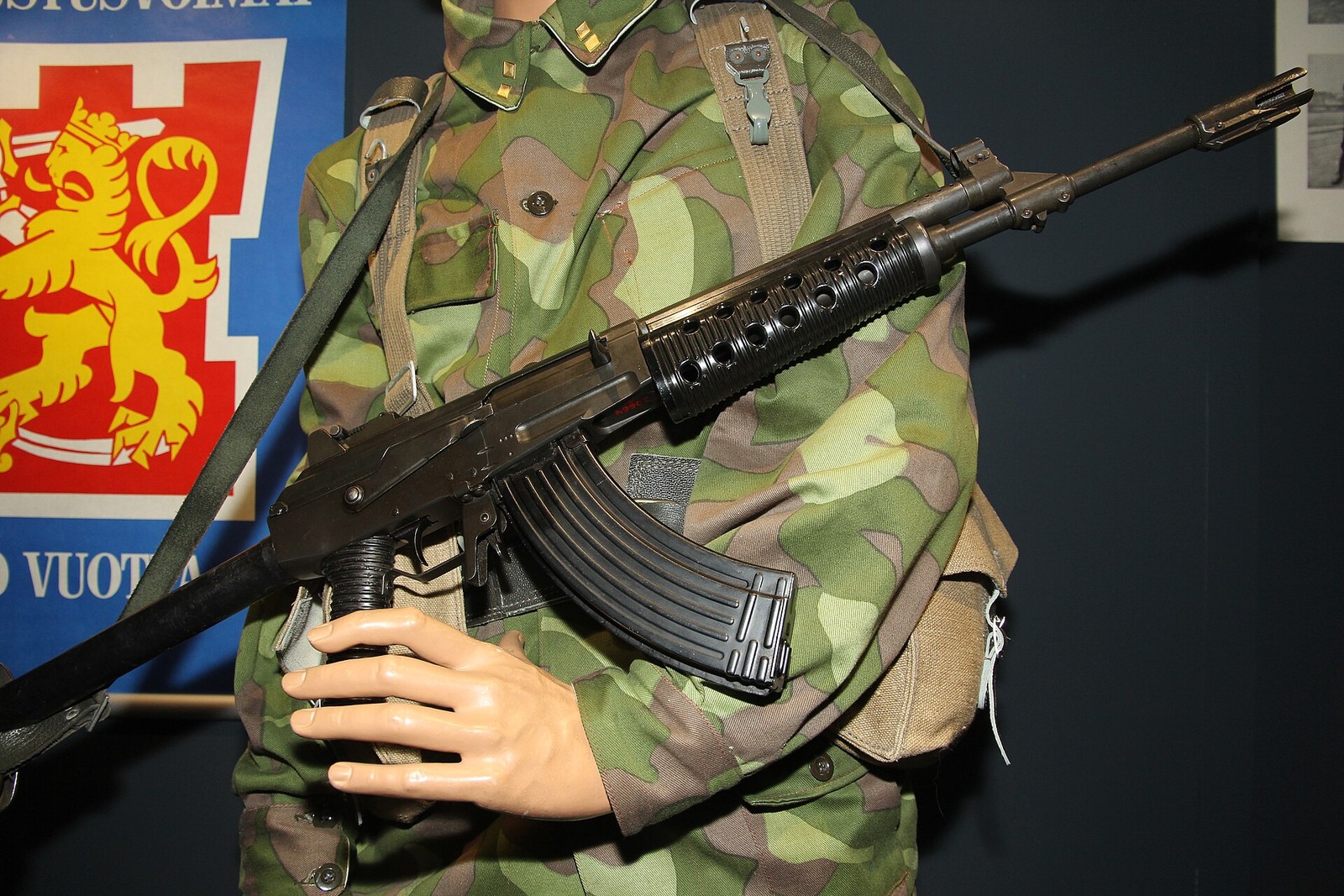
After the M62, the shape of the Finnish field figure stayed recognisably the same for a generation. What the museum figures in the Manege in Helsinki show is not a designer’s drawing but a clothing system actually issued: jacket, trousers, headgear and boots, and, in the 1960s and 1990s figures, a period weapon in frame.

The same display was photographed closer, where the size and spacing of the blotches can be read at the scale of the cloth.
Two faces, two seasons
The feature that most clearly belongs to the M62’s own design thinking is not the print but the reversibility. Most M62 garments were two-sided, with a white side, and the point of that arrangement is the Finnish year. The garment entered service, in the account given by Finnish sources, as a two-faced uniform intended to be worn over the wool sarkapuku: one side carries the summer pattern in various tones of green and brown, and the other side is white, usable as a lumipuku snow clothing. The same sources note that the M62 belongs to one of the last generations of reversible camouflage garments anywhere in the world.
One detail should be left open rather than settled. The sources do not agree on what the reverse side actually is: one describes it simply as white, another as a white side usable as snow clothing, while a Finnish surplus description refers to a kääntöpuku, a reversible garment, in which the snow print sits on the inside until it is turned outward. Whether the winter face was plain white or a printed snow pattern is not resolved here, and the safe formulation, a white reverse usable as snow clothing, is the one the sources support between them.
Colour variation is better documented than colour measurement. The reference literature records that a large number of colour combinations has been documented for the M62, and notes a suggestion by one author that some printings were intentionally seasonal. That suggestion has never been confirmed officially, and it is recorded as a suggestion rather than as an account of how the uniform was produced. No published source gives a colour reading for the M62, and the hexadecimal values that circulate online are third-party samples rather than measurements.
Kurkkusalaatti: the nickname two uniforms share
The M62 has a nickname, and the nickname is the most contested piece of the whole subject. Finnish soldiers and collectors know the print as kurkkusalaatti cucumber relish, a comparison made, obviously, to the look of the blotches. Camopedia attaches that nickname to the M62, and so does the Finnish collector literature: one Finnish militaria guide writes plainly that the three-colour pattern of the maastopuku m/62 received the sobriquet kurkkusalaatti.
The other reading comes from Finnish soldier slang, and it disagrees. A Finnish slang dictionary entry assigns kurkkusalaatti to the military field uniform of the M91, and adds that the word is not used of other field uniforms at all; in that vocabulary the earlier M62 is pellepuku (“clown suit”) and the newer M05 is dikipuku. Two attributions, both in circulation, and neither one obviously careless.
The question is not arbitrated here, for a reason that is itself the interesting part. If the nickname describes the look of the print, and the M91 reprints the M62’s drawing, then the nickname can migrate with the print while both accounts stay accurate: the M62 was the first garment to wear it, and the M91 is the garment a later generation of conscripts knew it on. What can be said without hedging is that the nickname is a soldiers’ word rather than an official one, and that Finnish nomenclature has produced several of these, which is why the naming layers of Finnish camouflage, not the drawing, are what a reader should watch for.
Reading the print itself
There is one close-up of the print in the free record, and it is not a pattern plate. It is a field photograph of a camouflage garment (jacket) of the Finnish spotted family, catalogued by Commons as M62 and dated 2006, with a carbine and optical sight lying across it. It is offered here as a visual reference for the size, spacing and soft outline of the shapes, not as a colour standard.

What exists instead is a narrow record: museum figures in uniform, official Finnish military documentation from the 2000s, and one close-up of the fabric.
M91: a new cut, not a new drawing
The M91 is usually written about, in English, as a new Finnish camouflage pattern. The reference literature does not describe it that way. Camopedia’s Finland entry records that the M91 pattern is essentially a reprint of the M62 pattern with a slightly different and considerably more consistent colouration, and that variants have nevertheless been documented. The same entry locates the real change in the tailoring: the M91 is described as a significant upgrade over the light reversible cotton garments worn during the preceding thirty years.
So the sequence is worth putting plainly, because it runs against the habit of treating each numbered pattern as a fresh design. From the early 1960s to the early 1990s, Finland did not replace its camouflage drawing. It kept it, reprinted it with more control over the inks and dyes, and put it on a better-cut uniform. A reader comparing an M62 figure and an M91 figure in the same museum series should therefore expect to see the same family of shapes, and that is what the museum display shows: two generations photographed in the same room, distinguished by cut, headgear, weapon and colour handling rather than by the geometry of the print.
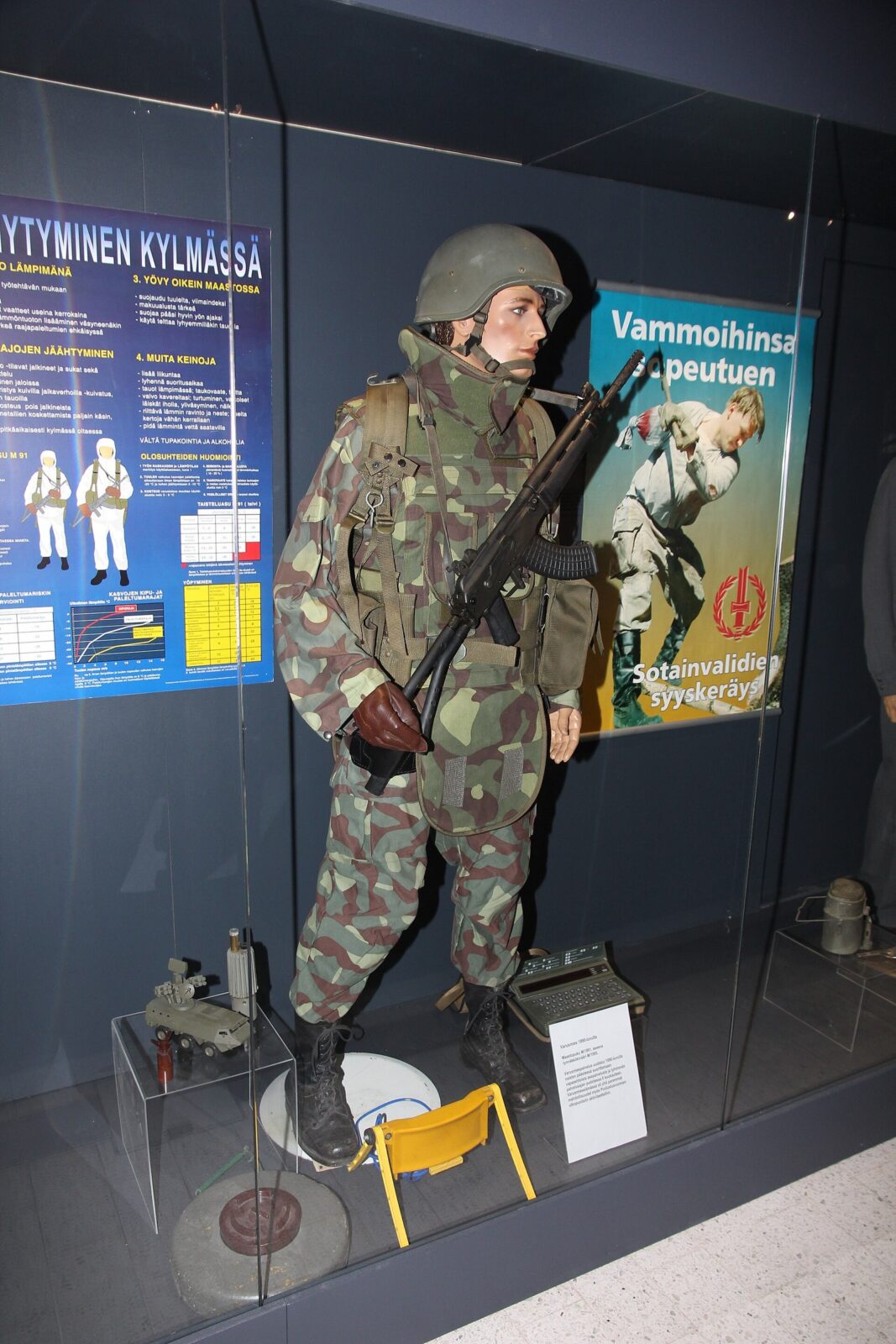
The same display was photographed closer. At this distance the print can be followed across the jacket and the body-armour cover, and the two do not carry the same colours: the vest reads darker and flatter than the garment underneath it.
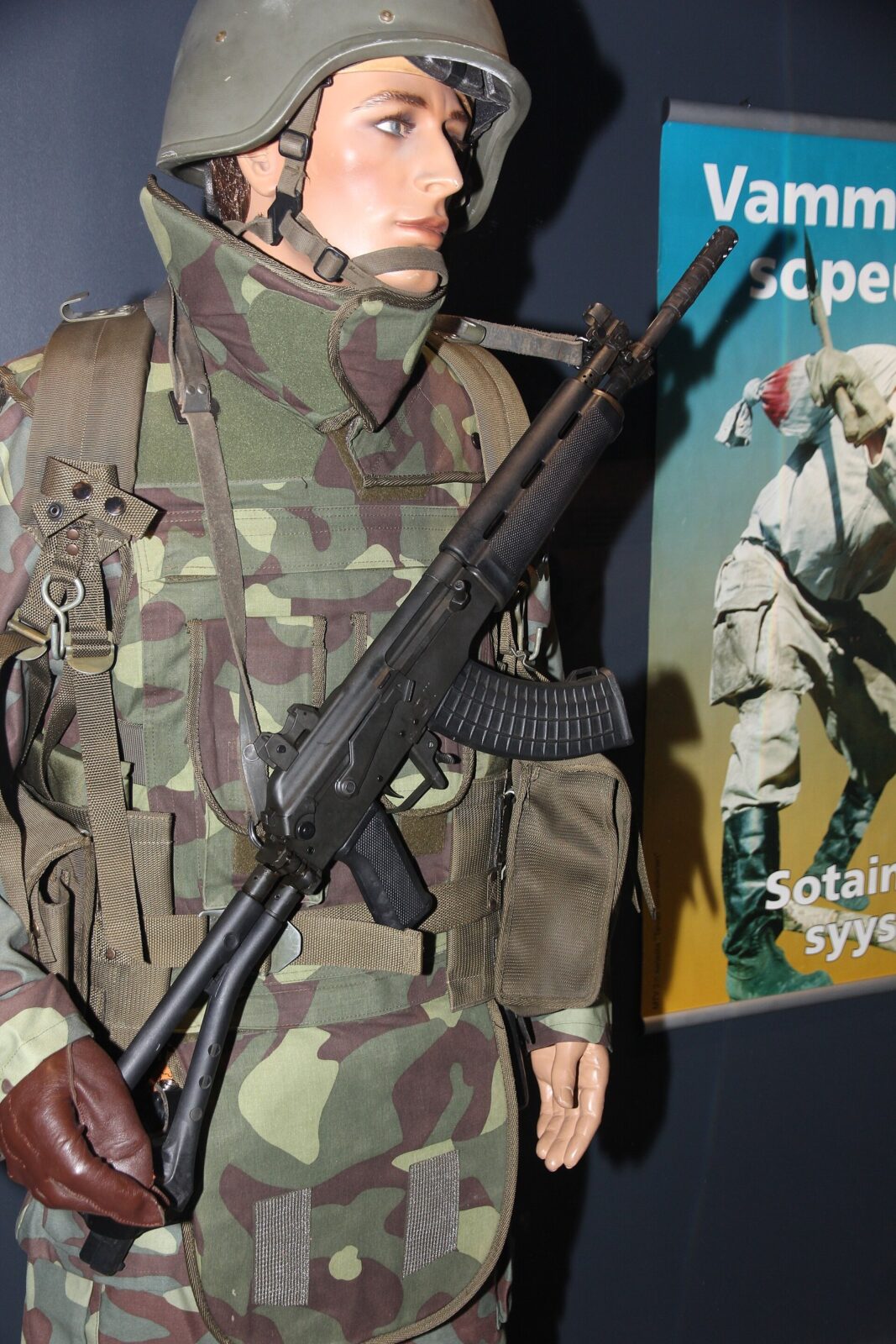
Dates here need care rather than confidence. Camopedia reports the M91 as originally released in 1990; the designation that Finland used is M/91, which invites the assumption of 1991; and one English-language commercial page that describes the pattern as Finland’s first official camouflage pattern of military history places it in 1991, a claim that cannot stand alongside the M62 being three decades older. The narrowest supportable statement is: designated M/91, reported as released around 1990-1991. As with the M62, no registered pattern code exists for the M91 drawing; a registry record exists for the M05, registered in Finland on 31 May 2007, and for neither of its predecessors.
One further gap is worth naming. Sources describe the M91’s colours as more consistent than the M62’s, and stop there. No colour reading for either generation is available, and no published source gives one. “More consistent” is a statement about production control, and it is treated as exactly that.
Why the M91 arrived late
The M91’s most surprising feature is not its design but its distribution. Camopedia notes that the M91 was, curiously, never fully implemented as a field uniform, and that its more common uses were as a garrison and service garment; genuinely widespread field use came only in the early 2000s, by which time the M05 was already being phased in.
The reason makes sense of the whole chronology, and it goes back to the grey. The Finnish army’s service dress did not switch to camouflage wholesale: the grey service uniforms of the m/65 and m/83 generations remained the norm into the 1990s, which means the camouflage garment and the everyday service garment coexisted for decades rather than replacing one another in sequence. An army that issues grey for the barracks and spots for the field does not need to convert its whole stock at once, and Finland did not.
The official record catches the M91 at exactly this stage. Finland’s 2000 dress regulation, the Sotilas- ja virkapukuohjesääntö, describes the field uniform M/91 with fur cap and boots, a uniform in a regulation rather than an experimental pattern. The surviving photographs from the period agree: the earliest freely licensed in-service image of the M91 generation comes from an official Finnish Defence Forces report showing reservists in an exercise around 2005.
No in-service photograph of the M62 generation is documented in the free record, while the M91 generation can be placed in the field on ordinary Finnish units in the years immediately before the M05.
Finland before M05
The M05, when it came, was genuinely a new drawing, and the way it was designed is the strongest argument that the M62 and M91 belong to a single earlier chapter rather than to the M05’s story. The M05 was built from photographs of Finnish forests taken by the Finnish Forest Research Institute, Metsäntutkimuslaitos, and reworked digitally at the VTT Technical Research Centre of Finland into a four-colour pattern, with an anthracite grey added to stand for shaded ground. The author attributed in English-language accounts of the Finnish record is Pekka Vilhunen; the pattern was registered in Finland on 31 May 2007; issue began from about 2007, and the pattern reached public sale only on 26 September 2016. That is observation of a specific landscape, converted into a print by measurement, a different method from the one that produced the M62’s blotches, even though the ambition is the same. MegaCamo’s account of the Finnish M05 covers the pattern, its seasonal colourways and the desert and snow family that followed it.
Two corrections belong in any article that approaches the M05 from the M62 and the M91, because both errors travel. The first is that the M05 is a pixelated or “digital” pattern. It is not; the shapes are organic, and the misreading is common enough that the reference literature notes it explicitly. Neither the M62 nor the M91 was ever digital either, there was no pixelation in Finnish field camouflage before the M05, and there is none in it. The second is the claim that the M91 was Finland’s first official camouflage pattern. The M62 predates it by roughly thirty years and the Winter War snow suit by more than fifty. The same reasoning that makes Swedish M90 a national symbol and Danish M84 a spot-pattern relative of Flecktarn applies in the other direction here: a pattern that looks like a beginning usually has a predecessor, and the predecessor is often the one nobody wrote down.
The M62’s own ending is not really an ending. English-language accounts of the Finnish record note that the M62 remained in niche use long after the M05 arrived, including with the paratroopers of the Utti Jaeger Regiment, where the older garment’s cut was reportedly better suited to jumping than the newer one. There is also the Yemeni footnote. Camopedia’s Yemen entry describes a three-colour blotch pattern worn by Republican Guard units as apparently copied from, or heavily influenced by, the Finnish “M70” pattern, and notes that the same units moved to a pixelated design in their old colours around 2008-2009. Camopedia’s Finland entry, the source used throughout for the Finnish side of the story, names the M62 and never an M70. The attribution in Yemen therefore rests on visual resemblance, as its own source presents it, and the designation “M70” is unexplained. It is recorded here as an attribution by appearance, not as a documented Finnish export.
For the wider vocabulary that separates a drawing from a uniform model from a family, the discipline that keeps “M62 the garment” and “M62 the pattern” from collapsing into one another, MegaCamo’s explainer on how camouflage is classified is the relevant companion, and the account of German World War II camouflage is the place to test one of the claims that are not certified here.
The pre-M05 Finnish prints have their own section, M62 first: Finnish M62 garments at MegaCamo. The rest of this article is history; nothing on sale can settle what a period photograph shows.
