
Camouflage History
Soldier 2000: South Africa’s Camouflage for the Bushveld
South Africa fought its last conventional war in a brown uniform. Through the 1970s and 1980s, SADF soldiers on the Angolan border wore Nutria, a flat chocolate-brown combat dress that hid dust and shadow but did nothing to break up the shape of a man. Soldier 2000 was the answer: a four-colour disruptive pattern drawn for the bushveld, adopted as the SANDF field dress in the 1990s and still worn on operations in 2026.
It is also one of the least documented major national patterns in the world. South Africa buys little publicity for its uniforms, its procurement records are thin on the ground, and most of what circulates online is dealer description recycled from dealer description. This article stays with what can be shown: the garment, the print, the dates on the photographs, and the places where the pattern has been worn.
Where Soldier 2000 came from
The starting point was the end of Nutria. A single flat colour works as camouflage only in one light and one season. South African operations spanned the dry Kaokoveld, the mopane scrub of the Caprivi, the thornveld of the eastern Transvaal and the green hills of Natal, and a brown uniform read as a dark slab in most of them.
Work on a disruptive replacement began in the late 1980s, inside the same defence research system that produced most South African field equipment of the period. The design brief was narrow and practical: a pattern that would sit in dry grass, dust and earth brown soil under hard sunlight, with enough dark tone to hold a shadow, and enough contrast to break the outline at the distances where infantry actually shoot.
The exact adoption year is disputed. Sources place the introduction anywhere between 1992 and 1995, and the change was gradual rather than a single issue date: units received the new dress as stocks and budgets allowed, while Nutria stayed in use for years afterwards. Treat any precise first-issue date you read online as unconfirmed unless it comes with a contract document.

The helmet cover above is worth a second look, because stretched over a shell the print loses the folds of a shirt. The pattern plate further down lays the same print out flat, where the shapes can be read without cloth distortion: an earth brown ground, large soft-edged green blotches, pale green patches and the small dark spots that sit inside them.
How to recognise the pattern
Soldier 2000 is a four-colour print with a strongly contrasted structure. It is not digital, it has no pixel grid, and it does not use the fine overlapping leaf shapes of American or Asian woodland patterns.

- An earth brown ground, a dusty brown rather than a sand tone, which carries the largest single share of the surface.
- Large, soft-edged green masses in three shades: dark green, grass green, and a pale green that photographs almost cream in hard sunlight.
- Small spots of dark green and pale green scattered inside the green masses, dense in some places and absent in others.
- Narrow channels of ground brown between the green masses, which read as dry earth at distance.
Collectors sometimes call it a giraffe or leopard print, which describes the blotch shapes but not the colours. The pattern also has a recognisable vertical bias: on a shirt front the green masses tend to run up and down the body, a consequence of the fabric direction rather than a deliberate design rule.

A uniform system, not a single shirt
Soldier 2000 is the name of a family of garments rather than one item. The core is a bush jacket and matching trousers in a ripstop cotton blend, cut loose for heat and for movement through thorn. Around it sit a helmet cover for the M83 Kevlar helmet, a field cap, and a set of pouches printed from the same screens so that belt kit reads as one object with the wearer.
Print registration varies between runs, and copies of the pattern made for the commercial market circulate widely. Public documentation of any print outside the issue run is poor, and dealer listings regularly present commercial copies as issue garments. The safe rule for a collector is to buy the garment, not the story: if the label, the weave and the print registration do not agree, the seller’s claim about where it came from means nothing.
From the border to peace support
The pattern’s longest public record is not the Border War but the years after it. South African contingents have worn Soldier 2000 continuously in United Nations service, most visibly with MONUSCO in the eastern Democratic Republic of the Congo, where South African infantry formed the core of the Force Intervention Brigade from 2013.

Photographs from Congolese patrols are worth reading carefully, because they show the pattern in an environment it was not drawn for. Against wet equatorial green, the greens of the print sit close to the foliage but the earth brown ground does not, so the uniform still reads as a brown patch on a green wall. Against the dry, dusty roads of the same theatre it does the opposite and nearly disappears.
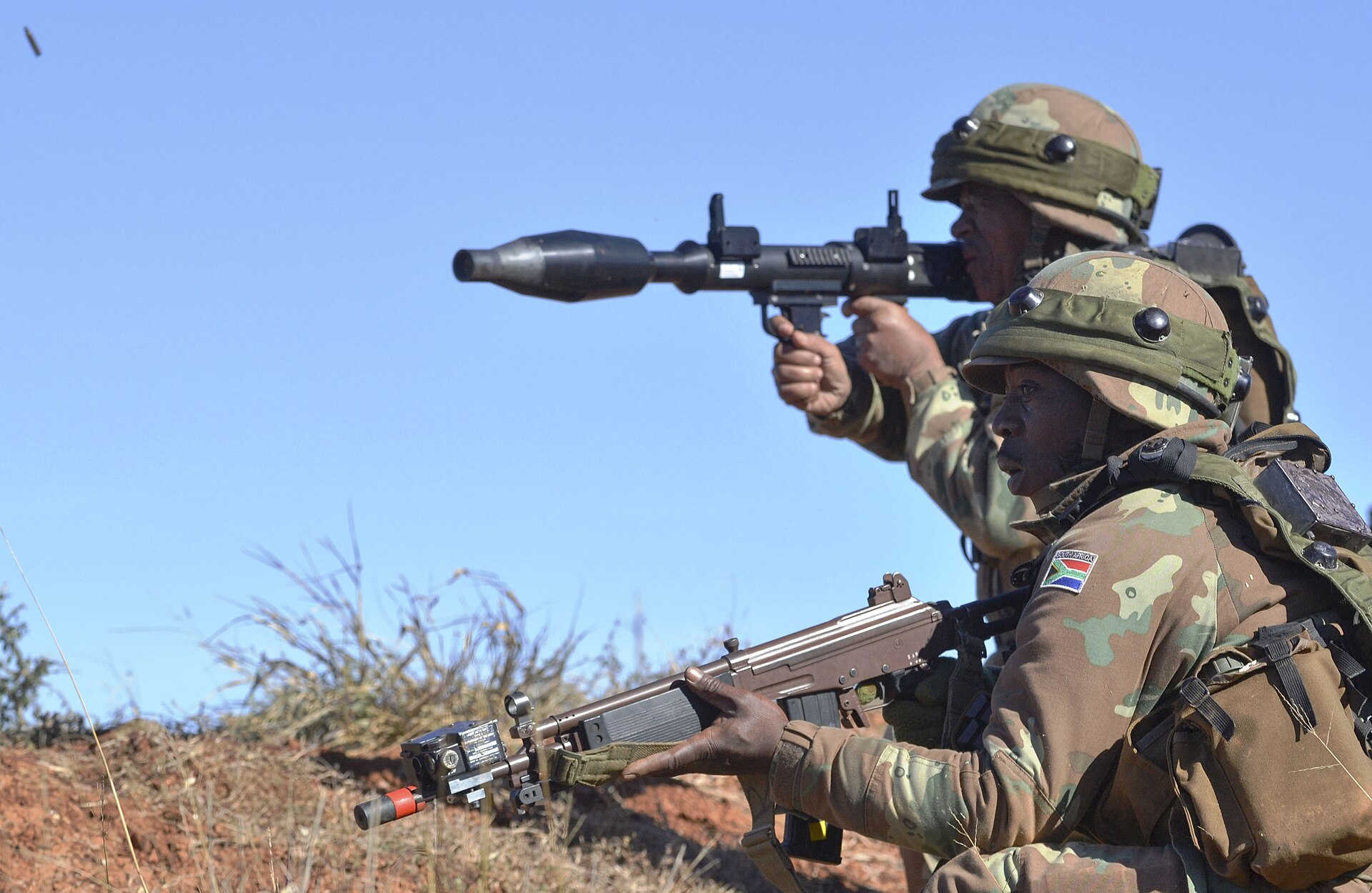
The pattern also appears in the training and exchange record. Shared Accord, the annual South African and United States exercise in the Eastern Cape, produced a run of clear photographs of SANDF infantry in Soldier 2000 on dry scrub terrain, which is close to the environment the pattern was actually designed for.

What the pattern does well, and where it fails
In its home environment Soldier 2000 is a genuinely good design. The earth brown ground matches dry soil and dust, the green masses match the dull olive of bushveld foliage, and the darkest spots add the shadow that a human body cannot avoid casting. At the ranges where small-arms fire is aimed rather than sprayed, the effect is to split the torso into three or four unrelated patches.
The failures are just as consistent. In deep green forest and in wet tropical vegetation the print is too coarse: the blotches are larger than the leaves, and the earth brown ground sits wrong against cold, wet green, so instead of blending, the uniform turns into a series of separate brown and green patches. In urban and built-up terrain it offers nothing at all, which is true of every bushveld pattern and is not a criticism of this one.

Reading a real garment
Issue Soldier 2000 is not hard to identify once you know where to look. The label carries a contract number and a date rather than a brand, and the print is applied to the fabric before cutting, so the reverse of the cloth shows the same colours in a softer, bled version. Faded originals keep their contrast better than modern reproductions, which tend to use a flatter, more saturated brown.
Three practical checks. First, look at the green: issue green is dull and slightly grey, reproductions are usually brighter. Second, look at the ground colour at a seam, where the dye is protected from sunlight and stays closest to the original tone. Third, look at the registration between colours: on genuine print the brown ground showing between the green masses is a gap in the screens, not a printed line.
Thirty years and still in the field
Soldier 2000 has now outlasted the state that created it, the army that adopted it and most of the conflicts it was designed for. Newer South African uniform programmes exist, and the pattern has been supplemented rather than replaced. For anyone interested in camouflage as design rather than as fashion, it remains a clean example of a national pattern built from one specific landscape, doing that job well and failing honestly everywhere else.
If you want to see how these prints look at pattern scale and in reproduction, our camouflage collection is a reasonable place to start: browse the MegaCamo shop.
