
Camouflage History
NWU Type I: The Navy’s Blue Uniform, and Why It Was Retired
For eleven years the United States Navy dressed its sailors in blue. The Navy Working Uniform Type I, a digital camouflage printed in navy blue, deck grey and black, began reaching the fleet in late 2008, became the service’s standard working uniform ashore and afloat by 2010, and was gone by 1 October 2019. Sailors named it “blueberries” and “Aquaflage”, and it is still the most argued-about working uniform the Navy has issued in modern times.
The arguments were not only about taste. Type I was asked to do two jobs that do not sit together: keep a working uniform presentable, and hide its wearer. It was designed for the paint locker, the pier and the flight deck, and it was judged, constantly and unfairly, against uniforms built to hide soldiers in woodland. Its story matters because it shows how a pattern that every sailor recognised instantly became one the Navy decided it could no longer justify.
What the Type I pattern is
The pattern is a pixel or digital design, built small squares rather than large soft blotches, in three working tones: navy blue, deck grey and black, with a paler haze grey in the background. When the Navy announced the uniform it gave a plain account of the choice. The colours were those of the working environment at sea and in port, the blues and greys of hull paint, deck non-skid, machinery and bulkheads, so that a uniform would not look stained the first time a sailor brushed against paint, grease or rust. The service also argued wear: the digital print held its colour longer than the solid-coloured utilities it replaced, and the Navy put the useful wear life of a set at up to eighteen months against roughly six for the older garments.

Type I was never presented as a combat uniform, and this is the detail that most of the argument later ignored. The Navy said from the outset that the NWU was a working uniform for shipboard and shore duty, worn by everyone from seaman to admiral in port and in the workshop. Camouflage in the sense of concealment from an armed enemy was not the requirement. The requirement was one garment that could replace several, survive a working week and look like part of the ship.
Task Force Uniform: how a blue pattern was chosen
The project began in 2003. Vice Chief of Naval Operations Admiral William J. Fallon set up a study group under the name Task Force Uniform, and between 26 February and 20 September 2003 the Navy surveyed the fleet on what it wore and what it wanted. Reporting on the survey later put the number of sailors consulted at about 40,000, with some 60 per cent asking for a working uniform in the style of the Army’s Battle Dress Uniform; the figure and the finding come from Navy Times’ coverage of the programme’s own history rather than from a published report.
Four prototypes were shown to sailors in late 2004 and 2005 and worn in tests over about six months. Two designs mattered. One, known in the project as NWU-C, took a blue, black and grey version of the old woodland pattern and kept its soft, analogue shapes. The other, NWU-D, used a small-square digital print dominated by blue, in the family of the pixelated patterns that were entering American service uniforms in the same years. Sailors also tested collar shapes, pocket layouts and two different covers. In early 2006 the Chief of Naval Operations, Admiral Michael G. Mullen, chose the digital design with the pointed collar and the eight-point cover.
The first public decision on colour came in 2006, and it was not a single colour at all. A naval administrative message recording the choice described one working uniform in three variants: a predominantly blue digital print for the majority of sailors and for shipboard wear, and two further digital prints, woodland and desert, for units whose work took them into those environments. That three-part structure is why the pattern family, and this article, has a Type I, a Type II and a Type III at all.
Fielding, from Great Lakes outwards
Recruits at Recruit Training Command, Great Lakes, Illinois, were among the first to be issued the Type I, and the photographs from the spring of 2009 show what issue day looked like: recruits in gold physical training shirts working through stacks of blue blouses and trousers, then a fitting hall where the new uniform was tried on for size. General issue ran through 2009, and by late 2010 the NWU had displaced most of the Navy’s older working clothing, the coveralls, the wash khakis, the utilities and the working blues, with the coveralls surviving alongside it.

The money is part of the story. Looking back at the retirement in August 2016, Navy Times put the programme at five years of development and 224 million dollars spent on a uniform that would be worn, in the end, for barely a decade. The figure is a newspaper’s accounting, not an audited number, and the Navy has never published a comparable total, but the scale is not disputed and it is why the decision to drop the pattern was described in the service’s own announcements as a saving.
In service: watch standing and the working day
In daily use the Type I did what a working uniform has to do. It was worn on the pier, in the hangar and at the issue counter; it was worn with body armour and a rifle on security watches, and it was worn by sailors handling stock in the Navy Exchange. Its printed blues held stains, and the rank and name tapes were embroidered straight onto the cloth, which removed a batch of things to iron, sew or polish.
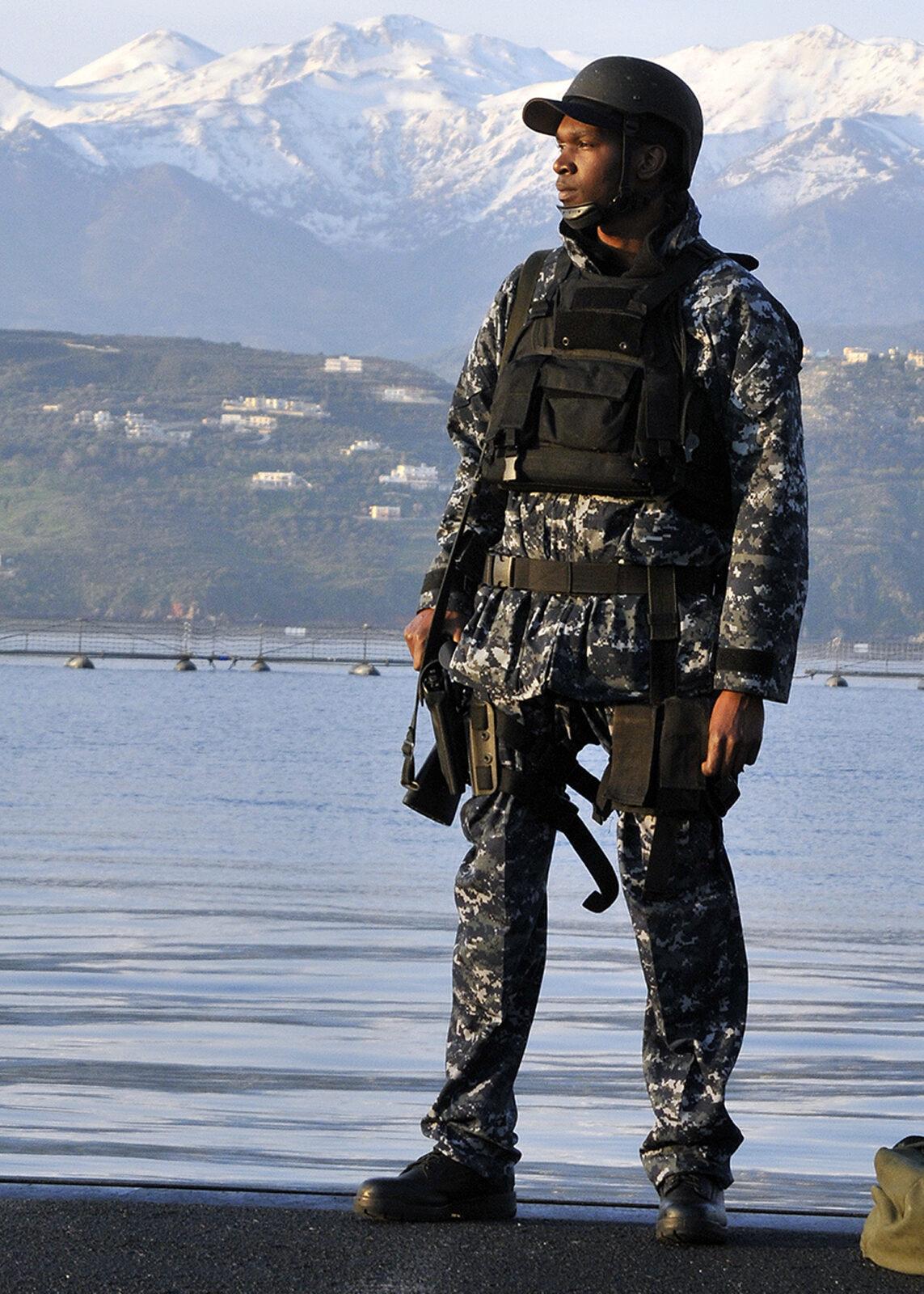
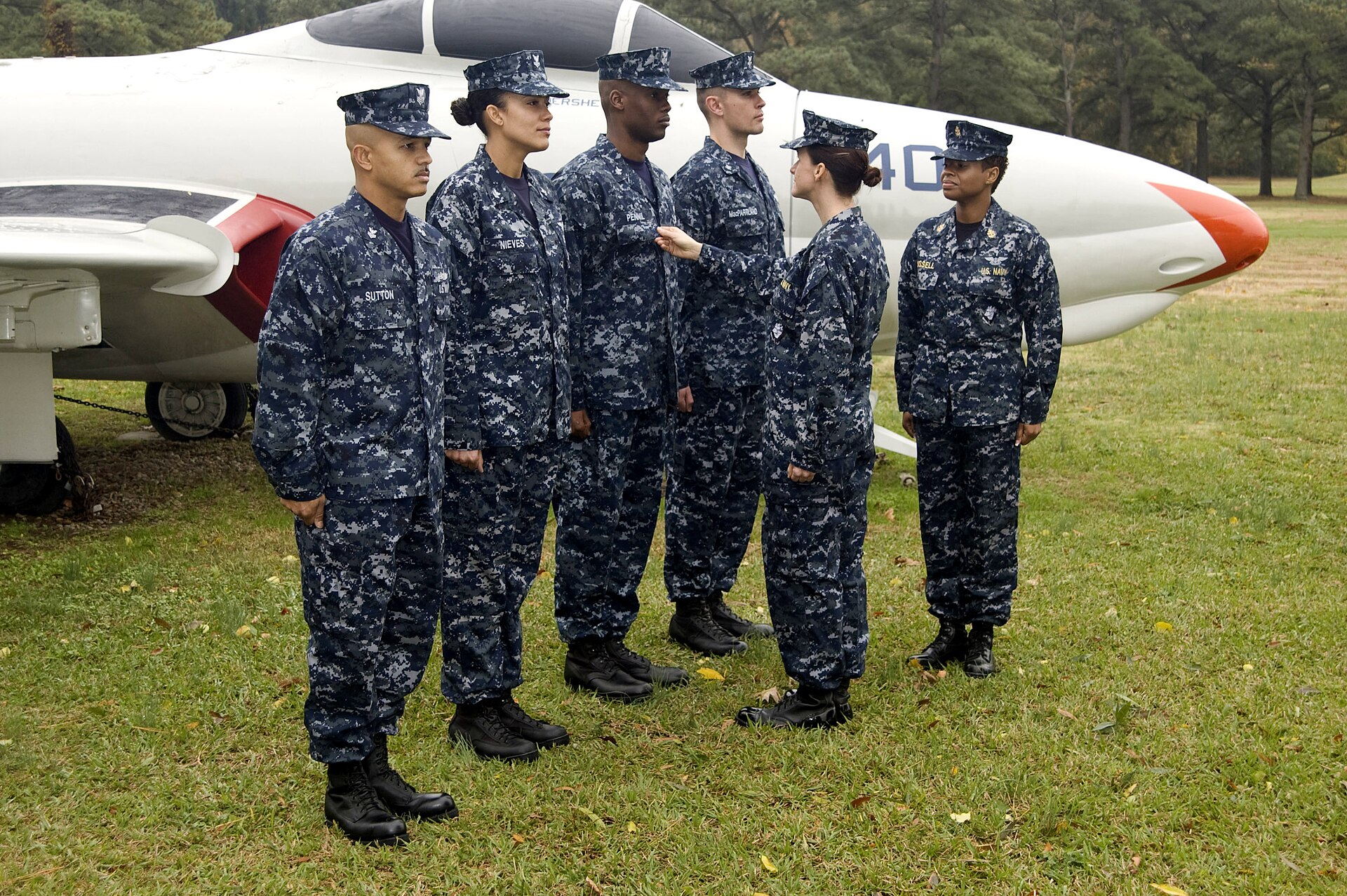
Two new patterns joined the Type I in the same period, and the Navy restricted who could wear them. A message published in 2009 limited the desert Type II to Naval Special Warfare personnel and the woodland Type III to Navy ground units, a division that lasted until the Type III was opened up to the rest of the service in 2016. For most of the fleet, the blue uniform was the only one on the shelf.

The two problems: fire and water
The first problem was heat. The Type I was made from a cotton and nylon ripstop blend, and nylon does not burn so much as melt, then stick to skin. In December 2012 Navy Times reported that a Navy review had acknowledged the uniform’s lack of flame resistance for shipboard environments and that there was, at that point, no ready alternative. Sailors working where fire was a realistic risk were expected to change into flame-resistant coveralls instead, and the service spent the following years developing a flame-resistant variant. A uniform issued to replace several garments had, in the environment it was designed for, been replaced by something else.

The second problem was water, and it is the one sailors talked about. A pattern in sea blue, deck grey and black matches a great deal of a warship and very little of anything else. Aboard, it flattens the human shape against steel, which is what concealment aboard a ship means, but the same colours were worn in ports, on airfields and, in the 2010s, through training areas that were green or brown. Sailors pointed out what a blue uniform does to a person who falls into the sea, and the pattern acquired a second layer of nicknames, “Aquaflage” above all, that stuck precisely because the joke was easy to make. Reporting of the period also noted how close the Navy’s new digital designs sat to the Marine Corps’ own MARPAT pattern, which made the service-specific camouflage project a political subject as well as a practical one.
What replaced it
On 4 August 2016 the Navy announced that the Type I would be eliminated and that the woodland Type III would become its primary shore working uniform. The change was phased: from 1 October 2016 the Type III was the standard ashore and in port where it was available, from 1 October 2017 recruits and officer candidates were issued it instead of the Type I, production of the Type I ended, and 1 October 2019 was set as the date by which every sailor ashore and in port was expected to be wearing it. Announcing the decision, Secretary of the Navy Ray Mabus described the Type III as comfortable, lightweight and breathable and said the change would reduce the number of uniform items sailors had to buy and keep. The last day on which the blue working uniform could be worn was 30 September 2019.
The Type II survived the change, and it survives today as the Navy’s arid-environment pattern, worn by Naval Special Warfare sailors and other specialised units whose work takes them into desert country. The Type III, meanwhile, lost one of the last visible traces of rank: from 2018 its eight-point cover carried an anchor, constitution and eagle device in place of the rank insignia embroidered on the older covers, and by October 2019 that device had replaced rank insignia altogether.
Legacy: what a working uniform is for
The Type I did not disappear without leaving a question behind, and the Navy answered it by trying again. To replace the flame-resistant coveralls worn afloat, the service tested prototypes in the years that followed, three of them based on the wash khaki and utility uniforms that had been retired in 2010 and one on the Type III cut in tan and blue rather than in camouflage. The direction of travel was clear: the shipboard uniform would be chosen for flash protection and for being recognisable, not for matching the paint.
That is the useful lesson of the blue uniform. A working uniform is designed against the wear, the stains and the hazards of a job. A camouflage pattern is designed against the background of one particular environment. Ask a single garment to do both and the compromise will show somewhere, in the accounts, in the complaints, or in a report about what happens when it burns. The Type I was not a bad piece of clothing. It was a uniform whose pattern made a promise, concealment, that the Navy never intended it to keep and that sailors, reasonably, kept testing anyway.
Type I garments and the two patterns that outlived them remain some of the most widely collected modern American camouflage. For the desert and woodland prints that replaced the blue, see AOR1 and AOR2: a field guide to the two U.S. Navy patterns.
US Navy working uniforms and other American issue are gathered here: US issue garments at MegaCamo. The rest of this article is history; nothing on sale can settle what a period photograph shows.
