
Camouflage History
Reading a Uniform Label: Contract Numbers, Dates and NATO Stock Numbers
What a uniform label actually contains
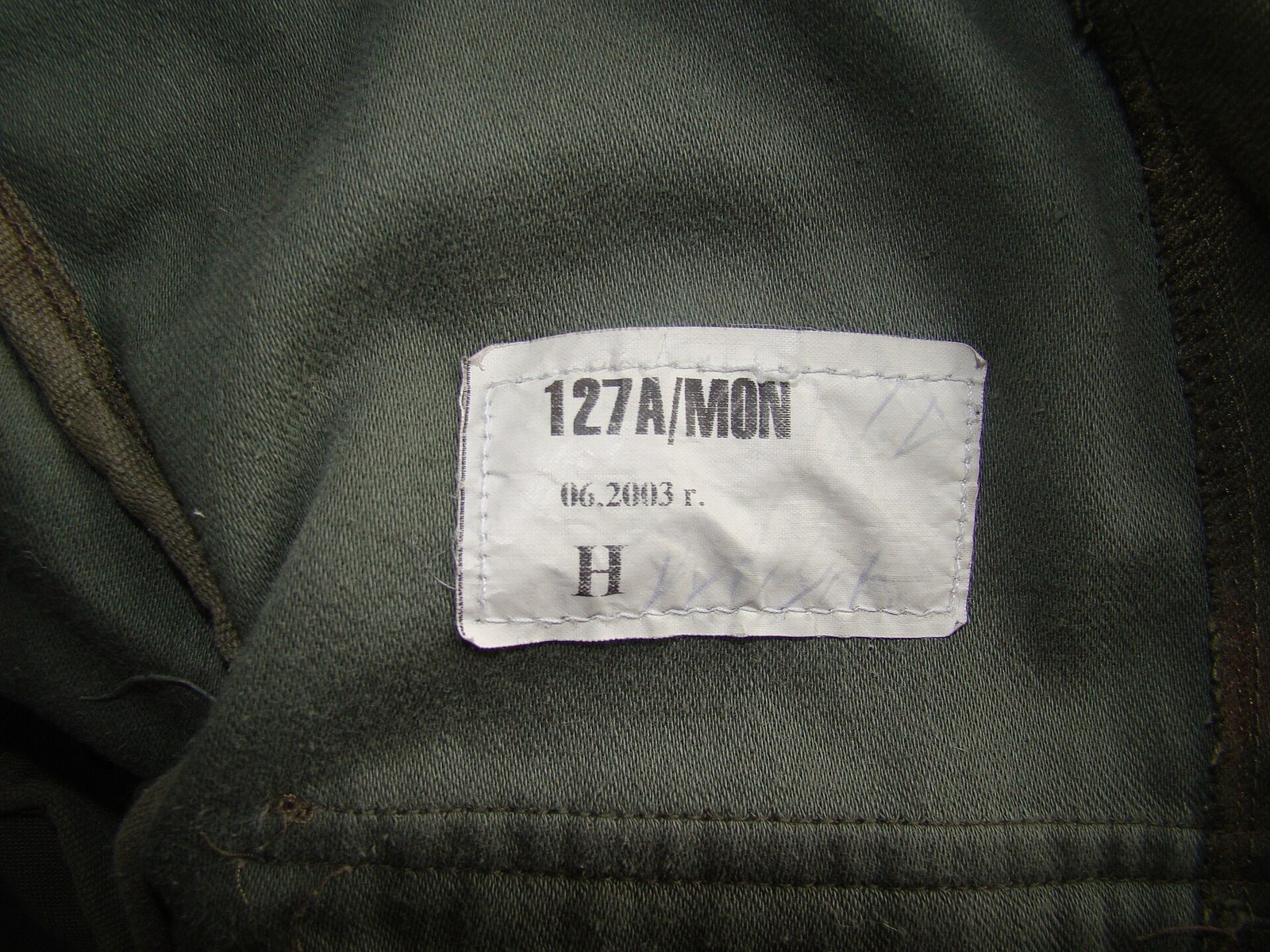
The single most informative label in the photographic record is the one sewn into an Improved Physical Fitness Uniform jacket: it carries the article name, the fibre content, a contract number, a size, the NATO Stock Number and the contractor’s name, six distinct blocks on one piece of cloth. That label is the exception. Across the six label photographs reproduced in this article, eight separate blocks of information appear somewhere, and no single document carries all eight at once.
| Block | Typical content | Example observed |
|---|---|---|
| Designation | article name in clear text, usually capitals, sometimes truncated | `JACKET, PHYSICAL FITNESS UNIFORM`; `JACKET, COLD WEATHER, PERMEABLE`; `COVER, HELMET, CAMOUFLAGE PATTERN` |
| Contract number | purchasing identifier, national format | `SP0100-03-D-0328`; a line beginning `WB11…-92-F-0008`; absent on several pieces |
| NATO Stock Number | 13 digits, with or without separators | `8415-01-465-4832`; `8415-01-592-2220`; `N.A.T.O. STOCK No. 4220-99-537-9743`; `8415010841709` |
| Size | national system, sometimes doubled by a “NATO SIZE” code | `MEDIUM REGULAR`; `SMALL_X-SHORT`; `L-R`; `LARGE (42-44)`; `R – 92 / 170`; `NATO SIZE: 6067/6979` |
| Fibre content and care | fibres and washing instructions | `FIBER CONTENT: 100% NYLON`; `SLEEVE:65%POLYESTER 35%COTTON / BODY:100%COTTON` |
| Manufacturer or contractor | trade name, short code, initials | `CONTRACTOR’S NAME: AMERICAN POWER SOURCE, INC.`; `MFR:AMERICAN PMG NE`; `MOUNT ROGERS CSB`; `MADE BY AVON RUBBER CO. LTD. ENGLAND`; the mark `ZOW Julianka` |
| Date | month and year stamped, a year printed, or nothing | `MAY 98`; `06.2003 R.`; absent on several pieces |
| Ancillary markings | individual serial, barcode, property stamp | `SERIAL No. 14669`; barcode plus UPC; the stamp `BUND`; the civil logotype `CC41` |
The table is a checklist of what may be there, not a description of any particular label. A label is not a standardised document: its content depends on the buyer, the period and the contract under which it was printed. What is actually international about uniform marking is the number, not the label. No published source establishes a single NATO label layout, and the evidence runs the other way, layout, material, presence or absence of a date, use of hyphens, mention of the contractor and the size system all vary from piece to piece.
The subject is narrower than “how to identify military clothing”. It deals with the markings themselves, contract numbers, dates, NATO Stock Numbers and the international marking conventions around them, and not with the naming systems used for camouflage patterns in the former Soviet Union and Russia, which are treated separately in Soviet and Russian Camouflage Nomenclature, Explained. Russian items do appear in the stock number system under their own country code, and that code is discussed further; what follows from it is a codification fact, not a naming convention.
Read the support before the text
The first question about a label is not what it says but what it is. The six photographs in this article show two supports only: five sewn cloth labels, woven or printed, and one paper hang tag. The range is wider than the images suggest. Text can also be printed directly onto the textile with no label at all, a moulded rubber plaque can be fixed to waterproof equipment, and an embossed mark can be struck into metal hardware. What the photographs show is one part of the range, not the whole of it.
The support determines how much weight the marking can bear before you read it. A sewn label is comparatively difficult to move from one garment to another without leaving traces at the stitching, whereas a paper tag is by design removable and can be attached, replaced or added. A tag that also carries a retail barcode is doing two jobs at once, and it may have been printed for a distribution chain rather than for the original issue of the item, a caution drawn from observation rather than a rule from a normative source.
Two practical consequences follow. Photograph both faces of a label flat, in diffuse light, with a scale in frame where possible, because the size and the barcode may be printed on a face the first photograph does not show, a point of practice rather than a rule, and an oblique single-angle photograph loses characters that are present on the object. Do not let a low-resolution photograph become evidence either: three documents carried markings that did not resolve even at native zoom, digits among them, and the honest output in each case is a note that the characters were not read, with the resolution used, rather than a plausible guess.
Contract numbers: what a published rule actually establishes
Contract numbers attract more confident internet explanation than any other marking on a uniform. It is worth separating what a published rule establishes from what collectors infer.
For United States federal procurement, the structure of the number is laid down in the Federal Acquisition Regulation, at FAR 4.1603. The identifier, a Procurement Instrument Identifier, or PIID, is composed of a six-character office code identifying the contracting activity; two digits that are the last two digits of the fiscal year in which the instrument is issued or awarded; a single letter giving the type of instrument; and a serial number assigned by the agency. The instrument-type letter distinguishes at least three cases: `C` for contracts of any type other than indefinite-delivery contracts, `D` for indefinite-delivery contracts, and `F` for delivery orders and task orders placed under an existing contract.
The regulation also states that the PIID should not contain special characters. Printed labels of the 1980s to 2000s, however, do contain hyphens, as the `SP0100-03-D-0328` example shows. The method that follows is simple and worth stating explicitly: read the number while ignoring punctuation, and recover the position of each segment from the characters themselves rather than from the dashes.
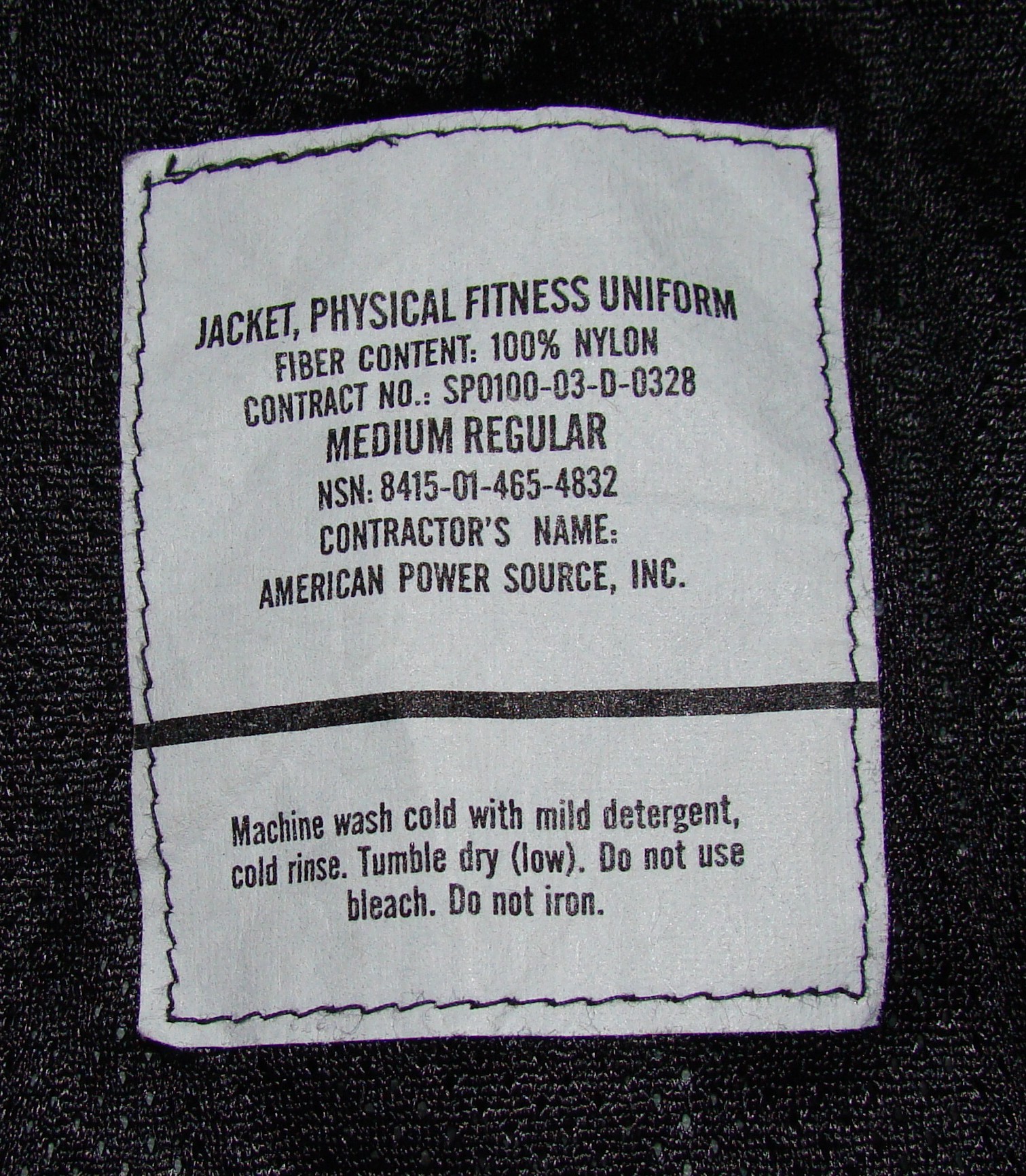
Applied to that label, the reading is mechanical. `SP0100` is the office code; `03` is the fiscal year of award, 2003; `D` marks an indefinite-delivery contract; `0328` is the serial. One limit has to be respected. No document located identifies the contracting activity behind the office code `SP0100`. A name is not supplied, and a reader should not supply one either: an office code is a code, and matching it to a supply centre or a command requires a key that is not available.
What the contract number does not date
Everything interesting about a contract number lies in what it fails to say.
The two-digit year dates the act of purchase, not the manufacture of the item. The regulation is explicit that the fiscal year recorded is that of signature of the instrument, not of its effect. A garment can be delivered, stored and issued well after the fiscal year stamped into its contract number.
On an indefinite-delivery contract, the picture becomes looser still. The orders placed under such a contract carry their own fiscal year, and they carry the letter `F` because they are orders rather than contracts, the same letter also covers calls placed under blanket purchase agreements and basic ordering agreements. A second example shows the shape of this: a contract line on a helmet cover reading in part `WB11…-92-F-0008`, where `92` is the fiscal year of the order, and `F` marks it as an order placed against a pre-existing instrument. A label of this kind can therefore be read as “an order placed in or after fiscal year 1992”, not as “an item made in 1992”. A piece marked with a `D` contract of one year may have been produced under an `F` order several years later, and the garment itself will not tell you which.
Reading a contract number you cannot fully resolve
The helmet-cover line beginning `WB11` is the honest case study in transcription: the two characters immediately after `WB11`, before the first hyphen, did not resolve at native zoom, while the later segments of the same line did; the correct output states exactly that, with the resolution used. Filling the gap with a plausible sequence is not transcription, because a printed identity that looks complete gets quoted downstream as fact.
NATO Stock Numbers: structure, and the limits of the code
The NATO Stock Number is the one element on a uniform label whose structure is genuinely international. It has thirteen digits, conventionally written in four groups as `abcd-ef-ghi-jklm`. The first four digits are the supply class: the first two give the supply group and the next two the class within it. The remaining nine digits form the NATO Item Identification Number, or NIIN, whose first two digits are the country code of the national codification bureau that assigned the number and whose last seven digits are the item number itself. The NIIN is what identifies an article within the system; the full thirteen digits identify a type of article.
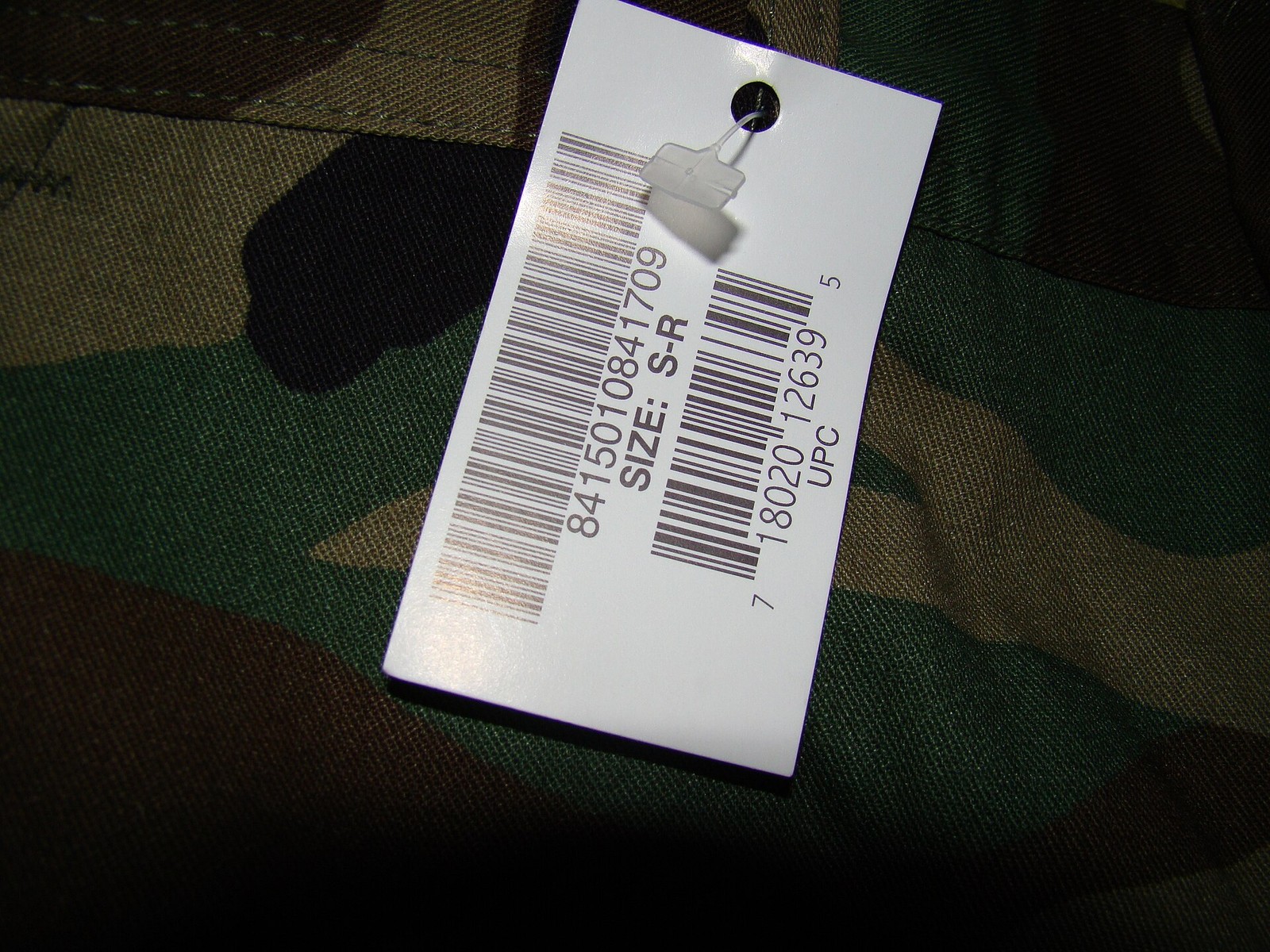
The hyphens are optional in print, and this tag shows why: the same thirteen digits appear run together as `8415010841709`. The only valid segmentation is `4-2-3-4`, here `8415`, `01`, `084`, `1709`, which yields supply class 8415, country code 01 and item number 0841709. Learning to cut a run of thirteen digits into that pattern is the most transferable skill in label reading, because it works whether or not the printer used separators.
The country code identifies a codifier, not a manufacturer
The two digits that follow the supply class are the most commonly misread element of a stock number. They record which national codification bureau registered the article in the system, which in practice is usually the country of origin or of final manufacture, but the code is a statement about who codified the article first, not a certificate of where it was made.
Two pieces transcribed in the tables below provide clean confirmations and no contradiction. A diver’s dress recorded there with the British stock number `4220-99-537-9743` is also marked `MADE BY AVON RUBBER CO. LTD. ENGLAND`, so the country code `99` and the marked country of manufacture agree. A padlock recorded there with `5340-12-139-2846` also carries the stamp `BUND`, and `12` is the German country code. Agreement of this kind is a check to perform, not a conclusion to assume: when a code and a marked country disagree, the disagreement is documented, with the object description and the transcription, rather than resolved by guessing.
The following table transcribes the country codes that matter to these pieces. One reservation travels with it: this table comes from a reference work that lays the codes out in three column groups, which makes the higher values easy to misread, and the values are to be checked against the codification documentation before being used to attribute a piece.
| Country code | Codifying nation or category |
|---|---|
| 01–10 (and 00) | United States |
| 11 | Articles standardised within NATO |
| 12 | Germany |
| 43 | Poland |
| 57 | Russia |
| 98 | New Zealand |
| 99 | United Kingdom |
The first four digits are equally readable and equally useful once the class names are to hand. Group `84` covers clothing, individual equipment and insignia; `8415` is clothing for special purposes, which is where most uniform garments land; `8465` is individual equipment; group `42` covers firefighting, rescue and safety equipment, with `4220` for marine lifesaving and diving equipment; group `53` covers hardware and abrasives, with `5340` for commercial hardware. Those names explain the pieces neatly: body garments under `8415`, a diving dress under `4220`, a padlock under `5340`.
The six stock numbers decode as follows.
| Number read on the piece | Class | Country code | Reading |
|---|---|---|---|
| `8415-01-465-4832` | 8415, clothing for special purposes | 01, United States block | an item codified by the United States |
| `8415-01-592-2220` | 8415 | 01, United States | helmet cover marking |
| `8415-01-519-8416` | 8415 | 01, United States | combat trousers |
| `4220-99-537-9743` | 4220, rescue and diving | 99, United Kingdom | consistent with `MADE … ENGLAND` on the same label |
| `5340-12-139-2846` | 5340, commercial hardware | 12, Germany | consistent with the `BUND` stamp on the same object |
| `8415010841709` | 8415 | 01, United States | the same numbering, printed without hyphens on a paper tag |
Eleven digits, thirteen digits
The stock number has an ancestor. The current system replaced the eleven-digit Federal Stock Number, which did not contain a national origin code. The changeover is dated to 1974, and articles catalogued before it carry the older eleven-digit form. The practical rule is therefore arithmetical: eleven digits means the older American federal numbering, thirteen means a NATO Stock Number. What the published record does not settle is whether an item printed after 1974 could still be marked with the word “FSN”, and the same doubt is met in this material, where the wording above one stock number could not be resolved at the resolution available.
Dates: what each kind of date actually dates
Dating is the reason most people read a label, and it is where the method most often fails, because the dated elements on a uniform are not all the same kind of date. Each one records something different, and none of them records the date the piece was worn.
| Dating element | What it actually dates | Status of the explanation |
|---|---|---|
| the `03` in `SP0100-03-D-0328` | the fiscal year of signature of the purchasing instrument | published federal rule |
| `MAY 98` on a diver’s dress | a date applied by the manufacturer, described as the date of the article’s entry into service | reading of the label and the archive description |
| `06.2003 R.` on a Polish item | a date printed on the label; the suffix `R.` is not documented by any published source | reading of the label |
| the `92` in `…-92-F-0008` | the fiscal year of an order placed against a standing contract | published federal rule |
| `CC41` | a civil programme whose marking is bounded to 1941–1952 | reference work |
| no date at all | nothing, several pieces carry no usable date | observation of the labels |
The difficult point sits in the middle of that table: no piece carries a dated issue record, and no published source establishes that a general “issued on date X” marking exists on clothing. The dates that do appear are either administrative acts or manufacturing statements, and between the date on the label and the working life of the garment there is a gap the label cannot close.
Sizes and dimensions: several systems in one drawer
Size markings on uniforms are a reminder that a shared stock number system does not imply a shared sizing system. Among these labels at least five conventions appear: letter plus morphology, as in `MEDIUM REGULAR` or `SMALL_X-SHORT`; a pair of letters combining size and length, as in `S-R` or `L-R`; a letter with measurements printed alongside in inches, as in `LARGE (42-44)`, `WAIST: 27 TO 31 IN` and `INSEAM: UP TO 26½ IN.`; a metric pair giving a circumference against a stature, as in `R – 92 / 170`; and a plain equipment size, as in `SIZE 3` for a diving dress. On one Polish label the only size information is a single stamped letter.

That photograph also shows the limit of what can be read off a label with confidence. The label prints a national size, the measurements, a stock number and, beneath it, a code labelled `NATO SIZE` in the form of two two-part numbers. The code exists, it sits next to the stock number, and no published source documents how it is constructed. It can be transcribed. It cannot be decoded. On the same photograph, the wording immediately preceding the digits of the stock number was not resolved at the resolution available, which is why the transcription gives the digits and withholds the label attached to them.
Sizing systems are weak evidence for dating: two garments of the same nominal size may carry incompatible systems, and a size does more to confirm that a piece belongs to an issued supply chain than to date it.
Designations and manufacturer marks that are not contract numbers
Short alphanumeric groups with a ministry suffix are the most frequently misread element on a European label, because they look like procurement codes and are not. On a Polish garment, the marking `127A/MON` is the designation of a cut within the wz. 93 field dress family, which entered service in 1993; the published reference dates this particular designation to the family’s 1997 modification. The suffix is best read as a ministry suffix: the group designates a pattern or cut of garment, not a purchase.
The reading heuristic that follows is one of shape rather than of country: a short alphanumeric group carrying a ministry suffix tends to designate a cut, whereas a six-character block followed by two digits, a letter and a serial follows the published American structure for a purchase identifier. The heuristic rests on a single national example and should be tested against each country’s own documentation. The two coexist on the same garment, as the Polish example shows.
Manufacturer marks are the other group with no dating value: a woven label carrying an oval logo, the letters `ZOW`, the name `Julianka` in a calligraphic script and the size `R – 92 / 170` identifies a producer and a size and nothing else.
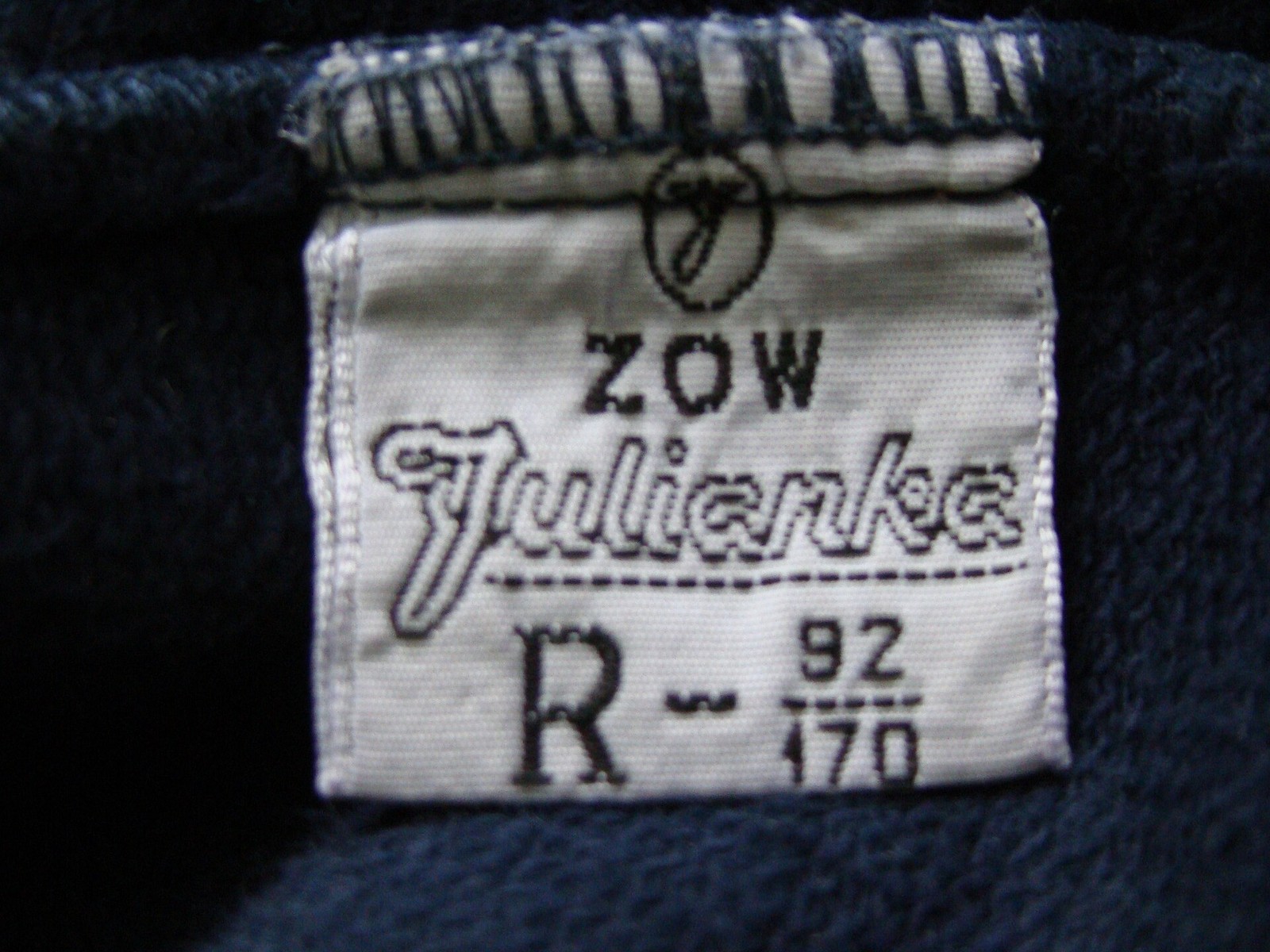
That label is a useful counter-example to the claim that any genuine service garment will bear a stock number: it belongs to an issued training uniform and carries a maker’s mark and a size, nothing more. A maker’s name is an industrial lead, not a date.
Civil markings, and the commercial label mistaken for a service one
Two traps sit next to each other, and both involve labels that look official and are not.
The first is the civil programme marking: a small woven label sewn into a red woollen garment in a museum display carries the logotype `CC41`, which belongs to the British Board of Trade’s Utility Clothing scheme, a civilian programme in force from 1941 to 1952. A civil marking can date a garment more tightly than many military markings do, because the programme has published bounds; and a dated marking is not necessarily a military one, since `CC41` says nothing about issue, unit or service. The printed wording beneath the logo is not resolved at the resolution available, so no further text is quoted.
The second trap is the commercial label read as a service label, and one of these photographs is a textbook case. A photograph is titled as the label of a Japanese desert combat shirt, pointing at a national self-defence force. The pixels show something else: a sewn label reading `SHIRT,COMBAT,DESERT JAPAN CAMO`, with sleeve and body fibre contents, a machine-wash instruction and a commercial mark, no stock number, no contract number, no ministry mark and no date. What the title asserts, the marking does not support.
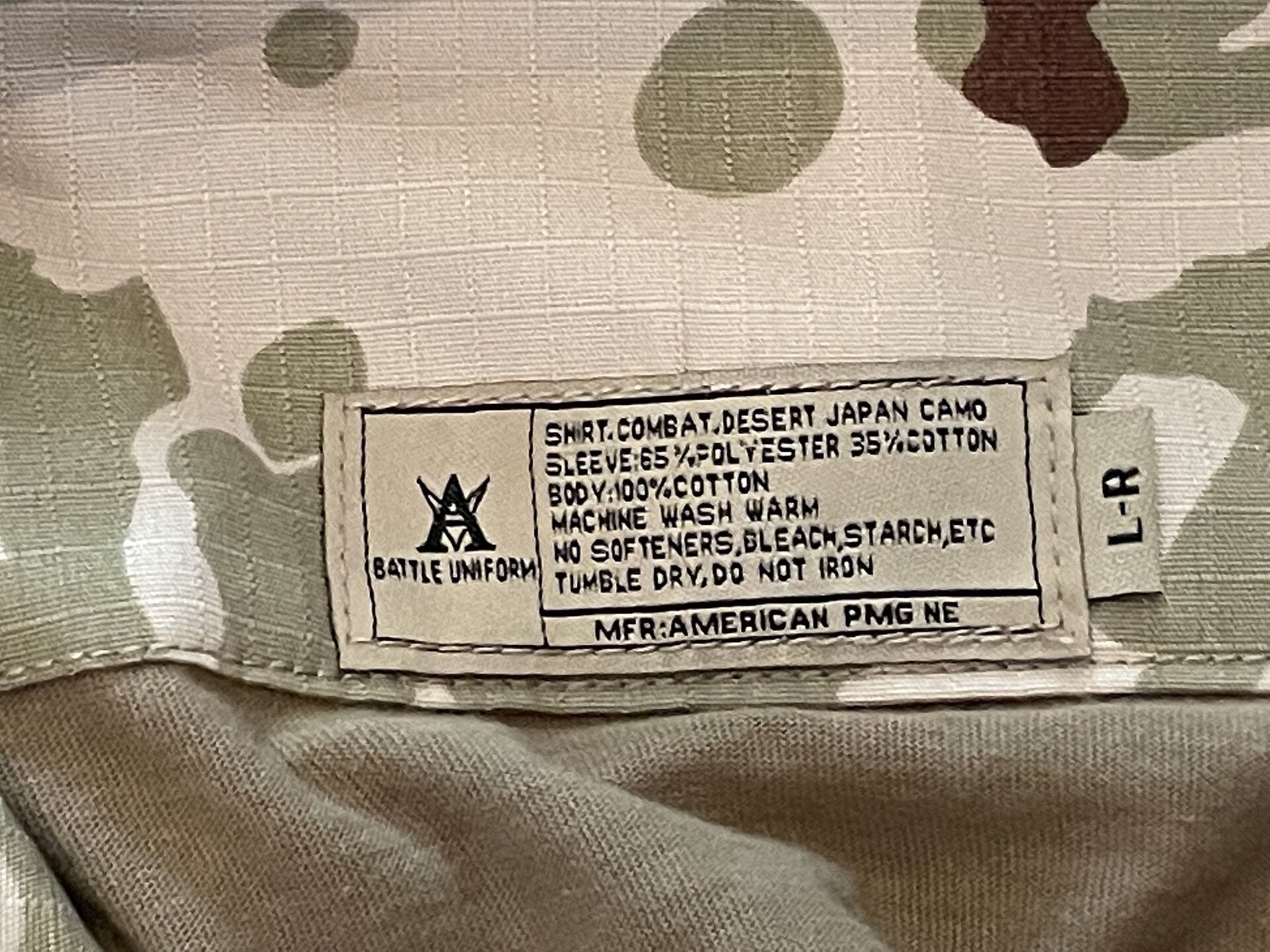
Markings that are not on a label at all
Markings among these pieces are not confined to cloth. A padlock, described in the object record but not among the photographs in this article, carries an embossed maker’s mark in a frame and, beneath it, the number `5340-12-139-2846` and the stamp `BUND`. Read with the method above, that number is a stock number of class 5340, commercial hardware, with country code `12`, Germany. The archive description of the object presents it as property of the Bundeswehr, the German federal armed forces, and gives the number the German name Versorgungsnummer, a supply number; reading `BUND` as the federal property stamp of that German military equipment is the reader’s inference, not the archive’s, a reminder that one codification system carries different names in different languages.
A reading routine you can repeat
- Record the support first: sewn label, direct print on the textile, paper tag, moulded plaque or metal. Note whether the marking is permanent or removable, because that governs how much weight it can carry.
- Photograph both faces of the label flat, in diffuse light, with a scale in frame where possible. A single oblique photograph loses characters that are present on the object.
- Transcribe character by character, without interpreting. Copy hyphens, spacing and punctuation exactly as printed, including nonsense separators.
- Segment the long numbers before reading them. Thirteen digits is a stock number and cuts as `4-2-3-4`. Eleven digits is the older American federal numbering. Six characters, two digits and a letter is a purchase identifier of the American shape, and the letter says whether it is a contract, an indefinite-delivery contract or an order.
- Check the country code against the marked country of manufacture and the language of the label. Agreement is a confirmation; disagreement is documented, not explained away.
- Record what is absent. No stock number, no contract number and no date is a finding, and it points towards commercial manufacture, private purchase or a national system that does not print purchases on garments.
- Date a category of marking, not an example. State the lower bound that the marking establishes and the reservation that comes with it.
- Never transcribe a digit you cannot resolve. Write that the character was not resolved, and say at what zoom.
Ten ways to misread a label
- Reading a contract year as a date of issue. The fiscal year on an American contract is the year the instrument was signed, not the year the item was worn.
- Reading an order year as a manufacture date. On an indefinite-delivery contract, later orders carry their own fiscal year; production can follow the contract year by several years.
- Taking a commercial label for a service one. An article name in capitals plus fibre content is not a service marking; look for a stock number, a contract number or a ministry mark.
- Treating a file title, archive caption or museum catalogue entry as proof. All three are leads, and one caption among these photographs promises data the pixels do not carry.
- Treating a removable paper tag as equivalent to a sewn label. A hang tag can be added, replaced or printed for a distribution chain; a barcode on it does not make it a service document.
- Believing that an exact stock number authenticates an item. The number identifies a type and is public, so it is reproducible on copies.
- Reading property stamps and reform marks as dates. They state an owner or an administrative status, not a period of service, and the practices vary by country.
- Ignoring the possibility of a re-sewn or re-printed label. Transferred labels exist in restoration and in falsification; the thread and the stitching are the leads, and this is collector practice rather than a documented rule.
- Assuming the century of a two-digit year. Derive it from the rest of the label or leave it open.
- Trusting a low-resolution photograph. At the resolution available for some of these documents, markings did not resolve, digits among them, and the only defensible output was to say so.
The limits of a readable label
It is worth being explicit about the three things a label can and cannot do, because the difference is what separates a reading from an attribution. A stock number designates a class of article and does not locate the item in a unit, a date or a person. A contract number traces a transaction, a contracting activity, a fiscal year, a type of instrument, a serial, but not the receiving unit. A property stamp states an owner or an administration, and neither a date nor a duration of service.
A stock number designates a class of article. It does not locate the item in a unit, a date or a person. A contract number traces a transaction: a contracting activity, a fiscal year, a type of instrument, a serial. It does not name the receiving unit. A property stamp states an owner or an administration, and neither a date nor a duration of service. Exactly one individual traceability number appears in the tables below, the serial on a diver’s dress, and that is characteristic of equipment under individual quality control rather than of clothing.
What would constitute provenance is a different order of evidence: a documentary chain such as an issue record, a documented inventory, a museum file or a verifiable sale history; a unique identifier matching the piece; or an archival photograph linking the object to a unit. None of that is present, and the descriptions attached to these photographs are those of the uploaders, a secondary source about the object, not an official register.
The wording follows from this: “the label indicates”, “the markings are compatible with” and “the code is consistent with the manufacturer marked on the same label” are defensible. “Worn by”, “belonged to” and “issued to the 3rd Battalion” are not, on this evidence.
Five pieces, worked
| Piece | Markings present | Defensible reading |
|---|---|---|
| Polish field garment | cut designation `127A/MON`; date `06.2003 R.`; size stamp; pen annotation | markings compatible with production in the 2000s; the meaning of the suffix `R.` is not documented |
| American physical fitness jacket | `SP0100-03-D-0328`; `8415-01-465-4832`; `MEDIUM REGULAR`; contractor named | purchase made under fiscal year 2003 against an indefinite-delivery contract, with delivery possibly later |
| British diver’s dress | `4220-99-537-9743`; `SERIAL No. 14669`; `MAY 98`; manufacturer and country named | the strongest dating among these pieces: month, year and individual number, with a country code consistent with the marked manufacturer |
| Commercial garment labelled as a desert combat shirt | article name, fibre content, care instruction, commercial mark | not datable and not attributable from its markings: no stock number, no contract number, no date |
| Padlock | `5340-12-139-2846`; stamp `BUND`; maker’s mark | class and country consistent with the property stamp; nothing established about date or use |
Reading labels when you are buying
For a buyer, the value of this routine is comparative rather than romantic. Photographs of the same label taken by different sellers often show different amounts of information, and a description that quotes a stock number, a contract line, a size and a manufacturer is a description whose claims can be checked against the pixels. The marking is what a description can be held to, including on shop pages, where the same method tells you which markings you can rely on.
