
Camouflage History
Chinese Type 07: How China Digitised Its Army
When the People’s Liberation Army decided to modernise its camouflage, it did not design one pattern, it built a family. The Type 07, fielded in 2007, is a set of pixelated patterns in no fewer than six colourways, one for almost every environment Chinese forces might operate in. It followed a generation of borrowed Western trends, American woodland, German flecktarn, a copy of US MARPAT, and was in turn replaced by a new pattern designed around terrain rather than service branch. This is the story of how the world’s largest army went digital.
Introduction: the largest army goes digital
For a military the size of the People’s Liberation Army, the choice of camouflage is not a fashion decision. It is a matter of equipping millions of personnel across an enormous country that spans jungle, desert, plateau, mountain and ocean. When China made the move to modern digital camouflage in 2007, it did so decisively and on a massive scale.
The Type 07 was not really a single pattern. It was a coordinated family of pixelated designs meant to cover the spread of Chinese deployments. And the way China arrived there is a compact history of how camouflage trends travel, from the United States and Germany to the world’s largest standing military.

Before the pixels: Type 87 and the borrowed ideas
The story begins not with digital camouflage but with the pattern China adopted in the 1980s. The Type 87, introduced in 1987, was China’s first standard temperate-climate camouflage. It was a four-colour woodland pattern, essentially modelling the American US Woodland design but substituting one colour, a yellow-green where the American version used khaki. For about twenty years, the Type 87 and its derivatives (Type 95, Type 03) defined the look of the PLA.
China did not stop at copying American woodland. It also experimented with the German flecktarn. The Type 03 “Plateau Region” pattern, introduced in 2003, was a brown-dominant variation of the German Flecktarn, fielded in units deployed in Tibet, Inner Mongolia and the Beijing Military Region. This is the point where the PLA’s camouflage story starts to look patchwork: a mixed inheritance of American and German designs applied to different terrain.
By 2003 the PLA’s special forces were also testing a modified copy of the American MARPAT redrawn at a smaller scale, plus a copy of the US three-colour desert pattern. Both were short-lived experiments, retired when the pixelated family arrived in 2007. The point is that by the mid-2000s, China had thoroughly absorbed the digital concept that had spread from the Canadian CADPAT and American MARPAT through the entire world’s militaries.
The Type 07 family, 2007
The Type 07 family was introduced in 2007, replacing the Type 87 standard uniforms and, elsewhere, the Type 97. It first appeared publicly in the summer of 2007 at the ceremony marking the tenth anniversary of Hong Kong’s handover to China. It replaced all previous Type 87 camouflage designs worn by the PLA and by the paramilitary People’s Armed Police.
The family is characterised by a pixelated, digital motif and comprises six palettes:
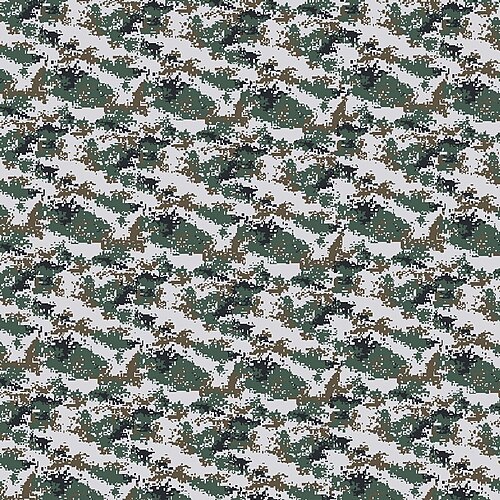

- Universal the general-purpose combat pattern for conventional personnel: grey-green, brown and dark green-black on a neutral grey base.
- Arid / “Gobi desert” tan and khaki with dark brown and black pixels, for desert and high-altitude regions; first worn at the 2009 National Day parade.
- Woodland the variant worn by certain strategic rocket units (documented mainly at the 2009 parade).
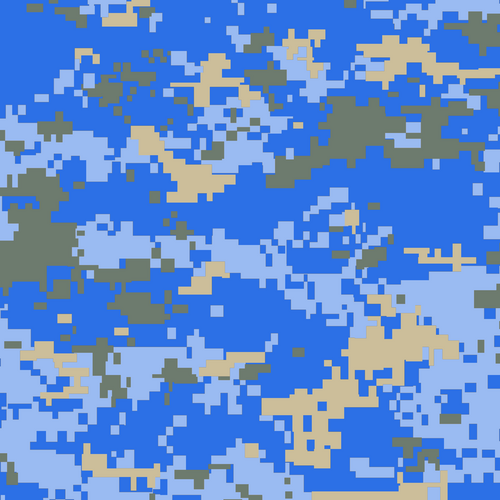
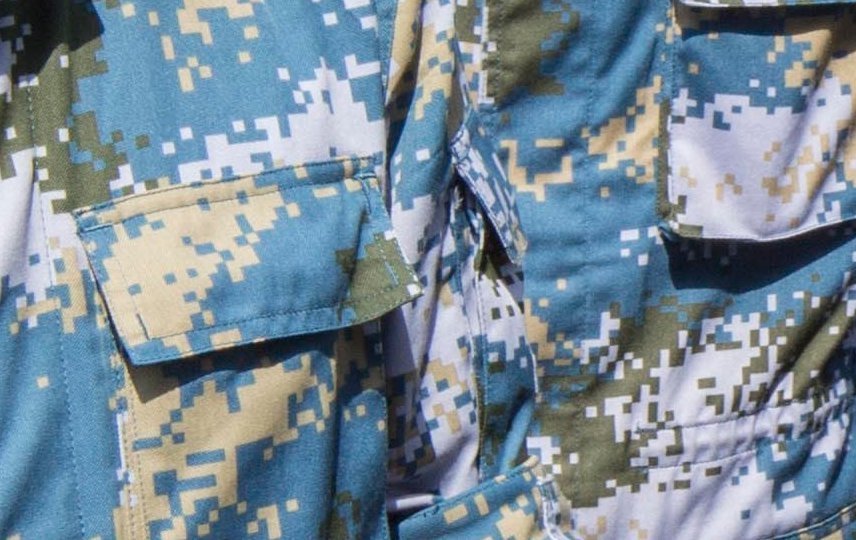
- Oceanic a blue-dominant pattern for naval vessel crews and the Chinese Marine Corps.
- Urban / Air Force a grey-blue pattern, sometimes called the PLAAF digital, worn by the PLA’s airborne forces.
- Special Operations Forces a “hunter” digital pattern introduced in 2010, a pixelated version of the Type 04 special-operations pattern.

A separate Type 07 winter/cold-weather pattern, white with sparse olive-green pixels, covers snow-covered and extreme-cold regions.
It is worth noting the term “M07”, used in Western surplus and collecting circles, is not the official Chinese designation. The official names refer to the uniform systems, not to a single pattern label.
From branch-specific to terrain-specific
The most telling feature of the Type 07 is how China organised it. Rather than one pattern for everyone, the army gave each branch or environment its own colourway. A soldier’s camouflage told you where he served or what part of the force he belonged to.
This was about to change. In 2019 China unveiled a new pattern, Xingkong (“starry sky”), which appeared before the 70th anniversary of the People’s Republic in October 2019. The Xingkong was designed to be a better multi-scale camouflage, with its stars and spots, as observers note, finer than those of the Type 07, and it was fielded with the Type 19 and Type 21 uniform systems.
In 2021 China announced the adoption of the Type 21 Xingkong across the whole PLA. Crucially, unlike the Type 07, the branches of service no longer had their own separate palettes. Instead the new family came in four terrain-based colourways, jungle, desert, gobi/tundra and urban, determined by the environment rather than by branch. It was a deliberate move away from the branch-coded approach of the Type 07 toward an environment-coded system that mirrors the logic of Western multi-terrain patterns.

The Type 07 was not only a parade or exercise pattern. In August 2017, PLA garrison troops were deployed to Macau to clear the debris left by Typhoon Hato, photographed at work in the Type 07 in a real, close-to-home rescue operation rather than a drill.

Type 07 and the international picture
The Type 07 did not stay in China. It has been documented as exported and worn by foreign forces. Most notably, the “Arid” colourway has been photographed on Iraqi Special Operations Forces. It is also worth guarding against a common confusion: the Vietnamese K07 pattern carries the number “07” but is a completely different design, and should not be mistaken for the Chinese Type 07.
Why the Type 07 matters
The Type 07 matters as a case study in how a military adopts a camouflage family at national scale. China absorbed every major camouflage trend of the late twentieth century, American woodland, German flecktarn, American MARPAT digital, and then quickly built its own multi-colourway pixel system, tailored to a vast and varied territory. The family shows both the strengths and the complications of a branch-coded approach, and its replacement by the terrain-based Xingkong shows how that thinking evolved.
It is also, in its own way, a mirror image of the American camouflage saga. Where the United States chased a single “universal” pattern and repeatedly found it wanting, China built many patterns for many environments, and then consolidated around an environment-based system. Different paths, but a similar lesson: camouflage works best when it matches the terrain.
Explore the Type 07 on MegaCamo
MegaCamo’s PLA Type 07 collection brings this digital family to modern apparel, made to order. The wider China country page gathers the full range of Chinese camouflage patterns.
