
Camouflage History
AOR1 and AOR2: A Field Guide to the Two U.S. Navy Patterns
Two U.S. Navy camouflage patterns dominate search results, marketplace listings and forum arguments, and almost every argument starts with the same mistake: treating the names as if they came from the same office. They did not. One set of names belongs to the U.S. Navy’s uniform paperwork. The other set belongs to the people who wear, sell and collect the material. When the two systems are laid on top of each other, four labels end up pointing at two patterns, and a fifth label, “AOR Universal”, points at nothing in the Navy’s inventory at all.
This guide does three things. It separates the official names from the popular ones, so that “NWU Type II” and “AOR1” stop being used as if they were interchangeable official terms. It shows what can actually be read off a photograph of each pattern. And it draws a hard line between what the Navy buys, stores and issues, and what the commercial market manufactures and sells under the same vocabulary.
Two naming systems, one family of patterns
The U.S. Navy names its working uniforms by number: Navy Working Uniform Type I, Type II and Type III. The Type I was the blue-grey digital uniform that sailors nicknamed “blueberries” or “aquaflage”. The Type II and the Type III are the two patterns at issue here, and both are digital, that is, built from a grid of small rectangular pixels rather than from smooth organic shapes. Readers who want the wider vocabulary for those distinctions, and for where digital prints sit in the broader families of camouflage, will find it in this MegaCamo explainer on how camouflage is classified: https://megacamo.com/camouflage-classification-morphology-family-lineage/.
The letters AOR come from a different register entirely. In the U.S. military, AOR is a standard abbreviation for “area of responsibility”, a geographic command boundary. In the specific case of these uniforms, the usage that appears in institutional American writing is AOR 1 for the desert pattern (the Type II) and AOR 2 for the woodland pattern (the Type III). A U.S. Naval Postgraduate School study published in December 2017 states the equation directly, describing the “NWU Type II (also known as AOR 1 for Area of Responsibility)” and, later, “the NWU Type III (also known as AOR 2)”. Navy-oriented reporting in 2011 used the same two labels when it described the new uniforms, noting that the patterns “are referred to as AOR 1 and 2”.
That is worth stating carefully, because it is the point where most identifications go wrong. AOR1 and the NWU Type II are not two patterns; they are two names for one pattern, one informal and one official. The same is true of AOR2 and the NWU Type III. The difference is not academic: the official names carry the procurement history, the dates and the rules about who may wear the uniform, and the informal names carry the collector market and the reproduction industry.
The third label, and a fourth that inverts everything
There is a third label in circulation, “AOR Universal”, and a fourth naming trap that comes from the collector side.
“Digi1” and “Digi2” appear in forum threads and marketplace listings in a way that reverses the AOR numbering: in that usage, Digi2 is the desert pattern and Digi1 the woodland one. Nothing in the institutional documents uses that convention. It is a collector shorthand, and in a listing that mixes shorthand with official terminology it can turn a desert item into a woodland one without anyone changing a photograph.
The safest habit is to ignore the labels at the point of identification and read the material itself. Name systems are useful for dating and for supply history; pixels are what identify a pattern. A buyer who knows the pixel geometry can survive a listing that says “AOR1” in the title and shows the woodland pattern in the picture. A buyer who only knows the labels cannot.
What the official record actually says
The documented history is short enough to put in order.
Approved at the end of 2009
The two patterns were approved at the end of 2009 as new working uniforms for the Navy, the desert pattern intended for the special operations community and the woodland pattern intended to replace the older woodland Camouflage Utility Uniform. The approving message is cited in the community as NAVADMIN 374/09, dated 29 December 2009. The text of that message is not available in full, so the details that circulate with it, the number of pattern shades, the test schedule, the offices named as technical authorities, remain unverified. The approval date at the end of 2009 is consistent with everything downstream: the fielding that follows from 2011 onward, and every subsequent Navy statement about the uniforms.
The 2011 fielding and wear guidance
The Type II entered service in February 2011, according to a 2018 Naval Postgraduate School study of uniform commonality; the same study records that it became the mandatory replacement for the Desert Camouflage Uniform for Naval Special Warfare personnel in June 2012. The Type III followed in September 2011, initially issued as organizational clothing to a specific list of Naval Special Warfare and expeditionary commands, and introduced as the replacement for the woodland Camouflage Utility Uniform.
The Type II was not a general-issue uniform and never became one. It is organizational clothing: procured through the supply system, issued to Naval Special Warfare personnel and to assigned personnel directly supporting their missions, and overwhelmingly worn in desert, arid and tundra environments. Its development and testing were led by Naval Special Warfare Command operating under the authority of U.S. Special Operations Command, a community-led path rather than a fleet-wide uniform programme. The Type III was managed the same way for its first years: issued as organizational clothing to an authorized list of commands, with organizational wear requiring a unit or command request and an approval process that was still in force until the 2017 transition order terminated it.
In August 2011 the Chief of Naval Operations published wear guidance that set out the split that would define the next decade. The Type III would replace the woodland Camouflage Utility Uniform for everyone and would serve as the standard garrison uniform, while the Type II remained limited to Naval Special Warfare, units in direct support of it, and Coast Guard personnel assigned or attached to it.
The 2016–2019 transition
The uniform that disappeared was the blue one, not the two camouflage patterns. A 2015 Navy clothing and textile briefing to industry set out the plan plainly: the Navy would transition from the NWU Type I to the Type III, starting with recruits at Recruit Training Command Great Lakes in October 2017 and fielding to the fleet through Navy Exchange uniform stores as inventory became available. The same briefing carried a note that matters more than any collector label: the NWU Type II remained required for Navy expeditionary unit missions.
The written order followed in August 2017. NAVADMIN 214/17 announced a two-phase rollout. Phase one, which had begun on 1 October 2016, authorized optional wear of the Type III as the daily working uniform for sailors who had already been issued it as organizational clothing; from July 2017, Navy Exchange uniform centres at Pearl Harbor and Newport and at designated installations in Europe, Africa and Southwest Asia began stocking Type III components for optional purchase at individual expense. Phase two began on 1 October 2017 with a twenty-four-month fleet implementation, starting with new accessions at Recruit Training Command and at Navy Training Command Newport, and ending with possession of the required components and mandatory wear of the Type III by 1 October 2019. At that point the Type I was discontinued. The same order terminated the unit and command request process for organizational wear of the Type III, because the uniform was no longer a special issue, it was the uniform.
For identification purposes the transition produced a decade-long overlap in which photographs of U.S. Navy personnel can legitimately show the blue Type I, the desert Type II or the woodland Type III, depending on the year and the unit.
AOR1: reading the desert pattern
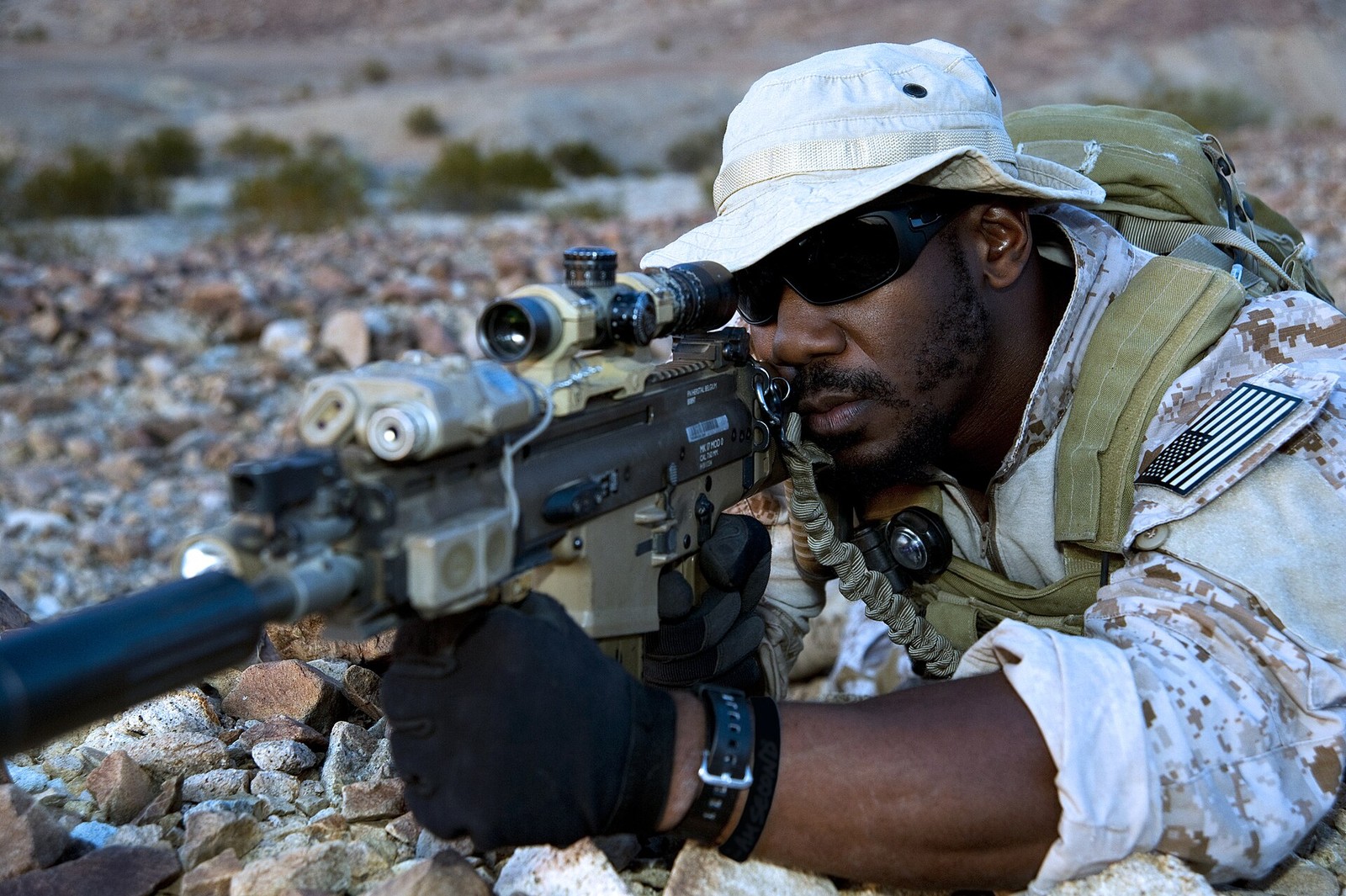
The desert pattern is built on a light base, sand and pale tan, overprinted with brown shapes in at least two values, one mid and one darker, so that the light ground occupies a large share of the surface. The overall impression at a distance is a warm, low-contrast field with no large dark masses: nothing in the desert pattern approaches the dark clumps of a woodland print, and a desert garment photographed in bright sun can look almost washed out. That is the condition the pattern was bought for. Exact hues vary between fabric lots and between manufacturers, which is why the structural features below matter more than a colour swatch reproduced on a screen.
Two features are worth learning because they survive bad photography. The first is the pixel geometry: the print is made of horizontal and vertical rectangles in more than one size, not squares on a single grid, so a genuine pattern never resolves into a neat checkerboard. The second is the Anchor–Constitution–Eagle emblem, the Navy’s ACE mark, which is worked into the printed pattern itself and repeats across the fabric at an interval determined by the pattern repeat, a subtle dark shape that reads first as a texture artefact and only later as a drawing. The mark is not legible in the published photographs; the account follows the Navy’s uniform documentation.
The desert pattern’s service history is short and specific. It was introduced in 2011 for Naval Special Warfare, whose operators had been the only Navy community consistently operating in environments where a blue uniform was actively harmful. It became the mandatory replacement for the Desert Camouflage Uniform for that community in June 2012. It has never been a fleet-wide working uniform, and it has never been sold to sailors through retail uniform stores as a standard item of issue.
AOR2: reading the woodland pattern
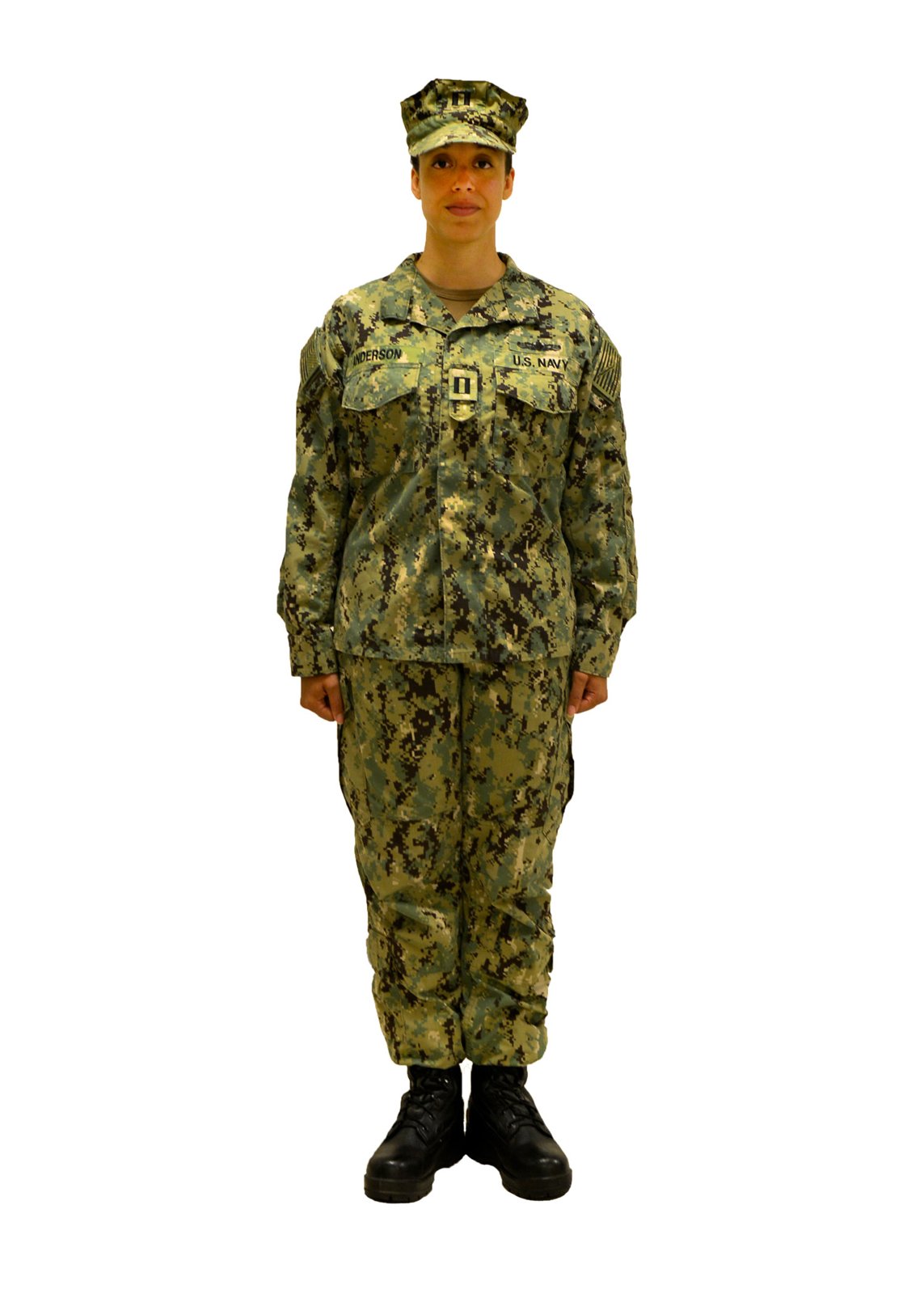
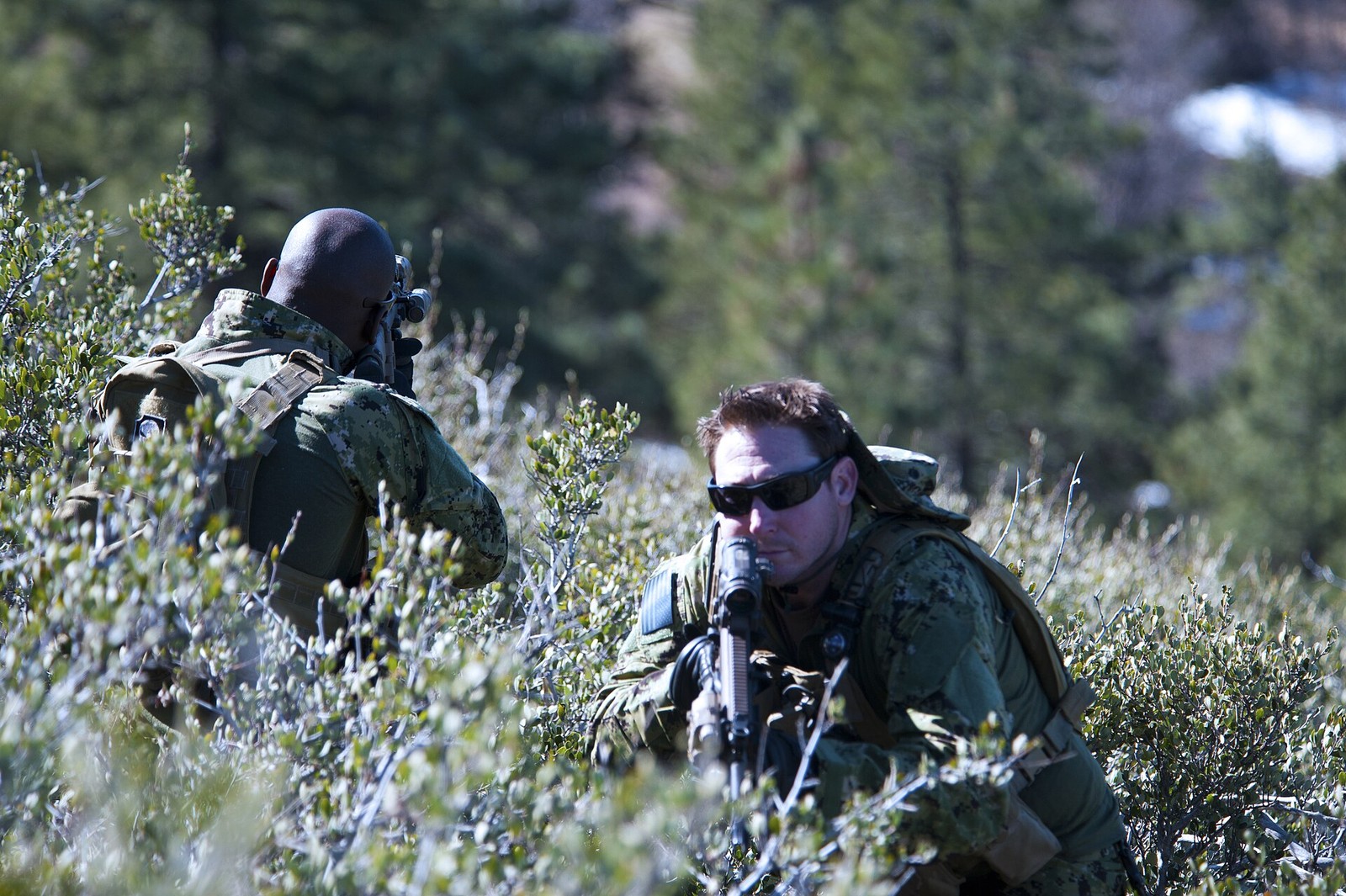
The woodland pattern reads as a mid-green ground carrying brown and dark-brown shapes, with a small amount of very dark tone that the desert pattern simply does not have. Its pixel geometry is the same construction as the desert pattern’s, rectangles in more than one size rather than a single square grid, but the value structure is far wider, so the pattern resolves into distinct dark clumps at distance instead of a soft wash. The browns in it are warmer and more abundant than in the Marine Corps woodland digital pattern, a difference noted in the Naval Postgraduate School study of 2017.
The pattern entered service in September 2011 as the replacement for the woodland Camouflage Utility Uniform, initially as organizational clothing to a list of Naval Special Warfare and expeditionary commands. It was authorized for daily wear by all Navy personnel from October 2016 and became the Navy’s standard working uniform from 1 October 2019. That history explains the shape of the photographic record: Type III images before 2017 cluster around expeditionary units, Seabees, explosive ordnance disposal, riverine and training commands, and images after 2017 are overwhelmingly recruits, students and ordinary shore commands.
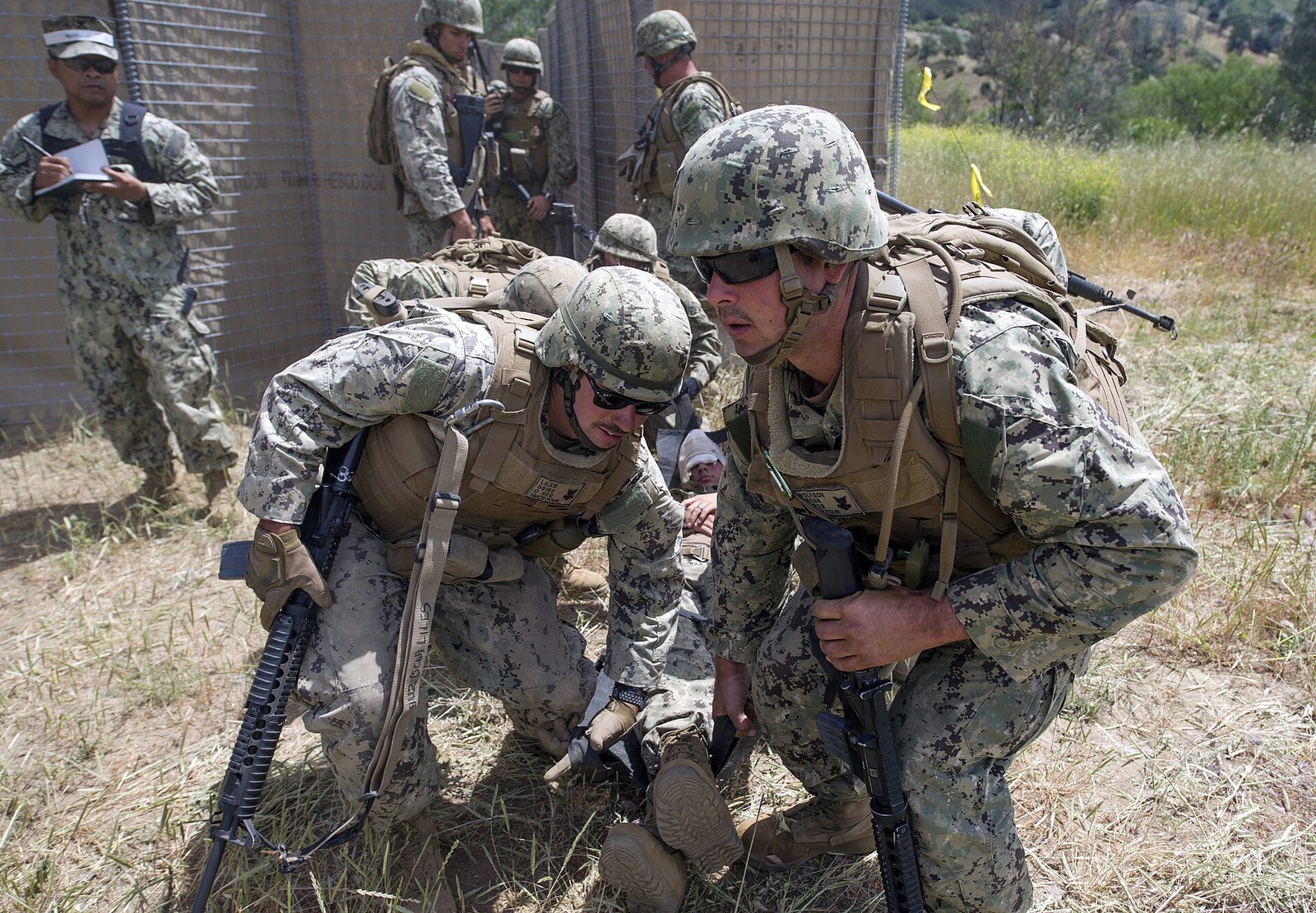
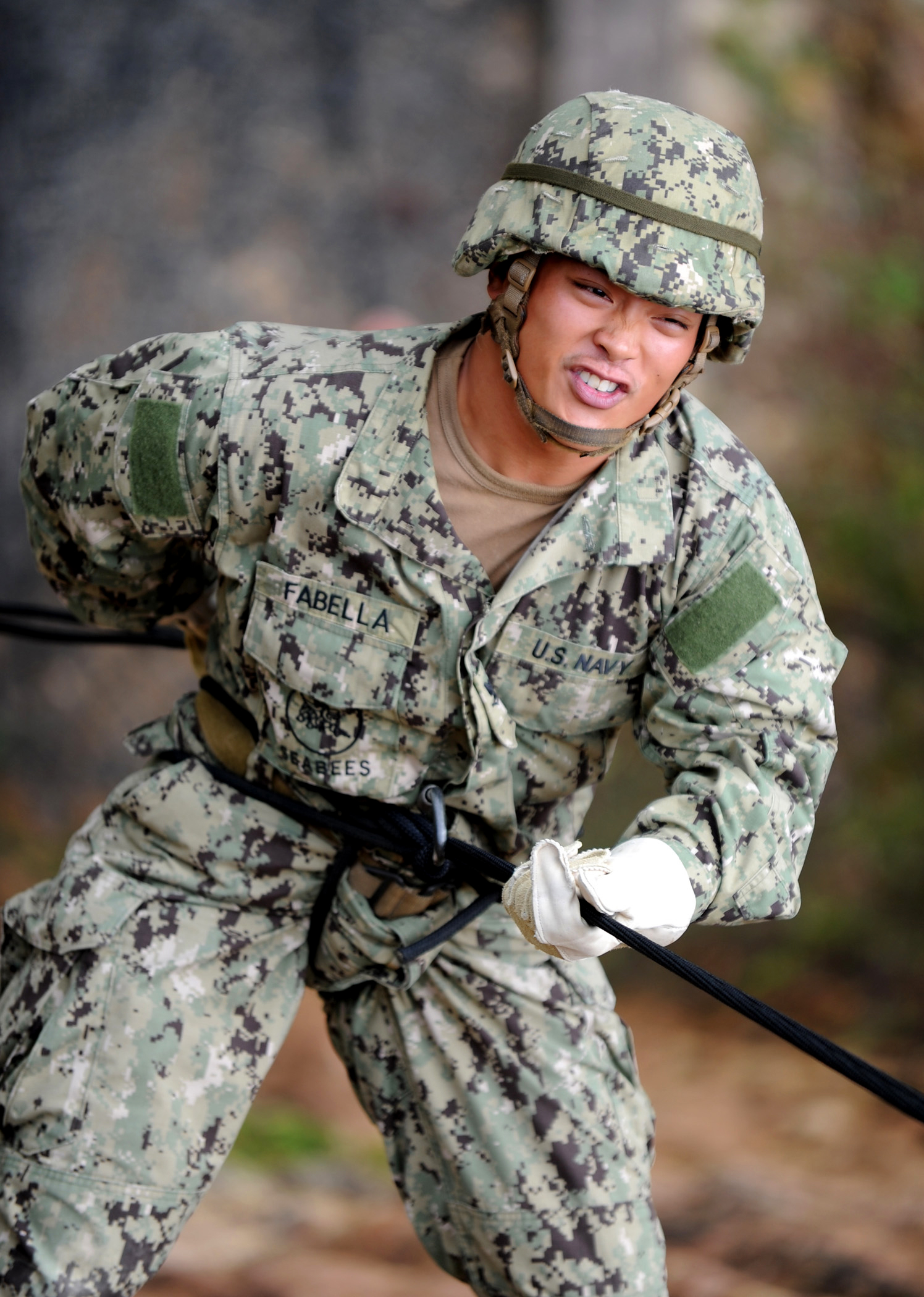
The two patterns side by side
The table below is the fastest way to fix the comparison. It separates the two name systems deliberately, because that is the discipline the identification requires.
| AOR1 | AOR2 | |
|---|---|---|
| Official name | NWU Type II | NWU Type III |
| Pattern family | Digital, desert palette | Digital, woodland palette |
| Dominant reading | Light sand and tan ground with brown shapes | Green ground with brown and dark-brown shapes |
| Value range | Compressed; light tones dominate | Wider; dark clumps read at distance |
| Approved | End of 2009 | End of 2009 |
| Entered service | February 2011 | September 2011 |
| Principal users | Naval Special Warfare and direct-support personnel; Coast Guard personnel assigned or attached | Fleet-wide from 1 October 2019; expeditionary and training commands before that |
| Supply status | Organizational clothing, issued rather than retailed | Standard working uniform since 2019 |
| Retail availability to sailors | None as issue | Standard issue and exchange stock |
What is actually in the supply system
Three practical facts follow from the paperwork, and they are the ones that decide whether an item for sale is plausible.
First, the desert pattern is not a retail uniform. It was and remains organizational clothing: issued against a requirement, to a defined population, through the supply system. Any listing that describes an AOR1 uniform as “standard Navy issue” is using the word standard loosely. The woodland pattern, by contrast, has been a genuine fleet-wide working uniform since 2019, which is why used Type III garments appear in quantity and Type II garments do not.
Second, the two patterns were adopted as a pair with different jobs, not as two generations of the same job. The desert pattern answers a specific environmental problem for a small community. The woodland pattern answers a general uniform problem for the whole Navy, the collapse of the blue Type I, which had been designed for appearance and durability rather than concealment and which was judged unsuitable for shipboard use after the Navy Clothing and Textile Research Facility tested it in October 2012 and found it failed a flame test. The Navy’s own 2015 briefing, and the written order of 2017, treated the two patterns as coexisting: Type III for the fleet, Type II still required for expeditionary missions.
Third, neither pattern is a flame-resistant garment. Both are a 50/50 nylon-cotton construction, as was the Type I, and the Navy developed separate flame-resistant shipboard clothing rather than fire-proofing the working uniform. A listing that presents an AOR-patterned blouse as FR clothing is claiming something the Navy’s own documentation does not support.
What comes from the civil side
Everything described so far is issue history. The material most readers actually encounter, however, comes from somewhere else: the commercial market, which has adopted the same two words.
The commercial story begins with fabric. The desert and woodland patterns were developed for a small, well-funded community with an unusually free procurement hand, and material with the same general appearance, sometimes produced under licence, sometimes produced as an interpretation, moved into the civilian market early. The pattern names travelled with it. In practice, a bolt of “AOR1” fabric bought today may be a commercial weave in a palette matched to the issue colours, a close interpretation produced from photographs, or a print that only resembles the pattern at a distance. Nothing in the official record transfers the issue nomenclature to civilian production, which is why the market’s use of “AOR1” and “AOR2” is better read as a family of trade descriptions than as a specification.
That gap explains most of the identification arguments on the collector side. A U.S. flag patch in the desert pattern, sold loose, can be a genuine issued item or a licensed reproduction; the pattern confirms the family, not the provenance. For a pattern reference the marketplace is a poor substitute for documentation, and the two Wikimedia Commons drawings that carry “AOR” names are a good example of the problem: they are explicitly their contributors’ own drawings, published under a Creative Commons licence, and the notes accompanying them state that the drawing is not the Navy’s pattern and, in one case, that the colours are taken from a commercial palette rather than from the issue fabric.
“AOR Universal”, explained
The ACE mark and the counterfeiting question
The Anchor–Constitution–Eagle emblem is the Navy’s attempt to make its own patterns self-authenticating. Because the ACE mark is woven into the print itself, at a defined interval and at a defined scale, a printed fabric that carries the mark in the right relationship to the pixel grid is more likely to have come from a Navy print than from a photograph-and-print operation. It is a useful tell, not a proof: reproductions can carry the mark too, and the mark is only as good as the person matching its scale and interval against a known sample. For the desert pattern, which was never sold to sailors, the mark does more work than for the woodland pattern, where genuine garments are widespread and easily available second-hand.
Identification pitfalls in the field
Two sets of confusions account for most of the misidentifications.
AOR2 against the other woodland digitals
AOR1 against the other desert patterns
The desert pattern is more exposed to confusion than the woodland one, because it has been the reference palette for a large commercial desert-digital market. Three checks in sequence: the pixel cluster scale, the presence of the repeating ACE mark, and the dark values. A print with sharp black accents at high contrast is not reading like the Navy’s desert pattern, which keeps its darks soft. Colour alone is the weakest test for either pattern, since fabric lots and screen calibration move the greens and browns more than most buyers expect.
What the labels are worth
Read as a pair, the two patterns tell a very ordinary story with an uncommonly confused vocabulary. The Navy approved two uniforms at the end of 2009, issued the desert one to a small community from 2011 and the woodland one to the fleet progressively until it became standard in 2019, and retired the blue uniform that had started the whole programme. The design vocabulary that followed, AOR1, AOR2, AOR Universal, Digi1, Digi2, was built by the people who wear and trade the material, not by the people who bought it.
That is the reason to keep the two languages apart. Official names answer the questions that matter for dating and provenance: which uniform, which year, which authority. Popular names answer the questions that matter for shopping, collecting and comparison. Anyone who uses one language to answer the other language’s questions will eventually make a mistake, usually the same one this guide opened with, where the desert item and the woodland item trade places because a label was trusted more than a photograph.
Clothing and accessories in this pattern are in our catalogue: AOR1 and AOR2.
