
Camouflage History
Danish M84 “Pletsløring”: The Flecktarn-Derived Spot Pattern
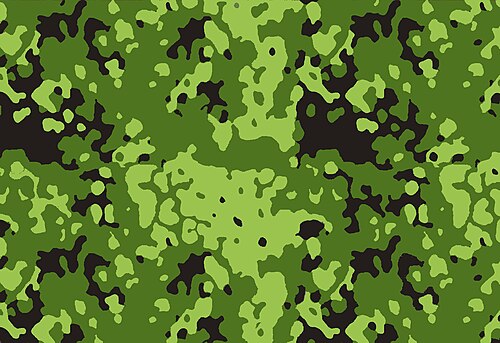
Denmark took a German camouflage design, simplified it, and ended up with a pattern that entered service before Germany’s own. The M84 “Pletsløring”, rendered “spot camouflage”, is a three-colour spot pattern derived from the German Flecktarn, adopted by the Danish army in 1984. It served for over three decades, through the Balkans, Afghanistan and Iraq, and is now a perennially popular collector pattern. This is its story.
Introduction: a German design, simplified
In the early 1970s the Danish Defence Force was looking for a replacement for its plain olive-green M/58 combat uniform. It found the answer in Germany, where a new camouflage called the Flecktarn was being developed. The Danish army took the German design as its base.
But Denmark did not simply copy it. The German Flecktarn uses five colours; the Danish version reduced that number to three olive green, light green and black, to better suit the Danish forest environment. The result is a pattern of distinctly Danish character. It is called M/84 Pletsløring “M/84 spot camouflage”, after the year of its adoption, 1984.

The Flecktarn connection
The story of the M84 is inseparable from the Flecktarn. The German pattern, of which the Danish design is a derivative, is commonly credited to the German textile firm Marquardt & Schulz. It was part of the German “Truppenversuch 76” trials of 1976. The Danish adoption, then, is usually dated to a design that was still in German trials.
The relationship between the two is direct: the M84 is a direct derivative of the German Flecktarn B design, retaining its characteristic spotted geometry but reducing the palette from five colours to three, a palette change rather than a redrawing; Wikipedia states that the Danish version uses the same shapes and pattern as Flecktarn B. The palette keeps the olive and light-green tones, with black as the darkest accent, and is designed for a temperate woodland environment.
Here is what is genuinely interesting: the Danish M84 entered service in 1984, while the Bundeswehr’s own official adoption of the Flecktarn is generally dated to around 1990. Denmark fielded a German-designed pattern before Germany itself officially adopted it. It is one of the earliest European five-colour-derived spot patterns to enter service.

Before the M84 came a prototype. In 1978 Denmark presented the T/78, a trial pattern that was never adopted. Its colours differed slightly from the final M84, a difference usually attributed to the manufacturer. But its experience informed the M84 that followed. Units absorbed the T/78 stock over the following years while others received the M84, and some soldiers continued to wear the old M58.
The spot pattern at work
The M84 uses spots to create a “dithering” effect that removes sharp boundaries between colours, the same optical trick that the later pixelated digital patterns achieve with squares. It is a clever application of the dithering principle years before the digital revolution. The pattern was built for the temperate forests of Denmark and northern Europe.
The desert variants: T/99 and M/01
When Denmark began deploying to arid theatres, it developed desert versions of the M84. There are two: the T/99 of 1999 and the improved M/01 of 2001.
The T/99 was issued from around 1999–2000 to SHIRBRIG elements deployed to the UNMEE mission in Ethiopia and Eritrea (early sources date the first issue to 2000). Recognizing the pattern’s adaptability, the M/01 improved it in 2001 for use in Afghanistan, and the desert version was also used in Iraq. The desert pattern is based on the standard M84 design, with the palette reworked for a tan and brown arid environment.

From the Balkans to Afghanistan
The M84 was the Danish army’s standard pattern through a busy period of international operations. It was worn in Bosnia from 1992 to 1995. It accompanied Danish troops to Afghanistan from 2001 to 2021, and to Iraq. It appeared across the cold-war and post-cold-war operations of a small but active NATO ally.


The pattern also travelled beyond Denmark. The Danish government gave M84 to the Baltic states of Estonia, Latvia and Lithuania as military assistance around 2000. The Russian Flectar-D pattern bears a strong resemblance to the M84, and some describe it as a derivative. A variant has reportedly been used by Sweden’s National Task Force.
(It is worth being careful here: some claims about M84 users rest on thin evidence. Photographs show the pattern on certain special-forces and police units in Scandinavia, but the general point is that the M84, like many cold-war-era patterns, spread beyond its home country in ways that are not always fully documented.)
The end of the era
The M84’s time as the regular Danish army standard eventually came to an end. The turn came with the decision to adopt MultiCam, designated the M/11 (“multiterrain concealment”), announced by the Danish acquisition agency in 2011 and widely reported in 2012. The M84 was phased out progressively, and progressively withdrawn, Camopedia places the phase-out from around 2013, while the 2018 uniform regulations reflect full regular-army replacement.
But the pattern has not disappeared. It remains in limited use with the Danish Home Guard. And because of its quality and rarity, and its fascinating link to the better-known Flecktarn, the M84 has become highly sought after by collectors and enthusiasts. A pattern that began as a simplification of a German design has become a prized piece of camouflage history.

Why the M84 matters
The M84 matters for several reasons. First, it proves that a camouflage design does not have to be complex to be effective, by cutting the Flecktarn’s five colours to three, Denmark made a clean, durable pattern precisely matched to its own forests. Second, it is a reminder that Germany’s most famous camouflage was adopted by its neighbour before Germany itself fielded it.
And third, it shows how a “spot” pattern built on the dithering principle would anticipate the digital-camouflage era, years before CADPAT and MARPAT made pixels the fashion. The M84 deserves to be remembered as more than just “Danish Flecktarn”, in our view it is among the most quietly influential temperate patterns of the late twentieth century.
Explore the Danish M84 on MegaCamo
MegaCamo’s Danish M84 collection brings this spot pattern to modern apparel, made to order. The wider Denmark country page gathers the M84 woodland and desert variants alongside the full range.
