
Camouflage History
EMR (Digital Flora): The Pattern That Pixelated the Russian Armed Forces
Everyone calls it “Digital Flora”, and almost everyone assumes it is Russia’s answer to CADPAT, the pixel camouflage that Moscow borrowed from the West. The Russians say something much more interesting. EMR, from the Russian “Единая маскировочная расцветка” (Edinaya maskirovochnaya rascvetka), the “unified camouflage colourway”, is the pattern that pixelated the entire Russian armed forces, and its designers trace the design logic not to Canada but to Germany’s Flecktarn. This is the pattern that turned Russia digital.
What EMR actually is
EMR is the abbreviation of a Russian phrase meaning “unified camouflage”, but the full form is not fixed. The most common expansion is Единая маскировочная расцветка (Edinaya maskirovochnaya rascvetka), “unified camouflage colourway”. Many Russian sources, and the occasional Western one, expand it instead as Единый маскировочный рисунок (Edinyy maskirovochnyy risunok), “unified camouflage drawing”, the “unified camouflage design” you may see as “Edinij Maskirovochnij Risunok” is simply the same phrase romanized a different way, using “j” for the Russian “й” instead of “y”. The final noun differs (colourway versus drawing), and the first word agrees with it (Единая with the feminine расцветка, Единый with the masculine рисунок), yet the initials ЕМР, and the pattern, are the same. Whichever expansion you read, the word “unified” carries the meaning: one pattern, common to every branch. It does not mean one colour; it means the pattern is common to all branches of the Russian armed forces, the ground forces, the airborne troops, the navy and the air-force ground personnel, a single standard pattern across the whole military, in place of the jumble of Soviet and post-Soviet designs that came before it.
In the West it goes by a string of nicknames: “Digital Flora”, “Tsifra” (Russian for “the number” or “the digital”), “Tetris” (after the video game), and “RUSPAT”. Of these, “Digital Flora” is the most common in English-language retail and discussion, and the most misleading, because it suggests a link to the older Flora pattern when the two are entirely different drawings.
What it looks like: pixels that form patches
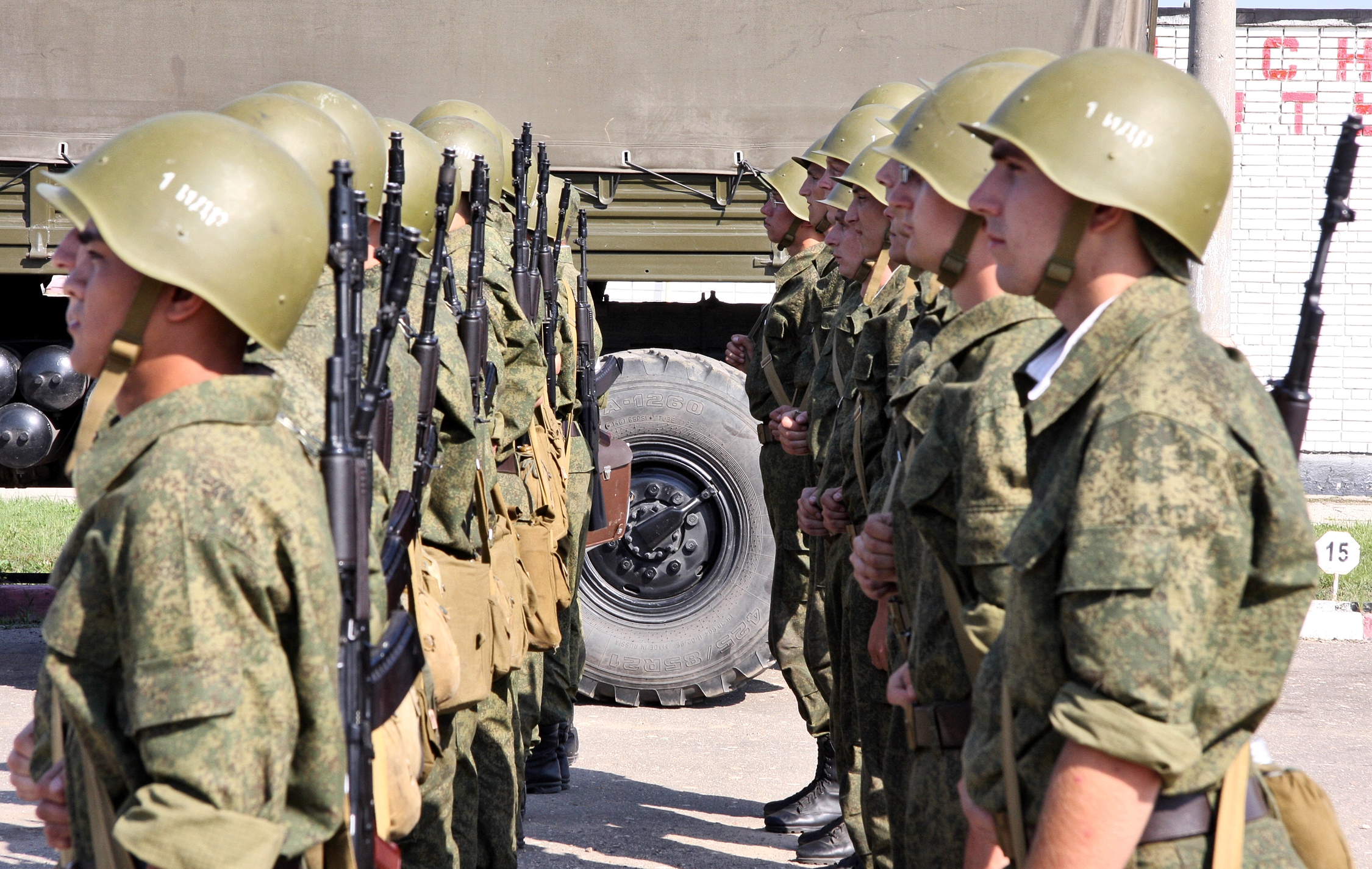
EMR is a pixelated, or “digital”, pattern. Its building block is the small, near-square pixel rather than the organic blotch. Those pixels cluster into larger disruptive patches, the classic structure of a multi-scale camouflage, where fine detail breaks the edge at short range and larger masses break the silhouette at distance.
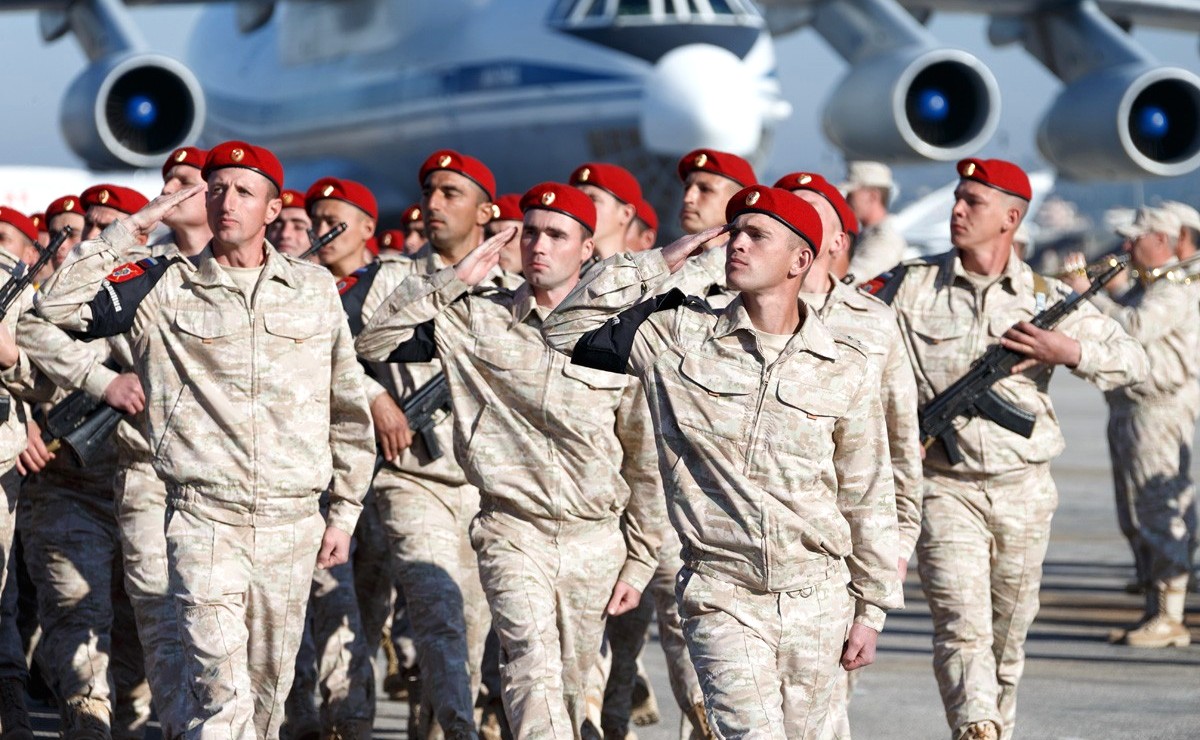

The standard summer (“leto”) colourway uses black, reddish-brown and foliage-green pixels on a pale green ground. There is a desert version (beige and brown pixels on a sand field, worn in Syria), a “Sever” arctic version (light and dark grey pixels on white), urban and winter variants, and a spring-autumn reversible version. It is a family of colourways, not one fixed look.

The design story: Flecktarn, not CADPAT
Here is the fact that most Western coverage of “digital camouflage” gets wrong. Because EMR is pixelated and appeared around the same time as the great wave of 2000s pixel camo, it is routinely filed under “CADPAT-derived”, lumped in with the Canadian CADPAT and American MARPAT school. The Russian designers do not describe it that way. They describe EMR as following the logic of the German Flecktarn: small “imitation” spots that group together into larger disruptive masses. The pixels are the modern rendering of Flecktarn’s dappled-fern idea, not a copy of Canadian pixels.
That matters. It means the popular label “Russia’s answer to CADPAT” is a Western shorthand, not a design lineage. If EMR has a design ancestor at all, the Russians point you to Germany in the late 1970s, not to Ottawa or the United States.
From Flora to pixels: 1998 to 2008 and the family it replaced
To see what EMR replaced, you have to look at the Russian camouflage that came before. In the 1990s the Russian soldier had worn the VSR / Dubok patterns of the immediate post-Soviet years, and then, from 1998 the Flora (VSR-98), a naturalistic, vertically-streaked foliage pattern nicknamed “arbuz” (“watermelon”) for its long dark stripes on a lighter green field.
Flora was the general-purpose standard for the conventional Russian armed forces and the MVD for a decade. EMR was introduced in 2008 as the decision to replace both VSR and Flora, and its large-scale adoption began in 2011. That is why the phrase “Digital Flora” is a trap: Flora is the older organic pattern that EMR replaced, and EMR is the digital pattern that took its place. They are not two versions of the same design.

The pattern across the Russian military
Because EMR is the “unified” pattern, it shows up across the whole force, carried by the modern Russian soldier through two systems worth knowing:
- VKBO (the all-season field uniform), the multi-layer clothing system whose kit is printed in EMR.
- Ratnik (“warrior”), the soldier-system programme, where EMR is the main camouflage in its ballistic clothing.
It is worn by ground troops, the VDV airborne, the naval infantry, and the arctic brigades in the Sever colourway (the 200th and 80th independent motor rifle brigades are the arctic-EMR units). It is the EMR that Russian soldiers were wearing when the “little green men” appeared in Crimea in 2014, unmarked uniforms whose Russian origin was later identified partly through the pattern itself.
Beyond Russia: an export and a copy
EMR has travelled well beyond the Russian military, in a mix of genuine adoption and unauthorised copy.
- Belarus uses a slightly recoloured EMR as a standard pattern.
- Tajikistan its army is in EMR.
- Belize Defence Force adopted an EMR clone in October 2011, replacing its non-digital uniform.
- Donbas separatist formations the DPR/LPR militia wear EMR.
- North Korean troops reported in Russian EMR uniforms in the Russo-Ukrainian war.
- Other partially-recognised entities and pro-Russian formations use it to varying degrees.
The successors and the competition
EMR may be the unified standard of the 2010s, but it has not gone unchallenged. From around 2017, the Russian National Guard (Rosgvardia) was reported as moving away from EMR toward the Izlom and Moss patterns. And from around 2023, the newer VKBO clothing generations began including local MultiCam copies alongside EMR, reflecting a broader shift toward multi-terrain patterns. Our companion research on the Russian leaf patterns and the arc of Soviet camouflage is in our earlier articles.
The comparison is worth spelling out, because it is a real fork in the road. EMR is pixelated (small square pixels grouped into patches, in the style of CADPAT-MARPAT on the outside, of Flecktarn on the design side). The newer Izlom is the oppositeanalogue, built from large angular “fracture” shapes. One is the digital approach; the other is the forgotten analogue route. The Russian military has experimented with both.
Why EMR matters
EMR matters for three reasons that go beyond one country’s uniform.

First, it answered a real design question about scale. By grouping fine pixels into larger patches, borrowing Flecktarn’s logic, it managed to break up both the close-range edge and the long-range silhouette at once, the trick that made multi-scale camouflage the conversation of the 2000s.
Second, it is a lesson in what “digital” means. EMR is not a picture of pixels on a screen; it is an engineering decision about texture, scale and reflectance, built to hide the wearer not just from eyes but from night-vision devices. The “unified” name signals a procurement decision, one pattern for every branch, as much as a look.
Third, and most usefully for anyone reading about camouflage, its naming exposes a trap. “Digital Flora” sounds like Flora redrawn in pixels. It is not. Flora is the older pattern. EMR is the new one. If that single fact is what a reader takes away, the article has done its job.
EMR and its relatives at MegaCamo
At MegaCamo the story of Russian and Soviet camouflage is well represented. Browse the Russian camouflage range, the full camouflage collection, or our complete pattern list and read our Soviet leaf-pattern article for the KLMK and Berezka ancestors of the digital era.
