
Camouflage History
Imperial Japanese Army Camouflage, 1937 to 1945: Nets, Foliage and White Snow Suits
Search for a Japanese World War II camouflage pattern and you will find a short list of names, most of them attached to garments that turn out to be rare, locally made or post-war. The record left by the Imperial Japanese Army between 1937 and 1945 tells a more interesting story. Japan did not fight the Pacific war in a printed camouflage uniform. Its concealment was built on nets, cut foliage, garments woven in the field from local fibre, and a white over-suit for snow, with a separate system of paint for vehicles and aircraft.
That difference matters when you look at a period photograph and try to read it. For most of the war, a Japanese infantryman was not wearing camouflage. He was carrying it, in his pack, on his helmet and in his hands.
A doctrine of concealment, not a print
The clearest contemporary summary comes from a United States Military Intelligence Service bulletin of 20 May 1942, whose chapter on camouflage opens with a single sentence on Japanese practice.
The Japanese have made full use of camouflage, using nets for personnel, horses, and equipment and adding jungle foliage to complete the job.
US Military Intelligence Service, Japanese Warfare, Information Bulletin No. 16, 20 May 1942
The same expectation of personal skill appears in the Soldier’s Guide to the Japanese Army, the handbook issued to American troops in 1944. It describes the Japanese soldier as an expert at camouflage who delights in deceptions and ruses. Both documents are enemy assessments, written by people who had to find Japanese positions and take them, and both treat concealment as a habit rather than a uniform.
The evidence has a shape worth naming. The detailed descriptions are American, and they date from 1942 onward, when US forces met the Japanese army across the Pacific. For the first five years of the war in China, from 1937, the record is thinner, and what survives is photographs and unit accounts rather than manuals. The 1942 and 1943 documents should be read as a snapshot of a mature system, not as its starting point.
| System | Documented | What it was | Source |
|---|---|---|---|
| Personnel nets | 1942 | Body net of about 1 by 1.5 yards, mesh just under 2 inches, plus a head net | TM 30-480, September 1942 |
| Field foliage | 1942 to 1945 | Cut vegetation added to helmet nets and to nets over positions | Information Bulletin No. 16, May 1942 |
| Fibre jungle jacket | 1943 | Garment woven locally from fibre, coloured to the local foliage | JAN No. 1, plate 80, October 1943 |
| White winter suits | about 1940 to 1945 | White overcoat, hood and helmet cover for snow | JAN No. 1, plate 77; ski troops, Kuril Islands |
| Vehicle paint | 1942 | Irregular painting in khaki, yellow, brown and green | Information Bulletin No. 16, May 1942 |
The net every soldier carried
The September 1942 handbook TM 30-480, the US Army study of Japanese military forces, describes infantry camouflage nets in the plain language of a supply list. An individual set had two parts. The body net measured about 1 by 1.5 yards, was made of greenish straw-fibre cord or ordinary twine, and had a square mesh of just under two inches. The head net used the same material, mesh and colour. Larger nets existed for machine guns, something over two yards square, and for artillery, which the handbook records as widely used. There was even a horse net.
Men carried that equipment every day. The Soldier’s Guide of 1944 lists what sat on top of the standard cotton pack: a raincoat, shelter half and camouflage netting placed across the top. A soldier could therefore camouflage himself, his weapon or a position without waiting for a specialist unit, using material he already had.

The cover of the Japanese occupation magazine Djawa Baroe of 1 April 1943 shows how that worked in Java. Two crewmen of a heavy machine gun have netted helmets with cut foliage pushed through the mesh. Their uniforms are ordinary. The camouflage is what they attached to themselves.
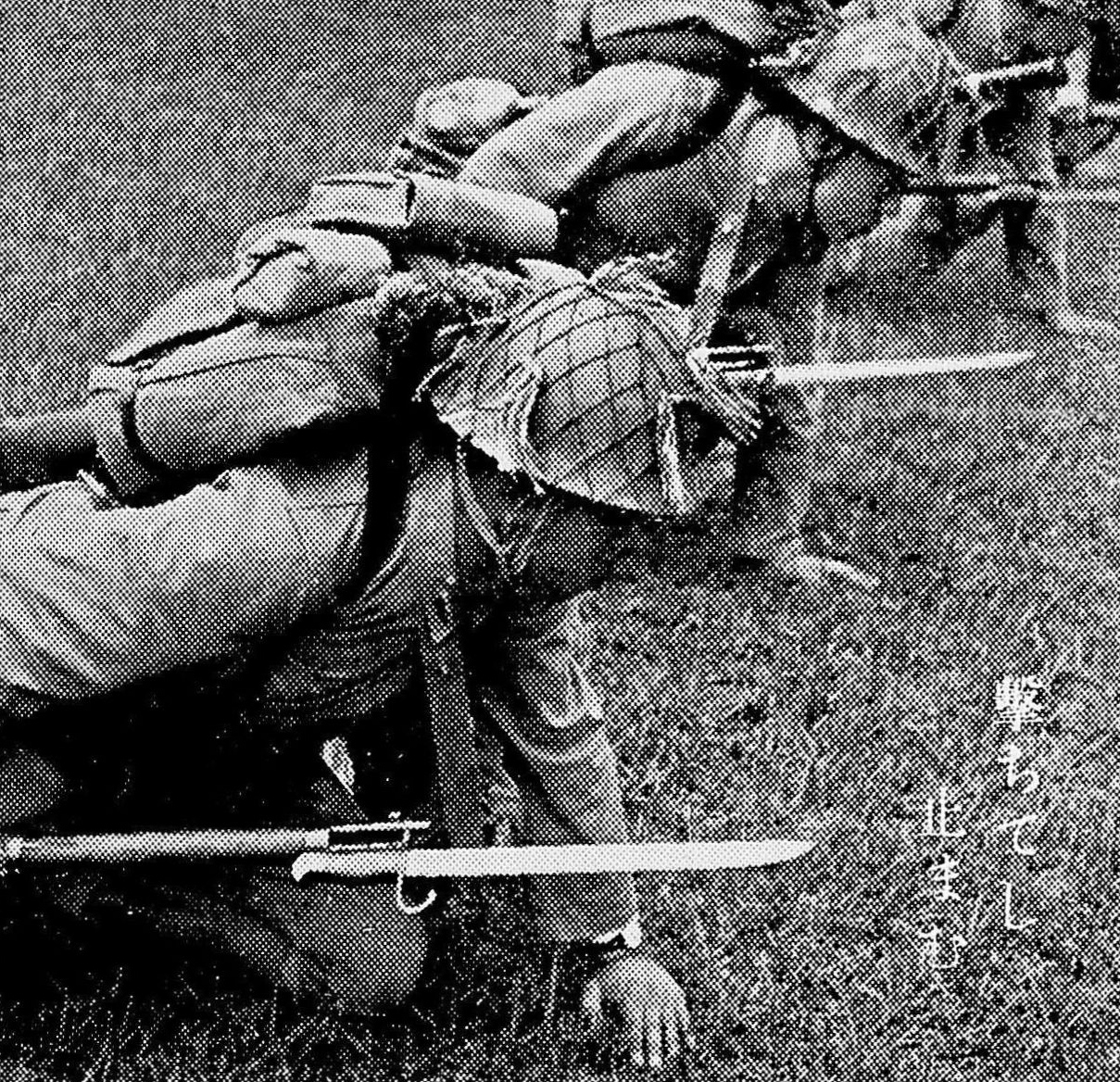
Fibre, foliage and the jungle jacket
Where a net was not enough, the Japanese answer was not a printed cloth but a woven one. Page 80 of JAN No. 1, the joint Army and Navy recognition manual of October 1943, illustrates a camouflage jungle jacket with a note on the material.
The fibre material of which the jacket is made may vary with the color of the foliage in the area in which jacket is worn.
JAN No. 1, Uniforms and Insignia, plate 80, October 1943

The figure on the right of the plate is the point. It wears a long jacket built from green fibre, with a helmet net full of foliage. This is camouflage as a local manufacture: a garment made close to the front from whatever fibrous material the area produced, rather than a factory print shipped from Japan. For a garrison on an island with no textile industry, it was the only realistic answer.

A jacket of that kind has no fixed appearance to catalogue. That is one reason the search for a single Japanese jungle pattern runs into trouble: the object was designed to be made anywhere, so two examples from two islands can differ completely.
White for the north
White is the exception. In the north the army did issue a genuine camouflage garment, and the October 1943 recognition manual gives it a whole plate. The white camouflage overcoat was cut long, worn over the uniform, and came with a hood that slipped over the steel helmet. The plate notes the yellow cap star and shows the matching winter kit: wool toque, trigger-finger mittens, high felt boots, fur-lined shoes, fur-lined leggings and a fur-lined cap.

Photographs from the Kuril Islands show the same idea in the field, with ski troops in white overcoats and hoods. In snow, white cloth is camouflage in the strictest sense: it removes the dark silhouette that gives a man away, and it does so without a single printed shape.
Paint for vehicles and aircraft
On wheels and tracks, camouflage moved into the paint shop. The 1942 bulletin is precise about it.
Vehicles usually are camouflaged with paint and local vegetation, and sometimes they are covered with nets. Armored force vehicles normally are painted irregularly in indeterminate shades of khaki, yellow, brown, and green. Some of the ordinary motor trucks are painted like the armored vehicles, though usually they have been of a sandy khaki color.
US Military Intelligence Service, Information Bulletin No. 16, 20 May 1942
Aircraft received their own treatments. Many fighter planes were painted jet black, according to the same bulletin, while Type 96 heavy bombers frequently carried irregular curling lines of light gray and light green, and Type 97 reconnaissance aircraft were seen in dark gray. Because period photographs are almost all black and white, these written descriptions remain the best record of the colours themselves.
Why it stayed improvised
The documents do not record a decision to reject printed uniform camouflage. What they show is a system in which nets were cheap, replaceable in theatre and already in every pack.
- Nets cost little and can be repaired or replaced with local material.
- Fibre garments can be woven where the unit is stationed.
- A white over-suit answers one problem, snow, with one colour.
- Paint is applied at workshop level, without a textile supply chain.
The result was a camouflage system that looked improvised and behaved flexibly. Its weakness was consistency. Two units in the same theatre could look nothing alike, and nothing in the supply system guaranteed that a replacement garment matched the one it replaced.
Reading a Japanese camouflage photograph
A few markers cover most period images. A steel helmet carrying a net with foliage pushed through it is field camouflage, and the man under it is likely to be in a jungle or a wooded position. A long white overcoat with a hood, worn in snow, belongs to the northern garrisons and to winter kit. A jacket of green fibre over the uniform is the locally woven jungle garment of 1943 and after. Plain khaki without netting or foliage usually means a soldier away from the front, a garrison, or a photograph taken for a magazine rather than for the record.
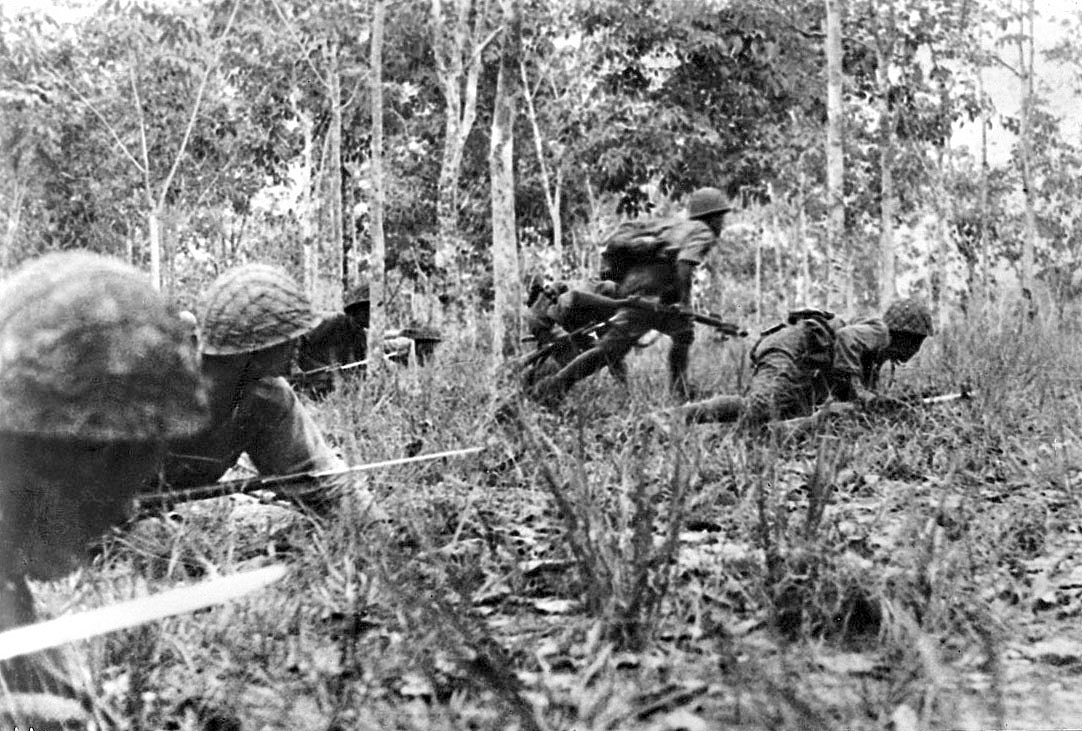
What looks like an absence of camouflage in a photograph is often only the camera angle. The net is folded on the pack, the foliage sits behind the helmet, and the printed pattern the reader is looking for never existed in the first place.
From 1945 to the modern wardrobe
The wartime system died with the army that built it. Post-war Japan started again with new designs for the Self-Defence Force, and those later patterns, not the improvised camouflage of 1937 to 1945, are what a collector can buy today. MegaCamo’s Japanese line follows that post-war story: the Japanese JSDF Jietai camouflage collection.
For the wider range of patterns and garments, start from the MegaCamo shop.
Japanese camouflage of the Second World War is best understood as a craft rather than a pattern. Nets, fibre, foliage, white cloth and paint each answered a specific problem, and each could be produced close to the front. That is less tidy than a printed repeat, but it is what the documents describe.
