
Camouflage History
Face Paint: The Camouflage Nobody Manufactures
Issue sticks come in three colour pairs, the rules have barely changed since 1944, and the surface being painted is the one piece of camouflage kit that no factory can supply.
Every other layer of a soldier’s concealment is a product. A helmet cover has a printed pattern and a contract number. A net has a mesh size. A uniform has a fibre blend, a print run and a shelf life. The face has none of that. It cannot be ordered in a size, it has no repeat, and nobody can deliver it. What can be delivered is a small stick of grease paint and a set of instructions that has survived, almost unchanged in principle, from the 1944 field manual to the one in use today. The instructions turn out to be more interesting than the paint.
The face is a beacon
In 1944 the US Army’s camouflage manual, FM 5-20A, put the problem in a single sentence: “Your face is light in color and like your canvas equipment, is a beacon to the enemy observer, who usually has the sighting end of a rifle at his eye.”
Nothing in that sentence has expired. Current doctrine uses the same reasoning: exposed skin reflects light and may draw attention, and even very dark skin, because of natural oils, will reflect light. The mechanism is the same one that makes a polished mess tin or a plastic map case visible from a distance. Camouflage is not only a question of colour. It is a question of breaking up shape, killing shine and matching a background, and an unpainted face fails two of those three by default. It is a smooth, curved, highlight-carrying surface attached to a body that is otherwise patterned.
That is why face paint appears in doctrine beside helmets and weapons rather than in a grooming chapter. FM 5-20A set out the order in which a soldier camouflaged himself: helmet first, then face and hands, then weapons, then shine, then canvas equipment. The face came second, before the rifle.
1944: darken, then disrupt
The wartime manual allowed two approaches. Toning down meant applying an even dark colour to remove the light tone of the skin. Disruptive painting meant breaking the face into areas that no longer read as a face, and the manual preferred it where there was time. Its rule is short and geometric: “On the face, disruptive patterns should cut across the nose line, cheek bones, eye sockets, and chin lines.” A stripe that runs along the nose reads as a nose. A stripe that runs across it breaks the vertical that the eye is looking for.
The modern version keeps the same logic and adds the reason. Paint the high, shiny areas, the forehead, cheekbones, nose, ears and chin, with a dark colour. Paint the low, shadowed areas around the eyes, under the nose and under the chin with a light colour. On a photograph this looks like a mistake. In the field it is the point: human vision expects a lit forehead to be lighter than an eye socket in shadow, and reversing the values stops the face resolving as a face at the distances where recognition actually happens.

A palette of six, issued in three pairs
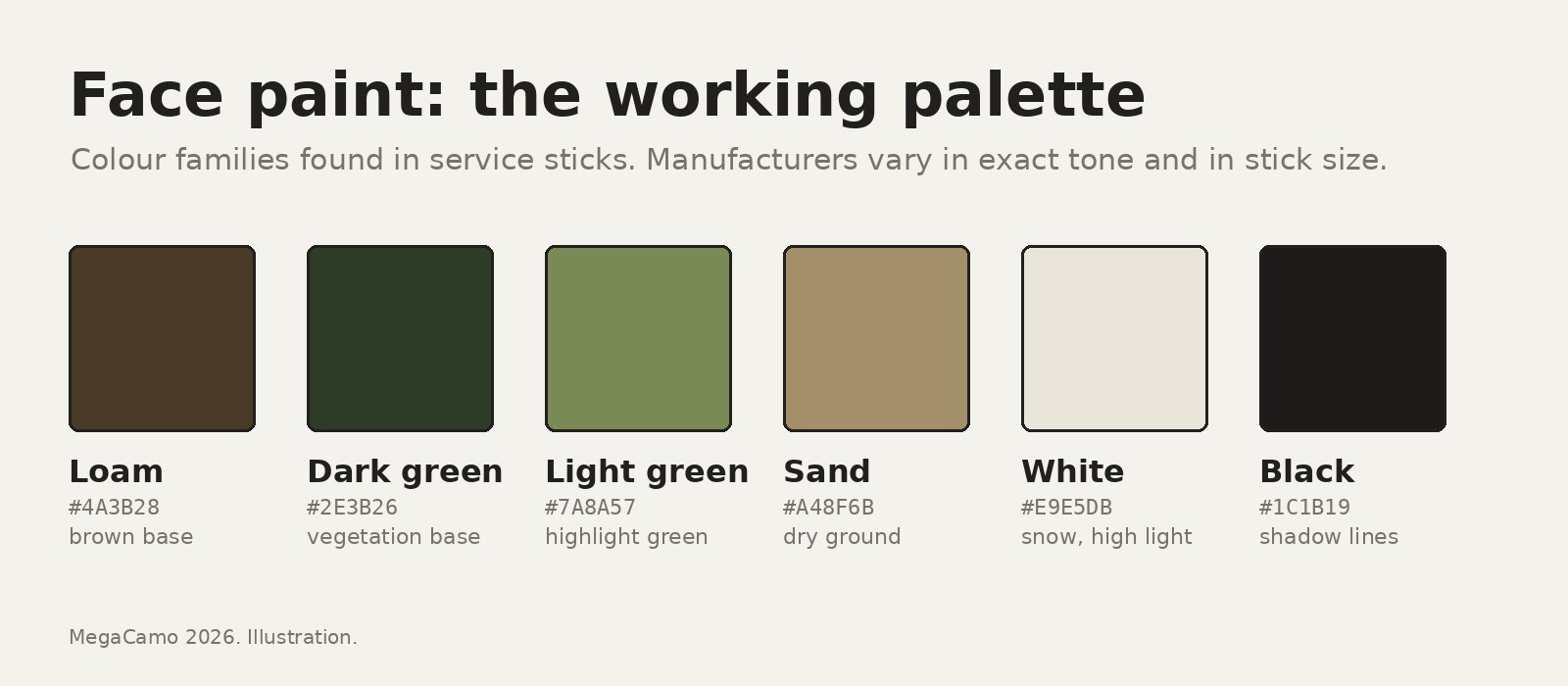
Issue paint is not a rainbow. There are six colour families, and the pairings named in the issue description are narrow and functional: loam with light green where there is green vegetation, sand with light green where there is little of it, and loam with white for snow. Dark green is the vegetation base, one step deeper than the light green used for highlights. Black is not usually a base coat. It is the drawing colour, used for the sharp disruptive strokes that define an edge and read as shadow.
The stick itself is two cylinders joined end to end, one colour at each end, with the paint advanced by pushing the carrier through. The design has a logistical elegance that is easy to miss: one item, two colours, no brushes, no mixing, no tin to lose the lid of, and a format that fits in a pocket next to a compass.
In the US system face paint is handled as a medical item rather than as a textile, because it sits on skin for hours at a time. The published design criteria are correspondingly unglamorous: resistance to perspiration, comfort, ease of removal, minimal odour, and no health hazard from skin contact or accidental ingestion. That is a long way from a borrowed tin of boot polish.
Never paint alone
Self-application has one predictable failure: the parts a person cannot see. The ears, the back of the neck, the edge of the jaw. Doctrine addresses it directly, telling soldiers to work in pairs and help each other because self-application leaves gaps, such as behind the ears. It is a small instruction and it is the difference between a painted face and a painted face that works when someone walks past it from the wrong side.
The same passage deals with an understandable temptation. Oils or insect repellent must not be used to soften a hard stick. It makes the paint easier to spread and the skin shiny, which defeats the entire exercise. A stick that will not spread in cold weather is telling you something about how it was carried, not asking for an additive.

Before the stick: soot, cork and mud
FM 5-20A named lampblack, burnt cork and plain mud, then added a caveat that reads as though it were written last year: some soils contain harmful bacteria and should not be used in mud form to darken the face unless a medical officer has determined that they are safe. The manual also offered one solution that has since gone out of fashion, a mesh mosquito face net toned down by dyeing it in strong coffee or in an issue dye, worn to break the outline of the face rather than to hide the features.
Current doctrine keeps burnt cork, bark, charcoal and lampblack as field expedients, but demotes mud to the last resort, and not only for medical reasons. Mud dries, changes colour and flakes off, which leaves patches of exposed skin on a face that was supposed to be dark. A field expedient that fails after twenty minutes is worse than no paint at all, because it encourages confidence.
The Black Devils
The best known face paint story of the Second World War belongs to the First Special Service Force, the Canadian-American commando brigade that fought in Italy. Its men blackened their faces with boot polish before night operations, and German troops are said to have called them the Black Devils. The nickname did real work: a unit that is believed to be everywhere at night has an advantage before the first shot is fired.
The evidence deserves care. The most quoted proof is a passage from a German officer’s diary describing the force’s night attacks, and Canadian historians have questioned whether that diary is genuine. What is not seriously disputed is the practice itself, which veterans’ accounts and museum collections describe consistently: burnt cork and boot polish, applied for night work, removed with whatever was available.
From polish to a stock number
The wartime expedient eventually became an item of supply. Two-colour paint sticks were in the US system by the Vietnam era, and collectors’ attributions of 1960s tubes to a specific manufacturer should be read as anecdotal rather than as procurement history. Issue was never universal, and many photographs of blackened faces from 1944 show cork and polish rather than paint, because that is what was available.
The modern item is documented in the pharmaceutical literature as well as in the supply system. The standard stick carries national stock number 6850-00-161-6202 and the compact carries 6850-01-493-7309. In 1999 an operational requirements document set out a combined camouflage paint and insect repellent, developed with the Walter Reed Army Institute of Research. The compact received its stock number in 2001, and a stick containing 30 percent DEET was later recommended for one. The logic is field logic: the repellent is going onto the skin anyway, so it may as well leave the wire in the same pocket.
The same problem, in every army
Face paint is unusually international, because skin is. The photograph below shows Japan Ground Self-Defense Force personnel aboard a US Navy ship during Exercise Iron Fist in 2012, painted with the same green and black logic as their American hosts, in a completely different uniform.

What varies between armies is the palette and the density of coverage, not the principle. Troops fighting in desert or in snow change the colour pairs, never the geometry. And the rule that survives everywhere is that the paint must be matte and irregular: a neat mask of solid colour becomes a shape in its own right, which is precisely what camouflage is supposed to prevent.
The only camouflage nobody manufactures
Every other layer of a soldier’s concealment has a factory behind it. A helmet cover has a pattern and a contract. A net has a mesh size and a specification. A uniform has a fibre blend, an infrared treatment and a print run. The face has none of these things. The surface is supplied by the soldier, and the camouflage is a technique: learned, applied in the field, renewed after sweat, and removed with soap and water.
That is why the doctrine reads the way it does, flat and almost impatient. There is no specification to hide behind and no purchase order that solves the problem. There are two colours, a partner, a few minutes, and the willingness to look ridiculous in a photograph.
What goes wrong
FM 5-20A taught by negative example. Beside a photograph of a mortar emplacement it noted that the crew’s equipment had not been toned down, that no attempt had been made to use natural materials on their helmets, and that their faces and hands had not been toned down at all. The failure modes have not changed: paint on the face but not the neck, hands left pale and shiny, a helmet left glossy, and a face painted into a solid mask that reads at distance as a dark blob with a helmet on top.

There is also a practical limit that doctrine states plainly and photographs rarely show. The palms are not normally painted when arm-and-hand signals are to be used. A signal is only useful if the hand doing the signalling can be seen, and a hand painted the colour of the undergrowth at dusk is a hand that has stopped communicating.
Painting for a camera, or for a reenactment
For readers who paint faces for photography, film or reenactment, the doctrine translates into a short list. Work matte, because anything that catches light defeats the exercise. Work irregular, with strokes that cross the nose, the cheekbones and the chin rather than a symmetrical mask. Cover the parts that shine: forehead, bridge of the nose, cheekbones, ears, chin. Take the colour down the neck and onto the hands, because those are the areas that give a painted face away at ten paces. And use a partner for the ears and the back of the neck, exactly as the manual says, because there is no mirror that solves them.
For a 1944 impression, the correct material is burnt cork, soot or boot polish. A modern green and loam stick in a photograph of the Italian campaign is a small anachronism, and one that is easy to avoid.
Eighty years, one instruction
The remarkable thing about face paint is how little the instruction has changed. The 1944 manual tells the soldier that his face is a beacon, to cut his pattern across the lines of the face, and to use what he has. The current manual tells the soldier that his skin reflects light, to paint dark on the highlights and light in the hollows, and to work in pairs. Between the two documents lie eighty years of textiles, infrared treatments and digital printing. The face has not changed, and neither has the method.
It remains the one piece of camouflage that cannot be issued in the right size, cannot be printed, and cannot be bought ready-made. Everything else in the kit is a product. This is a technique, and it is the last thing a soldier applies before leaving cover.
Related reading
Face paint is the last layer of a system explored elsewhere on MegaCamo. The printed patterns of the Second World War are covered in German World War 2 Camouflage Explained and in the history of the Denison Smock, while the American break with realism is the subject of Frog Skin and Duck Hunter.
Where paint wears off fastest, on the neck, fabric does the same job for longer. See the Russian Arbuz Flora and Taiga neck gaiter and the British DPM woodland neck gaiter.
