
Camouflage History
Turkey: From Foreign Copies to a National Camouflage Pattern
Turkey fought for decades in other nations’ camouflage. American spot prints, then American leaf, then American woodland: the Turkish armed forces borrowed the look long before they designed it. A pattern of the country’s own arrived around 2008, and by 2021 the army had a design on its back that no other country had drawn. The interesting part is the sequence, and the reasons a very large conscript army chose copying first and originality much later.
The cheapest answer was to copy
Designing a camouflage properly is expensive. A pattern has to be tested against several terrains, several seasons, wet and dry light, and the practical habits of soldiers who wear it for months. For most of the Cold War, Turkey had a large army, a limited research budget and NATO allies who had already done that work, so the rational move was to copy what worked. Camopedia’s survey of the country says it plainly: almost all historical Turkish camouflage designs derive from United States patterns.
The first was a copy of the American wartime spot print, the M1942, printed on cloth helmet covers from the 1970s into the 1980s. Production was crude, with uneven registration and colours that ran, and the covers were reversible: the spotted side for the dry Anatolian interior, the plain side for snow. For most infantrymen camouflage in that period meant a helmet cover and nothing else. The jacket and trousers stayed in plain field dress.
The Aegean exception
One unit-level design broke that monotony. The Aegean spot is a blue-green recolouring of the American spot pattern, worn by Commandos, Paratroopers and Marines from the 1970s until the early 1990s. It points at the sea rather than the steppe, and it did a job that modern armies pay designers for: it made a specialist visible to his own side and unremarkable to everyone else. In photographs it is still the easiest way to tell a Turkish commando of that era from an infantryman.
Two American generations followed. The leaf print reached Turkish elite units in the late 1980s, when copies of the ERDL design, dark green and brown shapes on a lighter ground, appeared on uniforms and helmet covers and stayed in service into the 1990s. A stretched version, catalogued as the elongated leaf and known to some collectors as the squashed leaf, appeared in the middle of the 1990s and was worn by the Army and the Gendarmerie. Camopedia notes that the same print later turned up in Azerbaijan and, early on, on units of the Afghan National Army, which makes it one of the more widely travelled Turkish exports of the period.
Woodland, and a nickname
The pattern that really settled in was a copy of the American woodland design, introduced in 1989 and issued as the standard combat uniform of the Land Forces for close to twenty years. Collectors call the early Turkish version pink woodland, because the background leans to tan and dusty pink where the American original is greener. That is not a manufacturing error: it is the local palette, matched to soil and dry vegetation that the American print was never designed for. Production ran until about 2008, and later Turkish copies became nearly literal reproductions of the American design, which is why a dated photograph is often the only reliable way to tell the two apart.


That 2012 photograph is a good measure of how long the woodland lasted. The rifle is the G3, the standard infantry weapon of the Turkish Army for decades, and the uniform is still the woodland copy, worn while nano was already entering service elsewhere. For several years the two patterns overlapped in the same army, which is exactly what a photograph of the period shows and what a supply catalogue does not.
By the end of the 1990s the same picture contained several generations at once. Elite units still had leaf prints, line infantry had woodland, and units deployed on international missions mixed Turkish items with allied equipment. That mixture is one of the reasons Turkish surplus is harder to date than the surplus of armies that standardised earlier.
Nano, the first pattern of Turkey’s own
The break came around 2008, with a design soldiers call nano and the archives record as the M2008. It was developed with the national research council TUBITAK working alongside the textile and clothing industry, including the designer Arzu Kaprol, a detail that says how the project was framed: a textile brief as much as a military one. The palette stayed familiar, olive green and reddish brown masses over a khaki ground, but the shapes were designed for Turkey rather than traced from an American original. It became the standard field uniform for roughly a decade, until about 2019, and Azerbaijan adopted it as well.
Camopedia describes the nano’s shapes as horizontal masses, and in service photographs the print reads as a broken, near-digital texture, closer to a jigsaw than to the soft blotches of the woodland it replaced. A waterproof version went into ponchos, and a darker variation was made for the Air Force ground defence personnel.

One design, several climates
Nano became a family rather than a single print, and the family tracks Turkey’s geography. Snow over-garments in plain white have been standard since at least the early 1990s, and a later arctic variation of nano served special forces. A sand-coloured desert variant was issued from late 2017 to personnel serving in arid regions, Qatar among them. The Air Force went further: an early blue colorway of the woodland design, in black, blue-grey and blue-brown on a light blue ground, was followed by a blue-grey variation of nano, worn first by the staff of the Air Force commander and eventually adopted across the service.

A separate thread belongs to rank rather than terrain. In 2018 a three-colour pattern was produced for general officers, a recolouring of the French Centre Europe print with brown in place of black. It was briefly considered for the whole force, then kept for senior officers, for Special Forces in arid terrain, and in 2019 for conscripts serving under the paid military service scheme. Seen next to nano it looks like a deliberate signal: the further up the chain, the quieter the uniform.
M2021 and the end of the copy
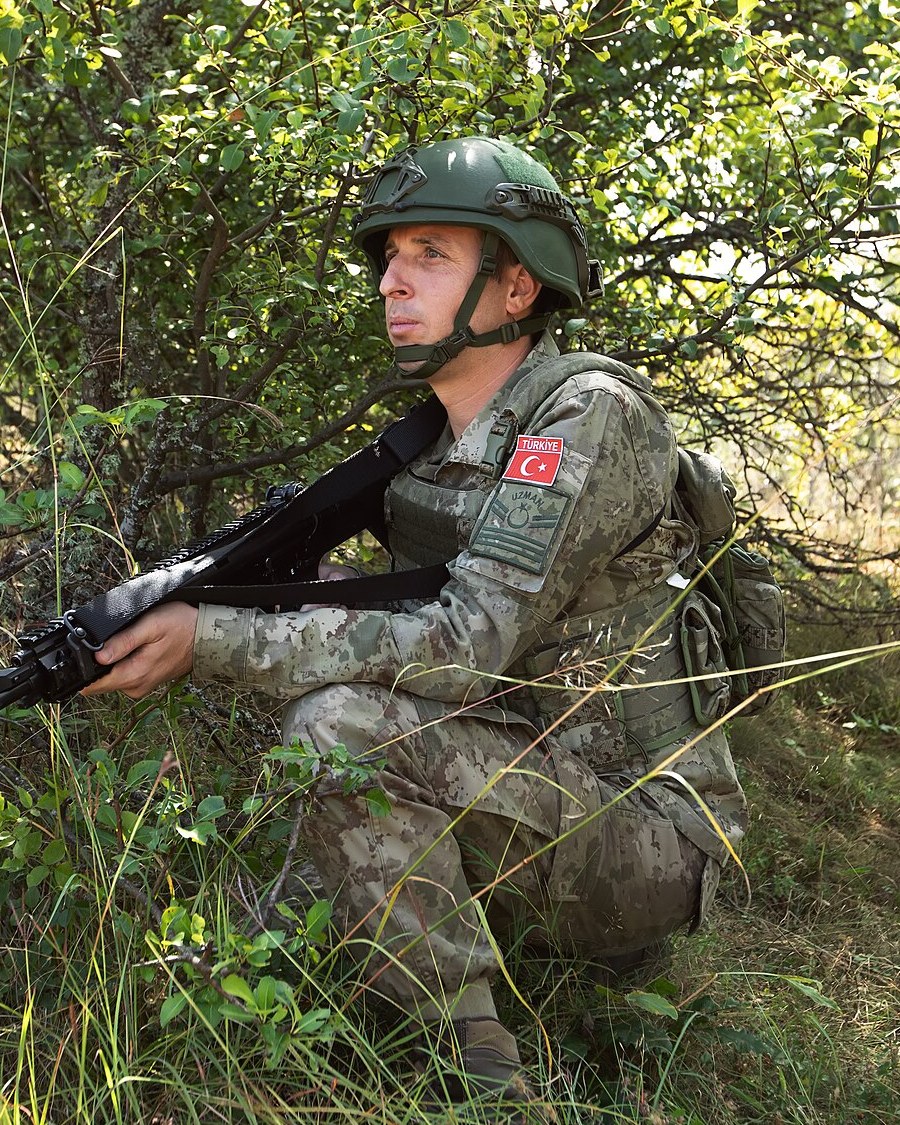
The national design announced in early 2021, recorded as the M2021 and intended for the Land Forces before the other branches, keeps the nano’s khaki-tan base and its olive and brown families of colour. What changed is the grammar of the shapes. Instead of leaves, blobs or a repeat, colour is mottled over the ground in concentrations of different density, so the eye never finds a repeating unit to lock onto. The uniform that carries it was approved with high-strength threads and water-repellent treatment, and Azerbaijan again adopted the pattern.
In photographs the result reads as a fine digital texture rather than a picture of foliage. That is a good description of where camouflage design has gone in the last decade: away from drawing the environment, towards imitating the optical noise of the sensors and optics that now look for a soldier.
What the Turkish sequence teaches
The same logic continues below army level. Since 2022 the mountain commando snow pattern has been replaced by a design carrying the M2021 texture, and the Gendarmerie had already gone its own way with its own M2008 version. Police special operations units passed through a black woodland phase, then a commercial pattern of the period, before adopting the M2021 texture in 2021. When a country reaches the point where several services and ministries share one visual language, the design work is finished and the procurement work has started.
For anyone studying camouflage as a subject rather than shopping for it, Turkey is a compressed case. Copying was not a failure of imagination, it was a stage: a NATO army with a conscript base got tested prints through the alliance, adapted the colours to its own soil, and built a textile industry on the back of the orders. The national pattern only arrived when that industry could print, cut and sew at scale, and when the doctrine asked for something the American prints could not deliver.
For collectors the practical consequence is variety. Two Turkish uniforms from the same depot can belong to different generations of the same idea, and dating one means reading the print structure first, the cut second and the label last. The pink woodland is the easiest trap: it looks like a faded American woodland until the label and the spacing of the shapes say otherwise.
The American lineage that Turkey copied for so long is covered in our history of the frog skin pattern and in our study of the ERDL leaf pattern. Related woodland and brush-stroke families are gathered in the DPM camouflage category and across the MegaCamo shop, where garments are made to order in the pattern you choose.
