
Camouflage History
ERDL: The 1948 Leaf Pattern That Became America’s Camouflage DNA
The most influential American camouflage pattern was born in 1948, waited almost twenty years for a war, and is now almost forgotten by name, even though the line of American woodland patterns descends from it. ERDL, the “Leaf pattern”, was designed by the US Army’s Engineer Research & Development Laboratories. Vietnam gave it a career, M81 Woodland gave it a legacy, and many of the leaf-style patterns of Asia trace their roots to it. This is the story of the pattern that became America’s camouflage DNA.
Introduction: the grandfather pattern
Ask most people to name the classic American camouflage and they will say “woodland”, the green, brown, black and tan pattern of the M81 Battle Dress Uniform that defined the US military from 1981 into the 2000s. Almost nobody knows the name of the pattern that came before it and made it possible: ERDL.

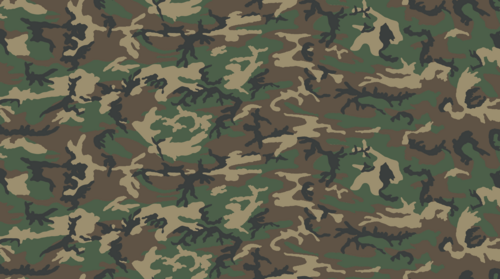
ERDL stands for the US Army’s Engineer Research & Development Laboratories, the organisation that developed the design in 1948. The pattern is also known, fittingly, as the Leaf pattern. It consists of four colours printed in an interlocking layout: large organic shapes in olive green and brown, black “branches”, and lighter leaf-shaped highlights. It was the first American camouflage designed for temperate environments, and for nearly two decades, the US Army did nothing with it.
1948: designed, then shelved
The pattern was developed under the laboratory’s Chief of Camouflage, Adolph H. Humphreys, with chief designer John Hopkins. (Contemporary references describe Humphreys as a captain at the time of the early work; the Army’s own research magazine documented the laboratory’s camouflage work through the 1960s.) The date, 1948, matters: it makes ERDL one of the oldest continuously influential camouflage designs in the world, a contemporary of the French lizard and the early Soviet leaf experiments.
But the US Army of the late 1940s and 1950s was not interested in camouflage uniforms. American ground forces wore plain olive drab through the Korean War and into Vietnam. The ERDL pattern sat in the files for almost two decades. Controlled trials did take place before the war, including with ARVN Ranger units and US Army test programmes in the early 1960s, but none led to general issue. The pattern waited for the right war.
Vietnam: a pattern finally finds its war
The right war turned out to be Vietnam. In early 1967, the ERDL pattern began to be issued to elite reconnaissance and special operations units, the first US troops to wear American camouflage in the jungle war. The pattern’s four colours proved well suited to the varied vegetation of Southeast Asia, and its use spread rapidly:
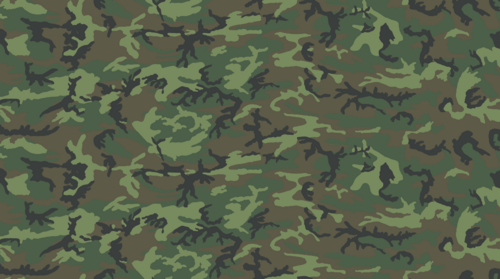
- The US Marine Corps adopted the green-dominant version as standard issue in South Vietnam in 1968.
- The US Army introduced it on a wide scale in Southeast Asia.
- The ERDL combat uniform was identical in cut to the standard OG-107 “jungle fatigues” it was issued alongside; Marines routinely mixed ERDL jackets with olive-drab trousers, officially tolerated because of periodic shortages.
- Australian and New Zealand SAS personnel were issued US-spec tropical combat uniforms in ERDL during their Vietnam tours.
- The pattern appeared on aviation garments too: USAF K-2B flying coveralls (1967–1969, replaced by Nomex in 1970) and US Navy coveralls in MIL-C-5390G.
- Commercial and local-tailor copies flourished, including “sterile” ERDL garments with no labels, made for classified missions.

By the end of the war, camouflage combat dress was the norm for US troops in Vietnam.
Two technical details are worth noting. First, early production suffered from roller slippage, which produced inconsistent prints, a common problem of 1960s textile printing. Second, there were two main colourways: the initial green-dominant version (olive and brown shapes, black branches, light green highlights) and the brown-dominant version introduced shortly after fielding, in which the light green was replaced by light tan. Collectors today distinguish them as “lowland” (green) and “highland” (brown) ERDL.
After Vietnam: experiments, leftovers, and a slow goodbye
When the United States withdrew from South Vietnam in 1973, the Army ceased routine issue of camouflage clothing, ERDL became a pattern in search of a mission again. A few threads kept it alive:
- From January 1973 to 1974, the 1st Battalion, 13th Infantry Regiment wore ERDL as an experiment in Baumholder, West Germany.
- In 1976, the Marine Corps obtained leftover Vietnam-era ERDL uniforms and made them general issue, replacing the solid OG-107 sateen utility uniform.
- The pattern was issued to the Rapid Deployment Force for tropical missions; photographs from the 1979 Iranian hostage crisis show US Marines guarding the embassy in Tehran wearing ERDL uniforms as they were taken hostage.

The ERDL era ended officially in 1981, when the Army introduced the M81 Battle Dress Uniform in a four-colour woodland pattern, an enlarged, slightly altered version of the ERDL design, for all branches of the US military. ERDL uniforms nonetheless remained in service into the 1990s: they were seen during the 1989 invasion of Panama and during US peacekeeping operations in Africa in 1996.
The worldwide leaf family
Because ERDL was printed in many countries, copied by local manufacturers, and exported through the grey markets of the Cold War, the “leaf pattern” became a global family. Documented users and derivatives include:
- Czech Republic the vz.95 woodland is a modified ERDL derivative, still in service today.
- Spain tested by special operations companies from 1982, the ERDL-influenced design became the standard Spanish Armed Forces uniform in 1985/86.
- Singapore a local “leaf” version, the No. 4 Uniform, used from the early 1980s.
- Taiwan, Thailand, the Philippines each fielded local leaf patterns; Philippine Special Action Force and Scout Rangers used ERDL variants into the 1980s.
- South Vietnam and Vietnam the ARVN wore regular and “invisible” ERDL-type patterns; the PAVN later used clones.
- South Africa used by Hunter Group and 32 Battalion commandos.
- Syria clones made for the Syrian military; ERDL variants have been photographed in the Syrian civil war.
- North and South Korea North Korean units photographed in ERDL-style patterns in 2012; clones made for the South Korean air force.
- Afghanistan formerly used by Afghan National Army commando and special forces units.
- Nicaragua, Panama, Turkey ERDL variants used by the National Guard, the Panama Defense Forces (seen during the 1989 invasion), and Turkish forces in the late 1980s/early 1990s.
- Non-state actors including the Karen National Liberation Army and the Khmer People’s National Liberation Front (which used Thai-made ERDL in the 1980s).
Some of these entries rest on single references or photographs; treat the list as a map of the family rather than a complete verified register.

Myths and clarifications
“M81 Woodland was a new design.” No. M81 Woodland is an enlarged and slightly altered ERDL, same DNA, bigger shapes, more contrast. The 1981 uniform was the culmination of a design lineage that began in 1948.
“ERDL was used in Korea.” No documented use; the pattern saw no general issue from 1948 to 1967.
“The ‘leaf pattern’ name means it was inspired by the French lizard.” The leaf shapes are a genuine parallel development of the same period (1948), not a copy of the lizard (1947-53 French era), the two families developed independently and converge visually. Some Asian “leaf” patterns, however, are direct copies of ERDL.
“ERDL was a failure because it was shelved.” It was shelved for doctrinal reasons, not performance reasons. When finally issued, it worked, and it dominated American camouflage for the next thirty years through its descendant, Woodland.

Why ERDL still matters
ERDL matters for three reasons.
First, it is the missing link of American camouflage. The lineage runs in a single clear line from ERDL to M81 Woodland, an enlarged, slightly altered ERDL, and on into the woodland-style prints that followed it. Understanding ERDL is understanding where the American woodland look came from.
Second, it is a lesson in how camouflage actually gets adopted. The best pattern in the drawer does not guarantee adoption; wars, budgets and doctrine decide. ERDL waited nineteen years for Vietnam, then was phased out, then came back through the back door in 1976, then became the basis of the M81, a bureaucratic epic as much as a design story.

Third, it shows how far one design can travel. A 1948 laboratory pattern ended up on the backs of commandos in Singapore, border guards in Korea, special forces in Spain and rebel armies in Myanmar. Few designs in camouflage history have travelled as far from their original desk.
Explore ERDL and leaf-pattern gear on MegaCamo
MegaCamo’s Worldwide ERDL Variants collection brings the leaf-pattern family to modern apparel, made to order, while the United States country page gathers the wider American range, from ERDL descendants to AOR and UCP.
