
Camouflage History
Flecktarn: The German Spot Pattern That Took 14 Years to Win
Germany’s most famous camouflage pattern nearly never happened. In 1976 the Bundeswehr tested a family of spot patterns and found one, “Flecktarn B”, to be the most effective for Central European terrain. Then it kept its old green uniform for another fourteen years, while the pattern quietly leaked abroad: the Belgian Air Force wore it before the Bundeswehr did, and the Dutch Army tested it, hated the political optics, and scrapped it. When Germany finally adopted Flecktarn in the early 1990s, it became one of the most copied camouflage designs in the world. This is the story of the pattern, its uncomfortable lineage, its worldwide derivatives, and its imminent replacement.
Introduction: the spots that work
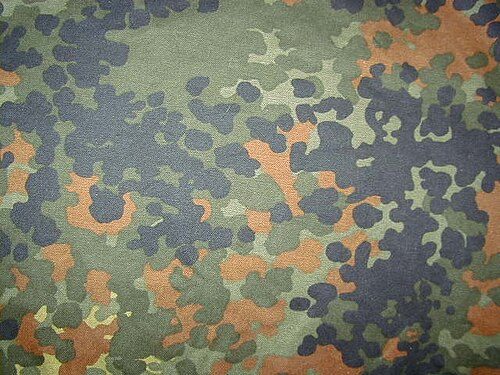
Flecktarn, from the German Fleck (spot, blotch) and Tarnung (camouflage), is a family of three-, four-, five- and six-colour disruptive patterns, the best-known being the five-colour woodland version: dark green, grey-green, reddish brown and black spots over a light green or tan base. At first glance the design looks almost chaotic, a dense field of small overlapping blobs. That apparent chaos is the point: where large-shape patterns (like woodland-style designs) work at long range, small-scale spot patterns blend into the texture of leaves, shadow and undergrowth at the medium and close ranges where much of European forest combat happens. German-speaking users sometimes joke that Flecktarn works because it looks like nothing at all, and that is precisely why it works.
The uncomfortable lineage: from the Waffen-SS to the Bundeswehr
Flecktarn’s family tree goes back to the Second World War, and to a part of the German military that post-war Germany has never been comfortable celebrating. The dot-pattern principle on which Flecktarn is directly based was developed by Johann Georg Otto Schick, director of the Waffen-SS “T” (Tarnung, camouflage) department. His 1936 Platanenmuster (plane-tree pattern) is generally considered the origin of the Flecktarn family, and it was followed through the war by related designs: Rauchtarnmuster, Palmenmuster, Eichenlaubmuster (oak leaf) and Erbsenmuster (the famous “pea dot” of the later Waffen-SS). The Waffen-SS were among the first forces in the world to issue camouflage on a mass scale, an innovation that carried a heavy historical freight.
The Bundeswehr’s first brush with that heritage came early: between 1955 and 1956, the Bundeswehr and the Belgian Army briefly used a version of the wartime Leibermuster, possibly with the idea of a common pattern for the proposed European Defence Community. The EDC collapsed and so did the common-pattern plan. For two decades, the Bundeswehr’s combat dress was plain olive-grey “moleskin”.
Truppenversuch 76: the trials that produced Flecktarn B
In 1976, the Bundeswehr finally decided to look for a camouflage uniform. That year it developed a number of prototype patterns, trialled in the Bundeswehr Truppenversuch 76 (“Bundeswehr troop trial 76”). At least four distinct designs were tested, all based on patterns found in nature: one was called “Dots” or “Points” (Punktmuster), another “Ragged Leaf” or “Saw Tooth” (Sägezahnmuster), another was based on pine needles in winter. Among the spot designs, one variant, Flecktarn B, which bore a resemblance to the wartime Platanenmuster and Erbsenmuster, proved the most effective for Central European terrain. The designs are credited to the German company Marquardt & Schulz.

Then the Bundeswehr did something surprising: nothing. It kept its green combat dress throughout the 1980s while trials continued and the design was refined. The reasons were a mixture of caution, cost and politics, a new German army was in no hurry to issue a pattern that reminded observers of the Waffen-SS.

The Dutch drama: Stippel and the optics of spots
The political problem surfaced most visibly in the Netherlands. In 1985, the Dutch government tested Flecktarn B with soldiers of its 13th Armoured Brigade at Oirschot, under the local name “Stippel” (speckle). The test went badly in public relations terms: the media attacked the pattern for its perceived similarity to the Waffen-SS Erbsenmuster and Eichenlaubmuster, and some testers complained of a “double vision” effect when staring at the dense dot pattern. The Dutch government scrapped the plan completely in 1987.
The episode says a lot about how the past weighed on the design. The pattern’s effectiveness was not really in question; its genealogy was.
Adoption at last: 1989–1990
German adoption followed a more discreet path. Camopedia records that a further Bundeswehr trial in 1989 confirmed the pattern’s effectiveness and that it was introduced as the standard combat pattern that year, with implementation actually having begun a few years earlier. General-reference sources date the wide introduction to 1990, in a newly reunited Germany, with the new pattern quickly phasing out the old green dress. The official designation is 5 Farben-Tarndruck der Bundeswehr the five-colour camouflage print of the Bundeswehr. Since then Flecktarn has been worn by all Bundeswehr service branches: the Army (Heer), the Air Force (Luftwaffe), some Navy (Marine) units, and even the medical service.
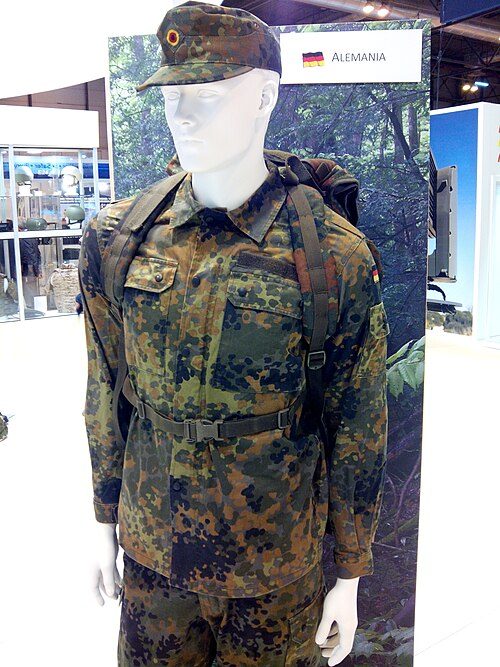
Two dating points are worth keeping straight: 1989 (trials confirmed, introduction begun) and 1990 (general issue). Specialist sources differ on the emphasis; the safe formulation is “adopted at the turn of the 1990s”.
The pattern and its evolution
Flecktarn is printed in five colours: dark green, grey-green, red-brown and black, on a light green or tan base depending on the manufacturer. The Bundeswehr’s technical specifications (managed by the BAAINBw procurement office) have been revised several times, the pattern is now in its fifth iteration. The most visible change came from around 2005: the colour screens became more separated, making the overall pattern brighter, the brown shifted toward rust, and the black screen gained sharper contrast. Older pre-2005 Flecktarn is noticeably darker and “closer” in hue.

Tropentarn, Wüstentarn and the desert family
Flecktarn has two main desert relatives, and the terminology is a genuine source of confusion even among specialists.
- Tropentarn is the five-colour Flecktarn printed on lighter-weight fabric with brighter colours for hot-weather climates. The name means “tropical camouflage”. Work on a tropical variant began in 1993, prompted by the planned deployment to Somalia, and the pattern was subsequently worn in Afghanistan and other arid deployments. Camopedia’s history notes that the desert pattern remained in trials until 1998–1999 before the first series production.
- Wüstentarn is the three-colour desert variant (the name means “desert camouflage”). Non-German sources frequently use “Tropentarn” for both, which is inaccurate.

Derivatives: the most copied European pattern of its generation
Flecktarn has spawned an enormous family of derivatives and copies:
- Belgium. The Belgian Air Force used the Bundeswehr pattern for its airbase security and anti-aircraft units from 1988 to 2000, notably, almost three years before the Bundeswehr itself introduced it. The Belgian version was slightly larger in scale than the eventual Bundeswehr production pattern.
- Denmark. The Danish M84 (T/78 and M/84 family) is a flecktarn-derived design in use since 1984, again predating the Bundeswehr’s own issue.
- Japan. The Japan Ground Self-Defense Force adopted a four-colour flecktarn-based pattern (Type II, commonly called Jietai) with light green, brown and black on a beige background; specialist references date the adoption to 1985, with a desert version also in service.
- China. The PLA’s Type 03 Plateau pattern, nicknamed “Tibetarn” or “Tibet Flecktarn” by collectors, is a five-colour flecktarn-style design used in Tibet in the early 2000s, with sand, grey, light-brown, mid-brown and black. It was replaced by the four-colour digital 07 Arid pattern in 2007.
- Poland. Polish counter-terrorist police (SPAP) use a five-colour variant called WZ AT 1 Plamiak (also “Metro”), notable for its regular short-interval repeat; the Polish Internal Security Agency (ABW) uses a woodland variant called Gepard.
- Russia. Russian forces and security units use several flecktarn-derived commercial patterns, including Sever (“north”) / Flectar-D, a three-colour pattern introduced around 2006 and close to the Danish M84 but on a tan base, and a “Tibet”-style pattern produced for Russian special forces by the firm SPLAV.

The list illustrates a remarkable fact: several allied and neutral armies were wearing flecktarn-derived patterns before Germany’s own army was.
The myth of the French origin
A claim circulating on forums and some reference sites holds that Flecktarn was derived from a French design, specifically from experimental “spot” patterns developed by the French textile firm Texunion in 1981 and 1983, which the French Army rejected and which allegedly formed the basis of the German pattern. This claim is not supported by the German-side documentation: Flecktarn’s German genealogy runs directly from the Waffen-SS dot patterns through the 1976 Bundeswehr trials and the Marquardt & Schulz designs, all of which predate the Texunion experiments. The Texunion story appears in Camopedia’s France page as a reported claim; it is not corroborated by any German procurement or design source located for this article. Treat it as an unverified story.
Multitarn: the end of the road (2026–2029)
After more than three decades of service, Flecktarn is being replaced. The Bundeswehr developed a new multi-terrain pattern, Multitarn (also written MultiTarn), researched from around 2012 under the supervision of the WIWeB (the Bundeswehr’s material research institute), and announced around 2015. Initially issued to special forces (KSK), the pattern was planned for wider use; unlike Flecktarn, the Bundeswehr has taken strict measures to control its production rights and distribution. According to current reporting, Flecktarn will be fully replaced by Multitarn within a four-year period from 2026 to 2029. The exact rollout dates remain to be confirmed as the transition proceeds.
Why Flecktarn still matters
Flecktarn’s story matters for three reasons beyond the pattern itself.
First, it is a lesson in slow procurement. The best pattern in a 1976 trial took fourteen years to reach German soldiers, blocked by caution, cost and the politics of optics, while other countries adopted the same design first. Good equipment does not always win the fastest.
Second, it shows how history attaches to design. A pattern cannot be judged purely on its merits; the Waffen-SS lineage made Flecktarn politically radioactive for years, and the Dutch “Stippel” episode is a textbook case of a design defeated by its associations rather than its performance.
Third, it is a design that aged well. Thirty-five years after adoption, Flecktarn is still regarded by many specialists as one of the most effective temperate-woodland patterns ever issued, and its derivatives span four continents. The spots, it turns out, were worth the wait.
Explore Flecktarn gear on MegaCamo
MegaCamo carries a dedicated German camouflage range, made to order, including:
- German Flecktarn collection the classic five-colour woodland pattern
- German Tropentarn collection the hot-climate five-colour variant
- German Schneetarn collection the winter/snow pattern
- Germany country page the full German range, including the extensive WWII collection
