
Camouflage History
Frog Skin and Duck Hunter: America’s First Camouflage Combat Uniforms (1942)
In 1942 the United States put a printed camouflage combat uniform into mass production for the first time. It was a reversible garment in cotton herringbone twill, printed with drifting clouds of green and brown shapes on one side and brown shapes on a pale tan ground on the other, so that the same uniform could be turned inside out when the wearer moved from jungle to beach. The Army called it a spot pattern. Marines wore it in the Pacific, French paratroopers wore it in Indochina, and American hunters were still buying it from mail-order catalogues twenty years later under a name borrowed from waterfowl shooting: duck hunter.
That double life is why the pattern is so badly understood today. This is an identification article: what the 1942 pattern was, what the record does and does not support about its service, and how later commercial versions and foreign copies differ from wartime cloth.
Two names, one cloth
The first confusion is linguistic. Frog skin and duck hunter describe the same family of prints, and collectors add spot, duck hunter spot and M1942 spot pattern to the pile. The nickname frog skin comes from the pattern’s resemblance to a frog’s mottled, cryptic skin. Camopedia takes the opposite route in its glossary of American designs, defining duck hunter first as “a camouflage pattern having large, irregular spots or blobs in several contrasting colors printed over a solid, usually lighter background color”, then tracing that term back to the same wartime American pattern.
Both references agree on the origin of the design. Norvell Gillespie, a civilian horticulturist who worked as a garden editor for Sunset, Better Homes & Gardens and the San Francisco Chronicle, is credited with drawing it. Wikipedia states the pattern was designed by Gillespie at the request of the US military, and Camopedia describes “the original ‘duck hunter’ camouflage” as designed by the same horticulturist and printed in a green-dominant and a tan-dominant version. The credit is consistent across reference and collector literature, though it rests on secondary sources rather than on a design contract.
The name M1942 spot pattern belongs to the Army’s designation of the material and the garments cut from it. It sits alongside the Marine Corps designations collectors now use, P42 and P44, for marine utility uniforms of the same period. Those names describe garments and contracts rather than two visibly different prints. As the specialist blog At The Front argues in its analysis of surviving frog skin garments, the wartime pattern appears to have been printed on a single “Army pattern” cloth in what was probably a single production run, which makes the tonal differences visible between surviving examples a matter of dye lots and printing rather than a marker of service, theatre or year.
What the pattern actually is
The pattern is a two-sided print, not a two-pattern system, and that is the detail most often lost in modern retellings. Wikipedia’s description distinguishes two colourways produced from the same design: a five-colour version of green and brown shapes on a pale green base, intended for wooded and jungle country, and a three-colour version of brown shapes on a pale tan base, intended for beaches and other plant-bare ground. Both were printed on cotton herringbone twill, the tough twilled cloth universally abbreviated HBT, and the Marine Corps utilities were built reversible, jungle colourway on one face, beach colourway on the other, so the wearer could show either as the ground changed.
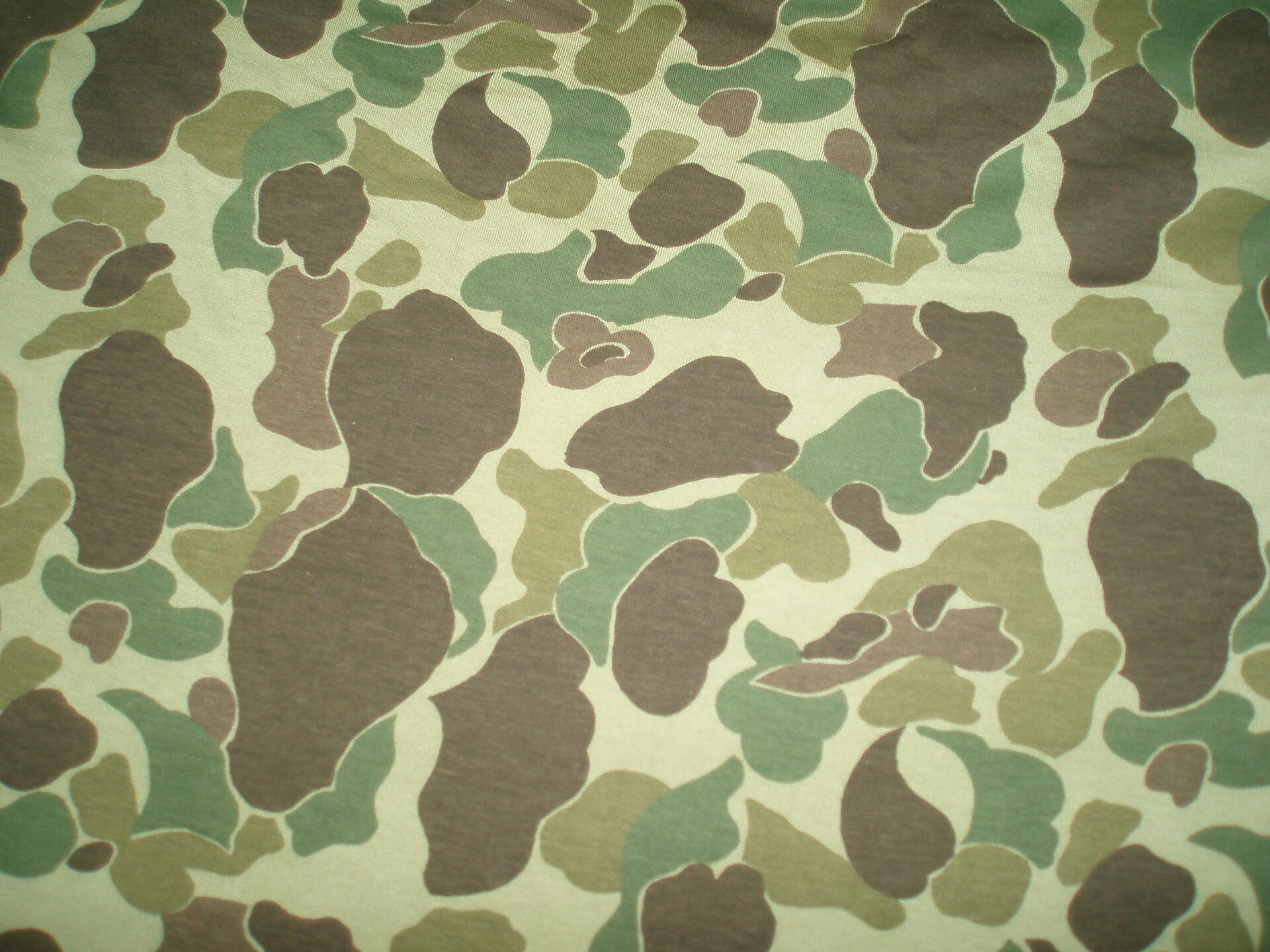
The shape language makes the family recognisable: large, soft-edged, irregular blobs, closer to inkblots or leaf shadows than to the angular geometry of later patterns, with strong contrast between the darkest shapes and the pale ground. It is a disruptive mottle intended to break up a man’s outline, not to imitate a specific plant.
The 1940 experiment that came before
Any article that calls frog skin “America’s first camouflage” has to state its perimeter, because the claim is only true of one thing. What was new in 1942 was the mass production and general issue of a printed camouflage combat uniform. What was not new was camouflage itself.
The Eastman Leather archive entry on the frog skin pattern, still readable through the Internet Archive, is the source usually cited for the point, and Wikipedia relies on it: the first American attempt at a printed camouflage uniform came in 1940, when the US Army Corps of Engineers began experimenting with a disruptive-patterned overall. That garment was tested and never issued. Wikipedia’s history section dates the wider Army experimentation to 1940–1941, citing Stanton’s reference work on US Army uniforms.
So the honest formulation is narrow: frog skin was the first printed camouflage combat uniform to be mass-produced and issued to American troops in quantity. Earlier painted, dyed and experimental work, including the 1940 overall, sits outside that claim, and no published document shows the 1940 experiment reaching production.

1942: the first issue
Wikipedia records that the US Army began experimenting with camouflage in 1940–1941, that the frog skin pattern was designed by Gillespie at the military’s request, and that 150,000 uniforms in the pattern were ordered, a figure sourced to the military-interest publication Coffee or Die rather than to a procurement record, so it should be read as a reported order quantity rather than an audited production total. In 1942, according to the same article, the Marine Raiders were the first unit issued a frog skin pattern uniform, and they used it in the Pacific theatre.
The Raiders usually open the story, and the photographic record supports the association: Marine Corps training photographs from the early war years show raiders negotiating obstacle courses in the patterned utilities. The Army’s own introduction ran on a parallel track, and the two 1942 Signal Corps photographs of the 25th Infantry Division’s problems show a uniform still being explained to its own users: the new camouflage worn in front of an audience of soldiers, and a soldier crouching in vegetation to demonstrate that the pattern breaks up his shape. Only the second of the two photographs carries a location in its archive record, which places Private Ziolo’s concealment demonstration with the division’s problems in Hawaii. Both captions stop short of naming a pattern designation, a reminder that contemporary captions are not identification keys.

The Pacific war the pattern was designed for
Frog skin’s Pacific service record is broader than the Raiders’ first issue. Wikipedia notes that the uniform was worn by marines in campaigns beyond that debut, naming the Battle of Tarawa, and the photographic record runs from a Marine Corps training course in the early war years and a Navajo signals detachment in the Southwest Pacific in June 1943 to the fighting on Saipan in 1944. It is a record of issue and wear, and, as one of those photographs shows, not always a legible record of the print.
Wartime photographs of the Pacific are uneven witnesses, and one of them shows why. The Saipan photograph of 1944 catches its subject low in the frame and from behind; its archival description identifies the man as a marine clad in a camouflage suit, but the frame itself does not resolve the print. What the picture documents is the setting and the posture, jungle, a man crouched against sniper fire, not the pattern. A June 1943 photograph of three Navajo soldiers attached to the 1st Marine Division at the Amphibious Scout School in the Southwest Pacific is more legible: it shows the uniform in a training and intelligence setting rather than an assault landing, a useful corrective to the idea that frog skin belonged only to the beachhead.

These images also set the limit of what wartime photography can prove. They demonstrate that the pattern was issued and worn; they do not tell a modern reader which contract produced the cloth on a given man’s back. Period captions rarely name a pattern; archival descriptions describe the action, not the uniform.
The European detour
Frog skin’s second theatre is the odd chapter, and the one that produced the most enduring story. Wikipedia records that in the summer of 1944 certain Army infantry units in the European Theater of Operations were issued the uniform, giving the 41st Armored Infantry Regiment of the 2nd Armored Division as the example. The Commons description of that photograph, credited to the US Army and dated to July 1944, identifies the man as a private of that same regiment heating rations on a stove, and notes that he is wearing two-piece HBT camouflage which was used by marines in the Pacific but was quickly abandoned in Europe.

That much is well attested. What is not well attested is the reason. The most repeated version holds that American troops in camouflage were mistaken for German troops, usually Waffen-SS or paratroopers, and fired on by other American units. The Wikipedia article does not state that; it notes only the summer 1944 issue in Europe, and among its external links it carries a documentary video titled “Normandy Myth Busters – Were American Troops wearing Camo HBT mistaken for the SS?”, itself a signal that the claim is debated.
This article therefore treats the friendly-fire explanation as a circulating account rather than an established fact. What the sources support is narrower and more useful for identification: the two-piece HBT camouflage was issued in small quantity in Normandy in July 1944, it was worn by the 41st Armored Infantry Regiment among others, and it appears to have been dropped in that theatre very quickly. Whether misidentification, a judgement that the pattern suited nothing in bocage country, or a supply decision produced the withdrawal is not resolvable from the surviving evidence.
Withdrawal, “limited standard”, and the surplus channel
The end of the pattern’s American service life is also where the sources disagree about dates. Wikipedia states that by January 1944 production of the pattern was stopped, and that the uniforms were later sold as military surplus. At The Front’s analysis of surviving garments, by contrast, describes the material as having been declared “limited standard” in September 1943, with a single probable production run printed on one Army pattern cloth. The two are compatible if declaration and early-1944 end of production are read as two moments in one retreat, but they are not the same date.
That withdrawal is the reason the pattern has two names. Uniforms the military no longer wanted entered the civilian market as surplus, and the men who bought them used them the way they had used them in service, outdoors, for hunting. Wikipedia ties the nickname directly to that flow: surplus uniforms became popular among hunters, which produced the common alternative name duck hunter camo. Camopedia dates the commercial exploitation of the design to the late 1950s, when American companies began responding to demand for specialised hunting clothing by turning to the camouflage design adopted by the US armed forces during the Second World War, and names catalogue houses and outdoor manufacturers, Sears and Roebuck among the retailers, and makers such as Kamo, Ranger and Western Auto Supply, as producers of civilian versions through the 1960s and 1970s.
Camopedia is equally clear about how loose that commercial relationship was. Most of the commercially sold designs were, in its words, only loosely based on the original frog skin drawings, and were certainly recoloured and printed on lighter-weight fabrics. That sentence is the most important identification rule in this article: by the mid-1960s the name duck hunter, the shapes of the print and the cloth underneath them had already come apart from each other, and a modern commercial duck hunter print can descend from the wartime pattern in outline only.
Korea and the lives after
The pattern’s American afterlife was modest but real. Wikipedia records that the Marine Corps revived frog skin during the Korean War for limited use as helmet covers, and the photographic record from Inchon in September 1950 shows marines going ashore with the print visible on those helmet covers rather than on their jackets, which appear plain, including First Lieutenant Baldomero Lopez leading a platoon over the seawall on the northern side of Red Beach.
What such photographs do not settle is whether the uniforms at Inchon were wartime stocks drawn from stores, new production to an old pattern, or a mixture. A garment worn in 1950 cannot be dated by the campaign it appears in; photographs establish that a pattern was worn, not when its cloth was printed.
Clones, copies and lookalikes
Frog skin’s most complicated legacy is geographic. Because the pattern was printed in quantity, exported as surplus and easy to copy, versions of it appear across four decades and at least a dozen countries, and they are not all the same thing. Three categories need keeping apart: wartime American cloth, early foreign production based directly on the American pattern, and later national patterns recognisably of the duck hunter family without being copies of the 1942 print.
Camopedia’s Duck hunter entry is the most compact inventory. It records early US M1942 copies produced by the Netherlands for commando units; Indonesia, formerly a Dutch colony, reproducing the green side in the 1960s and 1970s; South Korea adopting a duck hunter pattern in the 1960s that remains in use at some military academies; that Turkey produced what it calls the “Aegean” spot pattern; that Mexico fielded army duck hunter camouflage from the 1970s; that Colombia produced a copy from the 1970s through the 1990s; that crude Chinese copies can be dated as far back as the 1970s; and that Honduras produced its own. It also notes Iranian spot patterns derived from the duck hunter concept and observes, with appropriate caution, that the current Australian pattern, DPCU, can be counted in the family without having been copied directly from the original design.
Wikipedia’s users list overlaps and extends that inventory: Indonesian Brimob forces wearing copies based on the American pattern from 1965, with original 1942 uniforms used by airborne troops from the mid-1950s; Colombia’s national army using the pattern from 1960 to 1990; Iranian copies marketed as Panther; three-colour Spanish use in 1970, mostly for ponchos, helmet covers and field equipment; Turkish clones first seen in the 1970s; Mexican copies; Philippine Scout Ranger use; and French issue to the 1st and 2nd Foreign Parachute Regiments in the First Indochina War. The same article records two war-specific issues: Cuban exiles of Brigade 2506 received frog skin from the CIA for the Bay of Pigs invasion in 1961, and during the Vietnam War US Special Forces issued frog skin to Montagnard fighters, with Navy SEALs and Rangers also using it before other camouflage became available. Biafra acquired frog skin uniforms in 1968, and Brazilian troops wear a version known as camuflagem bolinhas.

The Dutch photograph deserves a specific caution, because it is the kind of image that invites over-claiming. Its archival record describes a paratrooper of the Korps Speciale Troepen during the second police action in Indonesia in December 1948, and Commons files it in the frog skin category, but the description does not say which pattern the uniform is, which country made it, or whether it is American wartime stock or a Dutch copy of it, even though Camopedia records Dutch production of early copies for commando units. Reading that photograph as proof that Dutch troops wore American-made frog skin in Indonesia would be an inference, not a documented fact.
How to read a duck hunter garment
For anyone trying to place a garment, the evidence supports a short list of distinctions rather than a test.
- The pattern itself is a two-sided print: a jungle colourway on one face, a beach colourway on the other, on heavy cotton herringbone twill, with the reversible construction carried through in how the garment is cut and finished.
- Tone is not a date. At The Front argues the pattern was printed on one Army pattern cloth in probably a single production run, so the darker and lighter base tones seen across surviving examples reflect printing and dye variation, not separate wartime patterns, theatres or years.
- Commercial versions are not wartime cloth. Camopedia records that most commercially sold duck hunter designs were only loosely based on the original drawings, recoloured and printed on lighter-weight fabrics from the late 1950s onward.
- Foreign production is its own category. A Dutch, Indonesian, Korean, Turkish, Mexican, Colombian, Chinese, Honduran or Iranian pattern may be a close relative and a period object without being American wartime production.
Clothing and accessories in this pattern are in our catalogue: Frog Skin and Duck Hunter.
