
Camouflage History
Chocolate Chip: The Six-Colour Desert Pattern of the Gulf War
In the winter of 1990 and the spring of 1991, the most photographed soldiers on earth were wearing sand-coloured uniforms speckled with small black and off-white chips. The pattern had been in American service for about a decade and had never been anywhere near a war of that size. Then it went everywhere at once, Saudi Arabia, Kuwait, the desert tracks of the VII Corps advance, and was retired almost as quickly as it had been celebrated.
Its official name is Six-Color Desert Pattern. Almost nobody uses it. In surplus shops, in collector listings and in most of the photographs floating around the internet, it is chocolate chip. In the United States it is also called cookie dough. The nicknames are older than the fame and are not official designations, which matters more than it sounds: when a pattern is known by what it looks like rather than by what it is called, its copies inherit the nickname long before anyone compares the cloth.
That is the story this article follows: not a catalogue entry for a uniform, but a lineage, what the American six-colour desert pattern is, where it came from, who wore it, and why the desert patterns of other countries keep being confused with it.
What the six colours actually are
The pattern is a six-colour disruption print on a sand-coloured ground. Pale green and two tones of brown break up that ground, and the elements that give the pattern its nickname are clusters of small, hard-edged spots in black and off-white, scattered across the cloth like pebbles, or, depending on your appetite, chocolate chips in cookie dough. The American reference literature describes those clusters as an attempt to imitate the appearance of stones and their shadows.
Those two spotting colours do most of the perceptual work. At a distance the tans and browns merge into a flat desert tone while the black and off-white chips stay legible as texture, exactly the effect a disruptive pattern seeks against gravel, broken rock and scrub.

What the six colours are, officially, is harder than it looks The cloth of the American desert uniform is covered by a documented material specification, MIL-C-44034, Cloth, Twill, Camouflage Pattern, Cotton and Nylon for Desert Uniform; but no published source prints a canonical enumeration of six named shades.
Not every desert pattern is a chocolate chip
The quickest way to get this pattern wrong is to assume that “desert camouflage” is one thing. It is not, and the confusion is structural rather than careless:
- A three-colour desert pattern, the American DCU family that followed, has no pale green and no off-white chips. It reads as flatter and lighter.
- British-lineage desert DPM is built from the same brushstroke logic as temperate DPM, with different colours and a different geometry. Photographs of Egyptian officers in the field are as likely to show something of that lineage as anything local.
- Single-tone and three-tone desert schemes on vehicles have no printed pattern at all at the scale of a jacket, and modern “universal” patterns have spent thirty years flattening distinct desert designs into similar tan-and-brown averages.
Two published photographs make the point: one shows a Saudi Arabian Humvee in plain and three-tone desert paint, the other an Egyptian officer in a British-derived desert pattern. Both show why “desert camouflage” is a family, not an identification.
From the leaf pattern to the desert trials
The six-colour desert pattern belongs to a family of American disruption prints that begins before the Second World War ended and runs through the Vietnam era. The reference point for that lineage is the 1948 ERDL leaf pattern: interlocking shapes, a light base, and dark contrast elements that carry the eye. Generations of American camouflage, desert versions included, work in that vocabulary. That is a design lineage, not a repeat identity, the six-colour pattern is not the leaf pattern recoloured, and no published source claims it is.
What is documented is a long, slow development, and the sources do not agree on a date: one library record cited by the encyclopaedic account uses 1970, Camopedia dates it to 1971, and a 1979 technical report on camouflage pattern size and colour refers back to reflectance and drawing work from as early as 1960. The honest reading is a prehistory in the late 1950s, an industrial development around 1970-71, and a finished garment in 1981. Anyone giving you one date is choosing a source, not settling the question.
The development itself is attributed in the American record to the Camouflage Branch of the Army’s Mobility Equipment Research and Development Command (MERADCOM) at Fort Belvoir, with the textile printing work passing to the Natick Research and Development Command, an attribution that runs through the MASSTER Phase II camouflage test documentation, catalogued by the Defense Technical Information Center as AD-A029 072. That is the programme environment: a research branch, a textile laboratory and a trials programme, not a single “invention moment”. No published source names an individual designer of the repeat.

The date on that archive photograph is the kind of anchor collectors rely on, and it is worth being precise about what it proves: the pattern was on PASGT-pattern equipment at the start of 1981, the year the reference literature gives for the uniform entering service. It does not show scale, priority of issue, or which units received it first.
The first documented wearers were not ordinary line infantry. The American record ties early use to Rapid Deployment Force units, to participants in the Bright Star exercises with Egypt, and to peacekeepers of the Multinational Force and Observers in the Sinai. That corrects the idea that the pattern was invented for the Gulf: before 1990 it was a specialist deployment uniform, produced most heavily between 1981 and 1991.
The same programme context produced the Desert Night Camouflage, a completely different idea built around a grid meant to defeat night observation devices rather than to blend into gravel. The two are often discussed together because they were tested in the same period, and Soldier Systems Daily’s account, “The 6-Color And Night Desert Uniform Trials”, treats them as two halves of one trials story. They are not the same pattern, and they are not interchangeable. MegaCamo’s account of the Desert Night pattern covers it separately.
Desert Shield: the pattern’s only mass war
In August 1990, Iraq invaded Kuwait, and the United States began moving forces to Saudi Arabia under Operation Desert Shield. A replacement desert uniform was already in the pipeline. The pattern the US Army had standardised in 1990, the three-colour desert camouflage that would become familiar as the DCU, was not ready in the quantities a deployment that size required before troops were already on the ground. The consequence is the reason the six-colour pattern looks like the Gulf War: American forces deployed, fought and came home in the older, busier, six-colour print.
That sequence is documented, and worth stating carefully: the standardisation of a successor in 1990 and its unavailability for the initial deployment are both attested. What follows, that everyone in theatre wore six-colour, is a reading of the photographic record, not a claim made here. Uniforms are issued, worn out and re-ordered; theatre photographs show variation, not uniformity.
What they do show is the pattern in ordinary, unglamorous use. Photographs from the 1990-91 Gulf deployment show soldiers and Marines in Saudi Arabia wearing the six-colour print: a man carrying his gear away from a transport aircraft, another moving out with his unit, a company of Marines trying on newly issued boots, and the Commandant of the Marine Corps briefing his troops in the same cloth.


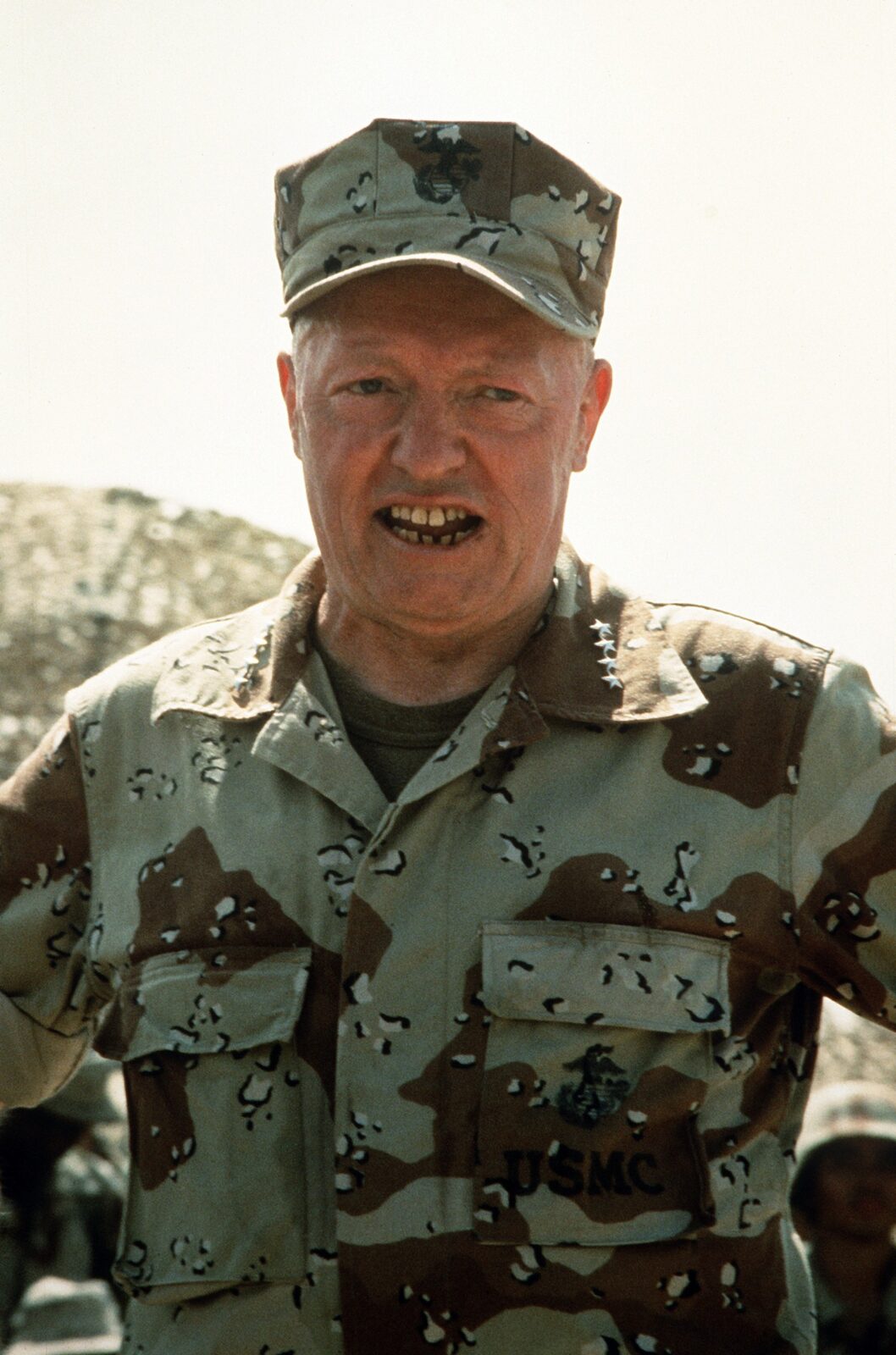
One production story is worth flagging because it is so often repeated without attribution. The encyclopaedic account, drawing on a 1996 memoir of Gulf War logistics, records that roughly half a million desert uniforms in 100 per cent cotton poplin were produced at the theatre commander’s request, for comfort in the heat, and that the practice was abandoned afterwards on cost grounds. That is a single-source figure attached to a memoir, and it is reported here as such.
What the Gulf War taught, and why the US moved to three colours
The American experience of the six-colour pattern in the Gulf was not a success story, and the sources are direct about it. Field criticism held that the pattern contrasted too strongly with the terrain it was meant to hide in, and that its dark areas absorbed heat and radiated it back at the wearer, a real problem on hot, dry ground. A British account from 2007 is among the sources recording that assessment.
The replacement followed a different method entirely. The three-colour desert camouflage that took over from 1991 to 1993 was developed from optical and infrared reflectance measurements of Middle Eastern sands and soils, followed by a series of trial patterns evaluated across desert test sites. The result was a quieter, lighter, less contrasted design, the opposite of the busy chip pattern in almost every measurable way.
The transition was not instant. In Somalia in 1992-93 both patterns appear in the same units, and six-colour helmet covers are still seen over three-colour uniforms: a pattern takes years to leave an army’s inventory, even after the decision is made.
The copies: who wears it, who prints it, who merely looks like it
The six-colour pattern did not stay American for long. Desert camouflage in the 1980s and 1990s was a global market, and a print that blended into sand and gravel was copied, adapted and printed locally wherever the equipment was sold, licensed, donated or simply observed. Sorting the resulting uniforms into three groups is the only way to keep the subject honest, and it explains why “chocolate chip” is such a slippery term.
Armies that wore the American original. The encyclopaedic list of users is long: Saudi Arabia, Kuwait, the United Arab Emirates, Jordan, Pakistan, Iran, Egypt, Somalia, Ethiopia, Eritrea, Chad, Niger, Mali and Yemen appear on it, largely through surplus, aid and purchases; the same list carries Argentina, Paraguay, Peru, El Salvador and the Dominican Republic as well, and Camopedia documents all five as users of the original US-manufactured pattern. Some are one-off uses in a single deployment, others national issue for years. The list is itself the story: a single American print became the default desert uniform of much of the world, and every army photographed in it makes the pattern look like their national design.
Armies that printed their own version of the scheme. Here the family tree grows branches, and Camopedia is the most detailed source available. South Korea produced locally made copies for troops deployed to the Gulf, to Afghanistan and on United Nations missions, and since 1993 has used a limited variant in which brown replaces black. Spain printed a copy that kept the original colour set but reduced the pattern by roughly twenty per cent, before moving to a pixelated arid design. Kazakhstan produced a variant in the early 2000s in which grey replaced the mid-browns. Saudi Arabia printed copies of the original for years, added a grey colorway for its marines, moved to a new colour variation for general issue in the early 2000s, and issued grey versions to border guards, with urban and blue variants for police. Kuwait went further: local variants include blue and grey colorways for police and marine units, a version in which barbed wire replaces the black “rock” elements, and a National Guard hybrid. Egypt’s locally made copy is dated to the early 2000s and described as based on the DBDU cloth, and the United Arab Emirates has produced several variants, including a five-colour version with no black at all.
The list continues: China printing a version for special forces from 1999; Iran issuing a copy to Revolutionary Guard commandos and also printing it on NBC suits; Iraq adopting the pattern in bulk only after 2003, partly local and partly from Asian factories; Libya with prolific production and many colour variations; Pakistan issuing a copy to special units and a colour variation to its air force; the Philippines issuing at least three colour variations to the police Special Action Force since 1995; Eritrea, Somalia and Yemen with local versions; and Rwanda with an orange colorway found in no other desert palette.
Patterns that are relatives, not copies. A third group is the most dangerous for identification, because these are not copies of the American artwork at all. Camopedia describes a Japanese hybrid, trialled and never adopted, with the explicit note that it is “not a true copy”; an Omani National Guard uniform mixing chocolate chip with an amoeba pattern; and a blue Palestine police version of the scheme. Elsewhere, South Africa’s Soldier 2000 design is described as close to the American design, proximity, not a claimed copy.
Many of these variants differ from the American original by exactly one variable: scale, browns replacing blacks, grey replacing browns, or a single colour removed from the set. On a field photograph, one variable is enough to make a national attribution uncertain, and nothing in the picture tells you which side of the line the garment falls on.
Reading a uniform, not a photograph
For collectors, the practical question is not “does this look like chocolate chip?” but “what is this item?” A few habits help, and they are heuristics rather than rules:
- Labels and contract numbers first. American clothing of this era is catalogue-numbered, and the inventory classes used for clothing, the 8415 family, are the place to look. A legible label tells you more about an item’s origin than any colour comparison.
- Construction second. The cut, the pocket layout, the fasteners and the stitching of an American combat uniform are not the same as those of a locally made desert jacket, even when the print is similar.
- Print third, and late. Compare the size and spacing of the spot elements, the shape of the brown masses, the tone of the ground, and whether black is present at all. If you cannot compare against a documented sample, say so rather than asserting an origin.
- Photographs last. A photograph tells you what a garment looked like on one day, in one light, through one camera. It is evidence of use, not proof of identity.
None of that amounts to a certificate. It is a way of ordering evidence, and it is why no pattern identification can go further than the photographer or the archive already did.
Why the confusion happens
If you spend an afternoon looking at desert camouflage photographs, three mechanisms explain almost every misidentification.
The first is family convergence. A desert palette has a narrow range to work with, sand, brown, some green, something dark, so any two dry-environment patterns share most of their colour vocabulary, and under harsh sun with dust on the cloth they are often indistinguishable. This is why the classification article on this site insists on morphology, family and lineage as separate axes: “desert” is an environment, not a pattern.
The second is nickname transfer. “Chocolate chip” describes a visual effect, dark spots on a light ground, not an artwork, so any pattern with small dark dots on sand invites the name. The same fate befell brushstroke families after the Denison smock, which is why British desert DPM and American three-colour patterns get filed under labels belonging to neither.
The third is market vocabulary, and it is the most corrosive. Surplus listings optimise for being found, not for being precise: “chocolate chip”, “six-color desert”, “desert storm camo” and “desert BDU” are used interchangeably across genuinely different items. A buyer searching for a Gulf War jacket will be shown Egyptian, Korean, Spanish and commercial prints, all carrying the American nickname, and nothing in the listing will contradict it.
There is also a chronological trap: the pattern was in service when photography became cheap and abundant, so the images that survive are numerous and casual, and a pattern better documented than its neighbours starts to look like the origin of everything else.
Where the pattern still lives
Thirty years after the US Army dropped it, the six-colour pattern has four lives.
It is surplus. Large numbers of uniforms, helmet covers, vest covers and accessories were sold off and remain common enough to be affordable, which is why locally made garments in similar prints are common too, and why market vocabulary matters.
It is still in service somewhere. Camopedia and the encyclopaedic record both note patterns in this family in wide international use in the 2010s and 2020s, from Iraq and Pakistan to Chad and the Philippines.
It is a museum object. Institutions such as the Fort Devens Museum in Massachusetts display it as one entry in the story of American camouflage, beside its predecessors and successors, in exactly the comparative setting a search engine cannot provide.
It is a reference point for the digital era. When the US Army’s later “universal” pattern failed in the field, one lesson that stuck was that a pattern optimised for everywhere usually works nowhere, MegaCamo’s account of the UCP failure covers that argument. Items in this family sit in the chocolate chip category of the MegaCamo catalogue; a shop is not a source, and nothing in it should be read as evidence about the historical pattern.
