
Camouflage History
wz. 93 Pantera: The Polish Panther That Survived Its Own Replacement
This is a camouflage about a president, a failed predecessor, and a replacement that never came. The Polish wz. 93 Pantera, the “panther”, is the standard woodland pattern of the Polish Armed Forces, and it has now outlived its own replacement. Created for an elite special forces unit, then promoted to a national uniform after President Wałęsa appeared in it at military exercises, it has outlived a rival that was meant to take its place. This is the story of the Polish camouflage that refuses to die.

What the Pantera actually is
The wz. 93 Pantera usually written simply “Pantera” (Polish for “panther”), is the standard woodland camouflage of the Polish Armed Forces. It has been in service continuously since 1993 and is still the standard today, over three decades later. The official designation “wz. 93” is the Polish military shorthand: wzór (“pattern”) plus the year of adoption.
It uses four colours shaped into soft, organic forms with no strong vertical or horizontal direction: an olive base (young grass and vegetation), dark green (dark foliage), brown (dead leaves, bark, forest litter and earth) and black (shadows and the darkest elements of a forest floor). The result is a soft, mottled woodland camouflage that works well in the Central European forests it was designed for.
One naming point, worth making clearly: the spelling “Panthera” (with an “h”) is a latinised or informal English variant. The Polish and official name is Pantera. And, importantly, the name “Puma” does not refer to this pattern. “Puma” is a different Polish camouflage, the wz. 89, which we will come to. The two are often confused because both are named after big cats.

From special forces to national uniform: the Wałęsa story
The most remarkable thing about the Pantera is how it became the uniform of a nation. It was designed for the JW GROM the Polish special forces unit, one of the most elite in Europe. It entered service in 1993; by the mid-1990s it had spread to all branches of the Polish Armed Forces. The Polish military historian Hubert Królikowski, who documented that expansion, attributes it to the President appearing in GROM’s field uniform at military exercises.
Polish President Lech Wałęsa the former shipyard leader and trade unionist who became the first President of post-communist Poland, wore the GROM pattern at military exercises on several separate occasions. The image of the head of state in this striking new pattern helped propel it from a special-forces design to the regulation camouflage of the entire army. It is one of those rare cases where the origin of a camouflage has a human story attached to it.
The predecessor it replaced: the failed Puma
Before the Pantera there was the wz. 89 Puma also called Żaba (“frog”) or “reptile” because of its elongated, reptile-like spots. It entered service in 1989 and was formally superseded in 1993 by the Pantera. Jackets in the pattern were still being produced into the mid-1990s, and the Puma stayed in service in the Polish Army until at least 1999.

The Puma was a two-colour design: dark olive-green, elongated blotches on a pale green field, which gave it its “frog” or “reptile” nickname. The shapes were larger and more varied than in the old wz. 68 Moro it replaced, but the pattern was still too small and too tight to do much good.
The Puma failed for a documented reason: it used dark colours and small, tight patterns that did not work well in the Polish forest. Its colours clashed with the woodland it was meant to hide in, and its poor infra-red signature made soldiers stand out to night-vision. Polish sources describe it as the shortest-lived camouflage print in the history of the Polish Army. The Pantera, with its softer, larger and better-tuned palette, replaced it, and it is worth noting the Puma was even passed on as a gift: some 3,000 wz. 89 combat jackets were handed to the Afghan National Army in 2008.
The desert version: PL Desert
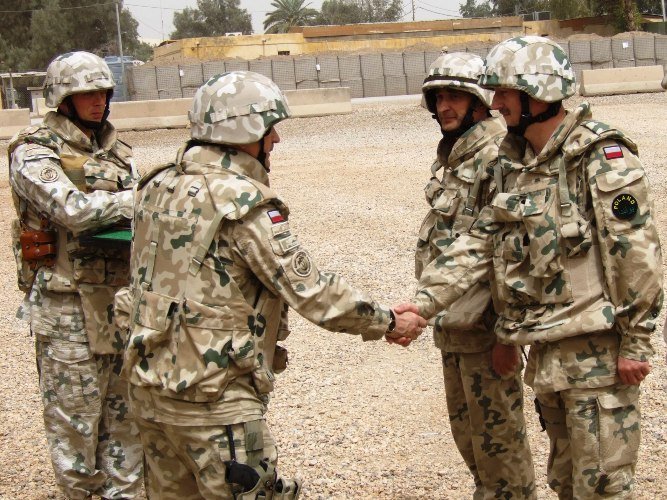
Around 2002 the Polish military introduced a desert variant of the Pantera for the arid theatres it was beginning to deploy to. This is called the PL Desert, and it is also known in different sources as the wz. 2000, the Pantera Pustynna (“desert panther”) or the Snajper. The naming varies, but it is the same basic design: the same soft Pantera shapes, re-coloured into sandy beige, tan and desaturated olive for desert conditions. This desert version is the camouflage Polish soldiers wore in Iraq and Afghanistan.

A genuine operational career
The Pantera is one of the few Central European camouflages to have seen service on a really wide range of battlefields. In combat it had what is usually described as its baptism of fire within the UNPROFOR deployments during the Yugoslav wars. It was subsequently used in Haiti, in Kosovo, in Afghanistan (within the ISAF mission), in Iraq, in the EUFOR deployment in Chad and the Central African Republic, and, more recently, it has been transferred in significant but unspecified numbers to Ukraine, both after 2014 and again after the 2022 Russian invasion (the 2014 eastern Ukraine photographs show fighters wearing it).
Who uses the Pantera
The Pantera is worn across the Polish Armed Forces army, air force, navy and special forces, and also by the Border Guard (Straż Graniczna) and the State Protection Service (SOP). Beyond Poland, uniforms and kit in the Pantera pattern have been supplied to allies, most visibly Ukraine, which has received wz. 93 material in unknown quantities since 2014. The Polish Border Guard began adopting a new MultiCam-inspired pattern (the SG-14) from 2015, but that is a separate development.
The replacement that never came
Here is the twist that makes the Pantera story worth telling. The Polish Ministry of National Defence announced what was intended as a replacement in September 2022 a new camouflage nicknamed “Lampart” (leopard) or “Bigos” (hunter’s stew). It was test-fitted on the ground by the 21st Podhale Rifles Brigade in late 2023.
Yet, as of 2026, the wz. 93 Pantera remains the standard uniform of the Polish Armed Forces. The replacement was announced, it was tested, and it has not actually displaced the Pantera. Three decades after it was adopted, the Pantera has outlasted both its failed predecessor (the Puma) and the successor designed to replace it.

Why the Pantera matters
The Pantera matters as a case study in how a camouflage is adopted for reasons that have little to do with testing. It was not chosen after a competition of swatches, it was chosen because a special forces unit designed it and because the President wore it. And it matters for its longevity: a Central European woodland pattern that has been in service for over thirty years, fought on several continents, and survived its own replacement.
A final point on the naming: this is not a World War Two pattern. There is no Polish camouflage from the 1939-45 period called “Puma”, “Pantera” or “Panthera”. The Polish paratroopers of 1944 were equipped on the British model, Denison smock included, while Polish units formed in the Soviet Union wore Soviet uniforms. The Pantera is a pattern of the Third Republic, the modern, post-communist Polish army.
Pantera and the Polish military at MegaCamo
At MegaCamo the story of the wz. 93 and its relatives is part of the wider European camouflage history. Explore the Polish military range, the wider camouflage collection, or our complete pattern list.
