
Camouflage History
AUSCAM: The “Bunny Cam” That Camouflaged Australia
For over thirty years, the Australian Defence Force fought in a camouflage unlike any other: five colours of rounded, overlapping shapes that collectors nicknamed “jelly bean camo” and soldiers called “hearts and bunnies”. Officially it is the Disruptive Pattern Camouflage Uniform, or DPCU. To the world it is AUSCAM, a pattern designed from aerial photographs of one continent, for one continent, and arguably the most Australian thing the Australian Army ever wore.
What is AUSCAM?
AUSCAM is the common name for the Australian Disruptive Pattern Camouflage (DCP), the five-colour camouflage adopted by the Australian Defence Force in the 1980s. The uniform is officially designated DPCU, Disruptive Pattern, Combat Uniform, and the abbreviation is so closely tied to the pattern that people use “DPCU” for the print itself. Other nicknames include OzCam, “jelly bean camo” (for the rounded spots) and “hearts and bunnies” (for shapes that resemble hearts and rabbit caricatures).

The standard DPCU uses a greenish-sand background overlaid with randomly arranged spots of orange-brown, mid-brown, leaf green and very dark green. An early test version included a mid-grey tone, but this was dropped in favour of a second brown in the final production design. The pattern was intended to work across Australia’s extraordinary range of environments, from arid bushland to tropical jungle, one camouflage for one very large island continent.

Before AUSCAM: jungle green and the Vietnam years
Australia did not issue camouflage uniforms in the Second World War. Its soldiers wore jungle green (JG), a practical olive-toned uniform developed for Pacific operations, and that remained the standard for decades. The Vietnam War changed the picture in a limited way: while regular Australian troops wore jungle green, the Australian Special Air Service Regiment (SASR) preferred US-made ERDL jungle uniforms or locally produced tiger stripe fatigues, neither of them official Australian issue. Australia did produce a thin waterproofed camouflage smock and hat during the war, sometimes called the “psychological smock”, with black smudges on olive green; it was the first truly Australian-designed camouflage, produced from around 1971 until the early 1990s, but it was never the standard uniform.
Development: designed from aerial photographs
In 1982–83, the Australian Department of Defence began testing camouflage designs suited to local geography, with an eye toward a standard-issue combat uniform for the whole Australian Military Forces (AMF). The design process was distinctive: the DPCU was developed with the help of aerial photographs of the Australian terrain, used to determine which colours and shapes would best break up the human silhouette in Australian conditions. The first DPCU uniforms were issued in 1982, the pattern was refined into its final production form in 1986, and the DCP was approved and introduced, progressively, as is usual with uniform changes, through the late 1980s and early 1990s. Jungle greens were finally phased out: last regular-issue for the Australian Regular Army in late 1991, and for the Army Reserve in late 1994.
The design drew partly on earlier US jungle camouflage concepts such as the “duck hunter” / “frogskin” family, but the result was unmistakably Australian, loose, rounded shapes that fit the mottled tones of eucalyptus bush and red earth, and that looked like nothing else in service anywhere.
The DPCU family
AUSCAM became a family, not a single pattern. The major variants tell the story of Australia’s deployments and institutional needs:
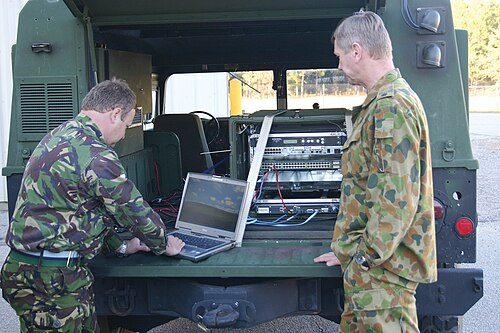
DPDU, the desert series
The desert version, officially the Disruptive Pattern Desert Uniform (DPDU), was first tested in 1998 at the Woomera missile test range in South Australia. It then evolved rapidly through three generations as Australia deployed troops to Afghanistan and Iraq:
- Mk I (2001) a rushed three-colour trial issue (brown and grey spots on a tan background) printed with about a third of the normal pattern missing, issued to the SASR deploying to Afghanistan as part of ISAF. It was judged “too yellow” for Afghan conditions.
- Mk II (2002) five colours: mint green, grey, brown and light grey on a pinkish background, issued to the SASR’s second rotation in Afghanistan.
- Mk III (2003) pale green, brown and grey spots on a yellow-tan background; approved for general issue, nicknamed the “Iraq Desert Pattern”. It remained in service across arid theatres until the Department of Defence retired the pattern in 2010. The desert lineage survives in reproduction: MegaCamo’s Australian AUSCAM Desert MKIII range keeps the 2003 look in production, made to order.
DPMU, the “Mid Point” trial
A further desert variant, the Disruptive Pattern Mid-Point Uniform (DPMU), was trialled around 2010 for the “green belt” areas of Afghanistan, the irrigated farmland where DPDU was too light and DPCU was too green. It used a light lime-yellow base with light grey, sand, olive-green and reddish-brown spots. Trials, including a uniform trial with the 6th Battalion, Royal Australian Regiment, showed that the standard DPCU performed better in most areas, and the DPMU was not adopted.
DPNU, the naval version
In 2008, the Royal Australian Navy received its own AUSCAM variant, the Disruptive Pattern Naval Uniform (DPNU), in “littoral colours”: light grey, mid-grey, dark grey and olive green on a very light grey background. The choice of a disruptive pattern for a navy uniform puzzled some observers, since the uniform also carried reflective tape for man-overboard visibility, but the point was as much identity as concealment: the pattern aligned the Navy with the other services as visibly Australian, while the grey palette marked the wearer as naval.

Red AUSCAM, the OPFOR print
In 1987, a startling recolouring of the standard DCP was introduced for Australian forces playing the enemy in military exercises: rust, medium brown, dark brown, light brown and deep red spots on a tan background. Nicknamed “enemy cams” or “Red AUSCAM”, it was worn by forces portraying the fictional nation of Musoria. Production was limited, supplies had dried up by 1995, and the pattern proved so effective in Australia’s red desert sands that it was later revived briefly in 2007.
Air Force experiments
The Royal Australian Air Force experimented with its own AUSCAM variant, the Air Force Disruptive Pattern Uniform (AFDPU), with a light grey background and a brown replaced by dark grey; it was never adopted. In 2014 the RAAF instead introduced the General Purpose Uniform (GPU), a blue-coloured version of the Australian Multicam hybrid, for non-combat and humanitarian duties.
Equipment: AUSCAM everywhere
DPCU was not limited to the uniform. The Australian system covered virtually everything a soldier carried: M88 and M94 rucksacks and their later Land 125 replacements, the 88-pattern and 94-pattern webbing and load-carrying harnesses, modular vest systems, body armour carriers (CBAS and MCBAS), helmet covers, ghillie suits (the “Yowie” suits made from shredded DPCU material), cold-weather clothing for Afghan winters, NBC ensembles, and specialist items from sniper boots to radio packs. Private Australian companies such as Bruck Textiles, Platatac and Sord produced both issue and commercial AUSCAM garments and equipment, some of it trialled by special forces in Afghanistan and Iraq.
The road to Multicam: AMP, AMC and the end of DPCU
By the late 2000s, Australian special operations personnel in Afghanistan had begun wearing Crye Precision’s commercial Multicam, with very positive reviews; in December 2009 the Special Operations Task Group formally recommended the Crye Precision Combat Uniform as its operational uniform. In November 2010, the Minister for Defence Materiel announced that troops deploying to Afghanistan would receive Multicam uniforms, judged to have a higher performance rating than the DPCU in that environment, beginning with a one-year trial by the Mentoring Task Force.

The transition was not a simple switch. First came the Australian Multicam Pattern (AMP), a Crye-developed variation that shrank the DPCU’s “bunny” and “jelly bean” features and embedded a miniature Australian Military Forces logo in the design; it saw only about two years of issue from late 2015. Then, in 2014, the Australian Army announced the Australian Multicam Camouflage (AMC), a hybrid developed by the Defence Science and Technology Group that combined the DPCU’s five-colour palette with one extra colour (six colours in total). The Australian Multicam Camouflage Uniform (AMCU) began replacing both DPCU and AMP-OCU in October 2014, with full integration targeted for 2019.
The Royal Australian Navy likewise moved on: it replaced the DPNU with the Maritime Multicam Pattern Uniform (MMPU), a blue-green Multicam hybrid with fire-retardant properties, designed by Australian Defence Apparel, which entered service in late 2021.
Yet DPCU has not entirely vanished. As of 2023, the Australian Army Cadets had officially adopted AMCU while retaining existing DPCU stocks, reservists in regional induction companies still received DPCU before their basic training at Kapooka, and DPCU remained in limited use with the Navy and reserve formations such as the 11th Brigade. For a pattern officially introduced in the 1980s, it has had an extraordinarily long life.
Why AUSCAM matters
AUSCAM is a reminder that camouflage can be national in a literal sense. Most patterns are designed for a general environment, woodland, desert, jungle, and exported around the world. AUSCAM was designed for Australia, from aerial photographs of Australia, to solve Australian conditions, and it stayed essentially Australian for three decades. Its rounded, “friendly” shapes became part of the national visual identity, instantly identifiable on news footage from East Timor, the Solomon Islands, Iraq and Afghanistan.
It also shows how hard it is to replace a beloved pattern. DPCU was not retired because it was bad; it was retired because Multicam-type patterns tested better in the specific theatres where Australia was fighting. The DPCU remained good enough for the bush at home, and its gradual phase-out, spanning more than a decade, reflects both practical logistics and a certain reluctance to say goodbye to the bunny cam.
If you want to see how far the pattern family stretches today, the Australia collection on MegaCamo gathers DPCU, desert, naval, OPFOR and AMCU gear in one place, while the Australian AUSCAM DPCU range covers the classic five-colour print itself, made to order.
