
Camouflage History
Tiger Stripe: The Vietnam War’s Most Famous Non-Issue Camouflage
No army ever issued it. No regulation ever authorised it. And yet tiger stripe became the single most recognisable camouflage of the Vietnam War, worn by the men doing the most dangerous work in the jungle. It was a family of private-purchase prints, made by dozens of tailors across Southeast Asia, adopted by Special Forces as a badge of trade, and its story says as much about how special operations actually equip themselves as about camouflage design.
What is tiger stripe?
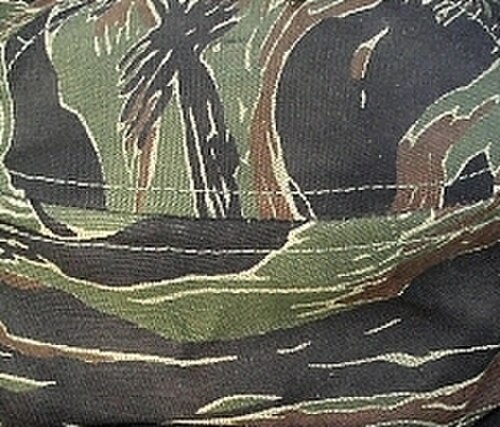
Tiger stripe is not one pattern. It is a group of related designs sharing a common DNA: narrow, brush-stroke bands of green and brown, overlaid with broader black strokes, printed on an olive or khaki background. The strokes interlock rather than overlap, which is the structural difference between tiger stripe and its French ancestor, the lizard pattern. The name comes from the obvious resemblance to a tiger’s hide, and Vietnamese troops called the striped French uniforms they had known since the First Indochina War Sọc Răn “striped uniform”.
The design is descended from the French TAP 47 lizard pattern. France supplied camouflage uniforms to Vietnamese colonial and airborne personnel during the Indochina War, and when the French left, the Republic of Vietnam Marine Corps began producing its own derived version, with interlocking elements instead of the French overlapping ones. From that starting point, an entire ecosystem of variants exploded.
The Vietnamese Marine Corps beginnings (1957–1967)
The first true tiger stripe designs were local copies of the French lizard made for the Vietnamese Marine Corps (VNMC), first produced in 1957. Collectors now distinguish several early VNMC types:
- VNMC Experimental (VMX) 1957, the first copy of the French pattern, with bold black stripes over brownish-drab and light green traces on olive. Production ended in 1967, though units wore it into 1970.
- VNMC Transitional (VMT) 1958, sometimes called “Viet Tailor Made”.
- VNMC Sparse (VMS) 1959, the “VNMC First Pattern” of collectors.
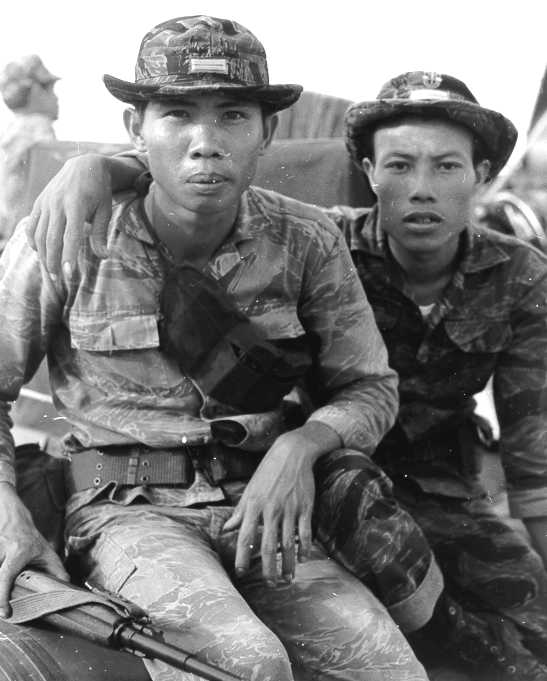
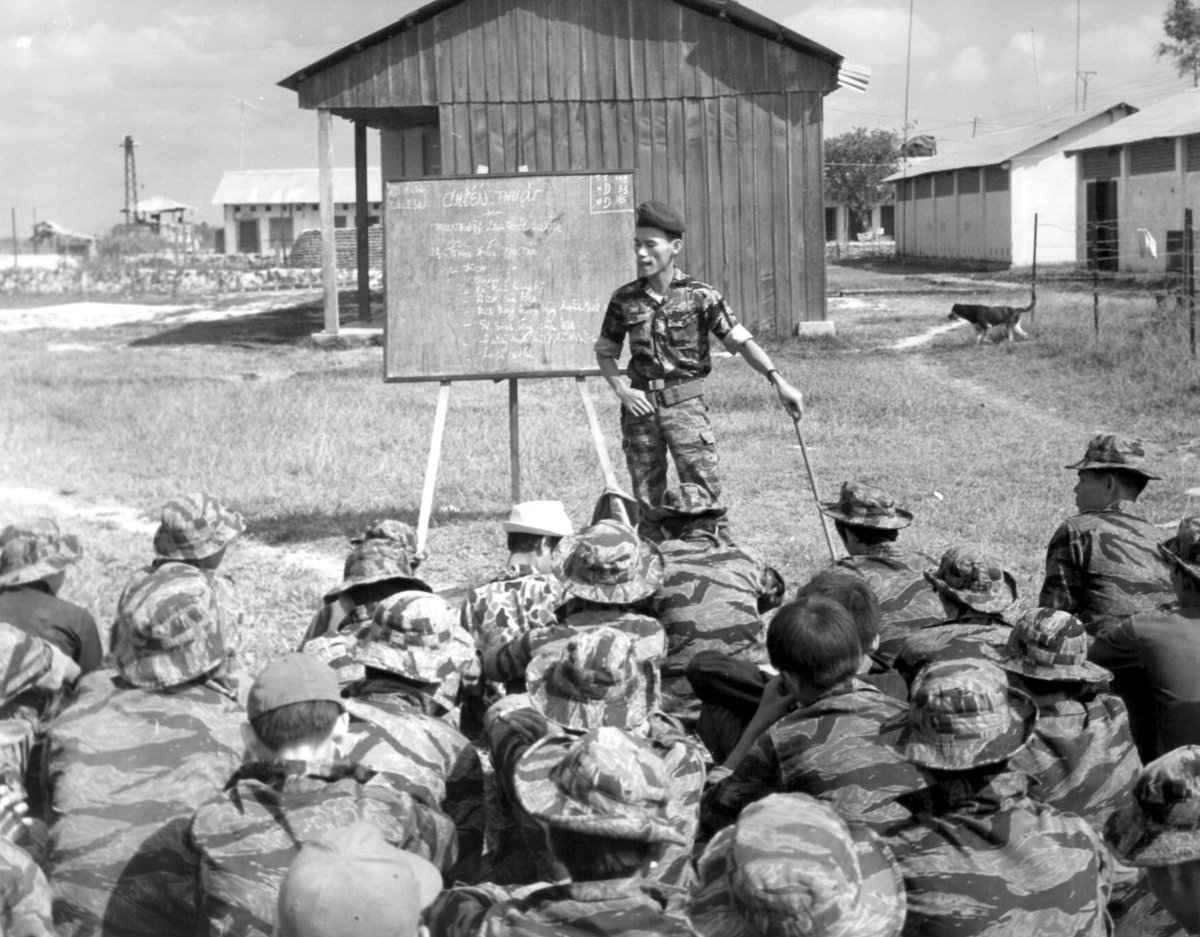
The Vietnamese Rangers (Biệt Động Quân) and the Vietnamese Special Forces (Lực Lượng Đặc Biệt, LLDB) adopted variants too, and when American advisors began serving alongside these units, they were authorised to wear the Vietnamese unit’s combat uniform with US insignia. That single decision opened the door.
The Americans arrive (1962–1964)
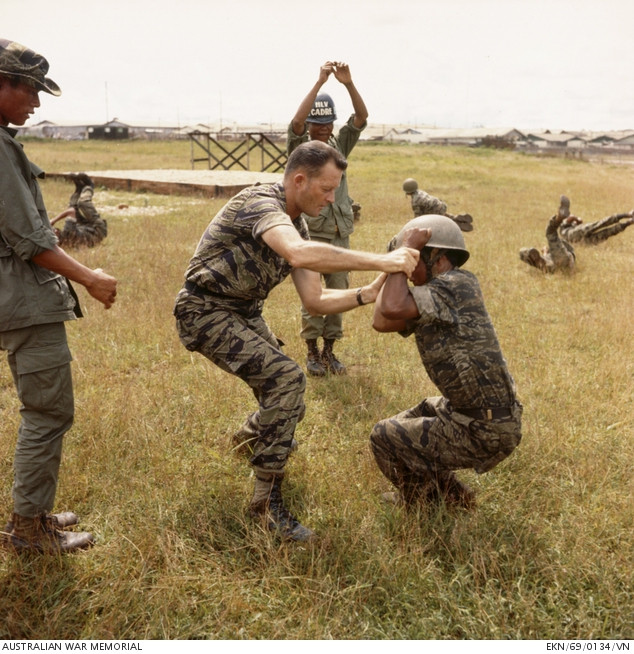
In late 1962 and early 1963, US Special Forces adopted tiger stripe for close-range jungle operations. There was a practical problem: ARVN uniforms were generally too small for American soldiers, so the camouflage fatigues had to be custom-made by local tailors. In 1963, Marine Corps advisors, and from 1964 the 5th Special Forces Group (Green Berets), contracted with producers across Southeast Asia, Vietnam, Thailand, Korea and Okinawa, Japan, to make fatigues, boonie hats and other items in tiger stripe fabric. Each producer worked from its own screens, with its own dyes and tolerances. The result was a flood of variations, in both Asian and US sizes, that has kept collectors busy ever since.
Tiger stripe was never an official US-issue item. That is the paradox at the heart of its legend: the pattern that became the visual signature of American special operations in Vietnam was entirely private purchase, tolerated rather than authorised. It carried no official status, and precisely because of that, it carried status of a different kind. It was worn by men on the most dangerous assignments: Special Forces advisors, MACV-SOG teams, Long Range Patrol units, and the Special Forces-advised Civilian Irregular Defense Groups (CIDG), who used tiger stripe from 1963 until the CIDG programme was disbanded in 1971.
The classification: Johnson’s tiger patterns
The most important attempt to catalogue the family is Richard D. Johnson’s book Tiger Patterns (Schiffer, 1999), which classifies the Vietnam-era prints by the formation of their shapes rather than by colourway. Johnson’s terms, updated by the Omega Militaria reference guide in 2025, include:
- John Wayne Sparse (JWS) 1963, “Early Classic” or “Fat stripes”; named after the film The Green Berets, in which John Wayne wore it. Exclusively produced in Japan.
- John Wayne Compact (JWC) 1963, “CIA”, a shorter-pattern version used for private-purchase aviation suits.
- John Wayne Dense (JWD) 1964, “Okinawa” or “Classic”; also Japanese, possibly Okinawan only. This is the design behind many modern reproductions.
- Tadpole Sparse (TDS) 1964, “Silver”, named for the tadpole-like shapes; Japanese production.
- Zig-Zag (ZIG) 1964, heavyweight cotton twill, four colours; some surviving examples contain a black shape collectors call the “penis pattern”, an anecdotal detail never officially substantiated.
- VNMC Dense (VMD) 1968, “Seawave” or “VNMC Second Pattern”.
- Advisor Sparse (ADS) 1968, “Gold”.
- Advisor Dense (ADD) 1968, “ARVN Classics” or “Purple”; a key feature is the black “bunny” shape resembling a rabbit silhouette.
- Late War Lightweight Sparse/Dense (LLS/LLD) 1969, “Late War”, ultralight fabric; made in multiple fabric weights (light, medium, heavy).
- Splotch (SPL) 1969, “CIDG” or “Coarse”, known only from CIDG service.
- Tadpole Dense (TDD) 1970, “TO78/TO79”.
- SEAL (SEA) 1972.
- Thai Late War Large (THL) 1973, “Thai Large”, used only by the VNMC.
- Saigon (SAI) 1975, at the end of the war.
- Thai Tadpole Sparse (TTS) date unknown.
The dates in this classification are estimates by collectors, not official records. Johnson himself, in comments on the Omega Militaria article, corrected some of the fabric-weight identifications, a reminder that even the bible of tiger stripe is a work in progress. Camopedia notes that the classification system is “in need of updating”, and that additional patterns have since been documented which do not fall within it.
Colourways and fabric reality
Nearly all the original fabrics and uniforms were produced in Asian countries, Japan (including Okinawa), South Korea, Taiwan and Thailand, with some in Vietnam itself. Dyes varied, factories varied, and the conditions of jungle use did the rest: black faded toward purple, greens toward yellow, and laundering transformed colours. This is why collectors classify by shape, not colour. A “silver” Tadpole may look quite different from another “silver” Tadpole, but the structure of the print identifies it.
Fabric types ranged from heavyweight cotton twill (common in the early and mid-war prints) to ultralight poplin-type cloths in the late-war designs. Some garments were produced in “sterile” versions with no labels, and many were private purchase or custom-tailored in Saigon shops, shirts, trousers, caps, aviation suits and garment bags, all in whatever tiger variant the tailor had on hand.
Who wore it
The user list reads like a roll-call of the Vietnam War’s elite and irregular units:
- ARVN: Rangers, Special Forces (LLDB), Marine Corps, and the CIDG strike forces.
- US: Special Forces advisors, 5th Special Forces Group, MACV-SOG, Long Range Patrol/Reconnaissance units, and Navy SEALs (who had their own late-war variant around 1972).
- Allied: Australian SASR and New Zealand SAS personnel on advisory duty with ARVN units were principal wearers of tiger stripe (and ERDL) in theater, while regular Australian and New Zealand troops stayed in standard olive green.
As the war progressed, American reconnaissance units increasingly switched to the newer ERDL pattern, a predecessor of the four-colour US Woodland. Tiger stripe never disappeared entirely, but by the end of the war it was already becoming a piece of the past, and a legend.
After Vietnam: a second life
Tiger stripe did not stay in Vietnam. Thailand became one of the most prolific manufacturers of tiger stripe designs after the war, and its Border Patrol Police Aerial Reinforcement Unit (PARU) has worn tiger stripe since the Laotian Civil War era. The Philippines developed numerous variants, some still in use by special units such as the Naval Special Operations Command and the Special Forces Regiment. Ecuador became known for its “red” or “orange” tiger prints. El Salvador produced its own crude copies during its civil war, and Guyana’s Defence Force wears a bright green tiger pattern.

The pattern also reached the post-Soviet world. Russian Ministry of Interior (MVD) and armed forces special operations units have worn tiger stripe variations since the early 1990s; the Kamysh (“reed”) pattern, based on Malaysian-made tiger stripes, remains in use with Russian law enforcement agencies, with an urban blue-toned variant known as Ten’ (“shadow”). In the modern era, US Special Forces have used both green and desert tiger stripe in Afghanistan, and the pattern has appeared in Ukraine, Haiti and South Sudan.
In the commercial world, Tiger Stripe Products (founded 1984) reproduced the John Wayne Dense design faithfully, and its Desert Tiger pattern, introduced just before Operation Desert Storm in 1991, was purchased by the US Marine Corps for evaluation and deployed with Marine special operations personnel, later seeing use in Iraq and Afghanistan. The USMC also evaluated tiger stripe variants prior to adopting MARPAT in the early 2000s.
Why it matters
Tiger stripe matters for three reasons. First, as camouflage history: it is the direct descendant of the French lizard pattern, proof that camouflage designs travel, adapt and multiply as they cross borders. Second, as special operations history: it shows how elite units equip themselves in the field, through private purchase, local production and tolerated deviation from regulation, driven by mission needs rather than procurement paperwork. Third, as collecting history: the Johnson classification, for all its imperfections, remains the foundation of how we talk about a pattern that was never official and never standardised.
For anyone wearing tiger stripe today, from a modern reproduction to an original 1960s jacket, it is worth remembering that the print they are wearing has no single author, no single factory, and no official specification. It was made by dozens of hands across Southeast Asia, for men who needed to disappear into the jungle, and it became, entirely unofficially, one of the most famous camouflage patterns ever made.
Tiger stripe remains widely reproduced today. If you want to wear a piece of that history, the Tigerstripes collection on MegaCamo covers the classic prints, made to order, including the VNMC Tiger Stripes t-shirt.
