
Camouflage History
MARPAT: The Camouflage the U.S. Marine Corps Patented
Between 2001 and 2004 the United States Marine Corps did something that, as far as the record shows, no other service had done with a camouflage pattern: it put the pattern itself into the United States patent system. Not a trademark on a name. Not a drawing in a training manual. Two patents, one on the ornamental design of the pattern, one on the uniform’s “pattern system”, its fabric and its construction, filed by named civilian designers and engineers, assigned to the Secretary of the Navy, and published for anyone to read.
Both patents have since lapsed. That is the fact that makes MARPAT worth an article of its own rather than a paragraph in a survey of digital camouflage. Most of what circulates about MARPAT’s legal status is a mixture of four different legal regimes that were never the same thing in the first place: patent, trademark, the special statute that protects military insignia, and copyright. Only one of those ever covered the pattern. Two of them never applied to a pattern at all. And the one that mattered most has been expired for years.
This article is about what the Marine Corps actually patented, what the patent documents say in their own words, what the Corps protected by other means, when each of those protections ended, and how to tell a piece of issue cloth from a copy today.
MARPAT in plain terms
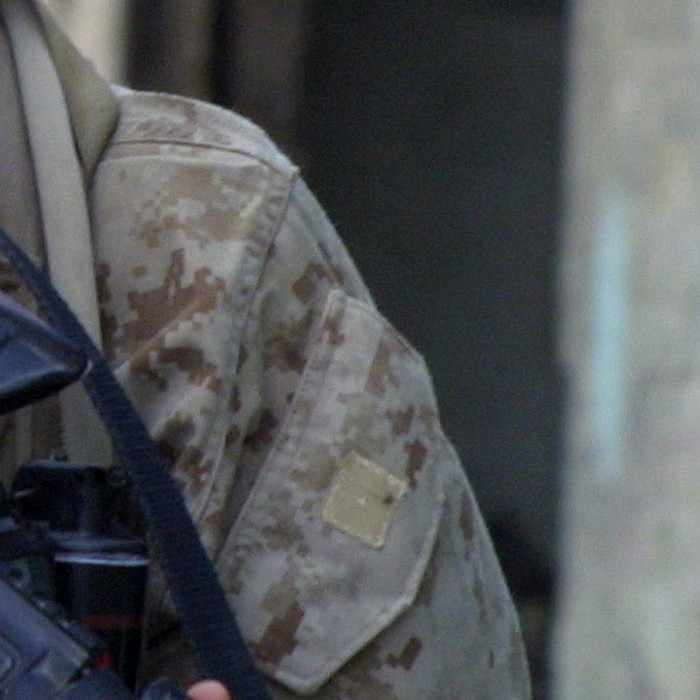
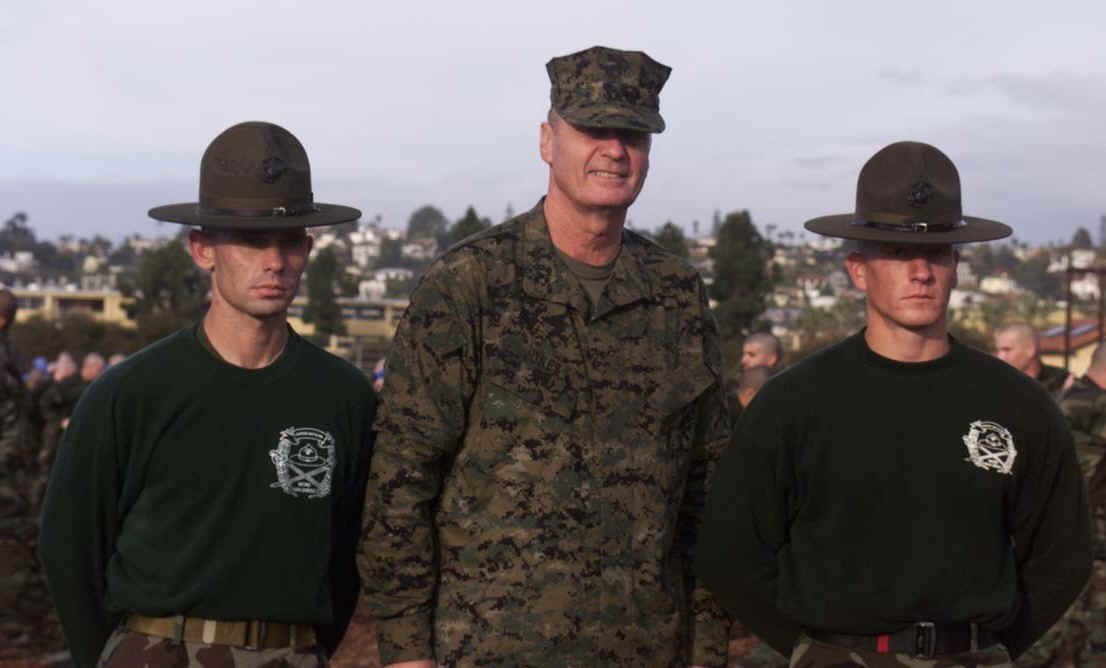
MARPAT stands for “Marine pattern”, and it is the camouflage worn on the Marine Corps Combat Utility Uniform (MCCUU), the service’s utility uniform from 2002 until today. The pattern is built from small, sharp-edged rectangular blocks of colour rather than the smooth, curved shapes of the woodland BDU it replaced. Up close it looks like large pixels; at distance the blocks merge.
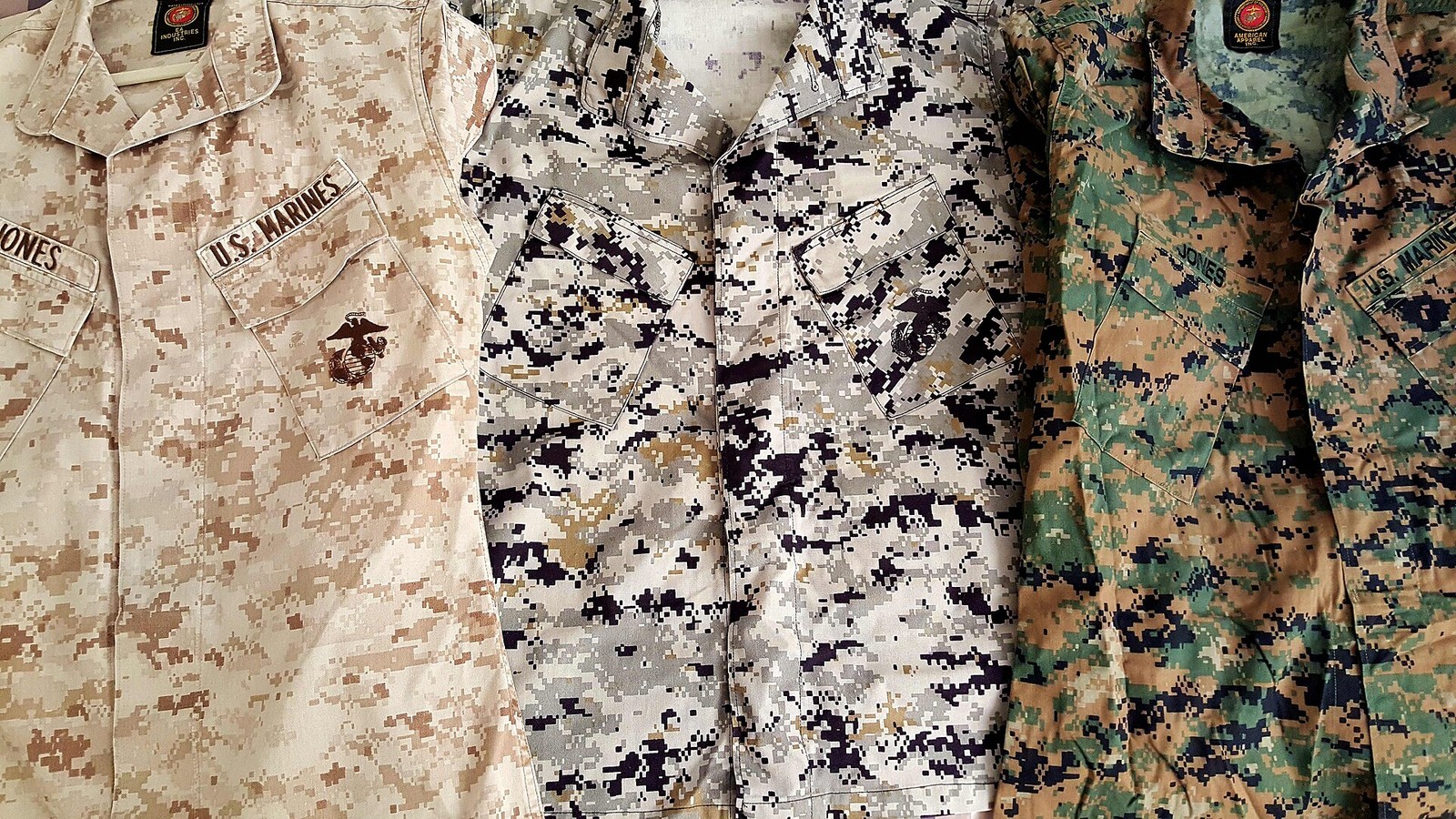
Two colour schemes were issued for general wear:
- Woodland, the green scheme, built around black, green, coyote brown and khaki tones.
- Desert, the sand scheme, built around light tan, urban tan, coyote and highland tones.
A third scheme, urban, was developed, the patent file describes its palette in detail, but it is generally reported as a prototype that was never issued operationally. Anything described as urban MARPAT should be read as a development sample rather than a service uniform. A snow or winter pattern associated with cold-weather over-garments also exists; it is a different design in a different lineage and should not be filed under “MARPAT variants” without qualification.
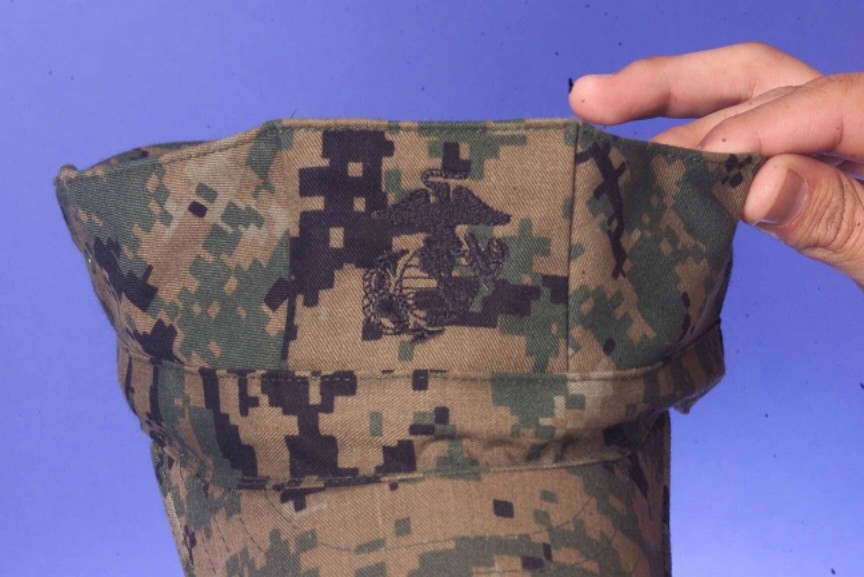
The pattern is not simply a texture. In the versions the Corps issued, the Eagle, Globe and Anchor and the letters USMC are printed inside the repeat, the pattern carries its own insignia.

The patent that is actually about the pattern
The document people usually mean when they say “the Marine Corps patented MARPAT” is US D491,372 S1, Camouflage pattern for sheet material and uniforms. It is a design patent, not a utility patent, and the distinction matters more than any other technical point in this article.
A design patent protects the way something looks. It does not protect the idea behind it, the method of making it, or the function it performs. The single claim of US D491,372 is exactly that narrow: “The ornamental design for camouflage pattern for sheet material and uniforms, as shown and described.”
What the document contains:
- Application US 29/143,683, filed 19 June 2001, granted 15 June 2004.
- Five named inventors: Anabela Dugas, John Joseph Heisterman Jr., Luisa DeMorais Santos, Gabriel R. Patricio and Deirdre E. Townes.
- Assignee: the U.S. Department of the Navy. The patent states that the invention “is owned by the United States of America as represented by the Secretary of the Navy and the Commandant of the United States Marine Corps”.
- Four figures, two of them in colour, with broken lines marking off one repeat unit. The description states that the pattern repeats indefinitely and that each repeat is about 36 inches by 36 inches.
- Figures 3 and 4 show the inclusion of the Eagle, Globe and Anchor and the USMC initials, and the text identifies these as insignia protected under 10 U.S.C. 7881 the statute dealing with the unauthorized use of military insignia.
That last point is the interesting one. The Corps did not rely on the patent to protect the eagle. The patent points at a different law to protect the eagle, and uses the patent to protect the arrangement of colours around it.
A design patent granted in this period ran for fourteen years from the date of grant. The expiry recorded for US D491,372, 15 June 2018, exactly fourteen years after it granted, is consistent with the patent running its full term rather than ending early.

The second patent: the uniform as a system
The broader document is US 6,805,957 B1, Camouflage U.S. Marine corps utility uniform: pattern, fabric, and design. This is a utility patent, and its subject is not “a nice pattern” but a system.
- Application US 09/986,016, filed 7 November 2001, granted 19 October 2004; published as application US 2004/0209051 A1.
- Eight named inventors: Luisa DeMorais Santos, Deirdre E. Townes, Gabriel R. Patricio, Carole Ann Winterhalter, Anabela Dugas, Timothy R. O’Neill, Rosemary Ann Lomba and Barbara J. Quinn.
- Assignee: the United States, “Navy and Commandant of US Marine Corps, Secretary of US Department of Navy”, again the government, not a company.
- Ten claims. Claim 1 covers a “disruptive camouflage pattern system consisting of a macro pattern and a micro pattern wherein the micro pattern is formed of sharp edged pixels proportional to the size of a camouflaged subject”.
- The abstract describes specialised techniques for printing the pattern onto fabric and claims effectiveness in the visible and near-infrared parts of the spectrum, which is what “camouflage” means to a soldier under night vision, not just to a photographer.
- Status: “Expired – Lifetime”, anticipated expiration 29 November 2021 consistent with the twenty-year term running from the November 2001 filing date.
Reading the specification is where the document stops being a legal formality and becomes a design record. It sets out the colour proportions of each scheme:
| Scheme | Colours (as specified) |
|---|---|
| Woodland | Black 477 (18%), Green 474 (30%), Coyote 476 (47%), khaki |
| Desert | Light Coyote 481 (18%), Highland 480 (5%), Urban Tan 478 (30%), Desert Light Tan 479 (47%) |
| Urban | Black 477 (5%), Medium Gray 487 (30%), Light Gray 486 (47%), Coyote 476 (18%) |
It also describes the finish and the fibre blend, a DMDHEU resin treatment on a nylon/cotton cloth, with one to five per cent electrostatic-dissipative fibre, and the boots that went with the uniform: coyote brown leather, worn rough side out. These are the details that separate a garment specification from a picture of a pattern, and they are the reason the specification is worth reading in full rather than skimming for the claim.
Two more things in the specification deserve attention because they are easy to miss and hard to overstate:
1. The Corps’ own patent cites the Canadian work. The background section discusses the Canadian disruptive pattern (CADPAT), describing it as consisting of “shapes having relatively straight sides”. The relationship between CADPAT and MARPAT, a design relationship, not a claim of identical repeat geometry, is therefore acknowledged inside the American document, not merely asserted later by commentators.
2. The evaluation was not done in-house on a hunch. The specification refers to the assessment of more than 60 commercial camouflage patterns at the U.S. Army’s Natick Soldier Center camouflage evaluation facility.

The filing that did not survive
A patent family ends when it stops being prosecuted, and this one has a third document that is easy to overlook.
Application US 10/967,885 was filed on 18 October 2004, one day before the utility patent granted, claiming priority back to 7 November 2001. It was published on 24 December 2009 as US 2009/0313740 A1 with thirty claims. It was abandoned Google Patents records the abandonment as taking effect on 7 August 2012 and nothing further was granted from it.
The practical consequence is straightforward. When the design patent expired in 2018 and the utility patent in 2021, the MARPAT patent family closed. Nothing in that patent family remains pending. Neither the pattern nor the uniform system is under patent protection today.
This is where the MARPAT story diverges hardest from the way it is usually told online. A search for the pattern returns page after page describing it as patented, protected, or trademarked. The patent documents themselves say otherwise, because the calendar says otherwise.
The three protections that were never about the pattern
The reason MARPAT’s legal position is so widely misreported is that the Marine Corps does protect things aggressively, just not the pattern, and not through the patent system.
The insignia. The Eagle, Globe and Anchor and the letters USMC are not ordinary decoration, and the design patent file itself defers to 10 U.S.C. 7881 on that point. The rule the patent invokes is about insignia, not about camouflage.
The names, seal and emblem. A separate federal regulation, 32 CFR 765.14, governs “unofficial use of the seal, emblem, names, or initials of the Marine Corps”. This is the machinery that lets an institution control how its identity is used by others, and it is the reason a manufacturer can be in difficulty for stamping the service’s marks on a garment while the pattern itself is free.
The uniform itself. 10 U.S.C. 771 makes it an offence for a person not in the armed forces to wear, in public, the uniform of the armed forces, and, importantly, a uniform any part of which is similar to a distinctive part of that uniform. This is a provision about wearing a uniform, not about printing a pattern. Two very different activities, frequently conflated in forum argument.
None of these three regimes is a trademark on the pattern. And none of them is a patent.
Copyright is the wrong tool here, too
American copyright law does not protect works of the United States Government, which is the subject of 17 U.S.C. 105. A pattern generated inside a federal design programme is therefore a poor candidate for copyright protection in the United States.
That is not a loophole; it is the reason the Corps went to the Patent and Trademark Office instead. When copyright is unavailable to a federal author, the tools that remain are patents, the insignia statute, and the regulations governing the institution’s own names and marks. MARPAT’s file is what that combination looks like when it is used deliberately and then runs out of time.
The clock: what ran, and when
| Date | Event |
|---|---|
| 19 June 2001 | Design patent application for the pattern filed |
| 7 November 2001 | Utility patent application for the uniform system filed |
| 17 January 2002 | First issue of the new uniform reported at Camp Lejeune, North Carolina |
| 15 June 2004 | Design patent US D491,372 granted |
| 19 October 2004 | Utility patent US 6,805,957 B1 granted |
| 18 October 2004 / 24 December 2009 | Continuation application filed (2004) and published (2009) |
| 7 August 2012 | Continuation abandoned |
| 15 June 2018 | Design patent expired |
| 29 November 2021 | Utility patent expired |
The details of the early deployment dates are the weakest part of this table and are treated accordingly below. The patent dates and the two expiries are read directly from the patent records.
Two decades of wear
None of the legal history explains why the pattern spread. That part is simple: it was issued to everyone.
The uniform entered the fleet in 2002, reference accounts, GlobalSecurity.org among them, date its debut at the Camp Lejeune clothing store to 17 January 2002, and went on to replace the woodland BDU and the three-colour desert uniform, a replacement that reference accounts record as complete by 1 October 2004. By the time the design patent was granted in June 2004, the pattern was already normal issue.
From then on it appears wherever Marines were: the desert colour scheme during the invasion and occupation of Iraq, the woodland scheme in temperate training areas and in Afghanistan, on helmet covers, on body armour, on the ILBE pack system. It was still the utility uniform of the Corps, with no replacement in general service, in photographs taken as late as March 2022.


Where the confusion comes from
Three separate confusions keep MARPAT’s legal status muddy, and each has a different answer.
MARPAT and MultiCam are not the same thing and are not related as copies. MultiCam is a seven-colour pattern designed by Crye Precision, unveiled in 2002 and developed with the U.S. Army’s Soldier Systems Center; the Army selected its own pixelated Universal Camouflage Pattern in 2004 and only moved to a MultiCam-derived pattern a decade later, after UCP’s widely publicised failures, a programme the U.S. Government Accountability Office reviewed in 2012, recommending that the services improve their development work and collaborate more closely. Both MARPAT and MultiCam use more than one scale of shape, which is why they are mistaken for each other in photographs, but they are different designs from different programmes. Crye’s route to protection was a different route: the company presents its pattern as protected by its own registered marks and licensed commercially and to governments, a business model the Marine Corps never adopted for MARPAT. Those registrations are the company’s claim, not an independent finding.
“Digital” does not mean “patented”. MARPAT was not the first pixelated pattern protected in law and the patent file does not claim that it was. Canada’s CADPAT work of the late 1990s precedes it, and the Marine Corps’ own specification discusses the Canadian design as prior art. A pattern is not patented because it is pixelated; it is patented because someone applied for it, and that depends on the applicant’s choices, not the style of the artwork.
Reproduction is not one thing. A manufacturer printing digital camouflage for a hunting jacket, a service issuing a uniform, a reenactor buying a shirt, and a business stamping the Eagle, Globe and Anchor on a cap are doing four different things under four different sets of rules. Only some of them were ever touched by the patents.
How to read a piece of MARPAT you are looking at
The pattern is not protected by patent any more, so “authentic” and “legal” are two different questions. If what you want to know is whether a garment is issue cloth, these are the checks that follow from the documents above.
Look for the eagle. In the woodland and desert schemes, the repeat carries the Eagle, Globe and Anchor and the letters USMC inside the pattern, small enough to be missed unless you look for it. The utility patent’s specification, describing its own figures, states that at least seven eagle logos are distributed within each repeat, and adds that the camouflage pattern itself is not shown in that drawing, for clarity. This is the single most useful check on a garment.
Check the repeat size. The patent describes a repeat unit of about 36 inches square for the sheet material. Very small-scale “digital camo” prints, the kind used on cheap pouches and novelty items, will not match that scale, because they are almost always designed to a different repeat entirely.
Look at the shape of the blocks, not the colours. MARPAT’s pixels are rectangles with hard edges. Blurry, rounded or “eroded” blocks belong to a different design tradition, however sandy the colours look. This check works on a black-and-white photograph too, which is why period imagery can still be used to identify the pattern.
Do not rely on colour from photographs. The desert scheme is close in tone to several other arid camouflage designs, and photographs shift sand tones badly. A photograph is evidence of structure; it is not evidence of colour match. A fabric swatch photographed under unknown light cannot settle a colour question.
Do not expect to test the technical claims. The near-infrared performance and the electrostatic-dissipative fibre described in the utility patent are not things you can check by eye, and no controlled comparison of two garments is possible without the equipment the Marine Corps used. Marketing copy that claims “the same NIR performance as issue MARPAT” is asserting something the buyer cannot verify.
What this means if you are buying cloth or a garment
Three practical consequences follow from the documents, and they point in different directions.
The pattern is free. The design patent expired in 2018 and the utility patent in 2021, and the continuation was abandoned in 2012. Printing a pixelated pattern in those colours is no longer an infringement of anything in the MARPAT patent family. That is why the market is full of it, and it is not a scandal, it is what patent terms are for.
The marks are not free. The Eagle, Globe and Anchor and the letters USMC are insulators of a different kind, protected under the insignia statute the patent itself cites, and the Marine Corps’ seal, emblem, names and initials are separately regulated by 32 CFR 765.14. A reproduction garment that prints the eagle into the pattern has moved from “unprotected design” to “protected insignia”, and the analysis changes completely. This is the distinction that matters, and it is the one most often skipped.
“Surplus” and “reproduction” are not the same article. Genuine issue MCCUU garments leave service through official channels, and reproduction garment-makers operate openly in the same market. Each has its place. What none of them can do is claim patent protection for the pattern, in either direction: a seller cannot assert it, and a buyer cannot obtain it.
Clothing and accessories in this pattern are in our catalogue: Desert MARPAT.
