
Camouflage History
Strichtarn: East Germany’s One-Colour Rain Camouflage
Strichtarn is the most minimal camouflage pattern ever to dress a European army for a quarter of a century. It has no blotches, no leaf shapes, no sprays of colour and no suggestion of branches. It has one printing colour, a red-brown ink, and one shape, a short vertical dash, printed across a field-dyed ground of pale grey-green. The dashes are thin, broken and arranged in loose vertical columns, and the overall effect is of light rain falling across the cloth. That is exactly what people saw in it. Western armies and Western collectors called it raindrop. The East Germans called it Strichtarn: line camouflage.
That austerity is why this pattern deserves a full article rather than a footnote. Strichtarn is usually mentioned only as a Cold War curiosity from a country that no longer exists, and it is better understood as a case study in what a camouflage pattern actually is. A pattern is not a picture of a landscape; it is a set of manufacturing decisions, how many inks, how many screens, what spacing, what base cloth, what dye, and those decisions determine where the pattern can be used, how long it survives in service, what it costs, and how easily somebody else can copy it. Strichtarn took the manufacturing logic of the Second World War German splinter prints and pushed it to its minimum: get rid of everything except the rain.
What the name actually means
Strichtarn is a compound of Strich, a line or stroke, and Tarn, camouflage. The pattern is Strichtarn; the design as such is Strichmuster, a “line pattern”. In service the first garment to carry it was formalised under a third name entirely: the Kampfanzug 64, combat suit 64, the designation of the uniform rather than of the print. The three words are not interchangeable: a Kampfanzug 64 is a garment, Strichmuster is a design, Strichtarn is the pattern as a system.
There is also a museum label worth knowing about. A surviving summer field-service outfit in the Museumsfabrik Pritzwalk collection, catalogued through museum-digital Brandenburg, is catalogued under the name Ein Strich – kein Strich (“a line, no line”), which the museum’s note records as what the outfit was often called, a common name rather than a display title. It is a neat description of how the pattern works at distance, since the dashes dissolve into a flat field tone long before a human figure resolves, and it is not an official East German designation.
A third name is African rather than German. In southern Africa the pattern became known as rice fleck, and that is the term that travelled with the cloth into Angola, South West Africa and the Rhodesian war. It is a vernacular nickname used by the people who captured or were issued the garments, not a manufacturer’s name, and it has stuck in the collector literature ever since.
Strichtarn also belongs to a family, and the family is where most of the confusion starts. Camouflage students group vertical-dash designs under the heading rain patterns: a high proportion of dark, vertically aligned straits or flecks set on a lighter ground, so that the cloth reads as falling rain rather than as terrain. Getting the vocabulary of family, morphology and lineage straight before comparing two prints is worth the effort, and MegaCamo’s explainer on camouflage classification sets out the terms. The family is genuinely international. Poland produced the first simplified Warsaw Pact rain print, the wz.58, a thin brown dash on field grey, issued to airborne units in 1958. Czechoslovakia produced its own version in 1963, the vz. 60 called Jehličí, needles. Bulgaria produced several. Rain prints in fact sit at one end of the same spectrum of Eastern Bloc pattern-making that produced the leaf designs of Soviet KLMK and Berezka, covered separately in MegaCamo’s study of Soviet leaf camouflage. East Germany’s entry, from 1965, is the one that lasted longest and travelled furthest, and the one most often mislabelled when a photograph of any rain print appears captioned as “East German”.
One ink, one screen, one direction
The manufacturing story is the least often told part of Strichtarn and the most useful for identification. According to the documentation published by the specialist author Michael Krauß, the pattern was developed as a project at the Research Institute for Textile Technology in Karl-Marx-Stadt, the industrial city now called Chemnitz, and the cloth was a polyester and cotton blend woven and finished by VEB Technische Textilien Meerane. The base fabric was dyed with indanthrene dyes, chosen for light-fastness and wash-fastness, and the printed dashes were applied over that dyed ground: small brown strokes, broken rather than continuous, at spacings of roughly half a centimetre and one centimetre. In a detail published only in November 2021, the dyestuff came from Switzerland, from West Germany and from Czechoslovakia, a reminder that the East German textile industry was not autarkic.
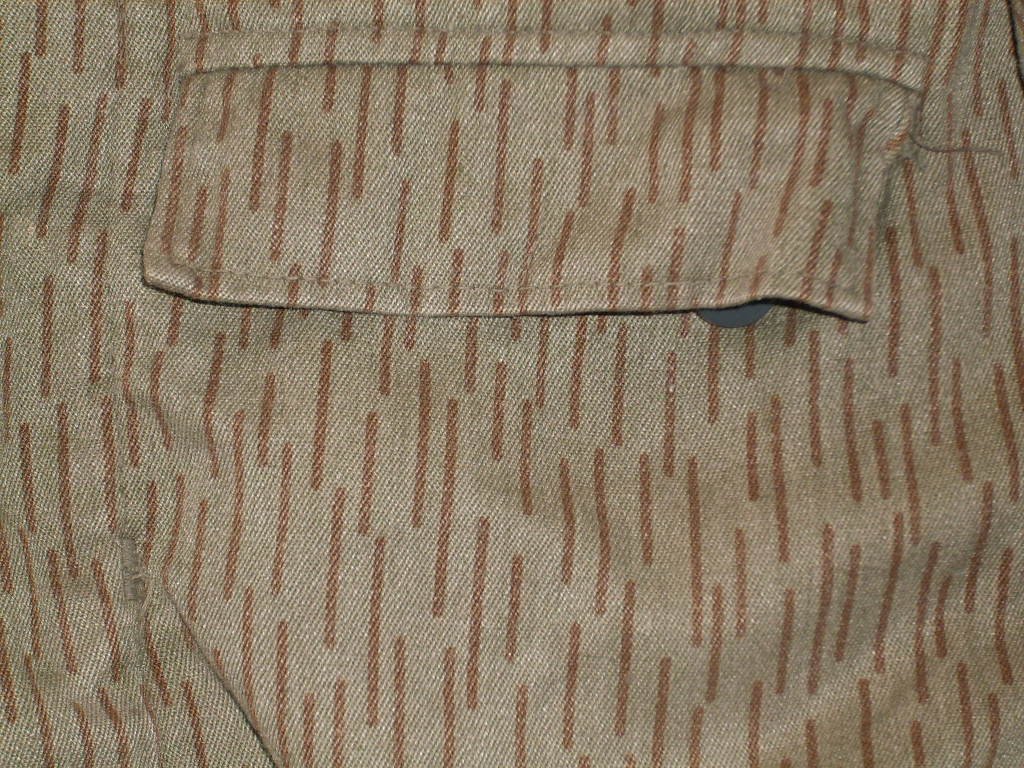
Three consequences follow, and they explain almost everything distinctive about the pattern. First, there is no background print. The ground is dyed, not printed, which is why Strichtarn has a uniform base tone instead of the mottled underprint seen in the Czechoslovak rain pattern; if the ground beneath the dashes is made of two or more printed tones, it is almost certainly not Strichtarn. Second, there is no contour: the dashes outline nothing and form no shapes, and the pattern relies entirely on vertical interruption reading differently from a flat surface at range. Third, one ink means one screen, one pass and one registration problem, a cheap print in a way a four-colour spot pattern is not, and cheap enough to go on almost anything, which is why the pattern spread through the kit list rather than staying on the suit. The same constraint works in the other direction: a single ink over a single ground has no contrast budget. It can be made finer or coarser, lighter or darker, but it cannot be tuned for two environments without re-cutting the screen.
Type 1 and Type 2
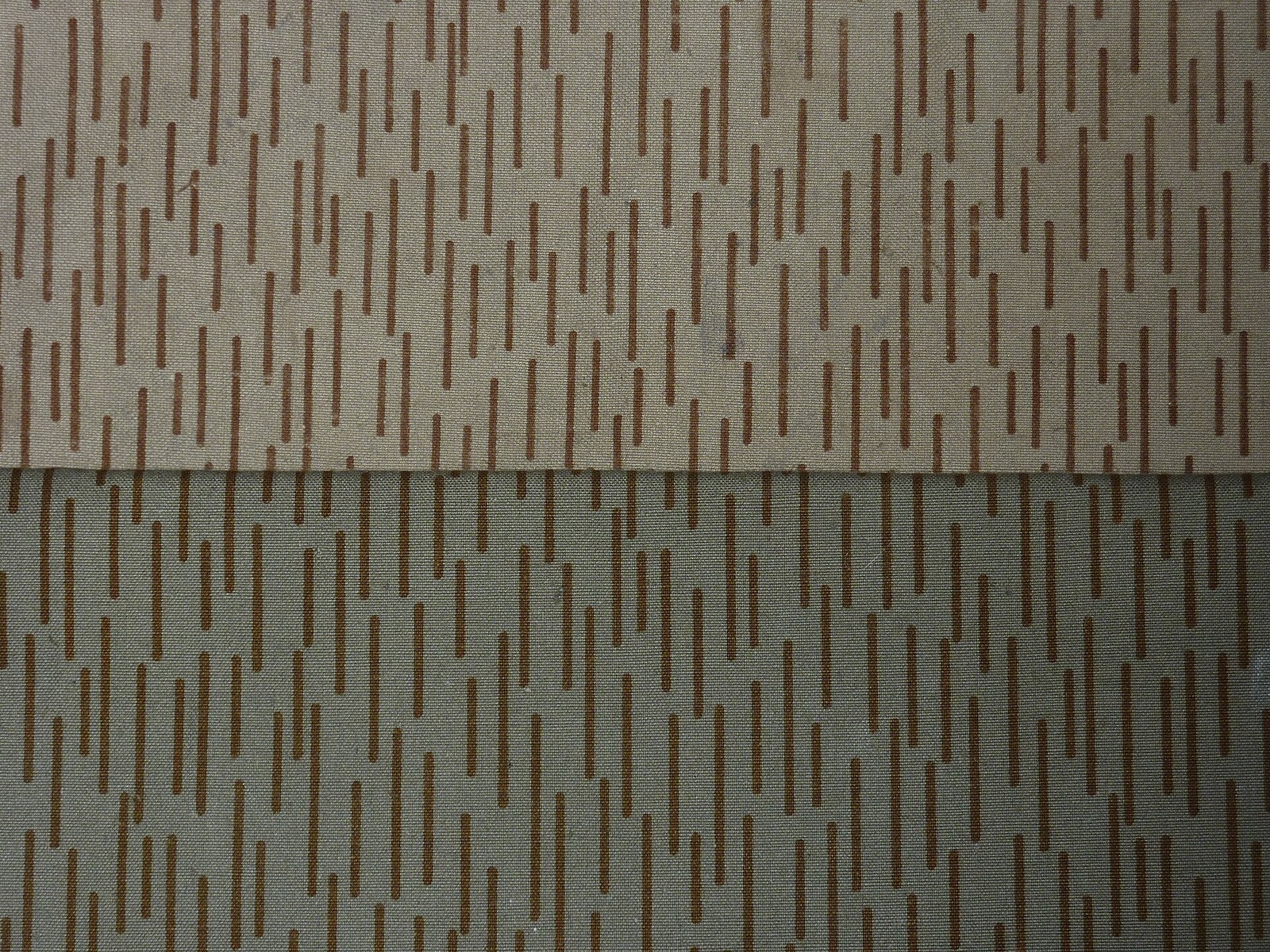
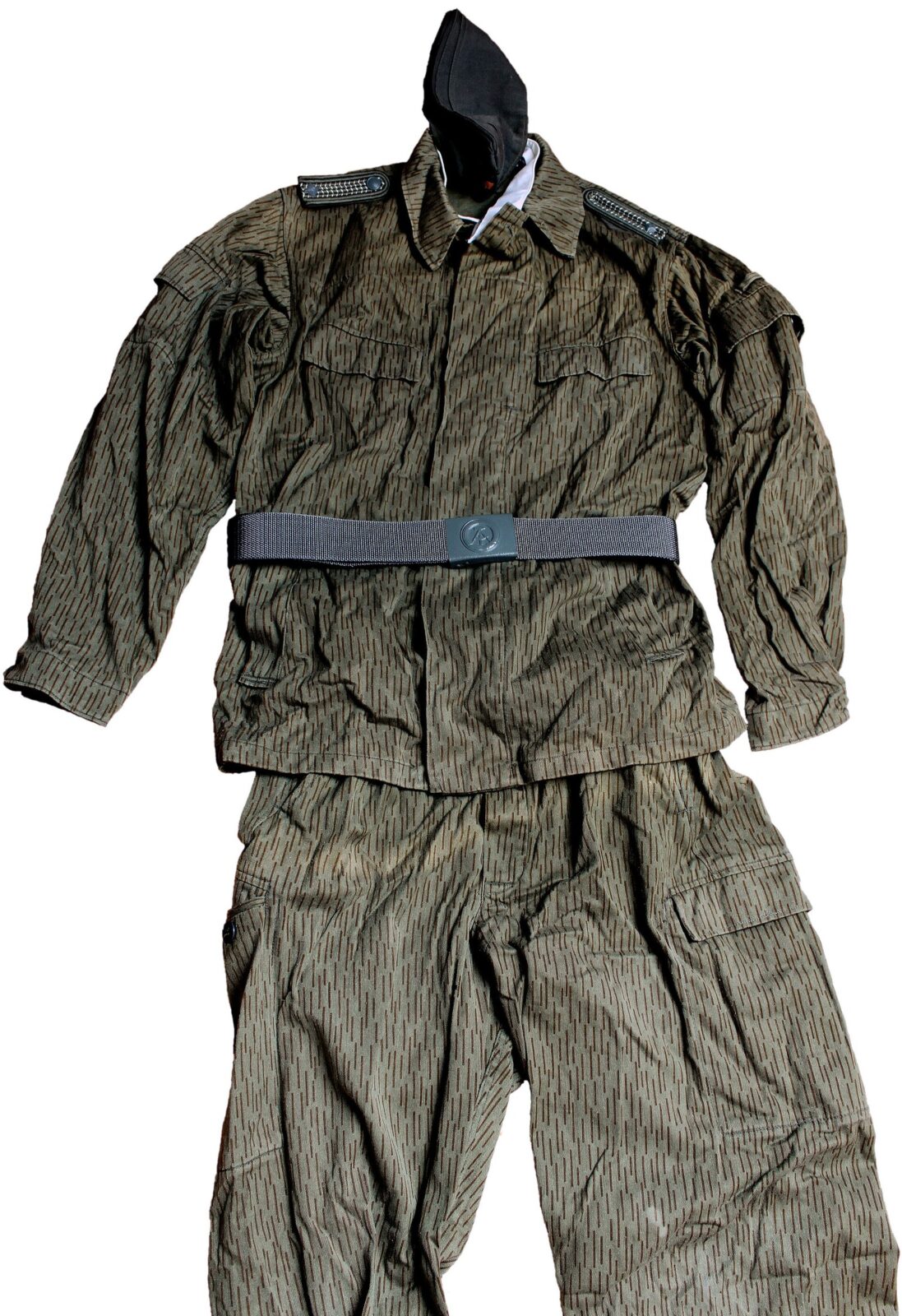
Two versions of Strichtarn are documented, and only two. Type 1 was produced for the Kampfanzug 64 from the middle of the 1960s: long, slender brown rain straits on a light greyish-green ground. Type 2 replaced it with a coarser screen, thicker brown dashes on a greyer, less luminous green, and is the pattern most people have seen, because it was in production until the collapse of the state in 1990 and went onto the great majority of surviving kit.
The dates at the boundary between the two are not agreed in the literature, and that is worth stating plainly rather than smoothing over. The standard German reference work, Michael Krauß’s study of East German summer field-service clothing, gives Type 1 as a 1965 to 1967 production and Type 2 as beginning in 1967. The collected camouflage reference Camopedia gives the first type as 1965 to 1968 and the second as introduced in 1968. The two accounts overlap and neither is decisive. The pattern should therefore be described as changing over between 1967 and 1968, with the caveat that transitional cloth presumably exists. Anyone who says a specific month separates the two is inventing precision the sources do not support.
One of the most common errors in online write-ups should be closed off here: there is no documented Type 3. The pattern was revised once at the start of its life and then carried, essentially unchanged, to 1990.
Kampfanzug 64: getting the rain into the field
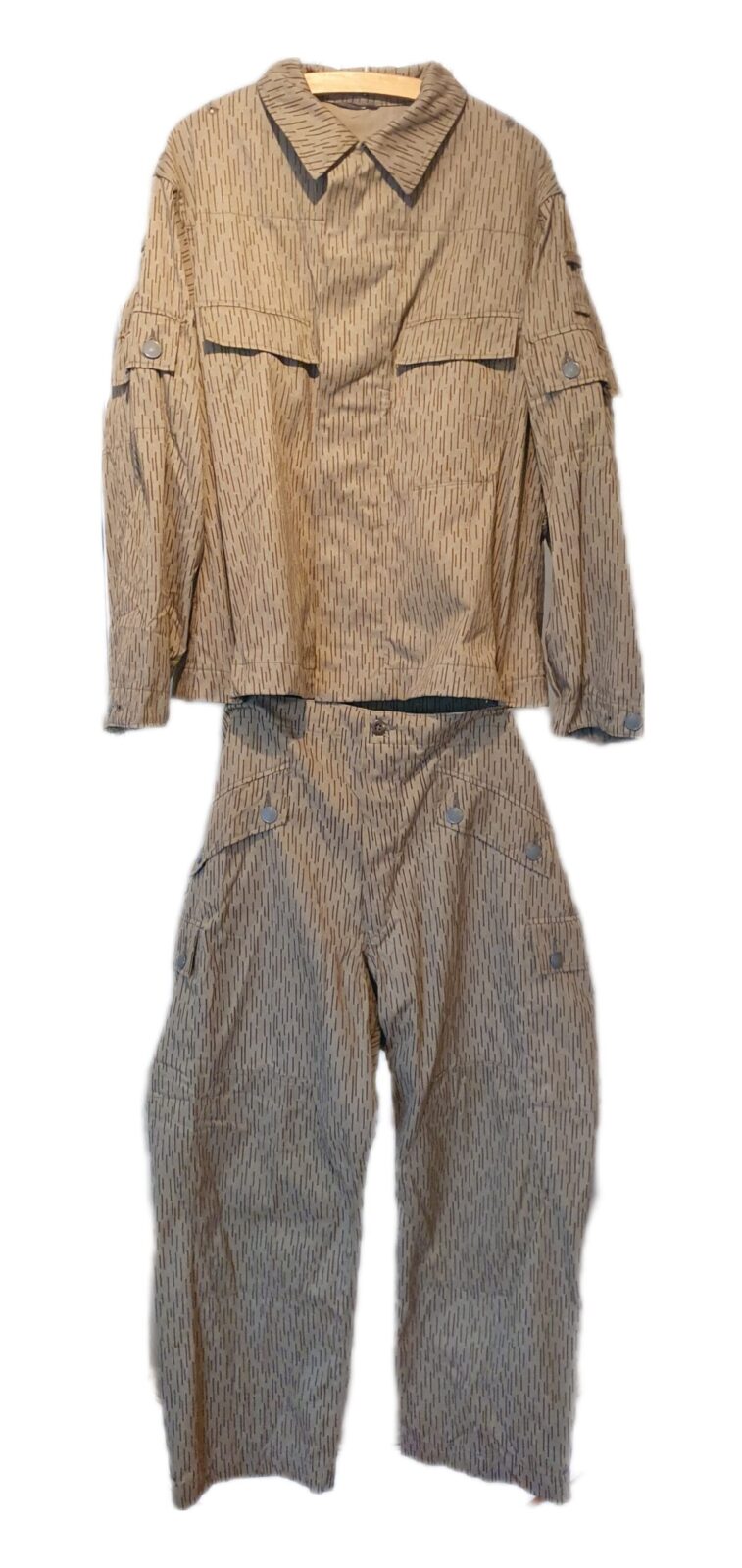
The introduction of Strichtarn was not a clean switch, and the sequence is unusually well documented in German-language sources. Trials began with the border troops in 1963, two years before formal adoption. The garment that carried it, the Kampfanzug 64, was introduced as a new lightweight field-service suit by order of the deputy of the Ministry of National Defence and chief of rear services, order 2/65 of 14 May 1965, and the first military district to receive it was Neubrandenburg. Full distribution across the army was intended to be complete by the end of 1969.
In 1965 and 1966 the same suit was manufactured in an identical cut in both the older Flächentarn print and the new Strichtarn, which means two soldiers in the same unit, in the same year, in the same uniform pattern, could be wearing two entirely different camouflage designs. Production of Flächentarn clothing continued in parallel at least until 1970, and the German-language account of the splinter pattern family notes that the pure Strichtarn print was only generally established in the National People’s Army from the beginning of 1970.
What Strichtarn replaced is a story in itself. The Flächentarnmuster, also called Blumentarn or, less kindly, Kartoffelmuster flower camouflage, or potato camouflage, was a blotch pattern of blue-green, olive and brown on field grey, adopted in 1958 according to the Imperial War Museums’ catalogue note, and it had itself replaced an earlier East German pattern derived from a Soviet wartime design. The German reference literature describes the move from a blotch print to a rain print as an inheritance from the Buntfarbenaufdruck 31, the 1931 splinter print of the Reichswehr and later the Wehrmacht, which had used rain-like flecks as part of a more complex multi-colour design; that wartime system is explained in MegaCamo’s guide to German Second World War camouflage and in the dedicated history of the Heer Splittermuster 31. The inheritance should be stated as an influence rather than a lineage: the collected Camopedia reference, the most cautious of the secondary sources on this point, says the rain theme in the Warsaw Pact was “probably influenced by” wartime German designs such as Splittermuster and Sumpftarn. Probable influence is not a direct copy, and the printed screens of the two patterns are not the same.
One reason often given in the English-language literature for the change of pattern is that the National People’s Army was concerned about its troops looking too similar to those of the Soviet Army. That is a reported motive rather than a documented decision, and a second, less flattering reason is implicit in the design: a single-ink dash print is the cheapest useful camouflage a textile industry can produce.
Not a uniform: the printed kit list
Because the print was cheap, Strichtarn was never only a uniform. The Imperial War Museums catalogue note on a pair of M1965 Strichtarn summer trousers states it directly: helmet covers and personal equipment were manufactured in cloth of the same pattern and worn universally until the end of the regime.
The documented list of printed items runs well past the suit: the field jacket and its matching trousers; a winter suit with more insulation, in the same print; the Zeltbahn, the shelter half that doubled as a poncho; the cover for the M56 steel helmet, a button-on, hood-like cover used with the helmet rather than a net; the field cap; personal equipment including magazine pouches for the Kalashnikov; and a fighting vest produced for airborne troops and scouts. The German-language collector documentation adds a telling detail: the M56 helmet cover is found with the jacket in the earliest Kampfanzug 64 sets, so the printed cover arrived with the pattern rather than being added later.
The airborne connection is the corner where the pattern is most often misidentified. East German paratrooper and scout kit includes a load-bearing vest in Strichtarn with no equivalent in the ordinary field-service issue, and the paratrooper field dress is among the pieces most reproduced for the collector market; when a vest with a layout you cannot match appears for sale, the odds are that it is a modern assembly rather than an NVA item.
Worn to the last month
Longevity is what separates Strichtarn from almost every other camouflage pattern of the Cold War. It was introduced in 1965, re-cut once at the turn of 1967 to 1968, and then carried unchanged for more than twenty years. The West Germans spent two decades arguing about spots before the Flecktarn family was finally adopted, and the contrast with the East German approach, decide once, print it cheaply, keep it, is instructive. The East Germans, with one of the smallest and poorest of the industrial Warsaw Pact states, kept a single-ink rain print in continuous production until the state itself stopped existing, and even developed their final field-service clothing experiment, the Uniformtrageversuch 85–90, out of the same line of development.
That longevity is not a compliment to the pattern’s concealment performance, and it would be dishonest to present it as one. No serious study in the public record ranks Strichtarn against contemporary Western patterns with any rigour, and the English-language claim that its effectiveness was “borderline at best” compared with British DPM or the American BDU carries a citation warning on the page that makes it. What can be said is that the pattern was cheap enough and stable enough that nobody in authority had a strong reason to replace it, and that in a state short of hard currency, with a textile industry that imported its dyestuff, those qualities were decisive.
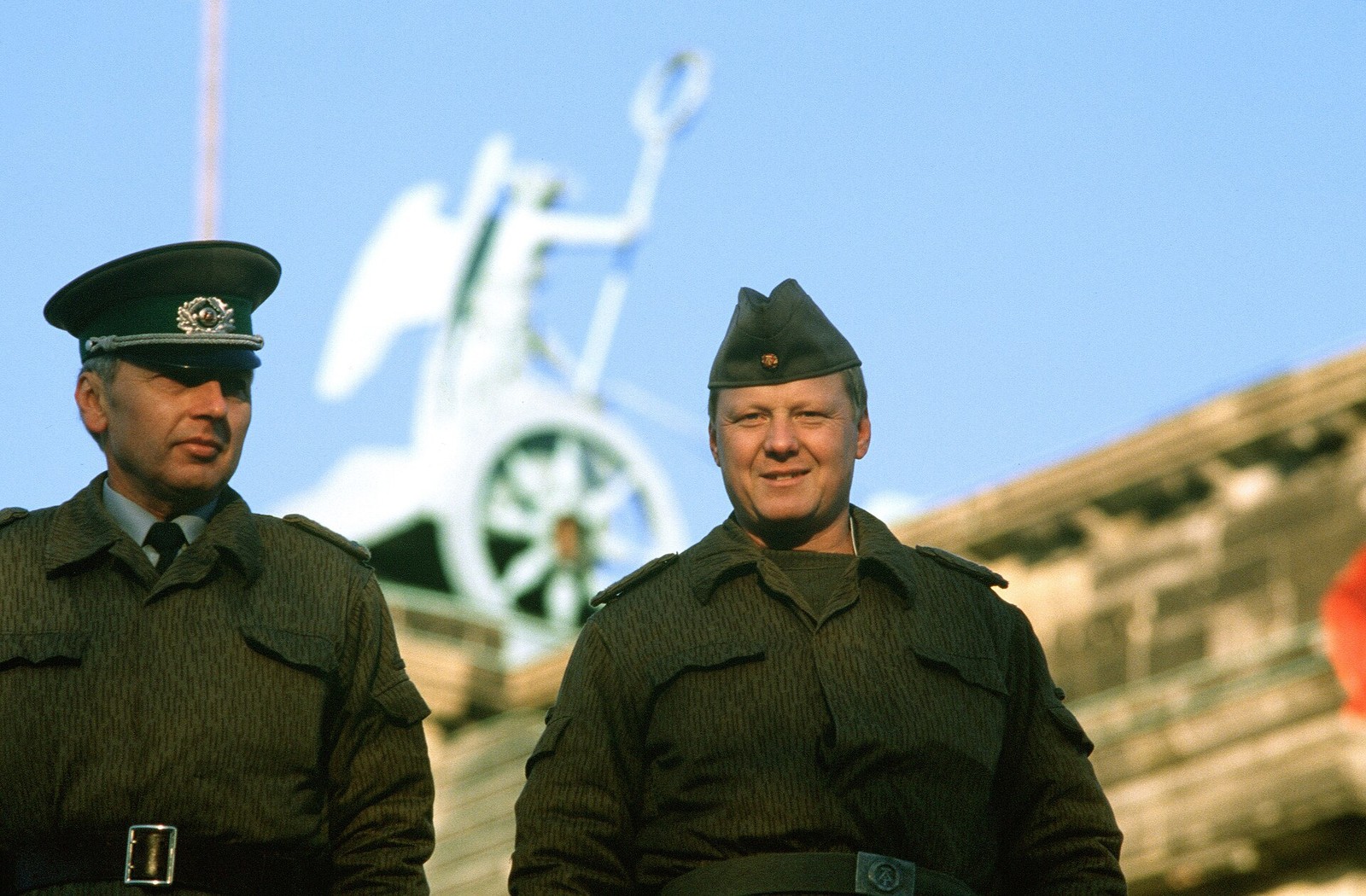
The pattern was still in service in the final weeks of the state. It appears in the news photography of the autumn and winter of 1989, worn by uniformed East Germans at the Brandenburg Gate in November and by guards standing on top of the Wall itself in December, at the moment the border was being opened. Those photographs are among the last documentary images of Strichtarn as working dress.
After 1990: the surplus decade
The end of the state produced one final, unintended export campaign. Stocks of uniforms were sold off as surplus, and the Imperial War Museums note that surplus uniforms of this type were purchased and issued to Croatian forces during the Balkan conflict; the Osprey study of the Yugoslav wars records Strichtarn-derived clothing in Croatian use until 1992, when the supply ran out. Argentina acquired surplus stocks in the 1990s and used them as garrison and fatigue dress until the early 2000s. Estonia’s Defence League used the pattern in the 1990s. Kyrgyzstan acquired surplus Strichtarn for its military in the same decade, and Uzbekistan’s airborne and special-task-force personnel are recorded in Strichtarn uniforms and fabric from roughly 2002 to 2006.
This is the “worldwide diffusion” half of the subject, and its character is worth naming: almost none of it is a planned export of a pattern, but the second-hand life of cheap cloth, printed in one ink on one screen in sufficient quantity that when the state disappeared the garments kept working for another fifteen years in armies that had never heard of the National People’s Army. Kazakhstan is sometimes added to this list; the claim carries no source in the reference article that makes it and is not treated here as established.
The pattern goes to Africa
The African chapter is older and more deliberate than the surplus story. The Imperial War Museums records that this style of uniform was supplied to a variety of what it calls “communist-influenced terrorist organisations” in Africa in the 1960s and 1970s. The museum holds a shirt in the pattern catalogued to SWAPO and UNITA, the Namibian and Angolan movements, and the collected Camopedia reference states that the pattern was worn in Africa by insurgent groups, particularly in Angola and South West Africa, where it was known as rice fleck. In the Zimbabwean case the pattern did not travel as a finished uniform at all: the reference literature records that ZANU and ZAPU wore locally made Strichtarn uniforms produced from East German supplied fabric, which is a more interesting fact than a simple shipment, because the cloth, the printing convention and the nickname all moved independently of the garments.
The evidence for this history has limits. It rests on museum objects with period attributions and on specialist and collecting literature about the Rhodesian and South African border wars, not on a published schedule of deliveries, and no reliable figure for the volume of cloth supplied appears in the published literature. “Popular” is a fair description; “massive” would need a document that does not appear in the published record.
Copies, look-alikes and the identification problem
This is where most Strichtarn mistakes are made, and the mistakes almost never involve the pattern itself. They involve the family. Four categories need to be kept apart: the East German original, the other Warsaw Pact rain prints, deliberate foreign copies, and modern reproductions.
The first distinction to draw is between the two East German types, already discussed: a finer, lighter print and a heavier, greyer one, changing over between 1967 and 1968. The second distinction is between Strichtarn and the rain prints of its neighbours, which look similar at a glance and are regularly confused online. Central European pattern-reading in general is a subject with its own traps, as MegaCamo’s account of how an American design became the signature print of Czechoslovakia’s vz. 95 shows.
| Pattern | Period | Ground | Dashes |
|---|---|---|---|
| Strichtarn Type 1 (East Germany) | c. 1965–1967/68 | single dyed tone, pale grey-green | long, slender, fine, widely spaced |
| Strichtarn Type 2 (East Germany) | c. 1967/68–1990 | single dyed tone, greyer green | thicker, denser, higher contrast |
| wz.58 Deszczyk (Poland) | from 1958 | field grey | thin brown dashes, simpler layout |
| vz. 60 Jehličí (Czechoslovakia) | from 1963 | two-tone, with a faint printed water-stain underprint | prominent dashes over the underprint |
| Bulgarian rain prints | 1960s onward | varies; a frogskin variant with a mottled ground | dashes, sometimes over mottling |
The single most useful rule follows from the third column. Strichtarn has one dyed ground tone: if a suspected rain print shows a printed mottled or two-tone background beneath the dashes, it is not East German. After the ground, look at the dash itself, the East German stroke is a short, broken, near-vertical mark with a fairly regular rhythm, not a long continuous line, not a splinter, not a fleck. Only then look at the garment, because East German kit has its own sewing conventions and hardware, and a right pattern on a wrong garment is usually an assembly rather than an issue item.
Deliberate copies are the most difficult category, and they are worth being precise about. The collector literature documents a Strichtarn-type print made for South African special forces in the 1970s and 1980s, published with photographs of surviving examples. Two further sources support the practice without providing a document: the Osprey study of South African Special Forces records that clones were made during the Border War, and the collected Camopedia reference states that the South African government reproduced the pattern for its special forces units, where the nickname rice fleck attached to it.
The 1975 file, and what it was not
A separate episode sometimes gets folded into the Strichtarn story and should be kept out of it. Around 2010 it became known that the East German Ministry of National Defence had run a camouflage design trial, with fabric samples produced by the Research Institute for Textile Technology in Karl-Marx-Stadt, the same institute associated with Strichtarn, and documents and surviving test cloths suggesting a date around 1975. The designs in that trial were not rain prints. The last of them, identified as “Example No. 6”, a blotch design resembling an amoeba pattern printed on ribbed uniform cloth, was worn by personnel of the Sandinista government in Nicaragua and was probably supplied to them by East Germany. That is striking evidence of how East German camouflage reached allied and non-state forces, but it is not a Strichtarn variant and not the Type 3 that does not exist.
The two Strichtarn types differ in dash weight and in the value of the ground, and both are altered by film stock, exposure, printing and the processing of a digital scan, so assigning a type from a news photograph is interpretation rather than observation.
Clothing and accessories in this pattern are in our catalogue: East German Strichtarn.
