
Camouflage History
Italian Camouflage: From Telo Mimetico to Vegetato
One of the most widely copied camouflage designs in Italian service was not designed as clothing at all. The pattern adopted in 1929 was printed on the shelter half, the telo tenda that Italian soldiers carried, and the name it acquired, telo mimetico, means simply “mimetic cloth”. For its first thirteen years the print’s job was to hide a tent, not a man. That it later ended up on smocks, oversuits, helmet covers and the uniforms of other armies is the accident that shaped a national tradition, and it is why Italian camouflage is best read as a sequence of generations built out of the same set of drawings rather than as a series of clean breaks.
Two warnings belong at the front, because they govern everything after them. Italy’s fourth generation is not a digital pattern: vegetato is an organic, soft-edged print, and the replacement announced in December 2025 is not digital either, the “pixel” in this story is a comparison with other countries, never a description of Italian cloth. And the newest Italian pattern, at the time of writing, is a procurement fact rather than a service reality: announced, described in supply paperwork and scheduled for a transition in November 2026, but not in general issue; no photograph of it in service is documented in the free record.
A pattern that began as a tent
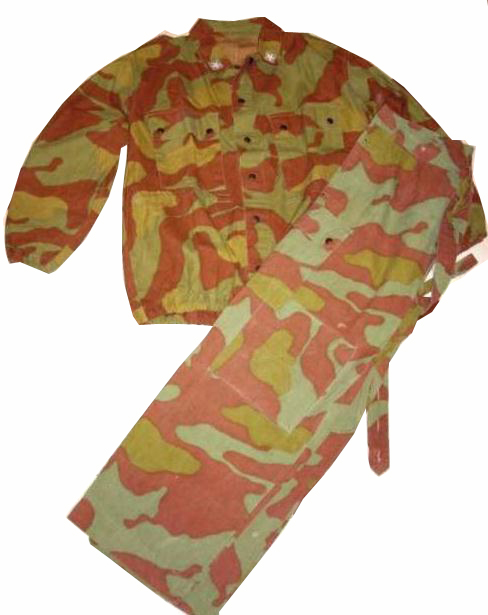
The M1929 telo mimetico was printed on the shelter half, and printed on one side only. That detail matters more than it looks: the object was a piece of canvas a soldier used for shelter, and the camouflage was a treatment of that canvas rather than a uniform design. The colours recorded for the first generation are large chocolate-brown and grey-green blotches on an ochre ground, an arrangement quite distinct from the later versions of the same drawings.
The drawings were not frozen in 1929. Before 1939 the pattern was modified, with the blotches compressed lengthwise, probably so that the design could be printed on narrower rollers, and the surviving evidence suggests the colours lighten with time and the print loses crispness. That account comes from the specialised literature rather than from a document, and it is worth keeping in that form: the print people call “the 1929 pattern” was already being adjusted before the Second World War.
The move from cloth to clothing is dated to 1942, when the printed fabric was used to make smocks for the Paracadutisti. This is the hinge of the Italian story. Once the print had been cut and sewn into something worn, it stopped being a tent treatment and became a uniform camouflage, and, with interruptions and re-cuts, it has remained one ever since. There is an earlier precedent worth naming without overstating it: in the First World War, Italy is described as the only nation to manufacture camouflage garments in significant quantity for a unit, a one-piece white suit issued to the Alpini and still in use in the campaigns of 1939-45 and afterwards. That is a snow suit, not a printed pattern, and it belongs to the prehistory of this story rather than to its four generations.
A vocabulary trap sits underneath all of this, and a large part of the confusion about Italian camouflage in English comes from it. Telo mimetico names both the object and the pattern: the printed shelter cloth, and, by extension, the printed family that grew out of it. The model designation M1929 belongs to the cloth, telo tenda is the term for the object, and mimetico is simply the adjective “mimetic” that Italian usage turns into a noun, hence mimetico deserto for a desert print.
The claim about being first
The M1929 print carries a large claim, and it is made in two slightly different forms. Camopedia describes it as “believed to be the first mass-produced camouflage pattern in existence”. The English Wikipedia article on the telo mimetico calls it “the first printed camouflage pattern for general issue”. These are not the same statement, and the difference is not pedantry: one is about printing as an industrial process, the other about issue as an administrative decision.
The honest formulation keeps both in view and attributes them. The defensible version is that the M1929 telo mimetico is described in the specialist literature as the first camouflage pattern printed in series and produced for general issue: printing the design onto continuous cloth with a roller, rather than painting or stencilling each item, is what makes the claim significant, and 1929 is early enough that no other candidate has been produced with better documentation. What is not written here is “the world’s first camouflage”, which is a claim about every army on earth and is not what either source says.
A second, softer claim attaches to longevity. English Wikipedia, drawing on the specialist writers Eric Verny and Jonathan Bocek, describes the M1929 print as “the camouflage pattern in longest continuous use in the world”. That is an assessment rather than an administrative record, no Italian document fixes a service life, but the dates support it: a pattern introduced in 1929 whose Navy version was still being produced in 2005, with the same drawings appearing across the Army, the Navy, the parachute troops and the marines in between. The nearest European comparison is German: Splittermuster 31 has the same origin story, a print developed for tent cloth that migrated to clothing, and comparing the two shows that Italy and Germany arrived at the same industrial idea within a few years of each other, with the Italian case at least as early.
Why the pattern outlived the war that created it
Italy’s armistice and the collapse of 1943 put large quantities of printed cloth and garments into the hands of anyone who was in the country, and the pattern’s post-1943 history is largely a record of reuse by other armies.
The best-documented case is German. In the spring and summer of 1944 the telo mimetico print was adopted and distributed to Waffen-SS units in Italy and in Normandy, and the photographs most often published of the pattern in German service are associated with the 1st and 12th SS-Panzerdivisions. That comes from the reference literature on German uniforms rather than from a German supply document: the evidence is a combination of surviving garments and period photographs, and it is worth saying so.
The post-war trail is thinner. Stocks are said to have reached Czechoslovak and Soviet units, and there is a widely repeated account of Italian printing machines being moved during the war, English Wikipedia suggests the transfer was made by the Germans, and reused afterwards for the Czechoslovak army. The principal English source flags that account as needing better sourcing, and the encyclopedia presents the machine story as documented without citing a document. It is therefore presented as a documented hypothesis rather than a fact: plausible, repeated in the literature, and not established by anything in the published record. The pattern also travelled by direct supply: from 1974, and through the 1980s, Afghan commandos and paratroopers wore a locally printed version of the Italian design, a reminder that a well-aged print can outlast the army that invented it and turn up in conflicts it was never designed for.
There is one more afterlife, and it is the most unexpected. In 1966, the date carried by the artist’s own archive, while the Museo Madre catalogue entry cited for the work reads 1967, the Italian artist Alighiero Boetti stretched sections of the printed cloth on frames and exhibited them under the title Mimetico, within the Arte Povera movement. The works are documented by the Museo Madre and appear in the Museum of Modern Art’s 2012 Game Plan presentation. The camouflage that Italy printed to hide a tent ended up, four decades later, in a museum of contemporary art on its own merits, as a surface, a repeat and a set of colours. It is a useful corrective to the reflex that treats camouflage as nothing but military equipment.
Generation two: the same drawings, new colours
Around 1950 the Italian Army and the Italian Navy each took the 1929 drawings and re-cut them. The shapes stayed recognisably the same; what changed was the scale and the palette, and the two services changed them in different directions.
The Army version, dated to about 1950, tightened the drawings and built its palette around russet and ochre on an olive-green ground. It was used on an infantry oversuit, on the helmet cover and on the parachutist’s dress, in addition to the general-purpose shelter half itself. The Navy version kept the same shapes but printed them on a bluish-grey ground, was worn above all by the Battaglione San Marco, and, this is the detail that makes the second generation so long, examples dated as recently as 2005 survive in collections, with the pattern’s naval use declining only after 1992, as the marines moved to a print of their own.
A third variant, which the source can probably date to the 1960s, is recorded with russet and sand on a light grey ground, in use into the 1990s. The same source records the origin as unknown: it is not established whether the pattern was developed for the Battaglione San Marco or intended more specifically for COMSUBIN, the Navy’s special forces command. The palette is the documented part.
The context matters here, because without it the survival of the 1929 drawings looks strange. During the NATO decades, the majority of Italian armed forces did not wear camouflage at all: the standard dress was plain dark olive green. Camouflage in the Italian Army of that period was not the norm that vegetato is today, it was a specialty, concentrated where it had a reason to exist: the marines, the parachute troops, the shelter halves, and the garments built on them. That is why the second generation survives mainly as maritime and airborne clothing, and why the pattern’s centre of gravity moved away from the line infantry and then back again, half a century later.
Generation three: Roma 90 and the woodland turn
The third generation is a break, and it is the point at which Italy stopped developing the 1929 logic and joined the American woodland family. The print usually called Roma 90 was developed from 1990, introduced in 1992, and remained general Army issue until about 2005. Its design is strongly influenced by the United States’ woodland pattern of the early 1980s, the descendant of the ERDL leaf pattern and its drawings differ slightly from the American original.
Two things need separating in that sentence, and the separation is what makes the identification hold.
The first is the descent. That the Italian pattern which followed the M1929 was based on United States woodland is stated both in Camopedia and, through the reference literature on camouflage uniforms, in English Wikipedia, which records that the M1929 print ended up being replaced by a pattern based on US Woodland. Two independent layers of writing agree, and the pictures agree with them: a woodland print is dark-ground with light overprint, the opposite of the light-ground blotch logic of the telo mimetico, and that inversion is the visible mark of the change.
The second is the name. “Roma 90” is a usage name. It is the form used by the surplus trade and by the specialist press, but no published source demonstrates an Italian regulation designation under that wording. The same caution applies to the date: 1990 for the start of development and 1992 for introduction are the convergent figures, and they rest on specialist encyclopedia material rather than on a document read directly.

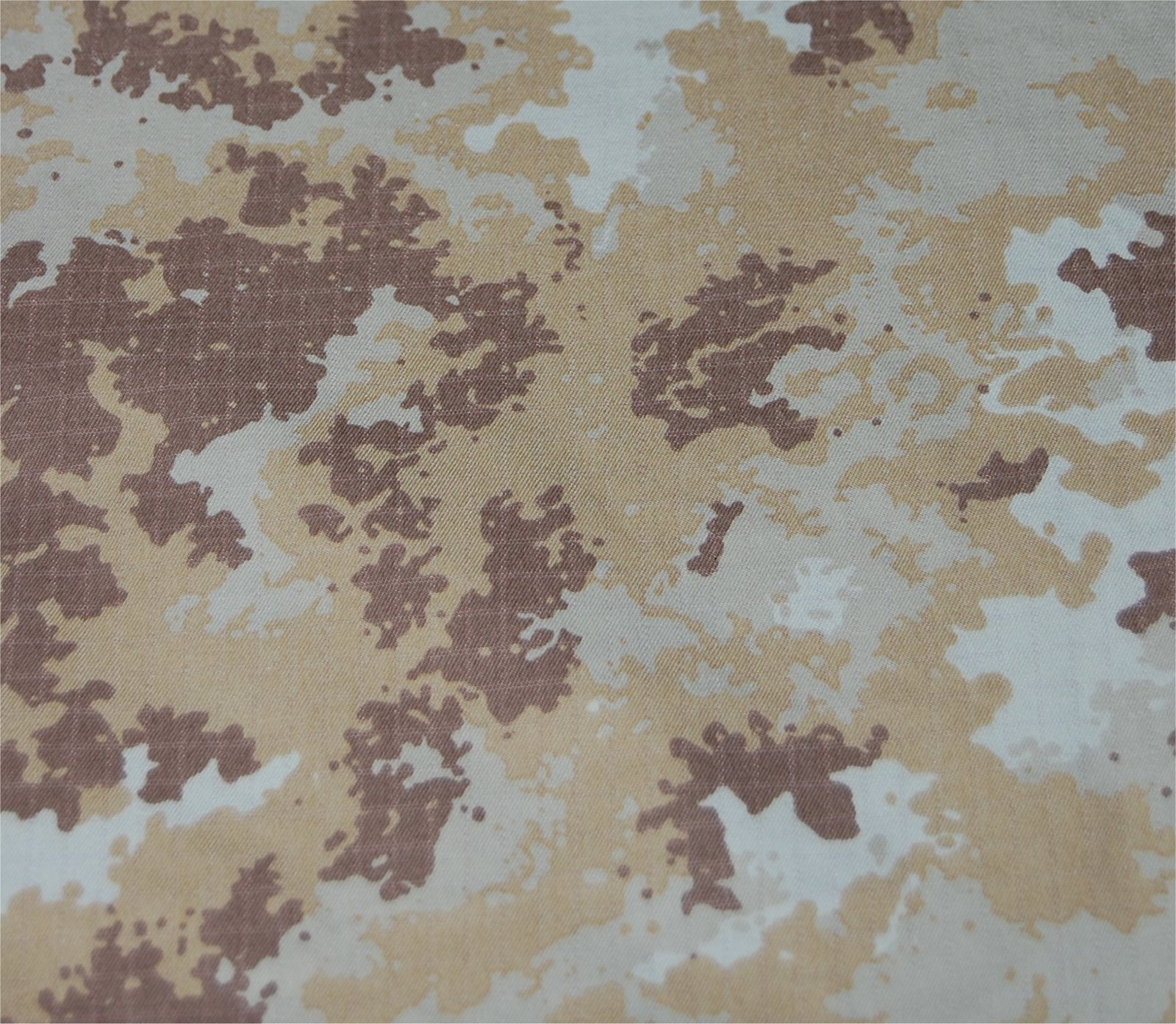
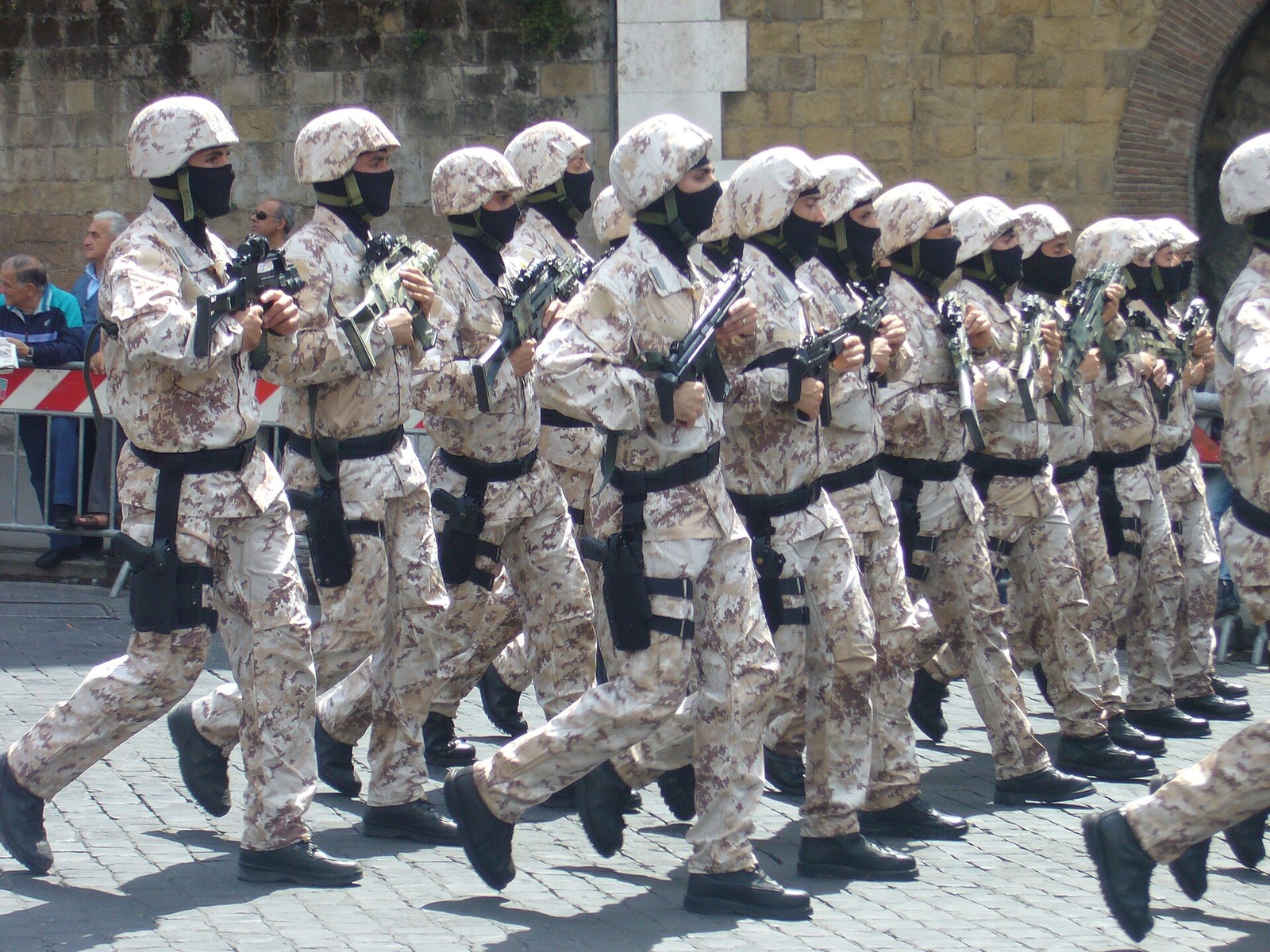
The third generation has a second member, and it is the one that matters most to the Italian Army’s subsequent history. In 1991 Italy introduced a desert print, used first in Kurdistan during Operazione Airone and then in Somalia as part of UNOSOM II, and it stayed in standard use for around fifteen years. Its nickname in Italian service, “Mogadiscio”, after the battle, is a usage nickname, not a designation, and it is best treated as the kind of informal label soldiers give to equipment they end up living in.
One honest problem is about pictures rather than about facts: No freely licensed photograph of the Roma 90 print is available. The free graphic reconstructions that had to be set aside document the earlier generations, the wartime M1929 and the prints of the 1960s, and none of them covers the Roma 90 print; no freely licensed photograph of Italian troops in the period was found in which the print is legible and identified. The consequence is stated rather than hidden: the third generation is documented by a period photograph that does not identify the print, and not by a look-alike.
Generation four: vegetata, and the pixel it never used
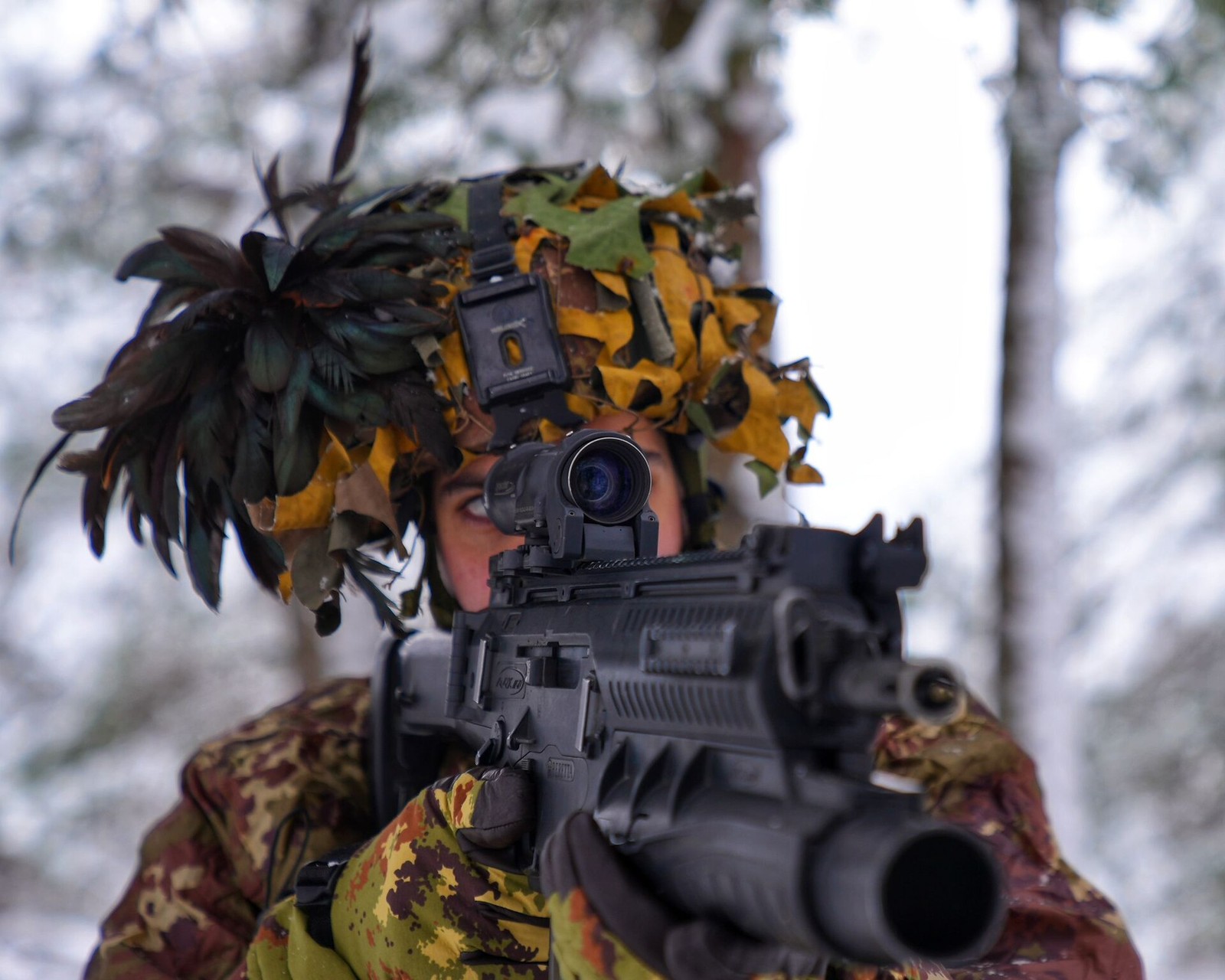
In 2004 the Italian Army adopted a new print, recorded in the specialist literature as mimetico Vegetata and known in the trade, and in MegaCamo’s own catalogue, as Vegetato. MegaCamo uses Vegetato and the sources spell it Vegetata; the two refer to the same print.
The pattern is conventionally described as chocolate brown, russet and olive green on a khaki ground: four colours, organic shapes, soft edges. Adoption ran in sequence rather than all at once. The Army took it first, in 2004; the Air Force followed; the Navy, including the San Marco regiment, came across in the early 2010s. A desert version was introduced in the same year, built from chocolate brown, ochre and light tan on a sandy beige ground, and a COMSUBIN variation runs darker in the brown.
Two editorial points about the fourth generation are more useful to a reader than any date.
The first is that the “same” pattern is not a colourimetric standard. Variation between production lots and between manufacturers is documented, which means that two garments legitimately in issue in the same year may not match each other closely in tone. Photographs exaggerate this further: dust, sun angle, white balance and the age of the cloth all move the apparent colours, and a swatch photographed indoors under artificial light will not match the same cloth photographed in a Latvian winter. Anyone trying to identify an Italian garment from a photograph, or to match a reproduction to a photograph, is working with a tolerance band rather than a specification.
The second is the description of the geometry itself. Vegetato is an airbrush-like, soft-edged blotch print, large organic shapes with blurred boundaries, and it is not a digital or pixelated pattern. This is worth stating flatly because the phrase “four generations, from tent cloth to pixel” describes the arc of camouflage in general, not the Italian arc in particular. Italy never went through a pixel phase: where the United States, Canada and others moved to grid-based printsCADPAT being the pattern that started that move, and UCP the one that taught the US Army what “universal” cannot mean, Italy stayed with organic shapes. The vocabulary in how camouflage is classified is the right instrument for describing that difference precisely.
The fourth generation also produced a commercial branch. Around 2012 a recoloured version of vegetato on a palette close to that of the widely licensed MultiCam family was marketed as “Vegecam” or “Multiland”, and it was taken up by the Army’s special forces. The same line of development explains the designation that appears in current procurement paperwork: a “SOD Vegecam” print is reported in issue with mountain troops of the special forces since 2018, and it is named in the documents that describe the pattern now scheduled to replace the whole family.
The parallel families that do not fit the line
The four generations are the Army’s story. Around them sit several Italian prints from the same decades that belong to the same country but not to the same line, and separating them is where short summaries usually go wrong.
The marines come first, because the San Marco regiment was the first Italian unit to receive a pattern that was entirely its own, the encyclopedia entry puts that primacy in the late 1980s, while dating the five-colour drawing itself to 1990-1992. That design is black, olive green, rosy red, light grey and a yellow-tan, with blurred, airbrush-like edges, known colloquially as ginestra, after the broom plant. Production continued into the early 2010s, and COMSUBIN is recorded with the same design one or two shades darker. A desert version of the marine print was trialled between 1993 and 1995 and reported as worn in Somalia around 1994-95, but the source that records it states explicitly that it was never officially adopted, exactly the distinction that disappears when a pattern is catalogued by the surplus trade.
The COMSUBIN desert line is a third thread, carrying the operator nicknames “peschite” and “pink panther”, worn in Iraq between about 2003 and 2006. One recent addition to this family is documented institutionally instead of by nickname: on 21 February 2020 the new blue-toned camouflage suit was officially adopted for the divers of the Navy’s Gruppo Operativo Subacqueo, in the presence of the Minister of Defence, Lorenzo Guerini. That date and the minister’s presence are recorded by the specialist press, which credits the Marina Militare’s own online news bulletin of 5 March 2020, and that bulletin is the strongest single source in the public record, a service publishing its own adoption, and it is worth naming as such, because so much of the Italian chronology rests on encyclopedic writing rather than on service documents.
The mountain troops add a further thread. In the 1980s the Alpini took up the German snow camouflage known in the trade as the “pine needle” pattern, and since 2006 the 4th Alpini Paracadutisti Regiment “Monte Cervino” has worn a vertical pattern of its own on lycra suits. The origin of that vertical print is recorded as unknown, and it is left there: an unexplained pattern is more useful to a reader than a guessed one.
The announced replacement: modello 2025
In December 2025 the Chief of Staff of the Italian Army, Lieutenant General Carmine Masiello, announced a mimetismo multi-terreno modello 2025 intended to replace the vegetata family, presented as descending from a design called “Altimetrico F”, linked in turn to the “SOD Vegecam” print reported in issue with special-force mountain troops since 2018. That the pattern was developed by the Army’s research directorate together with Beretta is recorded in the encyclopedia entry alone; the procurement coverage in the press names Beretta only in connection with a rifle presented on the same occasion.
What exists in public is a documentation file rather than a piece of equipment: procurement documents naming the pattern and the Altimetrico F designation, a technical plate of the “disegno Altimetrico versione F” published on the Army’s own site, and a reported objective of 70,000 suits during 2026, relayed by the specialist press from a defence news outlet. Camopedia records an official transition date set for November 2026, with senior officers and some units issued earlier, while the procurement coverage describes a supply destined for personnel “in preparation” for near-term operational use. The same coverage also states plainly that no official photograph of the new uniform being worn exists; the image circulating with the announcement is a technical drawing.
Two statements do not follow from that file, and neither is written here. The first is that the pattern is in service: it has been announced, documented and scheduled, which is not the same as issued. The second is that it is digital: nothing in the public description or the published plate is grid-based, and a multi-terrain print in the Italian organic tradition is exactly what the lineage suggests. Anyone who sees a photograph of Italian troops after November 2026 and is told it shows the 2025 pattern should ask for the document rather than accept the rendering.
- Generations one and two are large soft blotches on a light ground, in few colours, a design meant to be read at the scale of a shelter half.
- Generation three inverts the logic and joins the woodland family: a dark ground carrying lighter overprint, with detail at canopy scale.
- Generation four returns to the Italian habit of a light khaki ground with darker shapes, this time with four colours and soft, airbrushed edges.
- No Italian service print has used a pixel grid. Where pixel patterns are named here, the comparison is with other countries, not with Italian cloth.
- Colour is a band rather than a value. Variation between fabric lots and manufacturers is documented for vegetato, and photographs move colour further through dust, sun angle, white balance and the age of the cloth. A swatch photographed indoors under artificial light will not match the same cloth photographed in a Latvian winter.
- Identification of Italian camouflage from a photograph should therefore be provisional, and a reproduction should not be matched to a photograph for exactness. The flat sample is a pattern reference, not a colour-calibrated swatch.
Clothing and accessories in this pattern are in our catalogue: Italian Telo Mimetico and Italian Vegetato.
