
Camouflage History
PHILMARPAT: The Philippines’ Digital Marine Pattern
PHILMARPAT is a camouflage pattern with a well-known name and a surprisingly thin paper trail. The reference works that cover the subject state that the Philippine Marine Corps adopted it in 2008, and they state that it is copyright-protected. Both claims are repeated across the web as settled fact. Neither rests on a document. What the public record does support is narrower, and more interesting: a green, pixel-based pattern worn by the marine corps of an archipelago, whose earliest dated photograph in the openly licensed record is from October 2014, six years after the adoption date that circulates everywhere.
That gap is the reason for the account below. Camouflage writing tends to collapse three different things into one sentence: what a pattern looks like, when it entered service, and who owns the design. For PHILMARPAT those three questions have three different answers, of three different strengths. Here is what can be established, what is only reported, and where the two are routinely confused.
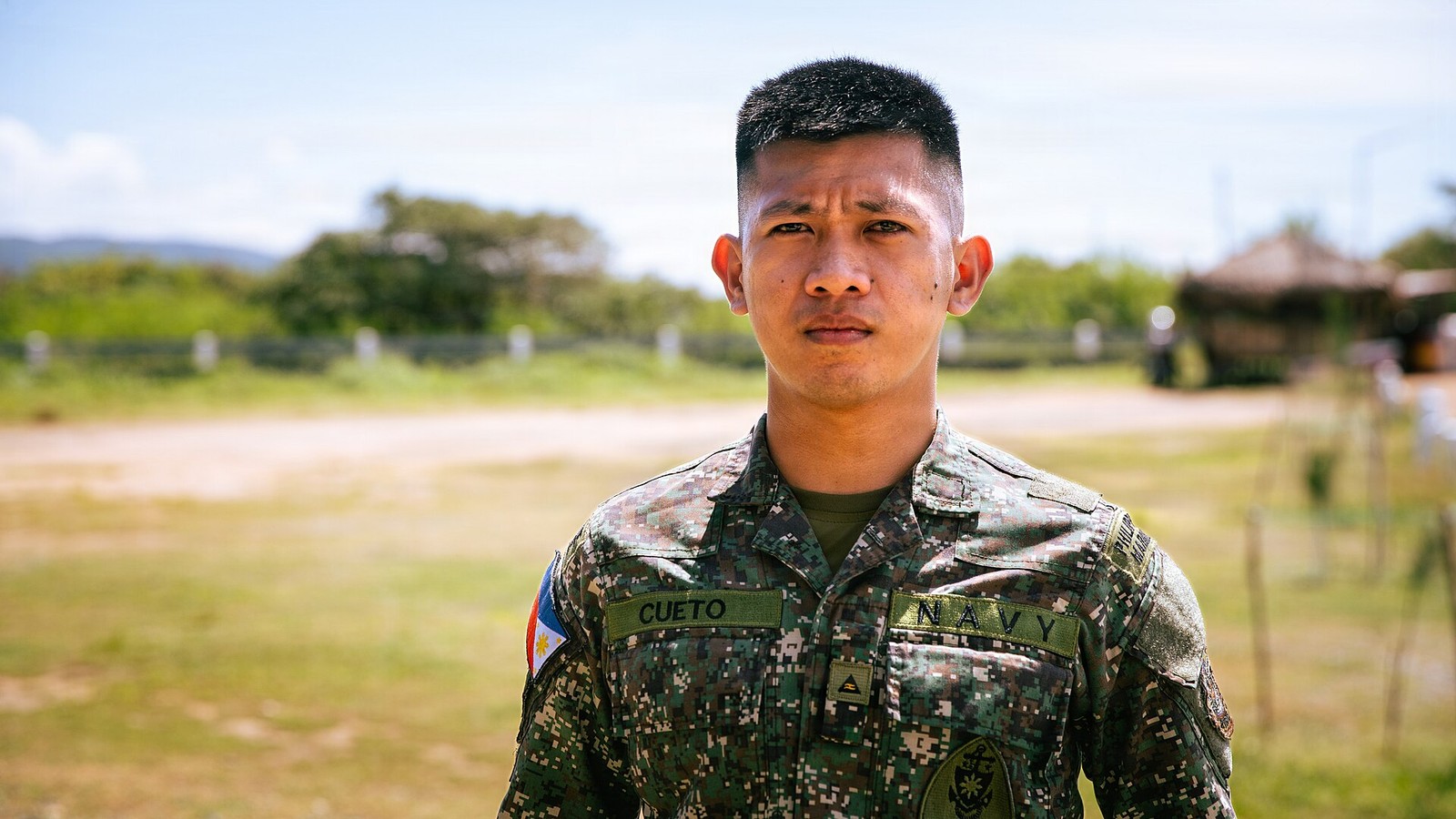
Two names, one uniform
The pattern has two published long-form names, and they are not identical. Camopedia glosses PHILMARPAT as “Philippines Marines Pattern”. Wikipedia’s article on the Philippine Marine Corps glosses it as “Philippine Marine Pattern”. The difference is small, but it is a useful reminder of how the pattern is documented: by summary, in passing, in reference works that are themselves compiling earlier summaries.
Alongside the pattern name sits PBDU, short for Pixelated Battle Dress Uniform. The distinction matters and is frequently blurred in collector listings and resale copy. PBDU is a name for the cut the garment, while PHILMARPAT is the name of the print. A uniform can be a PBDU in that sense without the conversation being about the pattern at all, and a pattern can be discussed entirely separately from the garment it is printed on. Terms like “PMC digi” or “PMC digital” are collector shorthand, not nomenclature, and should be read as such.
What carries the pattern is a specific organisation. The Philippine Marine Corps is the marine infantry corps of the Philippine Navy. Its lineage begins with the creation of a marine corps within the Philippine Navy in 1950, and the corps took its present name, Philippine Marine Corps, in 1995, the year of its 45th anniversary. Camopedia’s account of the pattern is slightly wider than the corps itself: the pixelated design is described as adopted by the PMC and by some units of the Philippine Navy. That detail matters later, when a photograph shows a sailor rather than a marine and the natural question is what that person is wearing.
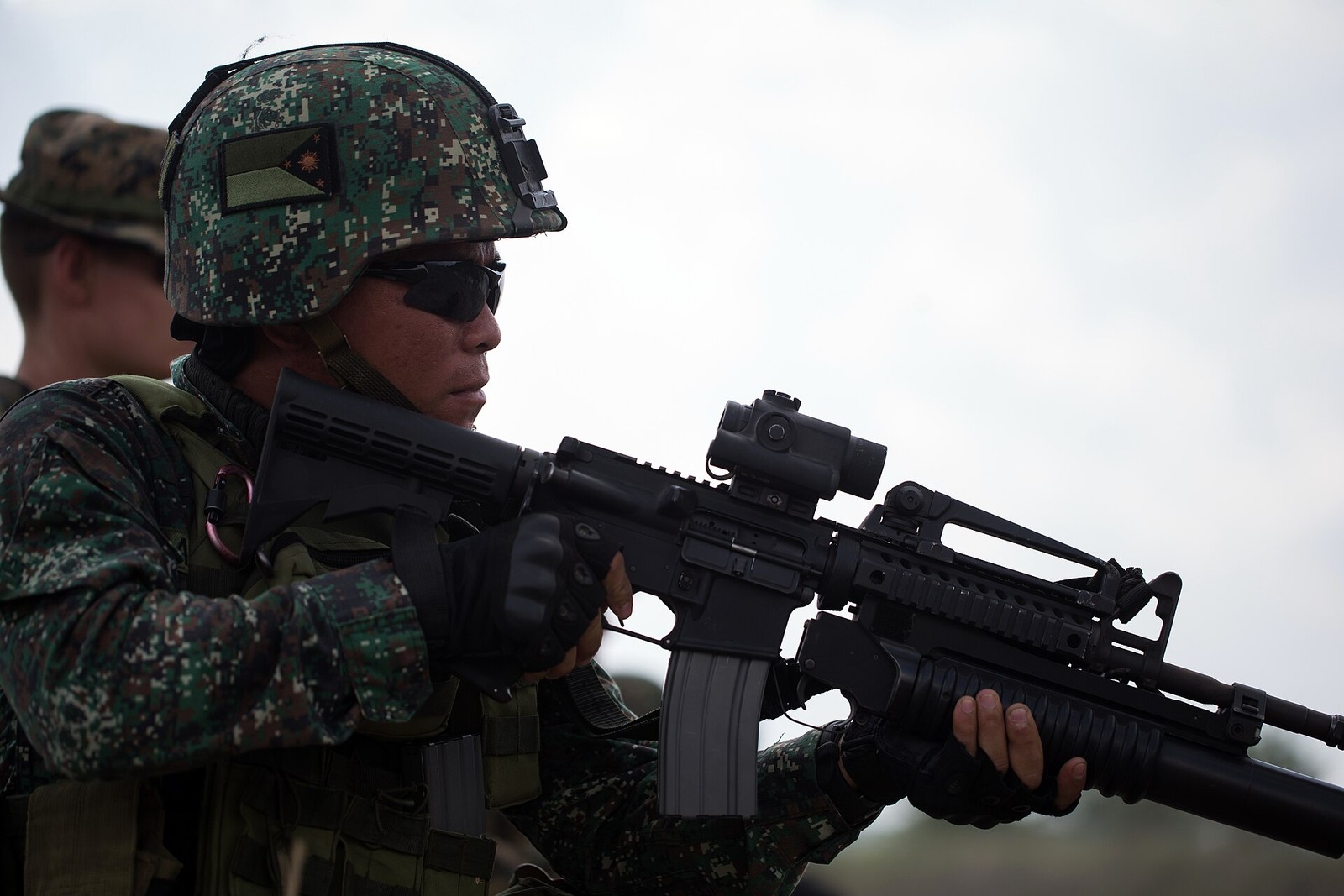
The pattern’s geometry is orthogonal: square blocks with strictly horizontal and vertical edges, in a green-dominant body of colour that also carries brown and dark elements, with nothing resembling a leaf shape, a branch or a vertical tiger stripe. The blocks are not of one constant scale across the documented record.

Camopedia states that the pattern has the Philippine Navy and Philippine Marine Corps logos embedded into it. That is a specific and checkable assertion, and it has not been verified on the documented record.
The 2008 date and the 2014 photograph
The adoption date attached to PHILMARPAT is 2008. It appears in Camopedia (“In 2008, the PMC and some units of the Navy adopted a pixelated camouflage design…”) and in Wikipedia’s account of the corps (“the PMC has used a digital disruptive camouflage pattern called the Philippine Marine Pattern (PHILMARPAT) since 2008”). Those two are the load-bearing citations, and they agree with each other.
Agreement between two secondary references is not the same as a primary record. In Camopedia’s treatment of the Philippines, the paragraphs covering the older marine corps patterns carry footnotes; the PHILMARPAT paragraph does not. There is no dated service memorandum, no procurement notice, no published uniform regulation, and no contemporary press release in the available material. So 2008 is best described as a reported adoption year, consistently reported, of unknown ultimate provenance, and not as an established service-entry date.
The photographic record, meanwhile, starts later. The earliest dated photograph in the openly licensed pool that shows this pattern on Philippine Marine Corps personnel is from 10 October 2014, at the closing ceremony of Amphibious Landing Exercise 15 at Fort Bonifacio. After that the record is continuous: 2015, 2019, 2023, 2024 twice, and 2025.
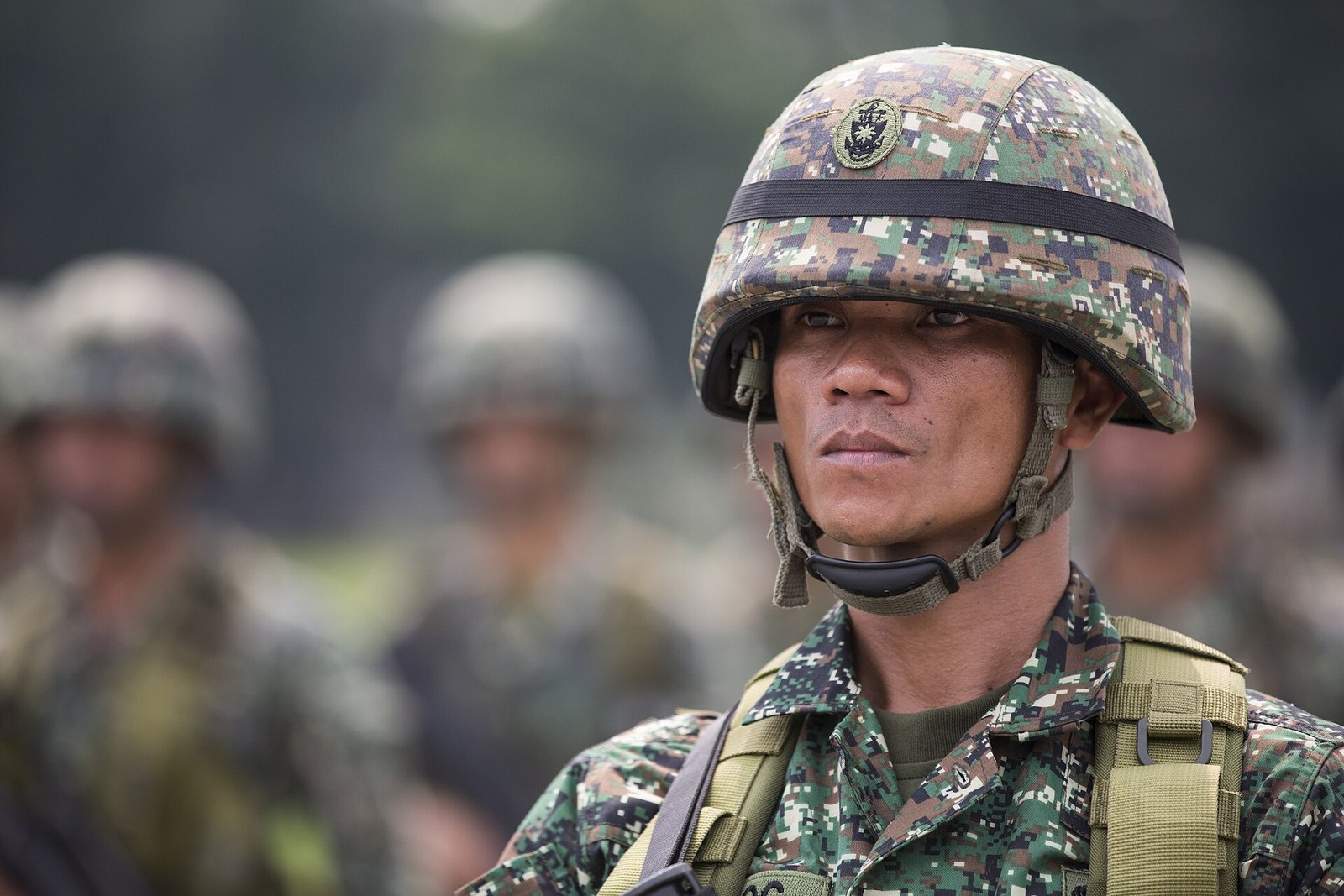
A six-year gap between a reported adoption and the first dated photograph is not a scandal. It is an ordinary consequence of how military clothing reaches soldiers: a design is approved, cloth is ordered and printed, garments are cut and issued, and units are photographed wearing them at whatever pace the documentation machine happens to run. Camopedia adds a detail that fits that sequence, noting that the original cloth supplies were imported from China. But a plausible sequence is not evidence of the sequence, and nothing here establishes that distribution took six years. What is supportable is narrower: the 2008 date rests on a secondary source, the 2014 photograph is primary evidence, and nothing examined bridges the two.
Before the pixels: Malunggay, Ugat and tiger stripe
PHILMARPAT is the fourth or fifth answer to the same question, so the pattern makes more sense read as the end of a sequence than as a beginning.
The Philippine Marine Corps’ first camouflage pattern was a leaf design, trialled around 1972 under the name Malunggay or Ugat. According to Camopedia, two versions were rejected before a third was approved by the Department of National Defense: brown and dark olive-green shapes with black twig-like marks on a tan ground, subsequently reworked onto a paler green ground. A second leaf pattern followed in 1978, described as influenced by the Ugat design. Camopedia notes that these drawings may have been of Thai origin, and that variants were still being worn in the 1990s and into the 2000s. That pattern family is discussed in its own right elsewhere in this series; what matters here is the timing. The pattern PHILMARPAT replaced had been in service, in one form or another, for roughly three decades.
Running alongside it was a second tradition. The Philippine Navy’s special operations group, NAVSOG, has worn tiger stripe since the 1970s, beginning with copies of South Vietnamese originals and settling on the current version of the pattern from 1990. Navy construction battalions, the Seabees, have worn vertical stripes since the late 1990s, and Camopedia records that those stripes were still being worn side by side with the Malunggay leaf pattern and with the marine corps’ pixelated uniform. A third strand, a copy of British Disruptive Pattern Material, has been the standard pattern of the Philippine Army and the Philippine Air Force since the early 1990s, with a blue-grey variant for the air force.
That mixture is the context in which the pixelated marine uniform arrived. Camopedia describes the underlying procurement situation bluntly: uniforms across the Armed Forces of the Philippines were historically standardised to a limited degree, and personnel were permitted to buy their own camouflage clothing provided it was of reasonably good quality and reasonably close in design to the issue item. In an archipelago of many thousands of islands, with three service branches, a marine corps inside the navy, and special operations units with their own traditions, that produced exactly the visual hodgepodge the policy implies.
A single pattern shared across a corps is therefore not a trivial thing. It is a procurement decision, and PHILMARPAT is best understood as the moment the Philippine Marine Corps stopped being a collection of locally sourced uniforms and became legible as one formation, at least in photographs.
The patterns that are not PHILMARPAT
The Philippine digital-pattern story has more than one branch, and most of the confusion in circulation comes from crossing them.
PHILARPAT is not PHILMARPAT. In August 2016 the Armed Forces of the Philippines revealed a pixelated pattern of its own, PHILARPAT, derived from the commercial Camopat™ design by HyperStealth Industries. Camopedia’s account of how it got there is the part worth remembering: the pattern was first negotiated with the Canadian design firm, and after no agreement was reached on rights and royalties, it was redrawn by the Philippine state. That is a digital pattern for the army and the wider armed forces, revealed eight years after the marine corps pattern, and it belongs to a different organisation with a different provenance.
PHILAIRPAT is a third branch. The air force version appeared in early 2020, described as a green, black and light-green palette on a light grey ground.
The grey pattern of the Philippine Navy is not a marine variant. Camopedia records that the navy adopted its own version of Camopat™, largely grey with black, around 2018. This becomes relevant when a photograph shows a naval uniform in greyish tones: the grey belongs to the navy’s pattern, not to a hypothetical grey edition of PHILMARPAT.
Older army-pattern trails are separate. The army’s Special Operations Command fielded a distinctive uniform known as the SDU around 2009; the Scout Rangers wore an SRDU pattern in 2009 and 2010, largely for ceremonial use, described as very dark grey, medium grey and white on a black ground; a Light Reaction Battalion uniform, the LRBDU, followed its own line. None of these is the marine corps pattern.
Two of the plan’s own relatives. The seven-colour brushstroke attributed to General Arwel Oropesa and introduced in May 1977, described as freely inspired by the “pinks” pattern of South Vietnamese airborne troops, and the “puzzle” pattern introduced in 1972 with its two distinct types, are treated on their own. Both are Philippine, both predate the pixels, and neither is PHILMARPAT.
MARPAT is the American relative. Wikipedia’s article on the Philippine Marine Corps presents PHILMARPAT as having been inspired by the United States Marine Corps’ MARPAT, the digital pattern designed in 2001 and issued with the Marine Corps Combat Utility Uniform from late 2002 into 2005. “Inspired by” is the formulation, and it is kept here: the reference works describe inspiration and resemblance, and no source states what, if anything, was licensed, adapted, or measured from the American design. The American pattern’s own legal history is a separate story and is not retold here.
Finally, there is the error worth naming because it is in print. A Philippine commercial uniform seller, advertising an item as the “PHIL MARPAT original”, describes the pattern as “the official camouflage pattern for the Philippine Army’s battle dress uniform since 2018”. Two things are wrong with that sentence: the unit (this is the marine corps pattern, not an army one) and the date (2018 is later than both reference works, and coincides instead with the navy’s grey Camopat™ adoption). It is a commercial listing, not a source, and it is cited here only as evidence of how the two branches get crossed in everyday use. The same crossing runs the other way too: PHILARPAT is regularly described online as a marine pattern when it is an armed-forces pattern revealed in 2016.
What “copyright-protected” is doing in this story
Here the record thins sharply, and it is worth being explicit about how thin.
Camopedia states that PHILMARPAT “has been a copyright-protected pattern since March 2010”. Wikipedia states that the corps “has official copyright awarded to them”, and its footnote leads to a single document: a decision of the Bureau of Legal Affairs of the Intellectual Property Office of the Philippines, dated 14 June 2016, in a case captioned Medtecs International Corporation Ltd. v. Vice-Adm. Ferdinand S. Golez, Major Gen. Juancho Sabban, Capt. Ramon Rernales and the Philippine Navy, docket number IPC No. 13-2011-00182.
That citation is the entire documentary basis of the legal claim as it circulates. It has three properties that a reader should hold onto.
First, it is a litigation document, not a registration certificate. A case number and a decision date establish that a proceeding existed, and who the parties were: a corporation named Medtecs International, and three named naval officers, an admiral and two generals, together with the Philippine Navy itself. Second, the docket number embeds a year. IPC No. 13-2011-00182 places the filing in 2011, that is, after the reported 2008 adoption and after the March 2010 protection claim, and five years before the decision. Third, and most importantly, the decision itself is known only by its caption and date. Nothing here states what the tribunal decided, on what legal basis, or in whose favour.
That limitation has a consequence for any sentence an editor might want to write. The claim “the Philippine Marine Corps owns the copyright in PHILMARPAT” cannot be made from this record. Neither can “the pattern is in the public domain”, which is the equally unfounded mirror image that circulates among people who want to reuse it. What can be said is what the two reference works say, attributed to them: the pattern is described as protected since March 2010, and the authority cited for that description is a 2016 decision of the Philippine intellectual property office.
What the existence of the case does support, as an interpretation, clearly labelled, is a certain kind of dispute. A textile corporation suing naval officers and the navy itself, in an intellectual property proceeding, in a country whose marine cloth was reported to have been imported, is a shape that suggests an argument over who owned a design, or over the terms on which it was supplied. Camopedia records a related pattern of events a decade later, when the armed forces’ PHILARPAT was redrawn by the state after negotiations with HyperStealth Industries failed on rights and royalties. That is a suggestive parallel, not a finding. Ownership disputes over camouflage designs are common, they are usually settled quietly, and the shape of a case caption is not evidence of its content.
One further caution belongs here. “Copyright” is a word used loosely in camouflage writing to mean “someone claims this design”. A copyright, a design registration, a trademark, a patent and a procurement contract are different instruments with different owners, durations and effects. Which of them, if any, covers PHILMARPAT, and who holds it, is unresolved on the available record. Anyone who needs a definitive answer, for a publication, a reproduction, or a product, needs the decision text itself, and that is a task for a lawyer rather than for a reference work.
Where the pattern has been worn
The strongest evidence about PHILMARPAT is not about the cloth at all. It is about who is standing in it, and where.
Compiled from the dated captions attached to official photographs, the green digital pattern appears across the corps rather than inside one elite niche. An infantry battalion on a live-fire range at Colonel Ernesto Ravina Air Base in April 2019. A battalion landing team, Marine Battalion Landing Team 10 (MBLT-10), as credited in the source, handling anti-tank rocket launchers in March 2024. The intelligence company of the 3rd Marine Brigade launching a small unmanned aircraft in October 2024. A coastal defence platoon commander in October 2025. Companies, battalions, brigades, and a defence regiment with a maritime mission: the pattern is a service-wide uniform, which is precisely what a corps-level adoption implies and precisely what the earlier pattern-per-unit arrangement did not deliver.
The geographic spread is just as telling. The photographs place marines wearing this pattern at Fort Bonifacio in the Manila metropolitan area, at Ternate in Cavite province, at a live-fire facility in Ilocos Norte during a June 2025 exercise of the 4th Marine Brigade, and at exercise locations connected to the annual United States–Philippines series Balikatan and KAMANDAG. That is Luzon and the metropolitan core; it is not the whole archipelago, and no claim is made here that the pattern’s distribution has been mapped.


Against that record of units, there is an important absence. The corps’ two best-known modern engagements, the fighting in Zamboanga City in 2013 and the battle of Marawi in 2017, do not appear in the visual record below as dated frames showing this pattern. The reference sources list those operations as part of the corps’ recent history. They say nothing about what the marines were wearing, and neither does the account below. A reader who wants a photograph of PHILMARPAT in combat is asking for something the openly licensed record does not currently supply.
One more thread from the same year the pattern’s legal status is usually assigned to: in 2018, according to Wikipedia’s account of the corps, legislators proposed making the Philippine Marine Corps a separate service branch. Nothing in the available record connects that proposal to the uniform question. It is noted only because 2018 is the year the commercial listing described earlier picked as the pattern’s start, and because the marine corps’ institutional ambitions and its visual identity have a habit of being discussed together.
How to read a PHILMARPAT photograph
Four habits separate a defensible identification from a guess.
Read the caption before the cloth. In every case examined, the thing that establishes what is being worn is the attribution and date in the original caption, the corps itself, a named battalion, a specific exercise. The visual pattern confirms the caption; it does not replace it. A photograph described only as “camouflage uniforms” is not evidence about a specific pattern, and a stock-library keyword is not a description.
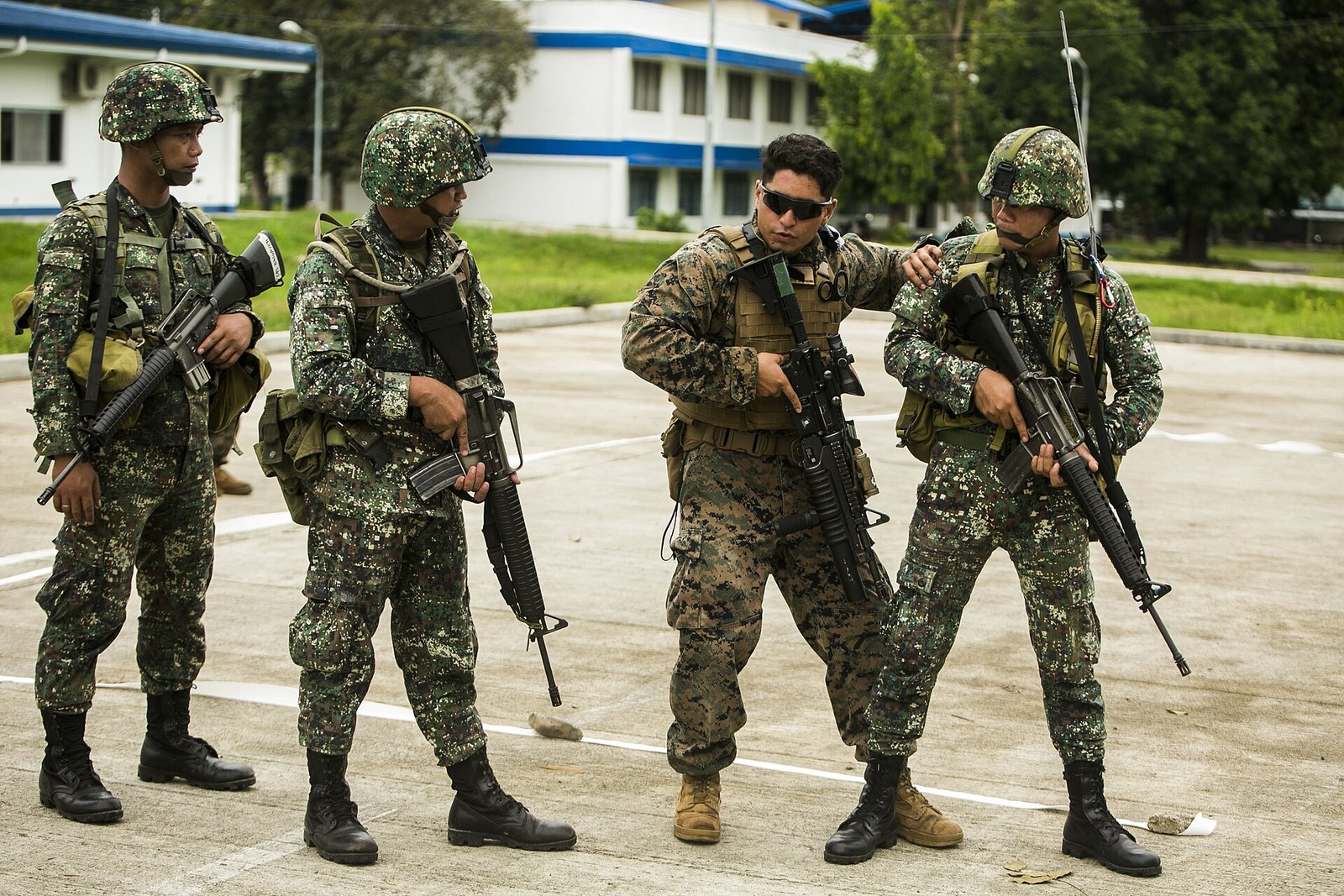
Check what the lighting is doing. The pattern’s apparent colour moves with daylight, wear, and fabric batch. The October 2024 frame above reads grey-green; frames from 2014, 2015 and 2019 read as a deeper green. Reading a paler reproduction as a new pattern, or as a “grey PHILMARPAT”, is a natural error and a wrong one: the only documented grey digital uniform in the Philippine naval family belongs to the navy’s Camopat™, adopted around 2018, and it is a separate design.
Distinguish the pattern from the print pipeline. A related caution applies to cloth detail: a logo printed or embroidered onto a garment, a unit patch, a name tape, an organisational mark, is not the same thing as a motif inside the printed repeat. Camopedia’s statement that the navy and marine corps logos sit inside the PHILMARPAT repeat remains, on this record, unverified.
A pattern with a thin paper trail
PHILMARPAT’s place in the digital camouflage story is easy to state and worth stating precisely. Pixels reached the world’s armed forces in the years around the turn of the millennium. The American pattern this one is compared with was designed in 2001 and issued with the Marine Corps Combat Utility Uniform from late 2002 into 2005, on Wikipedia’s account, and other services followed through the 2000s and 2010s. A Philippine marine pattern reported as adopted in 2008 sits inside that wave, not among the pioneers of the pixel, and comfortably ahead of the Philippine Air Force’s own pixelated pattern, which appeared in early 2020.
Its design logic is equally legible in the record. Where CADPAT and MARPAT are woodland- and desert-oriented palettes, the Philippine pattern is green-dominant: dark green and medium olive as the body of the drawing, brown patches reading reddish in sun, black, and pale khaki and sand pixels for contrast. On the evidence of dated photographs of Philippine marines, that reading holds across a decade of frames and across units of very different kinds. Whether the palette was specified for the archipelago’s vegetation, or simply inherited from a supply of printed cloth, is not established, the recorded import of the original cloth supplies from China points at a supply chain as much as a design brief, and a supply chain explanation is not the origin story a service normally publishes.
What makes the pattern genuinely interesting is not the design, which is competent and unremarkable, but the asymmetry between how loud it is visually and how quiet its paperwork is. A military uniform pattern adopted in the 2000s normally generates a trail: a specification, a tender, an awarding supplier, a defence department circular. For PHILMARPAT the trail runs: two reference works that agree on 2008 and on a March 2010 protection date; one intellectual property case caption from 2016; imported cloth mentioned in passing; and then a decade of photographs which begin in October 2014 and never stop. That is not nothing. It is also not an archive.
Which leaves the three questions from the opening, with three different answers.
What PHILMARPAT looks like is established: a green-dominant, orthogonal pixel pattern with brown, black and pale blocks, worn by Philippine Marines in photographs dated from 2014 to 2025, and readable in the openly licensed record at a level of detail sufficient to distinguish it from leaf patterns, tiger stripes, and the American pattern it resembles.
When it entered service is reported: 2008, on the authority of two secondary references, with the first dated photograph six years later and no primary document in between.
Who owns it is unresolved: described as protected since March 2010, with a 2016 Philippine intellectual property decision cited as the authority by the only encyclopedic source that mentions it, and that decision not read.
For a pattern that soldiers have been photographed wearing for more than a decade, that is a strange distribution of certainty, and it is the honest portrait of how camouflage is documented. The cloth is public. The paperwork is not.
Clothing and accessories in this pattern family are in our catalogue: Philippines.
