
Camouflage History
ABU: The US Air Force’s Tigerstripe, and Why It Was Retired
For fourteen years the United States Air Force wore a uniform no other American service had: a pale tiger stripe printed in pixels, cut to be washed and hung rather than pressed, and issued to everyone from recruits at Lackland to crews inside air-conditioned operations buildings. The Airman Battle Uniform entered service in 2007, became compulsory in 2011, and disappeared from American air bases ten years later.
It was not withdrawn because airmen disliked it, although a great many did. The ABU, as it was known everywhere, was retired by a combination of legislation, budget logic and a concealment problem its own testers had already put in writing. Its story is a useful one, because it shows what happens when a service designs a uniform to look like itself first and to hide its wearers second.
A uniform of its own
In October 2002 the Air Force Chief of Staff set the service on a course the other branches had not taken: a utility uniform developed only for airmen. Until then the Air Force had worn the same woodland Battle Dress Uniform as the Army, a twenty-year-old design built for a European war that never came. Two requirements drove the project. The uniform had to be visibly Air Force, so that airmen could be told apart from soldiers and marines in joint environments. And it had to be cheap to maintain, because ironing, starching and polishing boots cost airmen hours they did not have.
The first design, shown to airmen in 2003 and 2004, was built around blue: a digital pattern in blue-grey tones that matched neither ground nor sky. Wear tests were run at dozens of bases and the response was blunt. Airmen objected to the blue, questioned how well it hid anything, and asked instead for colours that reflected the Air Force’s own working environments. By late 2004 the service had relented and produced a revised pattern, a pixelated tiger stripe in tan, sage green and a muted slate blue, with a fourth tone of grey added for the insulated combat layers. It was approved for production in 2005 and began reaching unit shelves two years later.

Fielding began in 2007, first with airmen deploying into the Central Command area, and in the first days of October 2007 recruits at Lackland Air Force Base in Texas began receiving four sets each instead of four sets of woodland BDUs. The changeover took four years. Airmen could wear either uniform until 1 November 2011, when the BDU, the Desert Camouflage Uniform, the black t-shirt and black combat boots were all retired on the same day. The date had first been announced as 1 October and was moved back a month.
What the pattern actually is
The Air Force had already adopted a name for its pattern by the time the ABU was issued, and it appears in the service’s own regulations: an Air Force digitised tiger stripe print. The tiger stripe family is older than most people assume, a set of flowing brush shapes that first appeared in Indochina and was later copied for special units elsewhere, including the Russian Kamysh pattern. The Air Force kept the flowing shapes and broke them into small squares, the trick Canadian and American designers had used in the same decade to soften the hard outline a large blotch produces. Where the CADPAT and MARPAT patterns that came out of the same research push went green and brown, the ABU stayed cool: pale grey, off-white, sage green and tan.
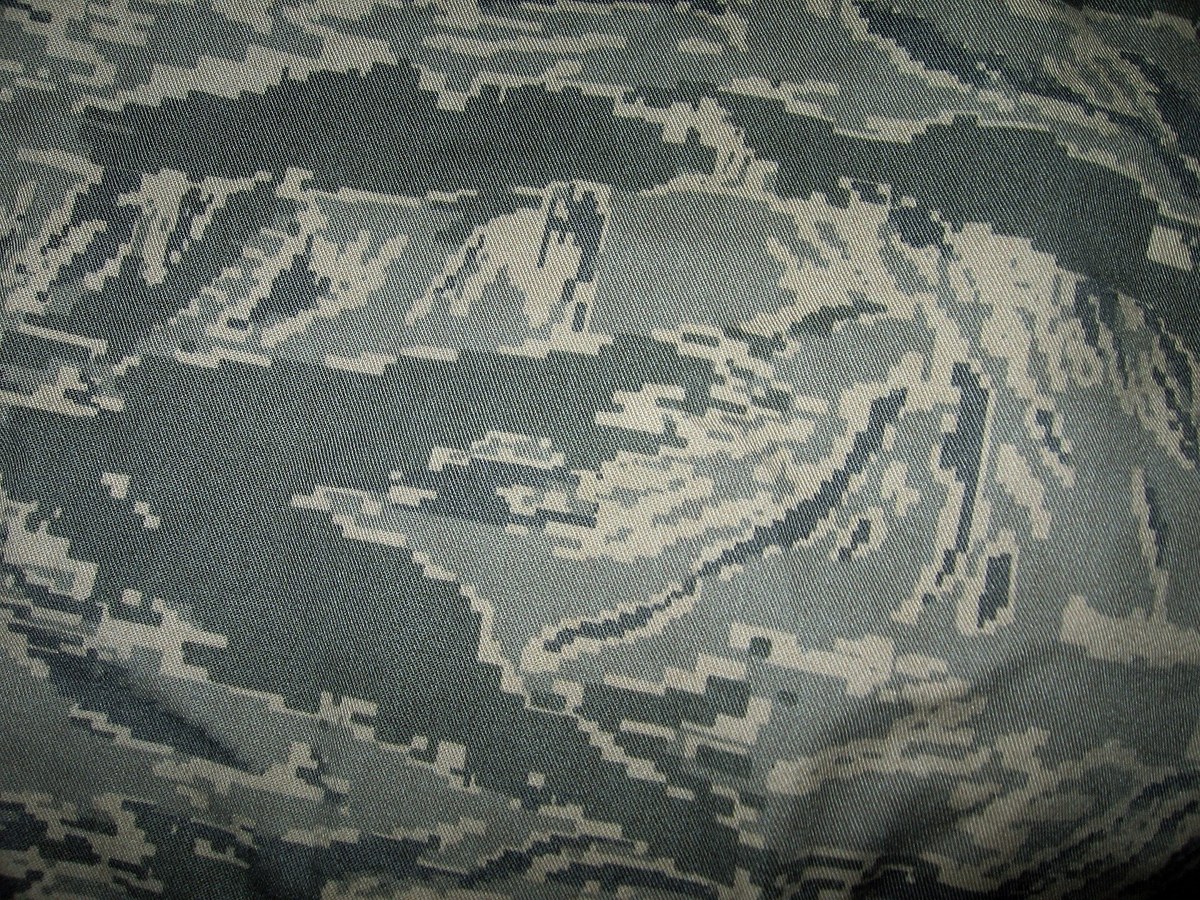
The palette is why the ABU looked the way it did, and it is also why it eventually had to go. Sage green, slate and off-white are colours of concrete, flight line tarmac, hangar interiors and cloud. In woodland and in the dry, brown spaces of Afghanistan and Iraq, they read as light grey.
Cut, cloth and the grab-and-go idea
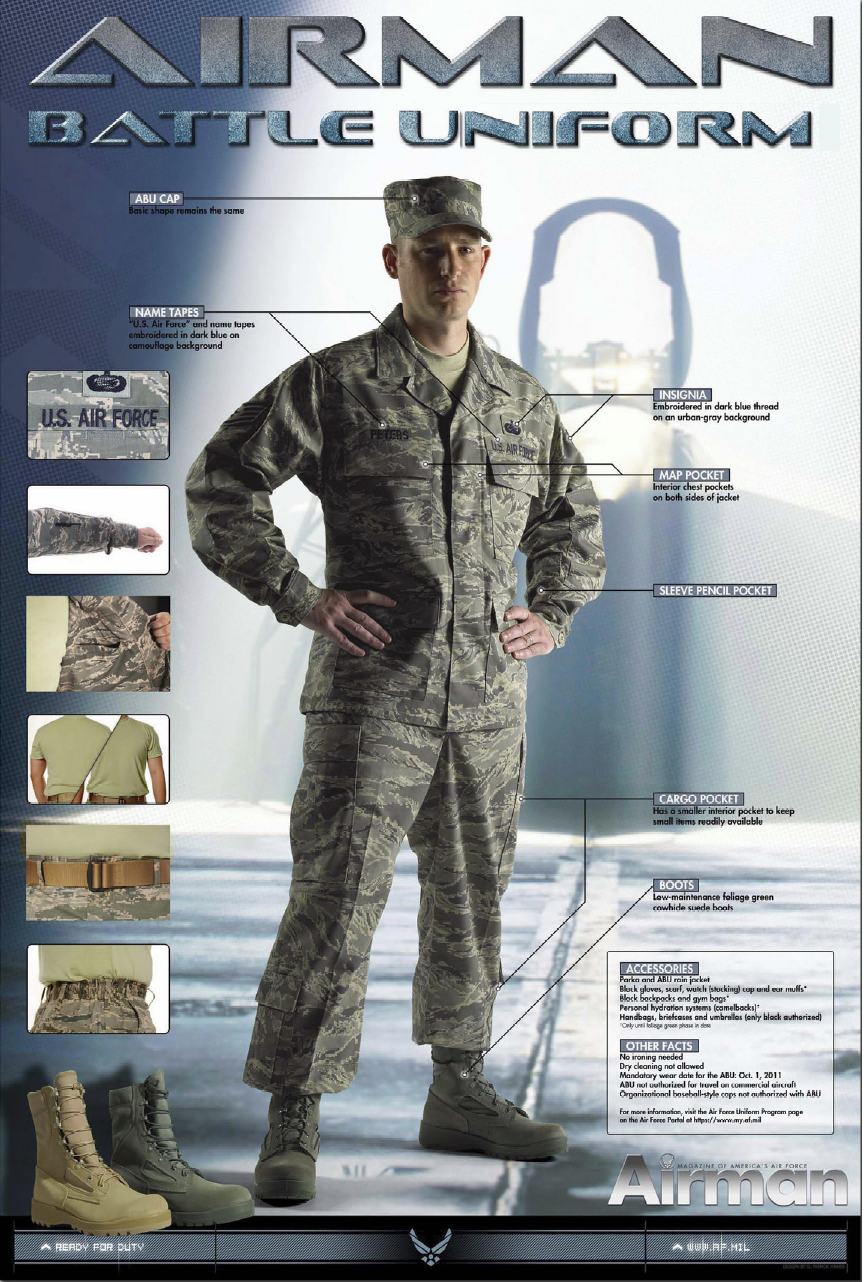
The ABU was built on a simple promise: an airman should not have to spend time on a uniform. The original cloth was a 50 per cent nylon, 50 per cent cotton twill, printed with the pattern, and the care rules were deliberately minimal. No starch. No dry cleaning. Wash it and hang it up. Rank insignia sat on an urban grey backing instead of on the pattern, name tapes were embroidered in dark blue letters straight onto camouflage cloth, and the trousers carried cargo pockets with a smaller interior compartment for small tools.
- Desert sand t-shirt and desert sand rigger belt
- Sage green full-grain leather boots, worn unpolished; tan boots stayed authorised in theatre
- ABU pattern patrol cap
- Sage green fleece and insulated jacket for cold weather
The cloth was the first element to draw fire. Airmen complained that it was heavy and held heat, and in June 2011 the service announced a thinner ripstop version in the same nylon-cotton blend. It reached military clothing stores in June 2012 and was known variously as the Improved ABU, the IABU or the RABU. The Exchange eventually stopped ordering the original altogether and sold only the ripstop version, while the older uniform stayed authorised for wear. The change was a quiet admission that the first fabric had been specified for the wrong climate.
Into the field, and out of place
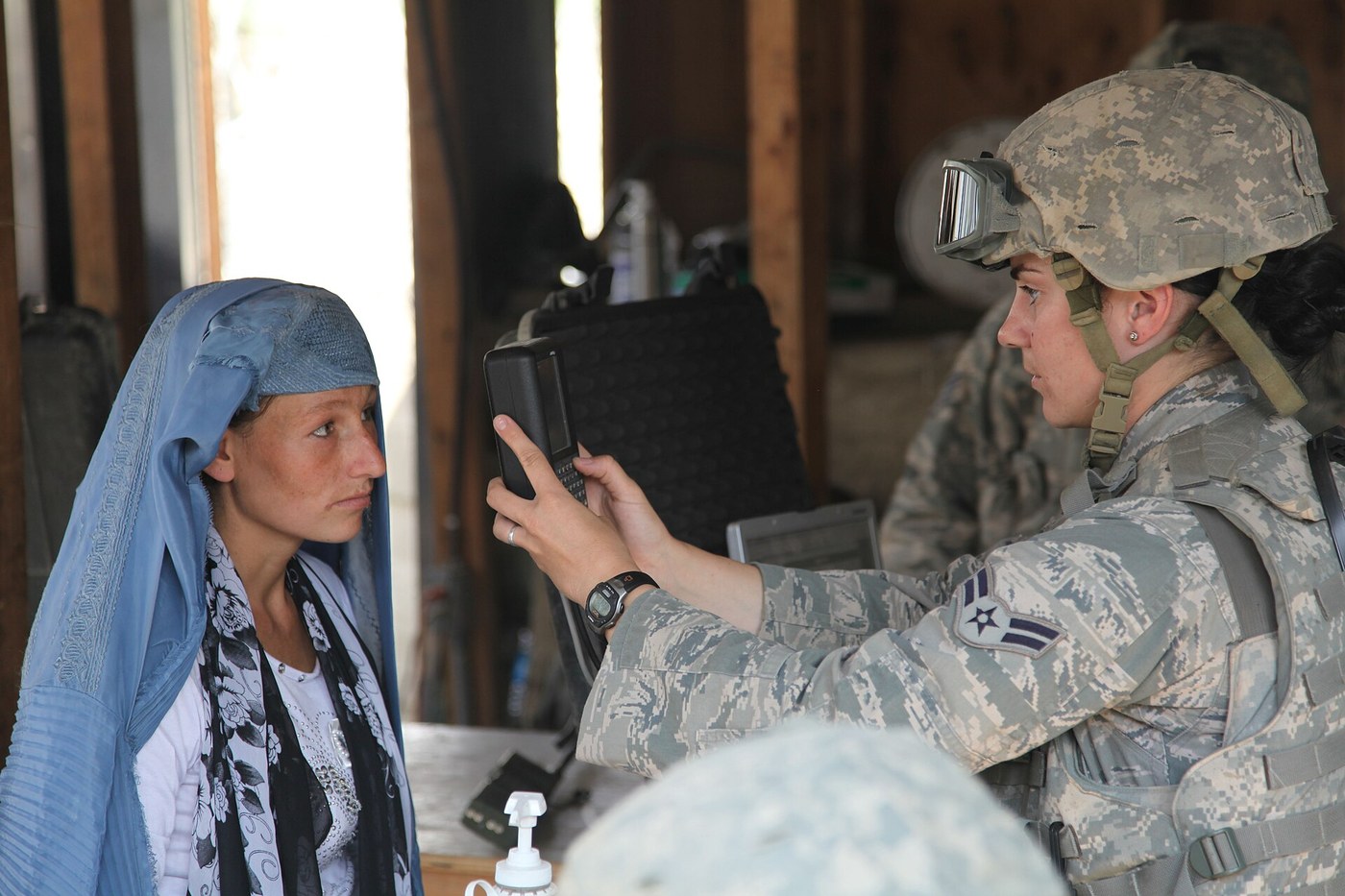
The ABU was designed for air bases, and the Air Force said as much when it introduced the uniform. That did not stop airmen from wearing it in Afghanistan, where between 2007 and 2011 they ran convoys, escorted Afghan police and stood at entry control points in it. Two problems followed them into those places.
The first was fire. In its original weave the ABU cloth was not flame resistant, so from 2008 the Air Force bought a separate fire-resistant uniform printed in the same pattern, the Airman Battle System-Ground, for airmen whose duties took them outside the wire. The second was colour. Against the dry brown ground of the Afghan provinces the pale grey and sage of the ABU stood out, and in March 2011 the service began issuing the Army’s darker Operation Enduring Freedom camouflage pattern to airmen deploying into those environments. The Air Force had spent the 2000s insisting that a single distinctive uniform could serve everywhere. Its own deployments had already disproved that.
One pattern, several shades
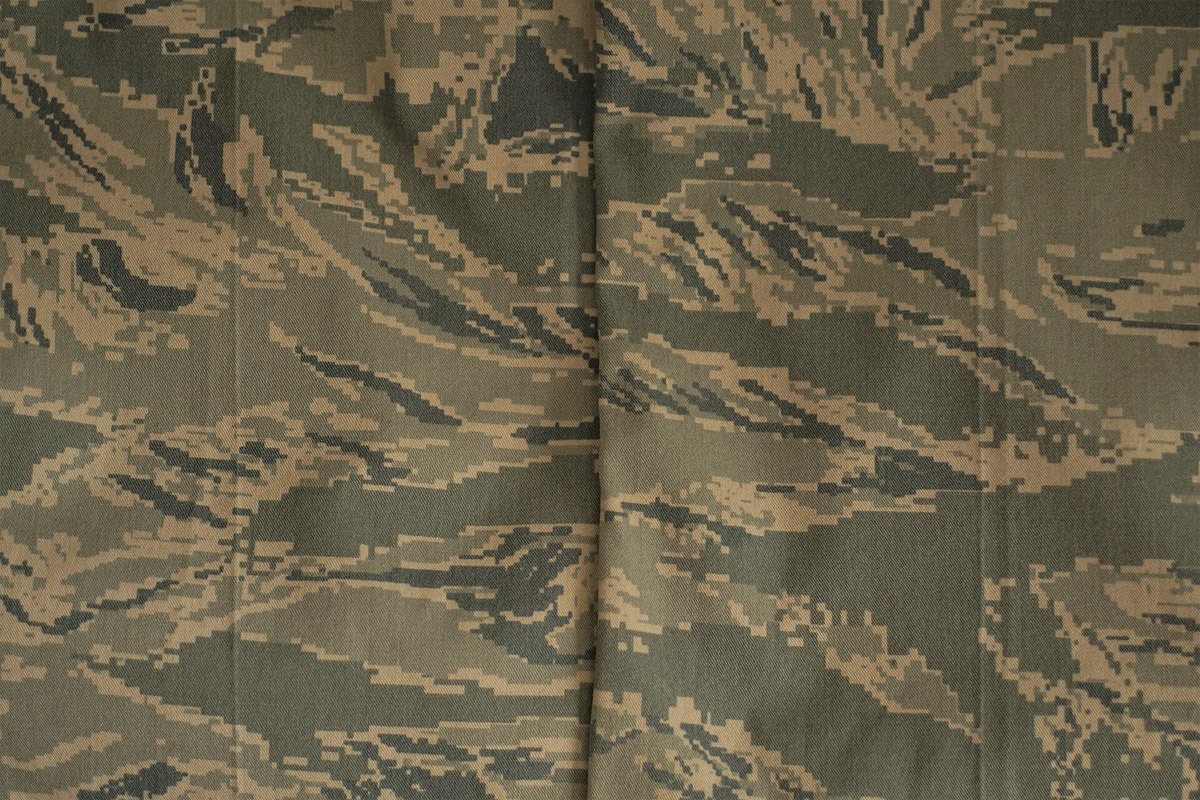
Airmen noticed early that two ABUs were not necessarily the same colour. Several manufacturers produced the cloth to the same specification, and dye lots did not always agree: depending on when and where a set was made, the same pattern could arrive in a pale grey-blue or in a noticeably browner, more olive tone. Airmen comparing sets bought in different years were still recording the mismatch well into the 2010s, and it mattered in the field, where a uniform in an off shade was a lighter patch against a darker background.
The Air Force’s own trials were harder on the uniform than any complaint. In 2005 the Air Force asked the Air Warfare Center to test whether the ABU was suitable for combat at all. The centre’s report, issued in October 2006, found that the camouflage performed respectably for a pattern meant to cover every environment, never ranking lower than third among the six uniforms it was measured against, but concluded that the ABU was not an effective combat uniform because of trouser fit, heat build-up and other problems. On concealment, observers rated it marginal or unsatisfactory 58 per cent of the time across 19 tests.
When the Government Accountability Office reviewed the services’ camouflage programmes in September 2012, it questioned the way the ABU had been judged: some of the uniforms it was compared against had been measured in environments they were never designed for, and the Air Force had settled on the tiger stripe before testing alternative patterns and fabrics. Recommendations to reduce heat build-up were never implemented. The Air Force’s answer, given to the GAO by the Clothing Office, was that the original direction for the ABU had been for non-combat use rather than as a combat uniform or a camouflage-effective garment. The GAO also put the ABU’s development cost at about $3 million and drew the wider conclusion that the Air Force and the Army had each developed a uniform that failed to meet mission requirements and had to be replaced, while the Marine Corps, which tested several patterns before choosing, had not.
The end of the service-specific pattern
By 2013 the problem had reached Congress. The Government Accountability Office counted seven new camouflage uniforms introduced across the services since 2002 and found the approach behind them fragmented: no joint criteria, little collaboration between the services, and no discipline on cost. It concluded that the Air Force and the Army had each bought a camouflage uniform that had to be replaced, and that the services had not taken the opportunities available to them to share development and inventory costs. In the National Defense Authorization Act for 2014, Congress made it policy that the Department of Defense should stop developing and fielding service-specific combat and camouflage utility uniforms and adopt a common one or a common family instead.
The Air Force announced on 14 May 2018 that it would move to the army’s Operational Camouflage Pattern. The timetable was deliberately slow. Airmen who bought their own replacement items could wear them from 1 October 2018, the Exchange was expected to stock them by April 2019, and recruits at Basic Military Training began receiving the new pattern in October 2019. The ABU stayed authorised throughout the overlap. After 1 April 2021 it was no longer approved for wear, ending a changeover that covered more than 500,000 airmen across the active force, the Guard and the Reserve. The Air Force’s estimate at the time was about $237 million over three years, a figure its leadership expected to recover as the service stopped buying two utility uniforms instead of one.
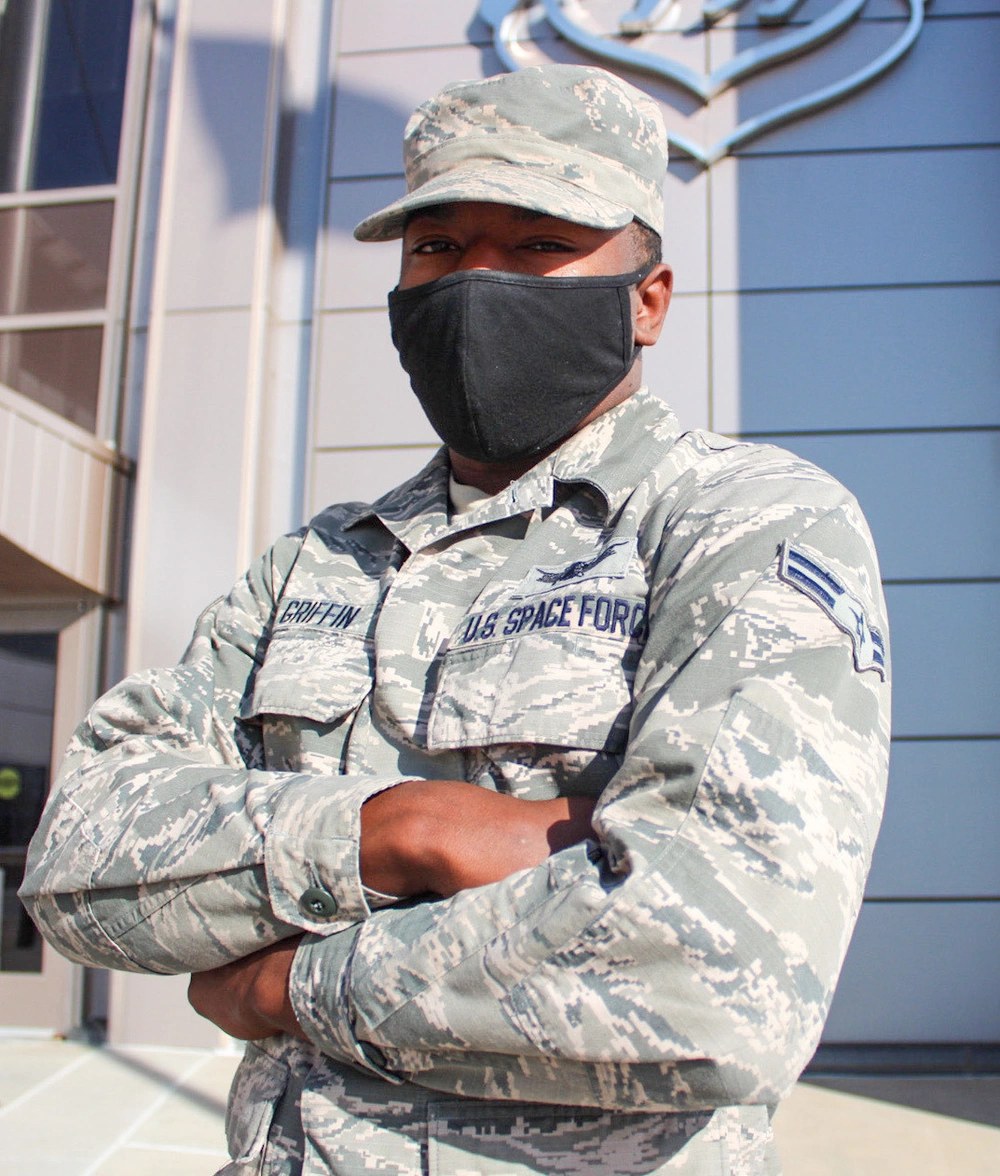
One group of wearers carried the ABU into its final months. Airmen who transferred into the new United States Space Force in 2019 and 2020 kept the uniform, with U.S. Space Force tapes where the Air Force tapes had been, until the wider changeover caught up with them.
After the Air Force
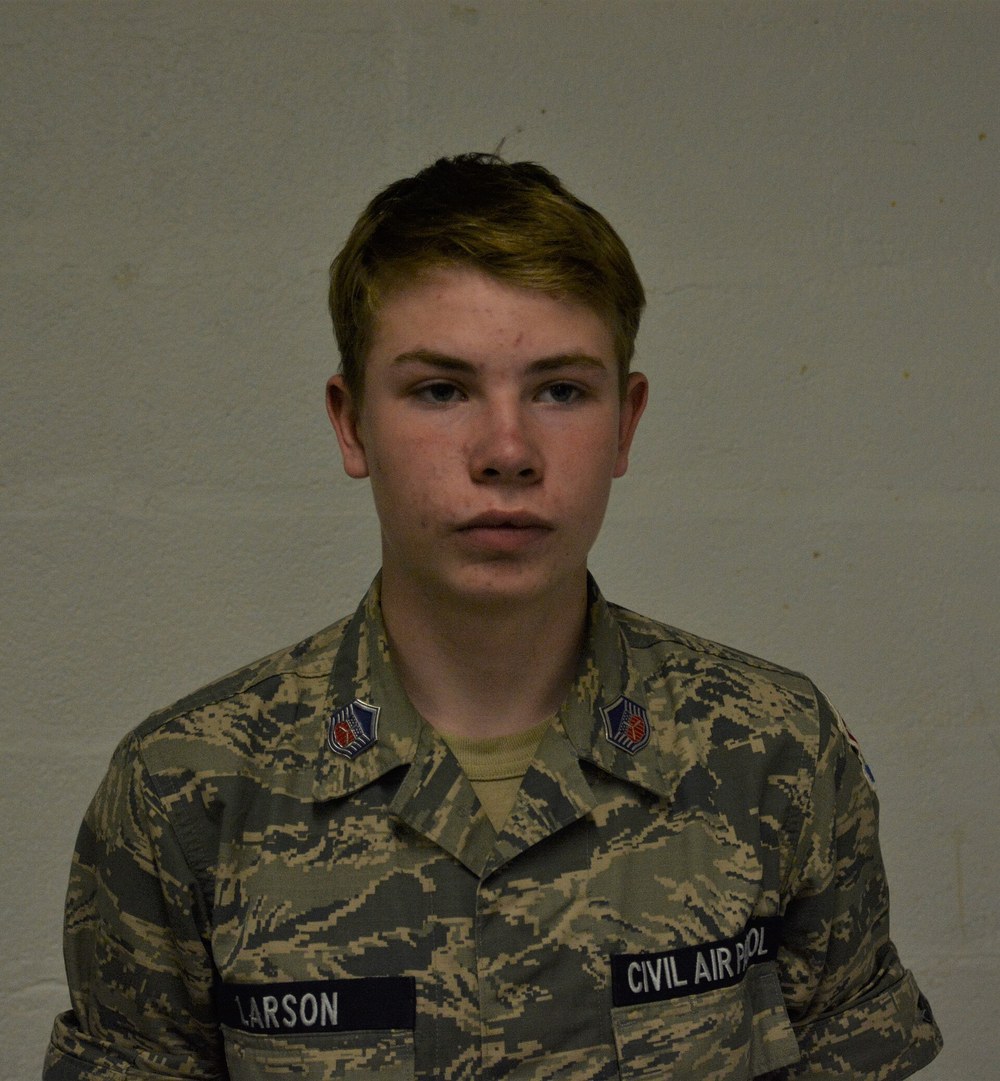
The ABU outlived its own retirement in one organisation. The Civil Air Patrol, the Air Force’s civilian auxiliary, had worn the uniform with its own name tapes and shoulder patches, and it kept the ABU after the Air Force stopped. The patrol began its own move to the Operational Camouflage Pattern only on 1 November 2025, and its members stay authorised to wear the ABU until 31 October 2028, seven and a half years after the last airman put his away. The pattern also survives in the surplus trade, where ABU coats and trousers are among the cheapest American camouflage garments on the second-hand market.
What the ABU got right
Judged as a camouflage pattern, the ABU failed the standard its own observers had set for it, and the Air Force gave it up in favour of a pattern the army was already wearing. Judged as a utility uniform, it changed habits. The idea that an airman should be able to wash a uniform, hang it up, and never touch an iron, a tin of starch or a boot brush survived the pattern itself and sits inside the uniform worn on air bases today. What did not survive is the assumption that a service can design a uniform to look like itself and still call it camouflage. Congress wrote that presumption out of the law in 2014, and the Airman Battle Uniform was the last American uniform designed under it.
The ABU at a glance
- October 2002: the Air Force begins developing a utility uniform of its own
- 2003 to 2004: blue-grey prototypes tested, airmen reject the blue
- Late 2004: revised tan, sage green and slate blue tiger stripe approved
- 2007: first issue to airmen deploying into Central Command
- October 2007: recruits at Lackland Air Force Base receive the ABU
- 1 November 2011: the ABU becomes mandatory; the BDU and Desert Camouflage Uniform are retired
- June 2012: the lighter ripstop RABU reaches military clothing stores
- September 2012: the Government Accountability Office reports on camouflage procurement
- 14 May 2018: the Air Force announces the changeover to the Operational Camouflage Pattern
- 1 April 2021: the ABU is no longer authorised for Air Force personnel
- 31 October 2028: end of authorised Civil Air Patrol wear
Related reading
The pattern the ABU replaced in the desert was covered in Chocolate Chip: the six-colour desert pattern of the Gulf War, and the leaf pattern behind the whole American uniform family in ERDL: the US Army leaf pattern that became America’s camouflage DNA. The digital designs that shaped the ABU’s pixels are examined in CADPAT, the Canadian pattern that started the pixel revolution and in MARPAT: the Marine Corps pattern it patented. For the tiger stripe family the ABU belongs to, see Kamysh, Russia’s tiger stripe for special units, and for the vocabulary used here, camouflage classification, morphology and lineage.
Clothing and accessories in US camouflage patterns are in our catalogue: United States.
