
Camouflage History
Multitarn: Germany’s New Universal Camouflage
For thirty years the German armed forces answered the camouflage question with a fork in the road. Fight in the forests of Central Europe and you wore Flecktarn, the five-colour spot pattern introduced in 1990. Fight in sand and scrub, as the Bundeswehr did in Afghanistan, and you wore Tropentarn, its three-colour desert sibling. Two environments, two patterns, two sets of everything, uniforms, pouches, rucksacks, covers, and a logistics officer on every mission making sure the right print was in the right depot.
That arrangement is now on notice. In summer 2025 the Federal Ministry of Defence confirmed a shift towards a single universal print, and the pattern behind that shift is Multitarn.
The word “planned” is doing a great deal of work in that sentence. This article is as much about the distance between a ministry decision and a soldier’s kit bag as it is about six shades of green.
The decision that took a decade to surface
Multitarn is not a new pattern. It is a pattern that spent almost a decade confined to a very small number of soldiers and was then, suddenly, promoted to the national standard.
The pattern came out of the Wehrwissenschaftliches Institut für Werk- und Betriebsstoffe (WIWeB), the Bundeswehr’s own materials research institute at Erding in Bavaria. Reporting from 2016 places the start of the commission in 2011, with test work from around 2012. The remit was deliberately broad: not a pattern optimised for one terrain, but one that would work acceptably across forests, towns, open ground and the transitional landscapes where European operations tend to be fought.
Prototypes were shown publicly in January 2016, and the pattern went first to the Kommando Spezialkräfte (KSK) and to the navy’s Kampfschwimmer. At that point the ministry was explicit that no decision about wider use had been taken. That caveat held for nine years. By around November 2020, roughly 4,000 Bundeswehr personnel had been issued items in the pattern, a rounding error against a force that was then some 180,000 strong.
The reversal came in 2025. On 30 July, hartpunkt reported that the ministry had abandoned its long-standing opposition, and that from 2026 personal equipment and clothing would be procured across the board in Multitarndruck, with full conversion of the force envisaged for 2028 and 2029. On 31 July, asked directly, the ministry confirmed to Augen geradeaus! that a “mittelfristige Umstellung auf den Multitarndruck”, a medium-term conversion, was planned, citing a newly fixed target strength of 460,000 service members. It added that reliable timelines and cost figures could not yet be given because the process was still running.
The reversal reads differently against what came immediately before it. As late as 17 July 2024, hartpunkt reported that the ministry was still refusing a cross-force introduction, with money going instead to a “new old” service dress. On 18 December 2024 the Bundestag budget committee released 130 million euros for a second generation of special-forces combat clothing from 2027, in three prints: Multitarndruck, the five-colour print and snow. On 12 May 2025 a temporary working group, AG Multitarndruck, delivered its report to the ministry with a clear recommendation and a prioritised list of affected clothing items. The decision had a documented paper trail well before it had a press release.
Multitarn “ist nicht das beste Muster in möglichst vielen Einsatzumgebungen, sondern in möglichst vielen Einsatzumgebungen nicht das Schlechteste”, not the best pattern in as many environments as possible, but not the worst in as many environments as possible. The WIWeB’s own formulation of what a universal pattern can honestly claim.
The ministry’s case rests on three arguments. One pattern instead of two removes a whole duplication of logistics. Studies at the institute found that Multitarn conceals better than the five-colour print in and around urban areas, and urban areas, as the war in Ukraine has made plain, are where a great deal of modern fighting happens. And, least discussed, the special forces themselves asked for it: wearing a pattern nobody else wore made KSK and Kampfschwimmer operators identifiable at a glance, a tactical problem in any formation that has to move with conventional troops.
What Multitarn actually is
The German name is Multitarndruck: multi, Tarn for camouflage, Druck for print, the word used for a textile print run, not for a registered graphic design. In English-language material it is usually just Multitarn.
Formally it is a six-colour disruptive pattern: light green, dark green, brown, beige, grey and off-white. What is immediately missing, and what anyone comparing it with Flecktarn notices first, is black.
Structurally Multitarn belongs to the same visual family as Flecktarn: discrete flecks rather than the sweeping organic shapes of a pattern like MultiCam, a distinction that matters under any disciplined classification of camouflage by morphology and family. The differences are in the details. Spot edges are softer and rounder than the 1990 print’s. Spot sizes vary more widely, which is intended to break up a silhouette both close up and at distance. And the overall picture is markedly lighter, partly because black has gone and partly because beige and off-white now carry more of the surface.
Six-colour printing is not free. Moving from five inks to six makes reproduction and garment production materially more complicated, a point raised even by commentators sympathetic to the change.
For collectors the pattern is also a naming problem in the market, not only in the archives. Multitarn goods are traded under more than one heading: Germany Multitarn and German Bundeswehr Neu Multitarn are both used as trade headings, which is a useful reminder that trade categories are not official nomenclature and do not always line up with what the Bundeswehr itself calls a print.
Six colours instead of five
The most concrete technical document in the public record is the Bundeswehr’s own explainer on camouflage, published in December 2025, in which a WIWeB pattern developer walks through how the institute designs a print.
The starting point is Flecktarn’s surface distribution: dark green 35 per cent, brown 20, light olive 20, light green 15 and black 10. To build a pattern for a new environment, the institute assembles a collage of that environment, reduces it to its five principal colours, sorts them by brightness, and maps each one onto the equivalent tone in the existing print. The substitutions are then applied according to surface share, so black, the smallest share in the five-colour print, is replaced by whatever the new environment demands. In the institute’s worked example, an urban industrial complex, the replacement for black is white.
Two decisions in that process are worth recording, because both are frequently misreported. The institute tried angular and pixelated variants and rejected them: Germany did not go digital. And the target was deliberately not maximum performance anywhere. The brief was a middle brightness that would hold up in vegetation, in built-up areas and on bare ground without excelling spectacularly in any one of them. That is the definition of a compromise pattern, and the Bundeswehr has never pretended otherwise.
Notably, the institute’s method is a Flecktarn method. The percentage table, the brightness ranking and the substitution rule are all inherited from how the five-colour print was reasoned about, a continuity that runs back through the German wartime prints surveyed in German World War II Camouflage, Explained. Whatever else Multitarn is, it is a descendant of German design thinking rather than an import.
The family did not stop at the German border either. Flecktarn’s logic of clustered spots travelled, and the Danish M84 remains its best-known relative, which is why a new German print matters well beyond Germany.
The two-pattern problem that Multitarn is meant to solve
Flecktarn and Tropentarn are not interchangeable, and the mismatch ran through the whole equipment chain. Soldiers deployed to arid theatres needed desert-printed webbing, packs and covers; units preparing for Central European operations needed the temperate print. Where both variants of an item could not be stocked, personnel mixed them, and mixed camouflage is exactly what a disruptive pattern is supposed to avoid. One print for all environments means one set of procurement lines and no more guessing which version of a pouch will be in the depot.
Germany was not first to that conclusion. Britain reached it more than a decade earlier, retiring DPM in favour of a single temperate-and-arid print, MTP, and has lived with the trade-offs ever since. The argument in Berlin is essentially the argument that was had in London, arriving late.
There is a second, quieter argument, and it concerns the environment the pattern is meant to hide in. Flecktarn was drawn for the Central European mixed forest of the late twentieth century. Several observers have pointed out that European vegetation has shifted, hotter, drier summers, more brown and grey in the landscape, more of the year spent in a transitional state rather than a deep green one. A pattern calibrated to a stable green baseline is calibrated to a baseline that no longer reliably exists.
The ministry’s own developer puts the trade-off bluntly: Multitarn is less conspicuous in mixed landscapes and urban spaces and is optimised against modern sensors, whereas Flecktarn reads too dark in the steppe and too contrasty in a town.
The name problem: Multitarn is not MultiCam
Multitarn and MultiCam are different patterns with different structures and different owners. Crye Precision’s MultiCam, introduced in the 2000s, is built from organic, multi-scale shapes and holds a dominant position in the commercial and NATO market. Multitarn is a spotted print in the Flecktarn lineage, developed inside a German government research institute, with the German state holding the rights.
The resemblance people notice is real but shallow, and it is a resemblance of colouring rather than of construction. Soldier Systems Daily, reporting the 2025 decision, wrote that Multitarn “takes obvious coloration cues from Crye Precision MultiCam.” That is a commentator’s characterisation, not a statement from the Bundeswehr or the WIWeB, and it should be read as such.
One documented technical difference cuts the other way. Reporting in 2016 noted that in MultiCam the near-infrared behaviour is not specified and depends on how each adopting force has the fabric made, whereas a specified near-infrared performance is precisely what the WIWeB claimed as its own contribution. Two patterns converging on the same market niche, the universal, one-print-for-everything role also occupied by Britain’s MTP, is not the same thing as one pattern copied from another.
The honest formulation is design relation, not repeat identity. No primary source shows that Multitarn was derived from MultiCam, and at least one documented design difference exists between them.
The same caution applies in the other direction, to the U.S. Army’s Universal Camouflage Pattern. UCP is the standard cautionary tale about universal prints, one pattern that performed poorly nearly everywhere it was asked to serve, and its failure is regularly invoked against Multitarn. The counter-argument is equally available: MultiCam and MTP are universal patterns that worked, so “universal” is not automatically a defect. The comparison is an argument, not evidence.
What the near-infrared claim does, and does not, cover
The most substantive claim the WIWeB makes for Multitarn concerns the near-infrared band from 700 to 1200 nanometres, the region in which night-vision goggles and light-intensifying sights operate.
That band matters because a print that looks convincing to the eye can glow conspicuously under image intensification if the dyes and the fabric are not specified correctly. It is a difference invisible to a human observer and obvious through a night sight. Multitarn is specified for that band. How the institute achieves it, beyond describing fibre and dye chemistry acting together, it will not say.
The important limit is this: near-infrared is not thermal. The WIWeB has been explicit that the body heat of a soldier cannot yet be camouflaged, because the ambient temperature against which a thermal imager reads a body is constantly changing with humidity, time of day and sunlight. Its stated position, from 2016, is that no militarily usable pattern exists anywhere for concealing soldiers in thermal imaging.
So Multitarn is a visible-plus-near-infrared solution, not a thermal one, and any account that treats the two as the same thing is wrong. Where thermal management exists in Bundeswehr clothing it is handled by garment construction rather than by the print itself.
Where the deployment actually stands
Everything above is the design story. The deployment story is much shorter, and it is where the most care is needed.
What is established: the ministry confirmed in July 2025 that a medium-term conversion is planned; procurement of personal equipment and clothing in the pattern is described as beginning from 2026; and conversion of the force is envisaged for 2028 and 2029. The special forces have had the pattern since 2016.
What is not established is any officially published schedule. The ministry declined to give “belastbare Zeitlinien und Angaben zu Kosten”, reliable timelines and cost figures, on the grounds that the process was ongoing. The dates in circulation are reporting from specialist defence media citing Bundeswehr sources, not a dated ministerial decision with milestones attached. That distinction should be preserved rather than flattened.
Two further points of care. First, Flecktarn and Tropentarn remain in service. There is no documented removal from service and no date for one. New Feldanzug sets in the five-colour print were still being delivered in the mid-2020s, which provoked criticism that uniforms ordered shortly before the decision could be superseded before they were worn out. Writing that the older patterns are being “replaced” states a plan as an accomplished fact.
Second, the conversion is planned in phases, as the original introduction of Flecktarn was. A phased issue means years in which a formation may hold both prints, precisely the mixed-camouflage problem the universal pattern is meant to eliminate, an irony worth naming rather than smoothing over.
The patent question: deliberate scarcity
One aspect of Multitarn has no real precedent in the history of Bundeswehr camouflage, and it has practical consequences for anyone outside the force who wants the pattern.
Multitarn is an Eigenentwicklung, an in-house development. The federal state holds the rights, and the pattern carries registered design protection. Earlier German prints carried no such control, which is why five-colour Flecktarn copies have circulated freely on the commercial market for decades.
The purpose is twofold. A legal hold lets the ministry act against unauthorised production of equipment in Multitarn, and the design protection is intended to limit the appearance of Multitarn items on the open market. That is also, quietly, a way of discouraging soldiers from privately buying kit that does not meet the technical specification: compliance with the near-infrared requirement is not something a buyer can assess by eye, so a market in unofficial Multitarn is a market in fabric that may behave very differently under a night sight.
The mechanism of control is a technical delivery specification, the Technische Lieferbedingung TL 8305-0345. The version in force was updated on 28 July 2025 and is not public. An earlier version, which expired in 2023, was published, and it remains the only open window onto how the pattern is formally specified. The exact colour names, near-infrared thresholds and tolerances cannot therefore be cited from a primary source, and anyone who offers precise numbers is guessing.
The argument against
Multitarn is not a settled question in Germany, and the objections are specific rather than nostalgic.
The strongest is geographic, and it is not only a critic’s argument. Flecktarn was built for exactly the terrain the Bundeswehr is most likely to defend, and the institute’s own developer said in 2016 that the new print was not suited to predominantly green Central European or tropical terrain. The brief, in his words, was that “es gibt nicht den Allround-Tarndruck”, there is no all-round camouflage print. Critics read that as an admission that the universal pattern is weakest precisely where German forces would most probably fight. The counter is that the most probable scenario now includes built-up areas, and that vegetation itself has moved.
The second is colour. Multitarn is lighter than the print it is meant to succeed, and not everyone reads that as an improvement. Commentary from serving personnel and veterans has argued that the new print is too light for northern and Central European conditions, and that the five-colour print’s darker, contrastier look is the one that disappears into a German forest.
The third is money. The ministry has not published cost figures, and the vacuum has been filled by a wide range of numbers, most of them unsourced. What can be said with confidence is narrower: six inks instead of five make printing and manufacture more complex, the conversion covers a force of a stated 460,000, and the ministry intends to draw on the 100-billion-euro special fund established for the Bundeswehr in 2022. Specific cost claims circulating online should be treated as unverified.
The fourth is the process itself. Asked by Augen geradeaus! what had changed the ministry’s mind after years of refusal, the procurement division did not answer the question. Reporting attributes the earlier internal resistance to senior figures in the armament directorate, one of whom was quoted comparing camouflage patterns to summer and winter tyres. A decision of this scale, taken without published costings or a published schedule, is the kind of thing that attracts scrutiny in a parliament that has just approved a very large defence budget.
Multitarn in the field
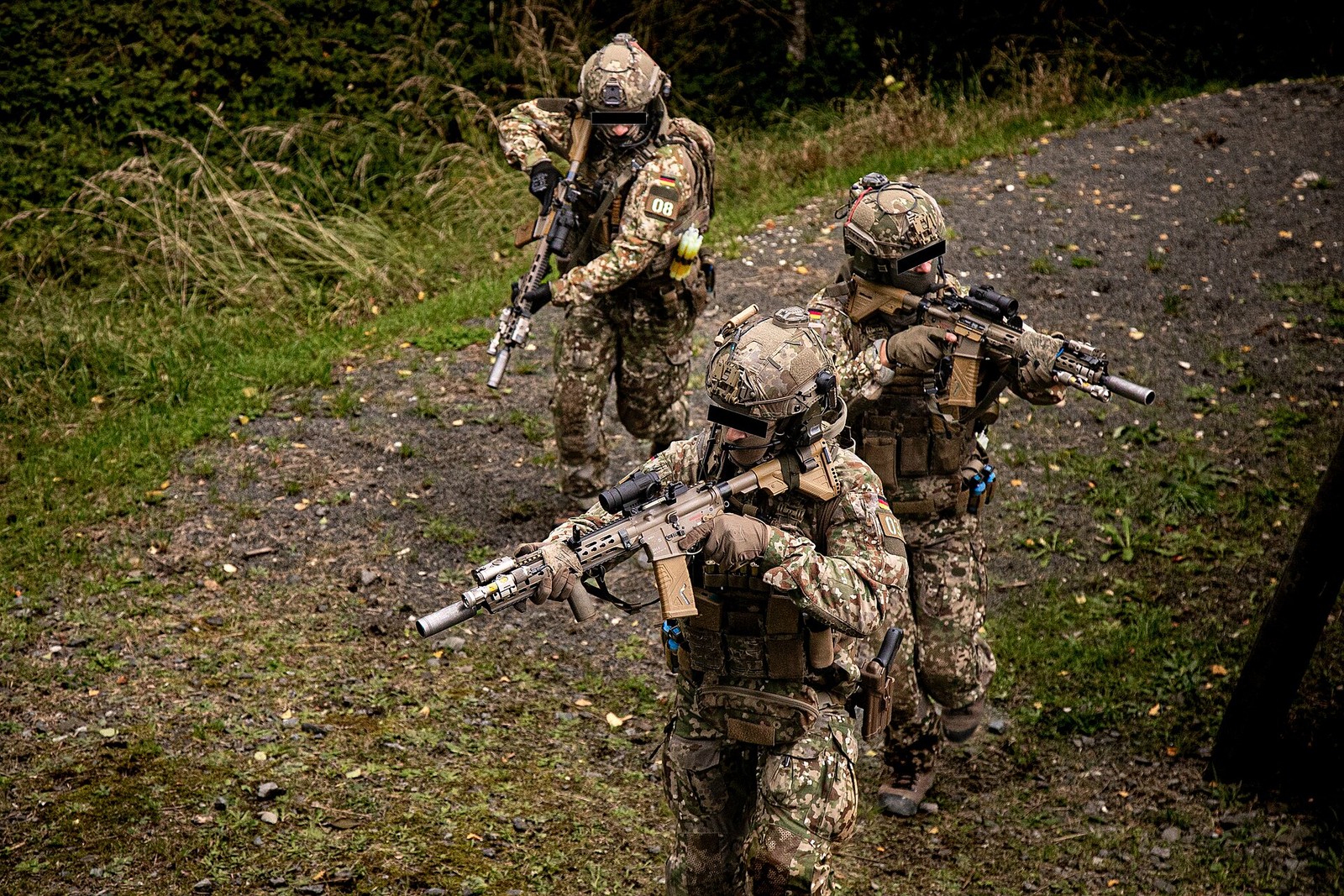
Because the pattern spent nearly a decade in a narrow issue, the photographic record is unusually specific. Most usable imagery comes from allied sources photographing German special forces at joint training, from outside the Bundeswehr’s own controlled release programme. That matters, because imagery involving special forces is tightly held: in the September 2025 German navy series, faces are obscured, most visibly by solid black bars over the eyes, or turned away.
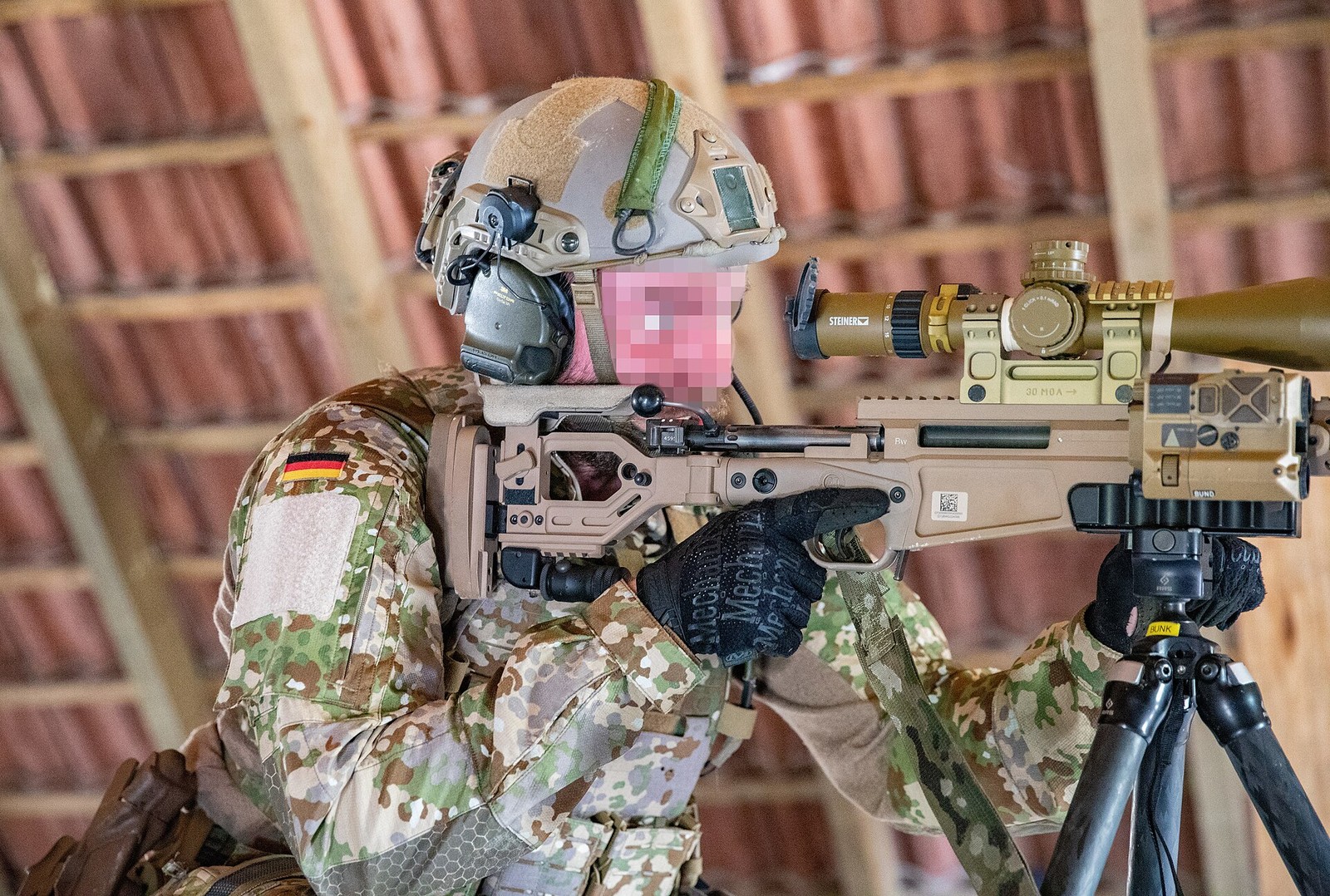
The photographic record of the pattern falls into two periods, which map onto the two halves of the German argument. The first set was taken on 4 May 2022 at an urban sniper course at Hohenfels and shows German special forces working in and around buildings, rappelling from a wall, descending into a concrete shaft, occupying a loft. The second set was taken on 26 September 2025 at a live-fire exercise by German navy special forces at Grafenwoehr, and adds the environment the German debate turns on.
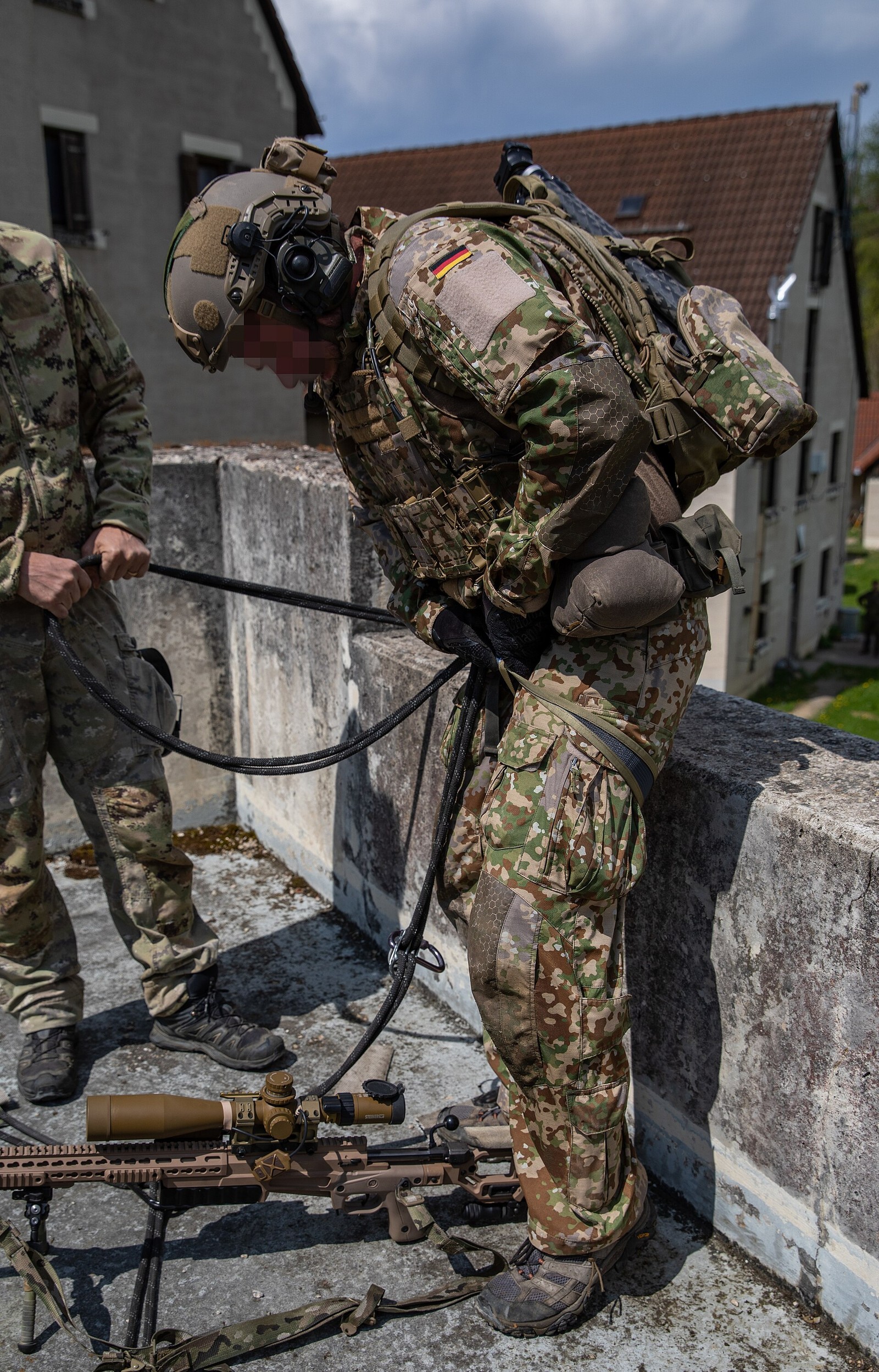
Look at the two environments together and the trade-off becomes concrete rather than theoretical. Against rendered walls, gravel, scraped timber and wet concrete, the lighter print sits easily: it is close in value to the surfaces it is meant to disappear against, and there is very little in a built environment for a dark spot pattern to bite on. On a forest track in September, the same print reads noticeably lighter than the vegetation around it. That is not a criticism of the design, it is the design, stated as plainly as a photograph can state it, and it is exactly the objection critics of the change have raised.
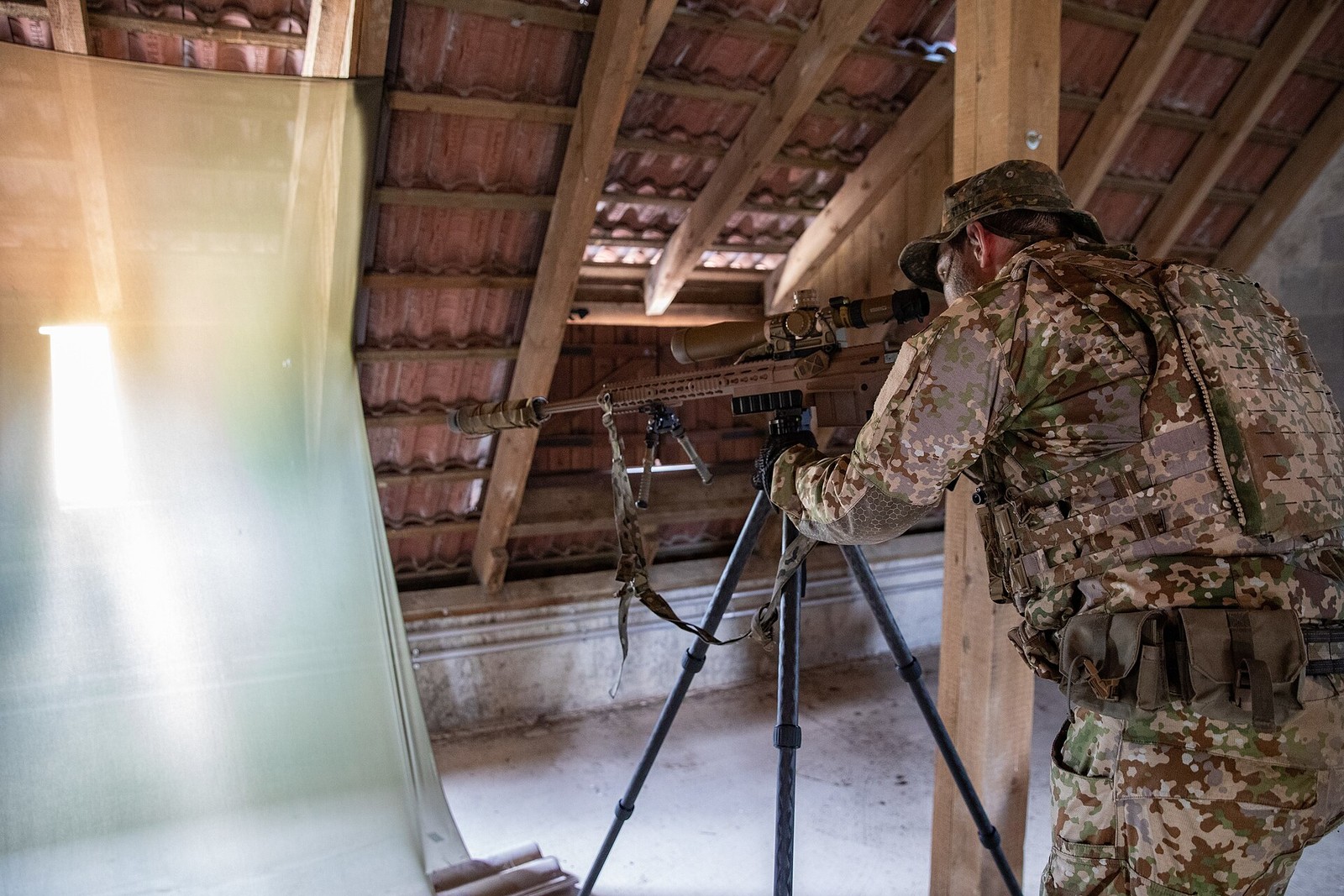
One further point about the record itself. Almost none of the clearest Multitarn imagery in the public domain was released by the Bundeswehr. It exists because allied forces, here the U.S. Army, photographed German troops at their own training events and released the results into the public domain. For a pattern whose own ministry restricts imagery, controls the design and keeps its technical specification unpublished, the most reliable visual documentation of how it looks in service is, ironically, American.
Pattern reference: reading the six-colour structure
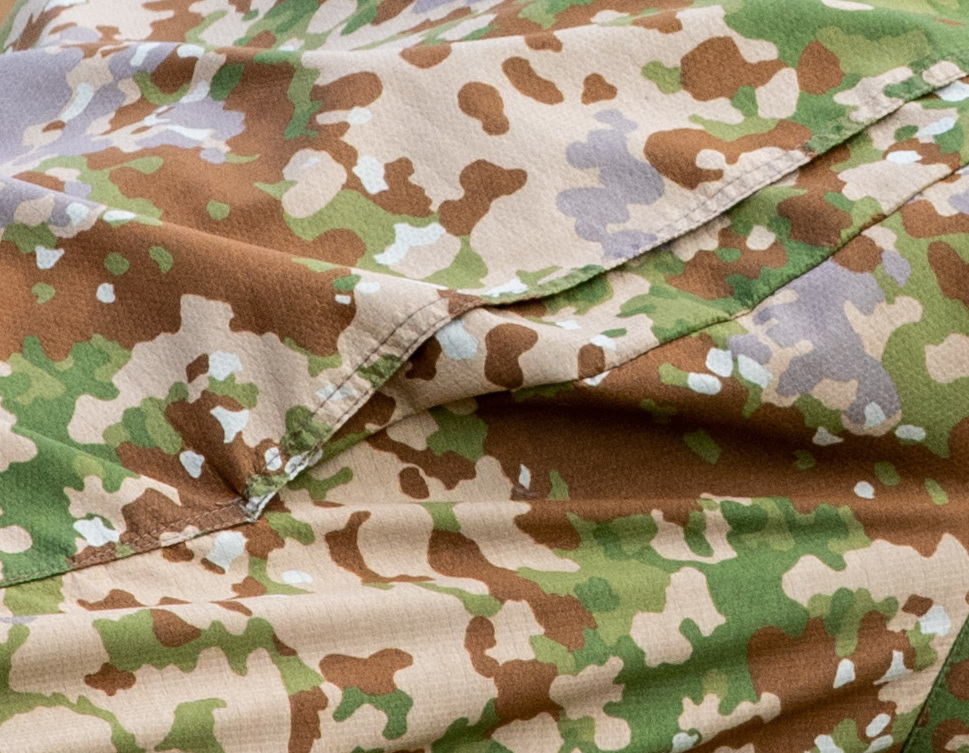
The pattern reference is a close crop of a Multitarn sleeve taken from the 4 May 2022 Urban Sniper Course photographs at Hohenfels, Germany. It is a detail crop, not a colour-calibrated swatch, not a museum original and not a manufacturer’s proof. Reproduced lighting and camera processing mean the tones cannot be read as exact; what the image does convey reliably is structure.
Four features are legible in it. The pattern is built from discrete spots rather than continuous shapes, confirming its place in the Flecktarn family. The spots vary considerably in size, from small flecks to clusters several centimetres across, the multi-range concealment strategy in visible form. Their edges are soft and rounded, noticeably softer than the crisper edges of the 1990 print. And there is no black at all: the darkest tone present is a brown, and the lightest is an off-white that occupies considerably more surface than the same tone does in its predecessor.
The full palette is brown, beige-tan, light green, dark green, a grey with a faint cool cast, and off-white. That is the six.
