
Camouflage History
Belgian Jigsaw: The Puzzle Pattern That Belongs to Belgium

For over sixty years, one camouflage went from a niche parachute uniform to the national standard of a NATO army, and its name says everything about the way it looks. This is the Belgian jigsaw: where it came from, why it is called “jigsaw”, the generations that followed it, and why Belgium finally let it go in 2022.
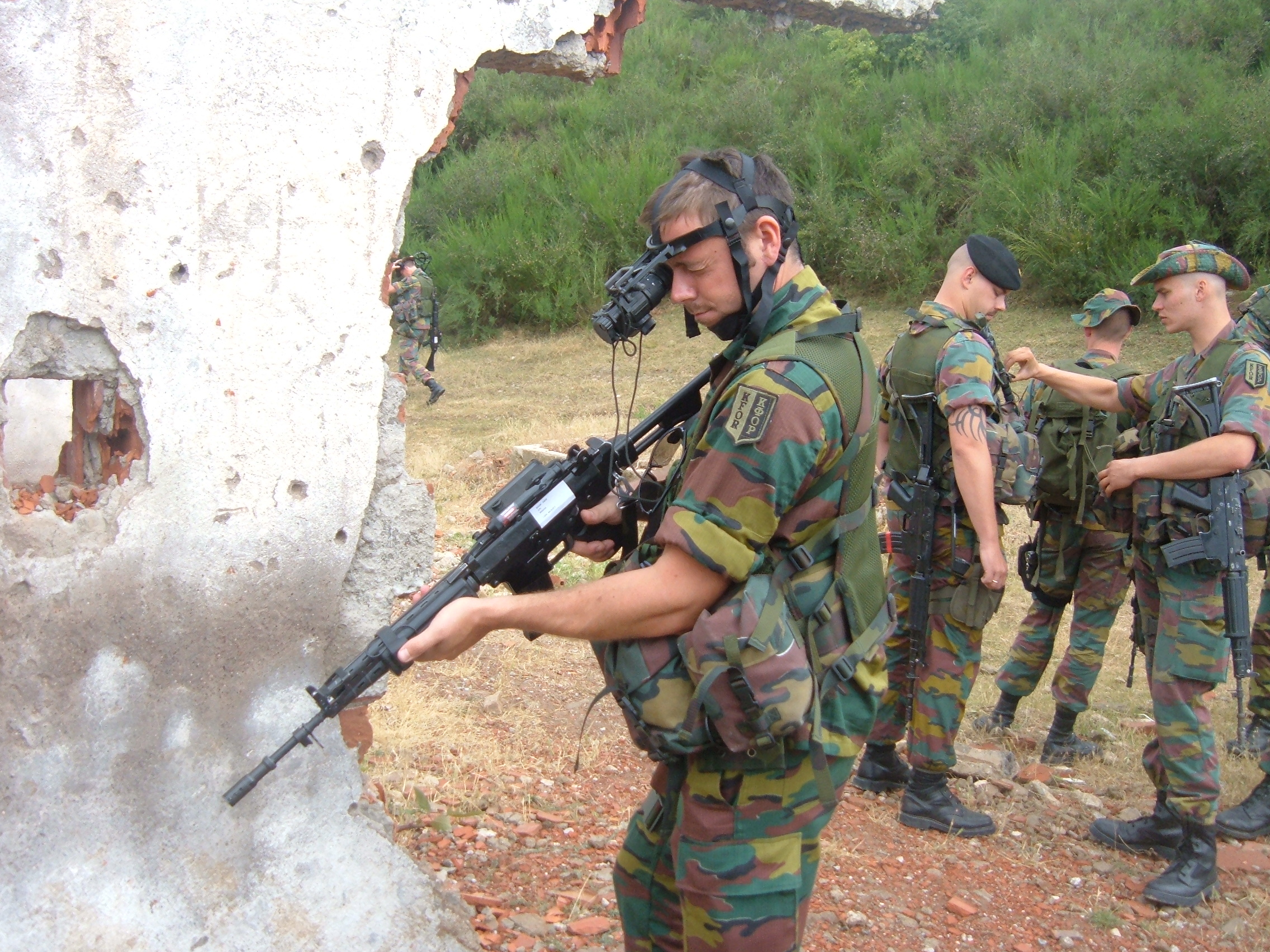
A pattern that looks like a puzzle
Pull up a Belgian military photograph from the Cold War and, at some point, you will see it: pale, irregularly shaped patches, sharp-edged, almost cut-out, pressed together like pieces of a jigsaw puzzle that almost fit. That resemblance gave the pattern its nickname. It was never an official designation; Belgian forces simply called the pattern “jigsaw”, and the name stuck harder than any technical label.

The design is genuinely Belgian. It was not a copy of the American woodland, a German piece, or a British brushstroke, although Belgium had used the British brushstroke family after the war. The jigsaw was developed in the 1950s as an indigenous answer to a specific problem: how to break up a soldier’s silhouette at range in a European forest. It did that with a low-contrast scheme of earthy browns and greens, laced with smaller black-and-white shapes, three base tones plus black-and-white accents on the m/56, becoming a proper four-tone scheme (khaki green, bottle green, reddish brown and black) with the M1999 pattern that add a disruptive “grain” to the whole surface.
The first jigsaw (m/56)
The first incarnation, often designated m/56, was introduced in 1956 and produced, essentially unchanged, right through the 1970s. It was not for everyone: like many specialist patterns of the era, it was mostly issued to elite units, the Belgian paracommandos, the airborne troops, commandos and marine units, and later the Immediate Reaction Cell that succeeded the Para-Commando Regiment.
The design used rusty earth, dark green and khaki-green elements, worked in among small black and white shapes that white accent is what most clearly sets the first generation apart. The palette was meant for European woodland, and the pattern sat on heavy canvas, durable but stiff and heavy to wear. Some production did reach Africa, where it ended up in the hands of elite units of Belgium’s former colonies such as Zaire. The m/56 reportedly runs large, with a light edging on the shapes that gives the puzzle pieces a raised, three-dimensional read.
The brushstroke inheritance
To understand the jigsaw, it helps to know what came before. After the Second World War, Belgian forces were deeply influenced by the British “brushstroke” camouflage of the Denison smock, a loose, painterly reproduction of the classic windproof pattern worn by airborne troops. Belgium produced several local variations of brushstroke and issued them mainly to airborne and commando units well into the 1970s.
The jigsaw is a different animal. Where brushstroke is organic and flowing, broad, brush-drawn blades of colour, the jigsaw is hard-edged and geometric, with shapes that read as cut and placed rather than painted. In collection circles the two are never confused, even though they served the same elite units in the same decades.
The second generation: a darker jigsaw
A second variation appeared in the mid-1970s. Camopedia describes it as having a noticeably darker overall appearance, and its use was again confined to elite units of the Belgian Army and Navy, both of which ran assault, commando and amphibious roles that justified specialist clothing.
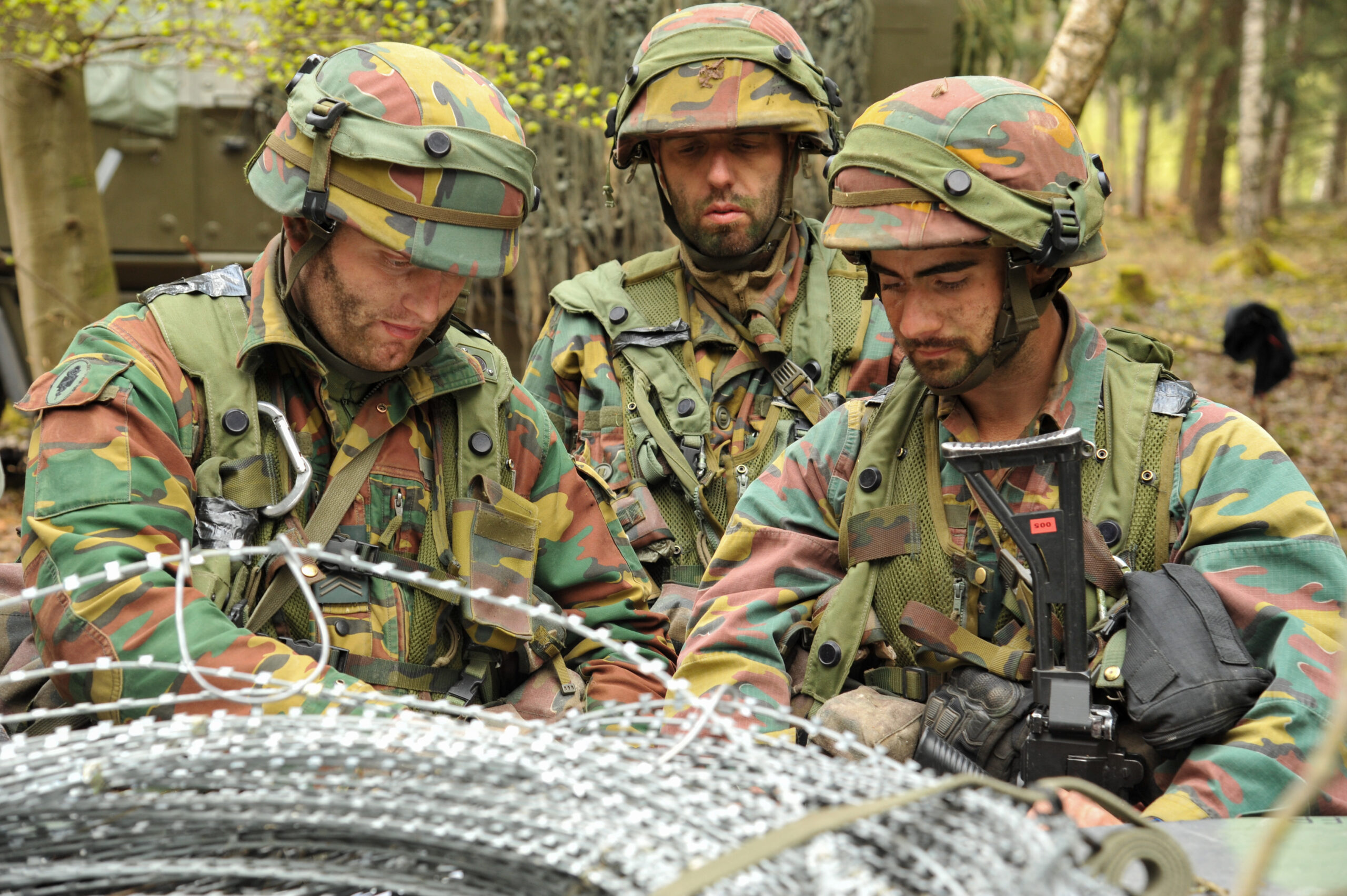
This generation also marked a change in fabric philosophy. The heavy canvas of the first pattern was dropped in favour of heavyweight cotton twill and lightweight poplin, a shift that prioritised comfort and movement over sheer durability. The darker tones were also a practical refinement: the original m/56’s lighter colours could stand out in shadowed woodland, and the darker palette blended better against dark earth and dense foliage.
1999: from elite issue to national standard
The pivotal moment came in 1999. A few years earlier, the Belgian Ministry of Defence had concluded that the armed forces needed a recognisably Belgian, universal camouflage, one that would work for every branch and every soldier, rather than a patchwork of solid greens and specialist patterns. The jigsaw was the obvious answer.
The “third jigsaw”, as Camopedia calls it, the M1999 was not just the same family with a slightly condensed appearance. It was compressed vertically (the 1970s version having been stretched horizontally, as documented by Bob Morrison of Joint Forces News, 7 March 2020), which made it work better at range: the tighter geometry disrupted the wearer’s silhouette at a few hundred metres under dense cover, instead of breaking up at close quarters the way the larger earlier pattern did. It kept the light edging that gives the design its almost three-dimensional depth. The 1999 pattern is the one that carries the official designation “Woodland” in Belgian documentation, a four-tone mix of khaki green, bottle green, reddish brown and charcoal black. It was produced initially in a variety of fabrics before the standard combat uniform settled on medium-weight ripstop.
What changed most was reach: for the first time, jigsaw became the standard combat uniform of the entire Belgian Armed Forces, from paracommandos and commandos to conventional infantry, armour and support troops.
The effect was immediate and lasting. For two decades, the jigsaw defined the look of the Belgian soldier, in the Balkans, in Afghanistan, at home on NATO exercises. Its stability also crossed borders: units of the Luxembourg Army, serving on peacekeeping missions, wore Belgian jigsaw pattern.

Desert, and the vanishing white
Belgian participation in international peacekeeping and, crucially, the ISAF mission in Afghanistan pushed Belgium toward a desert iteration. Released around 2004, the Belgian desert jigsaw kept the distinctive puzzle geometry but re-tuned the palette to light brown and grey-brown shapes on a sandy background. Luxembourg Army units in Afghanistan wore it too.
A fourth variation followed around 2005. This one is almost identical to its predecessor except for one telling detail: the tiny white bits that had traditionally appeared in the pattern were removed entirely. Their disappearance reflects the same logic that drives most modern camouflage refinement, white patches tend to catch the eye at distance and in certain light, so reducing them tightens the pattern’s overall disruptive effect. Because the white accent appears in the earliest m/56 but vanishes in the 2005 rewrite, the presence or absence of white is one of the quickest ways to date a Belgian jigsaw garment at a glance.
The name “Woodland” on the label
One detail that surprises collectors: the main Belgian four-tone temperate pattern was officially designated simply “Woodland” on Belgian documentation. The term “jigsaw” is the enduring nickname, not the official one. It is a good reminder that the names we use for camouflage are often more vivid, and more widespread, than the labels printed inside the collar.
Zaire, Burundi, Chad and the African spread
The jigsaw forms part of a wider story of Belgian influence on African military clothing. Because Belgium retained strong ties with former colonies and advised numerous African forces, jigsaw-derived patterns appeared across the continent:
- Zaire: a distinct jigsaw-style pattern, inspired by the Belgian precedent, was adopted by certain units of the Forces Armées Zaïroises into the 1990s.
- Burundi: a darker variant, and versions with blue colourways, were used by Burundian military and police.
- Chad: Belgian-based jigsaw camouflage was used by the Chadian Army in the 1980s.
These are not always identical to the Belgian original, they are local adaptations, often on different fabric and with regional colourways. That is precisely what makes the family interesting to collectors: each country put its own stamp on the same underlying idea.
The end of an era: why Belgium switched to Multicam
In April 2022, Belgium announced a complete change of uniform. The Brussels Times and Le Soir reported the details of the Belgian Defence Clothing System: a new operational outfit fitted to women as well as men, and a move away from the jigsaw toward a Multicam-style pattern from Crye Precision. The production contract went to Sioen and Seyntex, under a budget reported at €410 million.
The switch raised a small but telling point: the new pattern is protected by an American patent. Where the jigsaw had been, in a sense, “everyone’s” pattern, a recognisably national design that happened to be loosely replicated elsewhere, the new system was a licenced product, manufactured under contract. The phasing-out of the jigsaw and the introduction of Multicam began in November 2022, closing more than sixty years of continuous Belgian service.
For collectors and military-history readers, the jigsaw’s retirement makes the earlier generations more interesting than ever: the elite-use m/56, the darker second pattern, the 1999 standard, and the short-lived desert version each represent a distinct chapter.
Why the jigsaw matters
The Belgian jigsaw deserves more than a footnote for three reasons.
First, it is a genuine national design. In an era when Western armies increasingly borrowed patterns from one another, woodland from the Americans, flecktarn from the Germans, and so on, Belgium developed a pattern that looked like nothing else and stuck with it on and off for sixty years.
Second, it shows how a camouflage can climb the status ladder. The m/56 was an elite-only item; by 1999 the same family was the uniform of a whole national army. Few patterns have made that transition so completely.
Third, it is a case study in how patterns spread informally. Zaire, Burundi, Chad and Luxembourg all used jigsaw-derived or Belgian-issue material, in different colourways and for different reasons. The family is a small map of influence, empire and alliance.
Explore Belgian jigsaw gear on MegaCamo
If the story has made you want the pattern, MegaCamo’s Belgian jigsaw range is made to order:
- Belgian Jigsaw camouflage quilted bomber jacket
- Belgian Jigsaw men’s camouflage cargo shorts
- Belgian Jigsaw BME-style sun protection hooded rashguard
- Belgian Jigsaw 1st-pattern sun protection hooded rashguard
- Belgian 70s Jigsaw camouflage O-neck t-shirt (190 GSM)
- Belgian Jigsaw desert v2 quilted bomber jacket
Browse the Belgian Jigsaw collection, the Belgian desert jigsaw, or the Belgium country page for the wider range.
