
Camouflage History
German World War II Camouflage, Explained
Germany entered the Second World War as the only major power issuing camouflage clothing on a mass scale, and left it as the country whose patterns still dominate the collector and reproduction market eighty years later. From the Army’s splinter pattern to the Waffen-SS’s oak leaf, pea dot and marsh patterns, the story of German WWII camouflage is a story of innovation, patents, shortages, and a design family so influential that it shaped camouflage from Switzerland to the United States. This guide explains the patterns, how to tell them apart, and how they live on today.
Introduction: why German WWII camouflage matters
No other country’s Second World War camouflage is as studied, collected and reproduced as Germany’s. There are good reasons. Germany was the first to design camouflage systematically for individual soldiers rather than just for equipment and artillery. It produced the first reversible, season-specific uniforms. And it created a family of patterns, splinter, plane tree, oak leaf, marsh, pea dot, whose names every camouflage enthusiast knows, even though (as we will see) some of those names were invented decades after the war.
For the modern buyer, German WWII patterns are also everywhere: in surplus, in historical reproductions, in airsoft and re-enactment, and increasingly on modern apparel. Understanding what you are looking at, and what you are buying, is genuinely useful.
Before the war: the splinter pattern (1931)
The story begins before Hitler came to power. The German military’s first mass-produced camouflage pattern was the Buntfarbenaufdruck 31 (“multi-coloured print 31”), created around 1929 and put into production in 1931, initially for the Zeltbahn the triangular shelter half / groundsheet carried by every German soldier. The design combined interlocking irregular polygons in green, brown and buff with vertical “rain” streaks. Around 1935 it was renamed Heeres-Splittermuster 31 the Army splinter pattern, and it became the only German WWII camouflage to see near-universal distribution, issued across the Wehrmacht, including naval artillery and police formations.
If you remember one fact about the splinter pattern, remember this:
it is the ancestor of the whole family. Everything else that followed was a development of its logic.
The lineage, not a Big Bang: 1918 to 1931
It is a common mistake to treat German camouflage as if it began in 1939. It did not. The pattern that became the splitter was the latest step in a lineage that began at the end of the First World War, which matters because it explains why the 1931 pattern looks the way it does.
In July 1918 the Imperial German Army introduced the Buntfarbenanstrich 1918 (“multi-coloured paint 1918”), the direct visual ancestor of the 1931 design. It was not for uniforms: it was painted on equipment and vehicles, truck tarpaulins, some helmets, in hard-edged rust-brown, green and yellow-ochre patches outlined with thick black lines. Applied by brush (spray painting only arrived in the 1930s), it produced huge irregular shapes, from the panels of the A7V tank to honeycomb patterns on aircraft wings. Individual German helmets had been hand-painted with geometric shapes since the M1916 Stahlhelm appeared in 1916.
The 1931 design inherited that logic, hard-edged, interlocking shapes, without the black outlines, and, crucially, was meant for the Zeltbahn, the triangular shelter half that every German soldier carried, rather than for combat clothing. So the most storied German pattern began as a piece of camping equipment, printed in screen-print on waterproof cotton with a striking innovation: thin, irregular, directional dashed lines (the “rain” or “grass” streaks), that made the shapes “bleed” into one another.
Camouflage as a laboratory science
What sets the German wartime effort apart is that camouflage became a discipline of the laboratory as much as of the artist. This is worth understanding because it is the reason the patterns are so technically sophisticated, and it is also the source of the biggest myth about them.
The central figure was Johann Georg Otto Schick, a Munich art professor who directed Germany’s camouflage research unit, designing the patterns for the Waffen-SS’s “Abteilung T” (Tarnung, or camouflage) until 1945. Very little reliably documented survives about his life, even his role as “inventor of the Flecktarn” should be treated as attributed rather than fully proven. His insight was observational: he studied how light falls on trees in summer and autumn, which produced the defining feature of Waffen-SS camouflagereversible clothing, green on one side for summer, brown on the other for autumn.
The second figure was the engineer Hellmut Leiber, whose name is generally regarded as the closest to an authentic German pattern name, though the designers are variously given as the Leiber brothers and the engineer Hellmut Leiber, and even this is not fully documented. Leiber’s 1942 patent is the key to understanding what the final German camouflage was really about. Its stated purpose was not primarily infrared. It explained that earlier patterns reproduced the colours of the terrain but that at a distance the individual patches merged and the outline of the soldier remained recognisable, the problem was not surface colour but form, especially seen from above. The remedy was to break up shape using strongly contrasting colours that imitate light and shadow (a lesson from painting), using black as the strongest shadow (~10-40% of the surface), white as the next, with high-contrast extremes. That is a system for breaking up the silhouette in the visible spectrum.
The infrared dimension was a late-war addition, not the core idea. Italy’s own night-vision programme (and the Bildwandler image-tube viewer) convinced German planners that an enemy would use infrared, so the final 1945 Leibermuster was printed with a heavy carbon-black element intended to defeat the enemy’s image tube at close infrared range. In practice the pattern reached the field only in the final weeks of the war, and its effectiveness was never tested. So the honest way to describe Leibermuster is: a visible-spectrum silhouette-breaking system, with a last-minute, untested infrared element added, a real but narrow, late and unproven anti-IR feature, not the all-purpose “infrared-proof” camo it is often made out to be.
The science also reached into the dyes. The patterns relied on high-quality waterproof cotton duck, and the dyes were supplied by major German chemical firms (among them BASF, Hoechst and Bayer). Production, though, was always the binding constraint: the firms Warei, Forster and Joring started hand-printing in November 1938, and by January 1939 had delivered only about 8,400 groundsheets and 6,800 helmet covers. Machine printing (33,000 smocks by June 1940) lifted output, but the high-grade waterproof cotton ran out in January 1943, after which the patterns were printed on cheaper, non-waterproof cotton drill, which is why late-war garments so often look different from early-war ones in the same pattern.
The Waffen-SS laboratory: Schick, Brandt and the reversible smock
While the Army made do with splinter, the Waffen-SS pursued something more ambitious. The key figure was Johann Georg Otto Schick, a Munich art professor who directed the German camouflage research unit. He was approached, in the commonly recounted account, by an SS engineer, Major Wim Brandt, commander of the SS-VT reconnaissance battalion, who wanted better camouflage for his men. Schick had studied how light falls on trees in summer and autumn, and his insight became the defining feature of SS camouflage: reversible clothing, green summer patterns on one side, brown autumn patterns on the other.
In 1937 the patterns were field-tested by the SS-VT regiment “Deutschland”, with an estimated 15% reduction in casualties (the methodology behind this figure is not known). In 1938, a reversible spring/autumn helmet cover, smock and sniper’s face mask in Schick’s forest patterns were patented for the Waffen-SS, and that patent is said to have prevented the Wehrmacht from using them. The practical result was that the most famous German camouflage patterns became a distinctive emblem of the Waffen-SS, a fact that still shapes how these patterns are perceived today.
Production began in November 1938 with the firms Warei, Forster and Joring, initially hand-printed: by January 1939 deliveries amounted to only 8,400 groundsheets, 6,800 helmet covers and a small number of smocks. Machine printing took over by June 1940, when 33,000 smocks were made for the Waffen-SS. But supplies of the high-quality waterproof cotton duck the patterns demanded were critically short throughout the war, and essentially ran out in January 1943, after which production switched to non-waterproof cotton drill.

The pattern family: a field guide
Here are the main patterns, with the dates and visual markers that matter.
Splittertarnmuster (Splinter, 1931–1945).

The Army pattern: angular interlocking polygons with vertical rain streaks. Two main variants: the Army splinter (Heeres-Splittermuster 31, “Splinter A”) and the Luftwaffe splinter (Luftwaffen-Splittermuster 41, “Splinter B”), a scaled-down version used from 1941 to 1944, notably on the paratroopers’ Knochensack (“bone sack”) jump smock and on Luftwaffe Field Division jackets.
Platanenmuster (Plane tree, 1937–1944).

The Waffen-SS’s first “dotted” pattern, with rounded shapes inspired by plane-tree bark, in spring and autumn colourways. This is the pattern later credited as an early design ancestor (a design relation, not an identical repeat) of later Bundeswehr spot-camouflage such as Flecktarn.
Rauchtarnmuster (Blurred edge / smoke, 1942–1945).

A Waffen-SS pattern with soft, blurred-edged shapes, produced in autumn/winter and spring/summer variations. The “smoke” name comes from the diffuse edges.
Palmenmuster (Palm, 1941–?). A short-lived Waffen-SS pattern with leaf-like shapes sometimes compared to palm fronds, in spring and autumn variations.
Eichenlaubmuster (Oak leaf, 1942–1945). The classic Waffen-SS oak-leaf pattern, in two forms (Eichenlaub A and the ringed “Beringtes Eichenlaub” B), with spring and autumn variations; used on reversible smocks and also on Zeltbahn shelter sheets.
Sumpftarnmuster (Marsh, 1943–1945).

The Wehrmacht’s evolution of the splinter pattern: same geometric logic, but with dithered, “blurred” borders around the shapes and the colour ratio reversed, larger green patches and smaller russet patches. The first version, Sumpfmuster 43, kept a geometric feel; the Sumpfmuster 44 of the following year removed the sharp edges entirely, with shapes bordered by small dots fading into the background. The 44 was largely limited to paratrooper jump smocks and Luftwaffe Field Division jackets. Many marsh-pattern smocks were reversible to snow camouflage.
Erbsenmuster (Pea dot, 1944–1945).
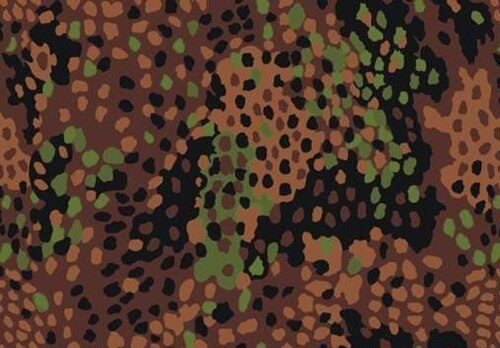
The famous Waffen-SS “pea dot” pattern: dense small dots and blotches based on the oak-leaf design. Late-war, widely photographed in Normandy 1944, and today one of the most reproduced German WWII patterns.
Leibermuster (1945).
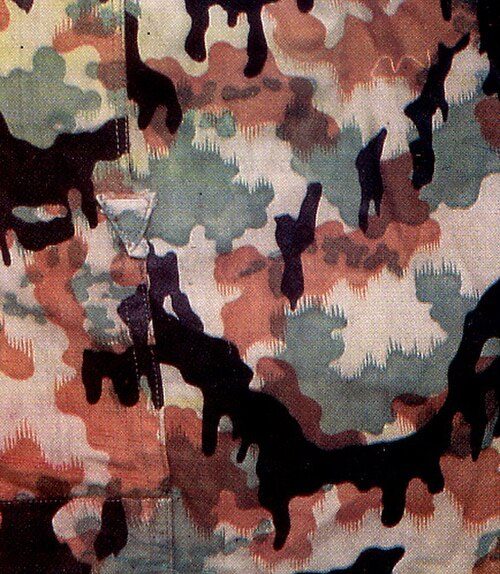
The final German pattern, named after the Leiber brothers (sometimes given as engineer Hellmut Leiber) who designed it. Bold, irregular shapes, designed to absorb infrared (a response to Allied night-vision research), intended to replace all previous patterns, but it saw only limited use at the very end of the war, mostly in Czechoslovakia. Its influence outlived it: it became the basis of the Swiss Alpenflage and, according to postwar analysis, inspired the American ERDL pattern.
One important note on names: several of the familiar German names, plane tree, palm, oak leaf, were not used by the German armed forces during the war. They were invented by postwar collectors to describe the patterns. That does not make them wrong; it makes them a collector vocabulary, not official terminology.
How to tell them apart at a glance
If you are looking at a garment or a fabric sample and want to identify the pattern quickly:
- Sharp angular shapes + rain streaks → splinter (Army or Luftwaffe version; the Luftwaffe version is finer).
- Rounded soft blobs, no sharp angles → plane tree (if large and bark-like) or blurred edge (if diffuse, smoky).
- Leaf-like shapes with two colourways → oak leaf (large, leaf-shaped) or palm (narrower, frond-like).
- Splinter geometry but puffy/blurred borders → marsh pattern (Sumpfmuster 43 or 44; the 44 is softer).
- Dense small dots over the whole surface → pea dot (Erbsenmuster).
- Bold, irregular, modern-looking shapes → Leibermuster.
Colourways matter too: reversible garments mean you may be looking at the spring (green-dominant) or autumn (brown-dominant) side.
Production, distribution and the myths
A few facts separate the documented history from common assumptions:
- Camouflage was not universal in the German Army. The splinter pattern was widely distributed, but camouflaged smocks were largely an SS and specialist affair (paratroopers, snipers, assault pioneers). Most Wehrmacht infantry fought in field-grey wool; the “every German soldier wore camouflage” image is a myth, fed by propaganda photography. Field-grey (Feldgrau) was the official base colour for 1937-45, and even the late-war M44 blouse used a plain dull field-grey.
- Several familiar names are postwar inventions. Nearly all the familiar names for these patterns, Platanenmuster, Eichenlaubmuster, Palmenmuster, Rauchtarnmuster, Erbsenmuster, Sumpftarnmuster, were coined by postwar collectors or by Allied postwar analysts, not issued by the German armed forces. Only a couple, Leibermuster, and the Army’s Buntfarbenaufdruck designation, have an authentic wartime basis, and even those are debated. Even “Splittertarn” itself is a postwar collector coinage; the Army’s technical designation for the 1931 design was Buntfarbenaufdruck 31 (“multi-coloured print 31”), though it was also referred to as Heeres-Splittermuster 31 from about 1935. The shorthand “Splittertarn” is a later, partly collectors’ truncation of “Splittermuster”, descriptive, not an official designation. Leibermuster is generally regarded as the one German pattern known today under something close to its wartime name, though its designers are variously given as the Leiber brothers and the engineer Hellmut Leiber, and even this is not fully documented. No other German WWII pattern name is reliably traced to a wartime official designation. Worth knowing because, when you buy a modern reproduction, you are buying against a collector vocabulary, not a wartime administration’s terminology, and it is one reason different sources use the same word for slightly different designs. (Related confusion: “Blumentarn” is not a German WWII pattern; it is the nickname of the East German Flächentarn, adopted 1958.)
- The patent story is real but not complete. The Waffen-SS patent restricted the use of Schick’s patterns, which is why the Army’s own patterns remained splinter-based. But camouflage use also spread to the Luftwaffe, Kriegsmarine and Fallschirmjäger in their own forms.
- Production was always constrained. The cotton-duck shortage from 1943 onward changed the materials of every pattern, which is why late-war garments often look different from early-war ones even in the same pattern.
- Quality varied enormously. Hand-printed early items, machine-printed mid-war items and rushed late-war items differ visibly. For collectors this is part of the charm; for buyers of modern reproductions it is a reminder that “authentic” colourways vary.
The legacy: from Alpenflage to Flecktarn
German WWII camouflage shaped the post-war world more than any other pattern family:
- Switzerland based its famous Alpenflage on the Leibermuster.
- The United States a contested reading, is sometimes said to have drawn inspiration from Leibermuster for its ERDL pattern of 1948, which the US Army credits to its own Engineer Research and Development Laboratories rather than to the German design, the ancestor of M81 Woodland.
- Germany’s own Bundeswehr revived the spot concept: the Platanenmuster is widely regarded as an early spot/dot design ancestor (a design relation, not an identical repeat) of Bundeswehr spot-camouflage such as Flecktarn, developed by the Bundeswehr in the 1970s–80s and adopted in the early 1990s.
- The reproduction market is enormous, driven by re-enactment, airsoft and military history interest, and by the simple fact that these patterns still look striking.
Buying German WWII patterns today
When buying German WWII pattern clothing today, a few points are worth knowing:
- Reproduction vs original: most modern garments are reproductions of the historical designs; the pattern names and colourways are the historical ones, the cut is modern. Check the product description to see which pattern and which colourway you are getting.
- Colourway variants: spring/autumn, early/late and Army/Luftwaffe versions of the same pattern name are distinct designs. If you want a specific look (for example the Normandy 1944 pea-dot or the early splinter), choose the variant accordingly.
- Seasonal reversibility: historically many smocks were reversible; modern reproductions do not always reproduce the two-sided construction, so check what the product actually offers.
Explore German WWII camouflage on MegaCamo
MegaCamo’s German range is one of the deepest in the catalogue, with the WWII Germany country page gathering the full collection, made to order, in modern cuts:
- Germany WWII Heer Splinter the classic Army pattern
- Germany WWII Luftwaffe Splinter the finer Air Force version
- Germany WWII Pea Dot 44 the famous late-Waffen-SS pattern
- Germany WWII Platanen (Plane Tree) Spring and Fall
- Germany WWII Rauchtarn (Blurred Edge) Spring and Fall
- Germany WWII Eichenlaub (Oak Leaf) Spring and Fall
- German WWII Sumpfmuster 43 and Sumpfmuster 44 the marsh patterns
- German Schneetarn the winter pattern
And for the modern German story, see our guide to Flecktarn, the Bundeswehr pattern that descends from this family.
