
Camouflage History
Czech Vz95: How an American Design Became a Central European Signature
Some camouflage designs live a double life. The Czech vz.95, the “leaf” pattern of the Czech Armed Forces, looks like a home-grown Central European design, yet it descends from an American laboratory pattern created in 1948. Conceived for a country that no longer exists, shelved for years, and then revived as the standard of a new NATO member, the vz.95 is a compact history of how camouflage, and the map of Europe, changed after the Cold War.
Introduction: a pattern born as a relic
The vz.95 has one of the strangest genealogies in modern camouflage. It was designed in 1985, for Czechoslovakia, a state that dissolved in 1993. It was inspired by the American ERDL “leaf” pattern of 1948. That 1985 design is the vz.85; the designation “vz.95” comes from the 1994-95 competition that selected the successor pattern for the Czech Republic. It was never issued by the army it was intended for, and when a successor state finally adopted it, it got a new name, a new palette, and a new life.
Today it is the standard camouflage of the Czech Armed Forces, and one of a very large worldwide family of “leaf” patterns that trace their roots back to the same American laboratory. This is the story of how a shelved design became a national signature.

The Cold War roots
Czechoslovakia spent the Cold War inside the Soviet bloc. Yet the country had a long and surprising tradition of making its own camouflage. During and after the Second World War, printing machines for German pattern-production had reportedly ended up in Czechoslovakia. By the 1950s, Czech designers were producing distinctive, colourful camouflage for specific seasons and terrains, an unusual degree of independence inside a bloc that usually imposed Soviet patterns.
Those designs carry evocative names used by Czech collectors and later writers, though not all of them are attested in official documents: Bahňák (a derivative of the German Sumpfmuster), a four-colour 1948 pattern for shelters and jump smocks, mrácky (“clouds”, reversible, for airborne units), duby (“oaks”, reversible, for snipers and reconnaissance), the 1960 vz.60 mlok (“salamander”), and jehlicí/oblaky (needles/clouds, a 1963 copy of a Polish pattern that remained in service into the 1980s).
By 1963 the army had adopted a muted “rain” pattern, barely distinguishable from a plain colour at a distance, and in 1975 a plain khaki uniform. This was the low point, the most undistinctive period of Czech camouflage. Then, in the mid-1980s, the designers began again.
1985: the ERDL-inspired leaf
In 1985, Czechoslovak camouflage designers developed a new “leaf” pattern. They did not start from nothing: the design was strongly influenced by the American ERDL pattern, the “leaf pattern” created by the US Army’s Engineer Research & Development Laboratories in 1948. The ERDL had spawned the American M81 Woodland and, through it, many woodland-style patterns around the world. The Czech designers took that leaf-shaped language and re-coloured it to their own taste, producing a design with a distinctive palette.
The resulting vz.85 leaf was designed for the Czechoslovak army. But it was never put into production by Czechoslovakia. The plan sat, and soon the state itself was gone. With the “Velvet Divorce” of 1 January 1993, Czechoslovakia split into the Czech Republic and Slovakia.
The vz.95: a revived design becomes a standard
After the split, the new Czech Republic revived the shelved vz.85. The design was refined, the chocolate-brown and bottle-green reduced, the pale yellow-green and black kept, and it became the vz.95, official designation vzor 95 (“pattern 95”). It was developed drawing on both the vz.85 and the subsequent vz.92 line, and it has been the standard camouflage of the Czech Armed Forces since 1995.
In its final form the vz.95 is a four-colour leaf pattern: ERDL-style leaf and branch shapes in near-black, grey-green and olive-green on a pale green background. Camopedia describes the motif as black, grey-green and olive shapes on a pale green base.
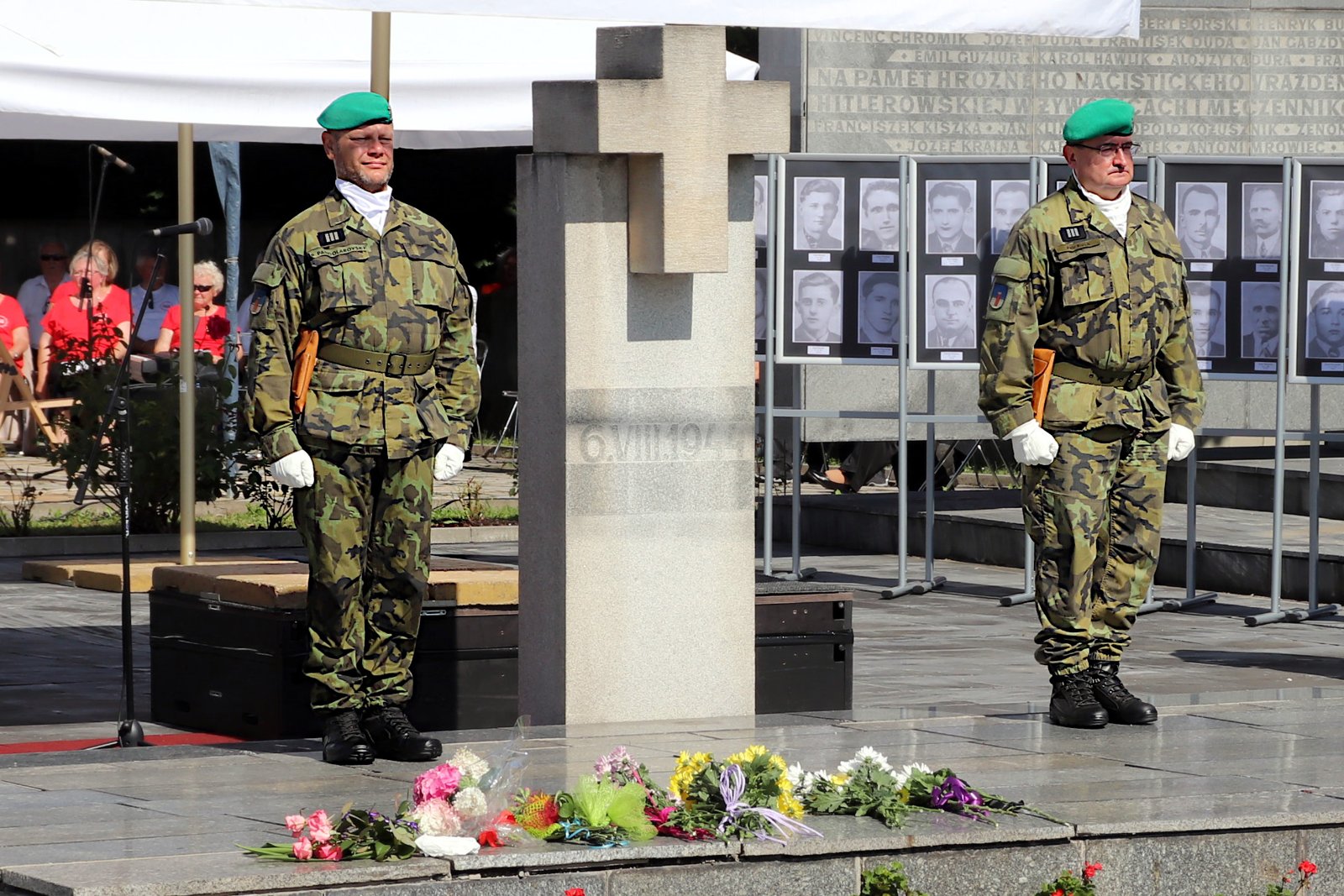
One point deserves care: some sources say the uniform actually entered service in 1993, earlier than the “vz.95” name suggests, while most record 1995. The designation and general issue trace to 1995, but individual accounts differ on the very first issue.


A desert sibling: the two-tone vz.85/vz.95 desert
Alongside the forest leaf, the Czechs developed a desert version. Czech specialist sources (Armádní noviny) describe the desert version as developed from the British army’s desert pattern, while other reference sources date it to the same 1985 design effort and note that its brown sections correspond to those of the vz.85 leaf pattern, so the two-tone desert print is best described as a colour reduction of the leaf design, which also explains the resemblance to British desert camouflage. Like the forest leaf, it was never adopted by the Cold-War Czechoslovak army. Unlike it, it became the standard desert pattern of the Czech Republic, printed in medium poplin and later in cotton ripstop, and worn by Czech personnel in dry theatres.

From Cold War legacy to NATO ally
The Czech Republic joined NATO in 1999. Its forces, and the vz.95, then transformed. The pattern has been worn by Czech personnel on operations from Kosovo and the Balkans to Afghanistan and Iraq.

Special operations and parachute elements, such as the 601st Special Forces Group and the 43rd Airborne Regiment (43. výsadkový pluk, Chrudim; a regiment since 1 October 2020), moved early to MultiCam. In Afghanistan, Czech special-forces contingents were sometimes observed wearing British desert DPM combat shirts alongside their own desert vz.85 uniforms, a practical, mixed kit.
The end of the era
After more than a quarter of a century, the vz.95’s time is coming to an end. In 2022, the Czech Ministry of Defence announced a new camouflage to replace it: the MAD21 (Camouflage Design Pattern 2021), strongly influenced by MultiCam and its international derivatives, designed by Tomáš Chorý (Palacký University, Olomouc) with the Army’s logistics section and project-managed by the University of Defence in Brno, approved in November 2021, registered as a European industrial design and publicly presented in February 2022. The MAD21 retains certain elements of the vz.95, a nod to the pattern it replaces.
Why the vz.95 matters
The vz.95 is a reminder that camouflage designs travel across borders and decades in unpredictable ways. A 1948 American laboratory pattern was re-coloured by Czechoslovakia in the 1980s, shelved, revived by the Czech Republic in the 1990s, and worn by a NATO ally into the 2020s, a single design linking the ERDL, the M81 Woodland, and leaf patterns around the world.
It is also a story about what happens to military equipment when a state dissolves. The vz.95 waited through the collapse of a country, and then became the uniform of the new one. Few camouflage designs have so clearly borne the weight of a geopolitical shift.
Explore the vz.95 on MegaCamo
MegaCamo’s Czech vz.95 collection brings this leaf pattern to modern apparel, made to order. The wider Czech and Czechoslovak country page gathers further Central European camouflage designs.
The photographs on this page are reproduced with credit to their authors, under the terms of their respective licences.
- Two Czech vz.95 summer jackets (desert, forest) via Wikimedia Commons, author “Chekotay”, licensed CC BY-SA 4.0.
- Czech vz.95 forest pattern, two colour variants (1995–2007 and 2013 palettes) via Wikimedia Commons, author “Chekotay”, licensed CC BY-SA 4.0.
- Vz.95 and vz.85 field caps via Wikimedia Commons, author “Chekotay”, licensed CC BY-SA 4.0.
- Czech soldiers in vz.95 desert, Afghanistan (2014) U.S. Army photo by Pfc. Nikayla Shodeen, public domain.
- Czech soldiers on KFOR patrol, Kosovo Czech Ministry of Defence, attribution.
- Czech soldier operating a mine detector, KFOR Czech Ministry of Defence, attribution.
- Czech soldier of the 74th Light Motorized Battalion, exercise Allied Spirit II U.S. Department of Defense photo by Spc. Courtney Hubbard, public domain.
- Czech soldiers patrolling Brno after the 2016 Brussels attacks via Wikimedia Commons, author “Lasy”, licensed CC BY-SA 4.0.
Images under CC BY-SA 4.0 are used in accordance with their licence, which requires attribution to the named author via Wikimedia Commons.
