
Camouflage History
Russian VSR “Dubok”: The Pattern That Emerged From the Soviet Collapse
When the Soviet Union dissolved in 1991, the new Russian army stumbled into its camouflage identity. It had no single pattern to call its own. What followed was a burst of designs, the VSR, the KMLK, the Kamysh, the SMK, the Flora, many of them so similar that even specialists struggle to tell them apart at a distance. At the centre of it all was the VSR, nicknamed “Dubok”, the little oak. It was the first camouflage to be issued broadly across the Russian army, and it distilled the confusion of a great army reinventing itself.
Introduction: an army in search of a pattern
In 1991 the Russian Federation inherited not just the territory of the Soviet Union but its army, and its camouflage. For several years Russian soldiers wore Soviet-era uniforms, including the tricolour woodland known as TTsKO. But an independent Russia needed its own identity, and it got one faster than almost anyone expected. In a few short years a whole constellation of camouflage patterns appeared.
The most important of these is the VSR, the pattern of the Vooruzhennyye sily Rossii, the Armed Forces of Russia. It has several names: it is called Dubok (“little oak”), and the technical shorthand 3-TsV (three colours). Collectors sometimes call it VSR-93. All three names point to the same design, the first camouflage to reach the Russian army on a wide scale.
An oak leaf in the undergrowth
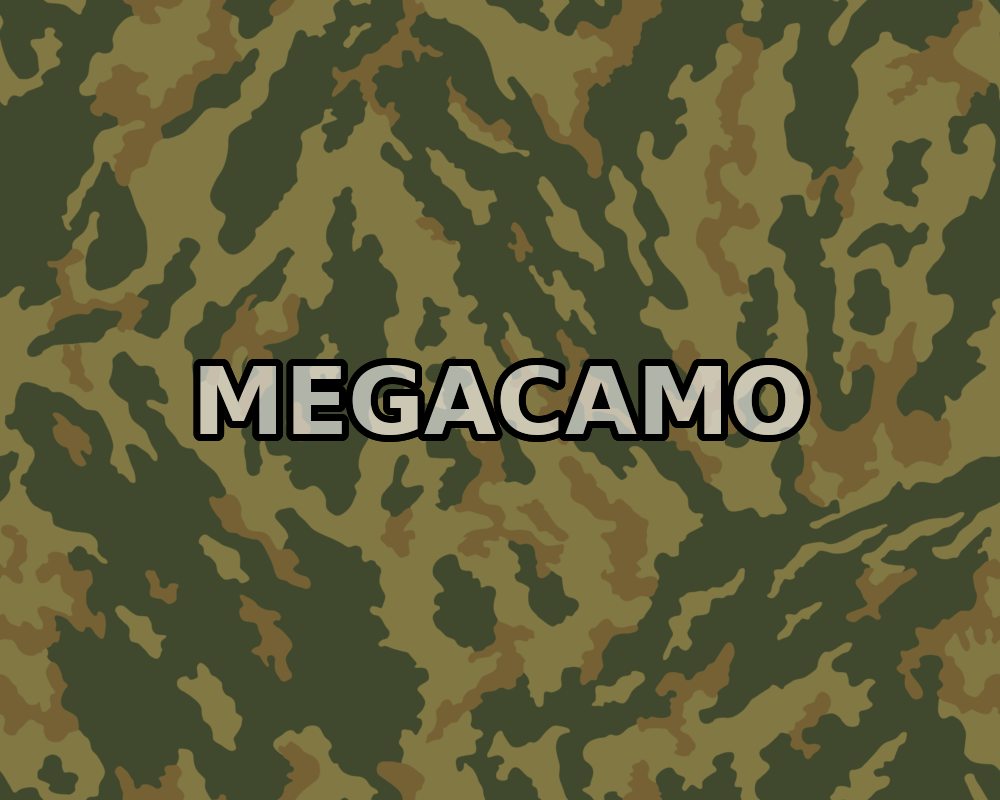
The VSR is a three-colour pattern. Its defining feature is the shape of the blotches: irregular, vertically aligned shapes in two darker tones on a lighter field. Camopedia describes it this way, vertical, irregular, organic shapes. It is not a pixel or geometric pattern; it is a soft, mottled, woodland-style design whose vertical orientation is its most recognisable trait.
The “Dubok” nickname comes from the resemblance of the shapes to the leaves and branches of a young oak. The design shares a strong family resemblance to the Soviet TTsKO, the three-colour woodland developed for the Soviet military. The project name for that Soviet camouflage programme was Butan (butane), and some sources use “Butan” as another name for the design. It is worth noting that the point is a matter of some debate, the term is attached sometimes to the earlier TTsKO and sometimes to the VSR itself, so it is best treated as a Soviet camouflage project name rather than a fixed label.
From research to issue
The VSR was developed at the end of the 1980s, after a period of trials that lasted about eight years, with early versions known as barvikha. It entered service in 1991, first in specialised units such as the airborne forces (VDV). By 1994 it had been issued widely across most ground units and the MVD, the internal-affairs ministry. It was the first truly general-issue camouflage of the Russian army.
The pattern came in many colourways. Early production was green-dominant, while other versions were brown-dominant. Photographs from Bosnia and Kosovo in the late 1990s show the green-dominant shade, while images from a US-Russian exercise in 1995 show the darker brown variant. The variety is a reminder that “Dubok” is less a fixed design than a family of closely related prints.
From VSR to Flora and beyond
The VSR was not the end of the story. Around 1998 the Russian army introduced the Flora pattern (Arbuz, “watermelon”), a design grown from the VSR’s DNA. The Flora uses larger, horizontally aligned shapes rather than the vertical blotches of the Dubok, a development of the same idea rather than a copy. The Flora, in turn, became the standard until the arrival of the digital EMR pattern.
At the same time, a whole galaxy of post-Soviet patterns appeared for distinct users, and this is where camouflage identification gets genuinely difficult:
- KMLK / KM-P (1992) a revival of the Soviet KLMK camouflage for the MVD special-designation brigades, printed in four patterns (desert, mountain, tundra, tropical).
- Kamysh / Tigr (1993) a Russian “tiger stripe” in green and blue urban variants, worn first by the MVD’s elite Vityaz unit and the OMON riot police.
- SMK a dense four-colour mottled pattern for MVD special forces, waterproof summer and winter suits.
- Rastr (2004) described by Camopedia as derived from the “reed figure” (Kamyshovy risunok) pattern now called Podlesok, seen with the MVD’s internal troops in Chechnya and with the OMON.
- SS-Leto (2004) a “summer” pattern strongly inspired by the German World War II oak-leaf design.
The challenge is that many of these look alike from a distance. Dubok, Flora, TTsKO and Kamysh all share a similar palette of greens and browns in organic mottled shapes. Telling them apart requires close attention to the shape and orientation of the blotches, a real problem for photographers, collectors and troops on the ground trying to identify friend or foe.

In the field: from Bosnia to Chechnya
The VSR and its relatives were worn across a turbulent period of Russian military history. Russian troops in Bosnia, part of the IFOR and SFOR peacekeeping missions of the mid-1990s, wore the VSR. In Kosovo, from 1999 to 2001, Russian units in the KFOR mission wore the three-colour woodland, seen in photographs of the Russian force commander meeting US generals at Camp Bondsteel.
In the Caucasus, Russian federal forces in Chechnya wore the three-colour patterns drawn from the VSR lineage, photographed with officials handing out decorations in the North Caucasus in 2000. The pattern also spread beyond Russia’s borders, adopted by several other former Soviet republics.
A pattern with two homelands
One complication deserves honest treatment. The term “Dubok” is shared between two countries. Camopedia associates it with the Russian VSR, issued from 1991 and generalised by 1994. Other references describe a Dubok as a Ukrainian pattern of the 1990s, though the dedicated Ukrainian record treats it as an entirely different design rather than a Butan derivative. Either way, the design grew out of a shared Soviet-era genetic pool, and both Russia and Ukraine used and adapted such patterns. Ukrainian VSR-type patterns exist. The truth is that the design grew out of a shared Soviet genetic pool, and both Russia and Ukraine used and adapted it. When writing about the Dubok, it is important to specify which army is being discussed.
Why the VSR matters
The VSR matters because it is the camouflage of a transition, the pattern that a new army found for itself in the chaos after the Soviet collapse. It is the first truly general-issue Russian camouflage, and it sits at the centre of a dense family of designs that even experts find hard to separate.
It is also a lesson in how camouflage reflects a nation’s circumstances. The Soviet Union had a single, stable pattern system. The new Russia, in the space of a decade, produced a scattering of closely related but distinct designs, distributed among regular troops, the MVD, the OMON and the special forces. The VSR is the thread that runs through it all.
Explore the Russian VSR on MegaCamo
MegaCamo’s Russian VSR Dubok collection brings this post-Soviet pattern to modern apparel, made to order. The wider Russia country page gathers the VSR, Kamysh, Flora and MVD variants alongside the full range.
