
Camouflage History
Swiss Alpenflage: The Most Complex Cold War Camouflage in Europe
Switzerland has not fought a war since the nineteenth century. Yet the neutral army of this alpine state built one of the most technically intricate camouflage patterns Europe has ever issued, a six-colour design full of red, green, dark shadow and pale flecks, descended from the last secret German camouflage of the Second World War. Soldiers called it the “four-fruit pyjama”; collectors call it Alpenflage. It is one of the great curiosities of cold-war camouflage, and a story about why a small neutral state built a pattern more elaborate than most NATO patterns of the same era.
Introduction: the neutral army with the loudest uniform
On the surface it makes no sense. Switzerland is famously neutral and non-belligerent; its army has not been engaged in combat operations for almost two centuries. So why did it field a camouflage so colourful that from a distance it looks less like concealment and more like a jar of mixed sweets?
The answer lies in what the Swiss pattern was designed for. The country is full of forest, rock, and damp leaf litter; and its cold-war army, a militia force expected to defend its independence at all costs, built an elaborate system of combat clothing and equipment to do it. The pattern had to work in the Swiss landscape, and it had to survive across a wide range of conditions. The result is a design that seems overwrought up close and works remarkably well at a distance, a pattern built for the alpine and forested terrain of a neutral country preparing for a war it hoped never to fight.
A name that is not official
First, a word about the name. “Alpenflage” is not a Swiss military term. It is a collector’s and historian’s name, shorthand for “Alpine camouflage”, and it only became widespread after large quantities of Swiss surplus garments hit the international military-surplus market in the 1990s. The official designation is the Tarnanzug TAZ, “camouflage suit”, with the model number. Thus TAZ 57 (1957) and TAZ 83 (1983) are the two most significant versions, and the French-speaking part of the army uses TASS (tenue d’assaut).
The Swiss soldiers themselves had a nickname, and it is memorable: Vierfruchtpyjama, the “four-fruit pyjama”, a reference to the multiple colours that give the pattern a fruit-tree appearance. Collectors have another: “pizza camouflage”, because the red, green, black and cream shapes look like pizza toppings. Both names tell you something important, this is a pattern that does not look like any other.
Descent from a German secret
The lineage of the Alpenflage is the most interesting part of its story. It descends directly from the German Leibermuster, the last and most advanced camouflage developed by Germany during the Second World War.
The Leibermuster, credited to the Leiber brothers and introduced in very small numbers in 1945, was designed as a universal multi-terrain camouflage intended to replace every German pattern then in service. It included infrared-related considerations woven into its design. As the war ended, the pattern barely had time to be fielded. And that is where the Swiss story begins: some sources, following the account of historian Daniel Peterson, hold that the printing machines for the Leibermuster were obtained by Switzerland from Czechoslovakia after the war, allowing the Swiss to develop their own version of the design.
What is well established is the visual lineage: the Swiss pattern that emerged around 1955-1957 is a direct adaptation of the Leibermuster concept, an inheritance of the German wartime pattern-development programme.
What the pattern actually looks like
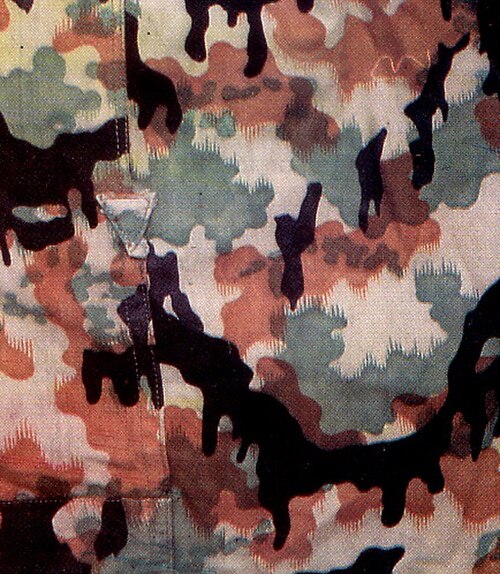
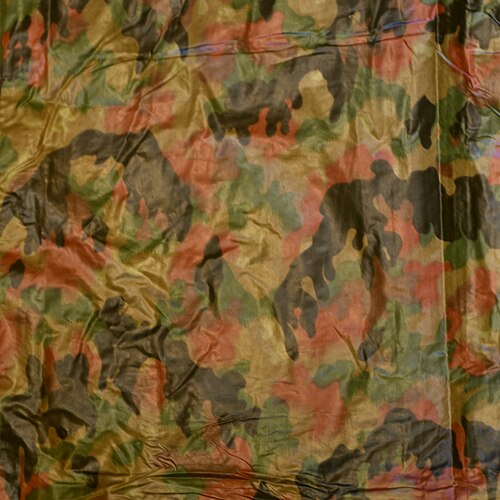
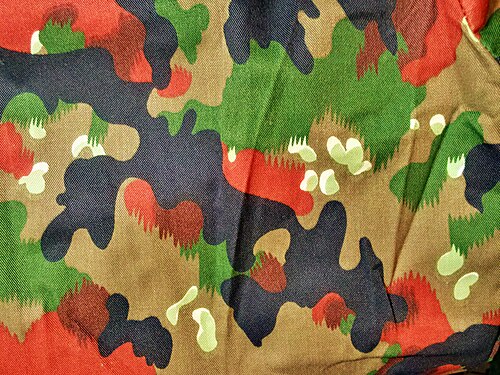
The Alpenflage is a multi-colour disruptor. In its full form it has been described as a six-colour design: a base of mottled pale yellow-beige with white flecks and light-green bodies, overprinted with leaf-shaped forms in green, red-brown and black.
The red is the signature. Most camouflage designers avoid such a bright colour because it draws the eye; the Swiss used whole fields of red-brown through carmine. Up close, the pattern is busy and almost unsettling. Yet its designers knew what they were doing. The black shapes create artificial shadows; the pale areas break up outlines; and the red and green, which look garish indoors, blend into the damp leaf-litter of a Swiss forest floor and work in built-up areas too, where they confuse the eye between natural and artificial surfaces.
A note on the colours: sources disagree on a precise count. Some describe the pattern with six colours, and some with four. Part of this comes down to whether the pale flecks are counted as an added shade, and part to the fact that the pattern exists in several forms and eras of production.

The suits themselves
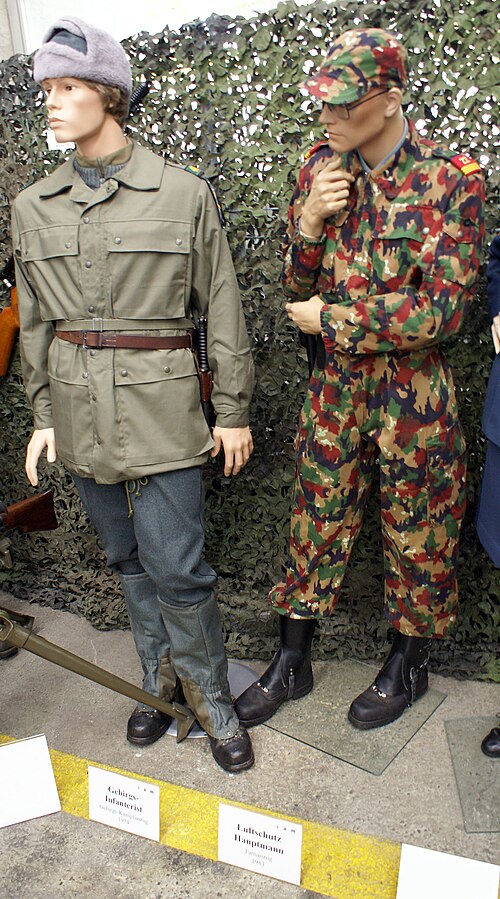
The pattern came on very distinctive clothing. The Kampfanzug 57/70 (“battle suit”) was a heavy, well-pocketed combat overgarment built to integrate the soldier’s load: it needed to carry a great deal of ammunition and equipment without separate straps. It was a substantial, layered system.
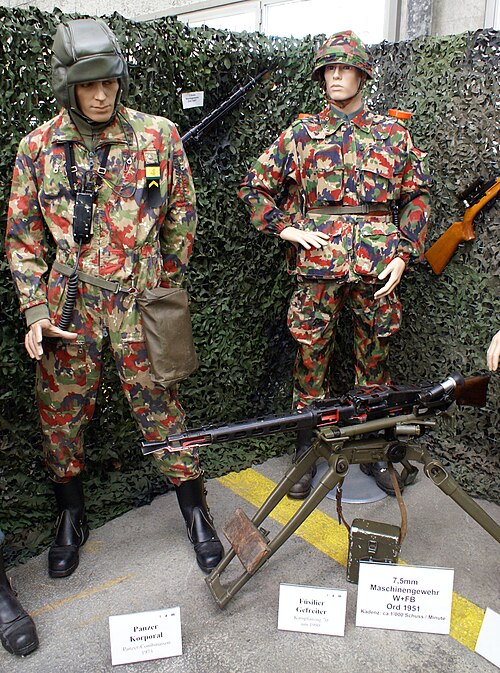
The TAZ 83, introduced in 1983, was a lighter, simpler take, closer to a conventional shirt-and-trouser combination, worn by support and non-combat elements. The family extended well beyond clothing: there were shelter-half sheets (Militärblachen), ponchos, helmet covers, and even a one-piece tanker’s overall.
Thirty years of service and an international afterlife
The Alpenflage family served Switzerland from the late 1950s to the early 1990s. The Kampfanzug 57/70 was in service from 1957 and the TAZ 83 from 1983, both replaced by the TAZ 90 from the early 1990s (sources give 1990 or 1993). The TAZ 90 is a direct development of the Alpenflage that removes the white flecks and the red, leaving a more conventional four-colour pattern, green, tan, brown and black, with colours chosen by the Swiss federal technical institute to match the natural Swiss environment.
The Alpenflage’s second life came through the surplus market. In the 1990s, thousands of Swiss suits entered the European and American military-surplus trade and became cheap, durable jackets and gear for hunters, campers, airsoft players, anglers and outdoor workers. That is why, for many people, the Alpenflage is a familiar sight even though most have never seen a Swiss soldier.
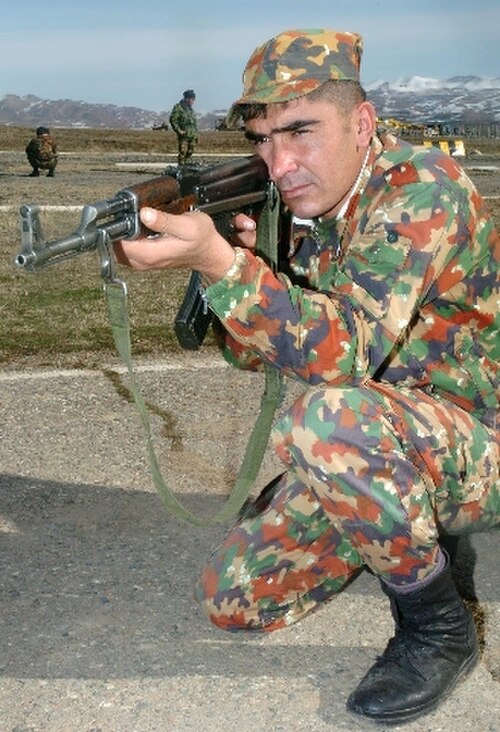
The pattern is also documented beyond Switzerland: a photograph from January 2007 shows a Tajik National Guard sergeant wearing a TAZ-83 uniform during a joint exercise with the US Army, and the pattern has been recorded in other countries as surplus and in regional forces. the Alpenflage’s global presence is mostly as surplus equipment rather than as a foreign standard.
The infrared question
One claim about the Alpenflage deserves careful treatment. Some popular references describe it as a “multi-spectral” or infrared-resistant camouflage, building on the German interest in infrared countermeasures. The German pattern development at the end of the war did consider infrared camouflage, and the Swiss inherited some of those visual ideas. But the materials, dyes and construction changed over several decades of production, and infrared performance is not documented across the whole range of garments. The Swiss pattern inherited infrared-thinking from its German ancestor; that inheritance did not extend to a multi-spectral performance on every item produced.
Why the Alpenflage matters
The Alpenflage matters for a few reasons. It is a reminder that camouflage is not a competition for the quietest or most “military” look, sometimes the most complex, most colourful pattern is the one tuned to a specific landscape. It is a case study in how a neutral small state, with no imperial ambition and no recent war, still invested enormous design effort into preparing for a defensive war. And it is a beautiful anomaly: arguably one of the few major cold-war patterns to feature red so prominently, a colour most militaries would avoid fielding, and one that, in the alpine forest it was made for, worked surprisingly well.
Explore the Swiss Alpenflage on MegaCamo
MegaCamo’s Alpenflage collection brings this distinctive Swiss pattern to modern apparel, made to order. The wider Switzerland country page gathers the full Swiss range.
