
Camouflage History
Malaysia: Jungle Patterns for a Jungle Nation
Malaysia is one of the few countries where a soldier can expect to fight in rainforest, and it has changed its camouflage more often than most. Brushstrokes gave way to tiger stripes, tiger stripes to pixels, and the pixels then split by service: green for the army, sand for the desert, grey for the navy, blue-grey for the air force. Read as a sequence, the patterns record what the armed forces thought a jungle looked like, and what the country’s textile industry could print at the time.
Two landmasses, one jungle problem
Malaysia is split in two. Peninsular Malaysia faces the Strait of Malacca, while Sabah and Sarawak share the island of Borneo with Indonesia and Brunei. Both halves are equatorial forest, and both halves produced the same military problem after 1948: an enemy moving in small groups under cover, along tracks that maps did not show, able to live off the ground for weeks.
The Malayan Emergency, the confrontation with Indonesia in the early 1960s and the communist insurgency that ended in 1989 were all jungle campaigns. They shaped an army built around light infantry battalions, a strong ranger tradition, and a school of jungle warfare that foreign units still attend. They also explain the conservative first choice. For years the Malaysian soldier wore plain jungle green, the British tropical uniform of the post-war period, and camouflage was a matter of helmet covers if it existed at all.
1969: the brushstroke
The first national pattern is a brushstroke design, dark green and black strokes over a khaki ground, catalogued as the M70. Camopedia places its introduction in the 1970s; Malaysian uniform histories usually date it to 1969, and both dates describe the same moment, when the army replaced jungle green with a printed combat uniform. It stayed in service for a quarter of a century. Its ancestors are the wartime brushstrokes of the Denison smock, covered in our study of the Denison smock and the brushstroke family.
What makes the brushstroke interesting is its inconsistency. Production batches differ in the density of the ground, in the shade of green and in the weight of the black. A collector who lays out five M70 jackets from different years is looking at five slightly different patterns, which is a normal feature of printing on contract, in several mills, over decades. The Johor Military Force, the state force of Johor, kept a modern production of brushstroke long after the army moved on.
1993: Harimau Kumbang, and the washing problem
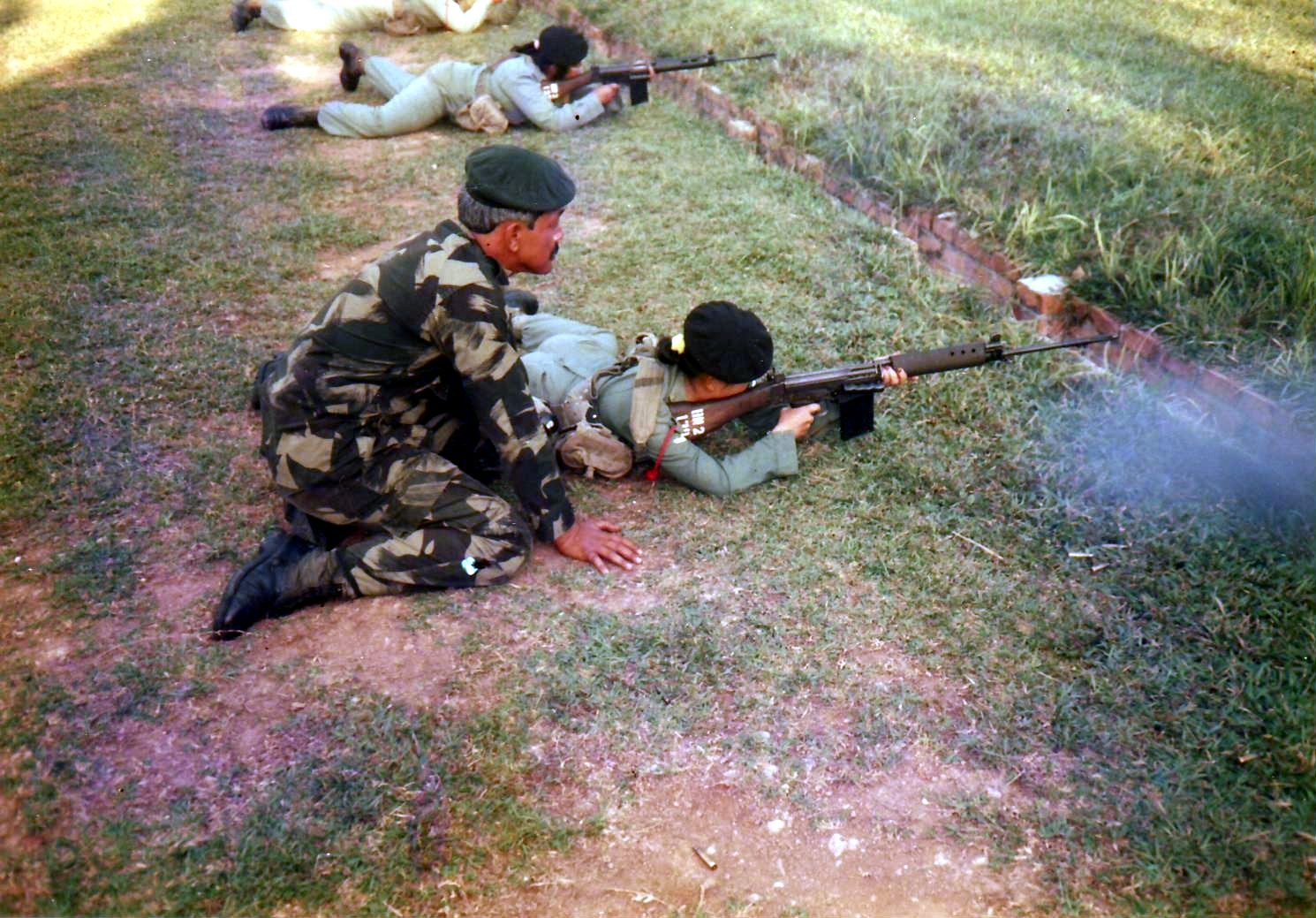
The next experiment tried to look more like the forest itself. The Harimau Kumbang, the black panther, was a mottled design in green, brown and black, also called Loreng Daun Pisang, banana-leaf stripes, and nicknamed the Cameronian after the highland district where it was trialled by a Royal Ranger unit in the early 1990s. It reached civil defence units and some ministries in 1993 and 1994 and was never adopted as the general issue pattern of the army. The objection was practical: the cloth lost its colour after repeated washing, so a uniform that looked right in the depot turned pale in the field. Photographs of the pattern in service are scarce, and it survives mainly in written accounts and in a small number of garments.
1994: Harimau Belang, the stripes that stayed
Malaysia’s answer went in the opposite direction: more contrast, stronger shapes, and a design that tolerated fading because its effect never depended on subtle greens. The Harimau Belang, the tiger stripe, printed broad horizontal bands of black, dark brown and green over a khaki ground, a zebra-like structure closer to the wartime tiger prints of Asia than to the soft blobs of Western woodland. The older Asian tiger prints, with which it is often confused, are described in our history of tiger stripe camouflage. It was introduced in 1994, and Malaysian reporting places its first public appearance at Exercise Halilintar that year.
Sources do not fully agree on its origin. Camopedia treats the tiger stripe as a pattern of its own, while later Malaysian accounts describe it as an improved version of the 1993 print. What is not in dispute is its durability. It remained the standard combat pattern of the army for almost twenty years, outlasted the first years of the digital rollout, and was still being photographed on Malaysian soldiers in the early 2010s. In the forest it also did something that a mottled design cannot: at a distance the horizontal bands broke the outline of a man in a way that reads as vegetation only a few metres away, and they held that effect when the cloth had faded to a washed brown.

The tiger stripe is the pattern most often associated with Malaysia abroad, in the same way that the brushstroke belongs to the 1970s and the pixels to the present. MegaCamo prints it on request, including a quilted bomber jacket in the zebra Harimau Belang pattern, and the country index gathers the patterns of the region under Malaysia and its neighbours.
The units that never waited
Malaysian special forces rarely accepted the pattern of the day without an argument. From 2000 the naval commando unit PASKAL wore a locally produced copy of the American M81 woodland, a design that had nothing to do with the tiger stripes on the army’s back and everything to do with what its operators had tested abroad. The borrowing was sometimes more direct still: a Malaysian contingent served with SFOR in Bosnia between 1996 and 1998 in British DPM windproofs, and the police’s 69 Commando Battalion used DPM for a period as well. Since 2025 the army’s special forces group, GGK, has worn a commercial multi-terrain pattern rather than a national design, which ends a long period in which every Malaysian soldier, regular or not, wore a pattern drawn in Malaysia.

2013: the pixel arrives
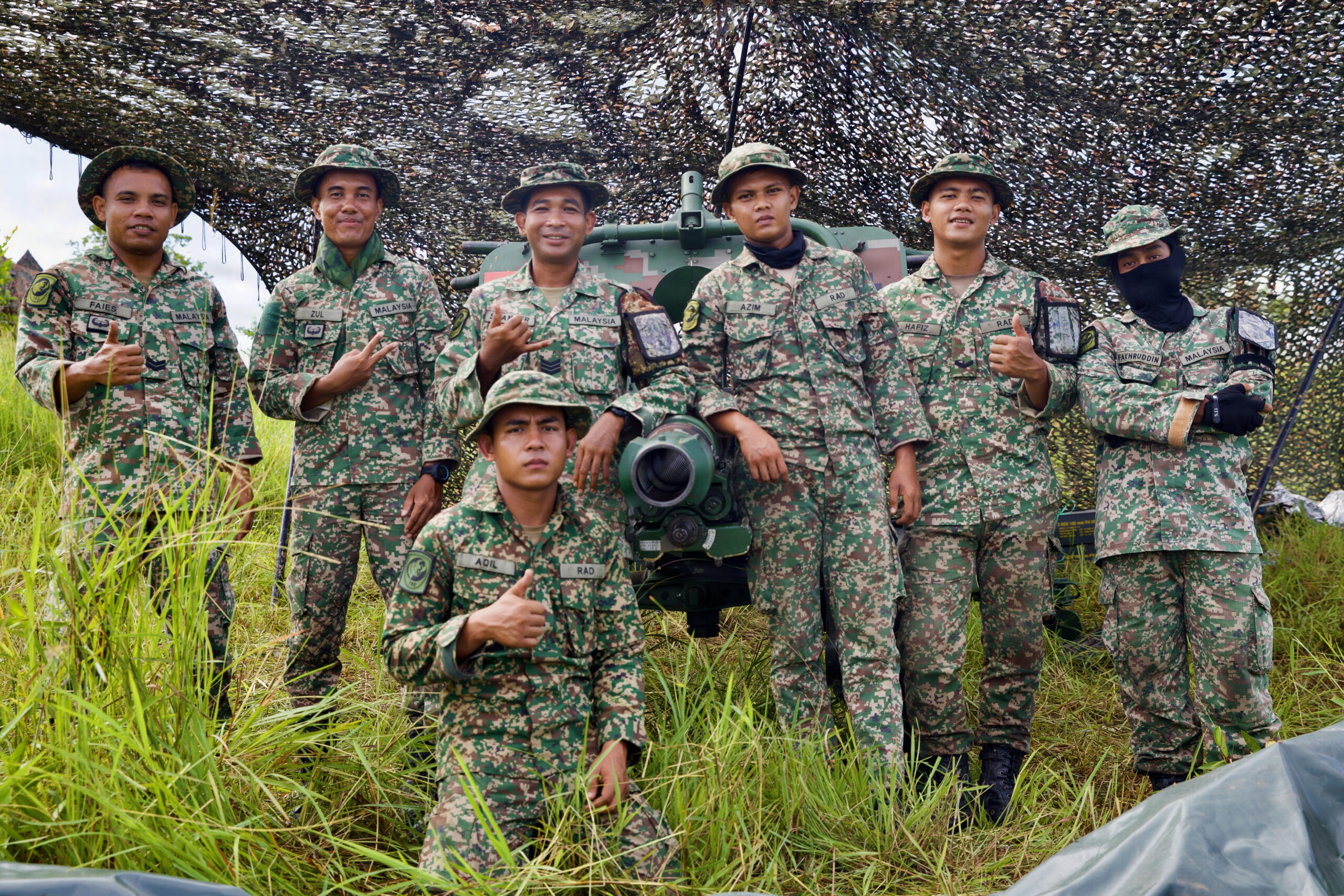
The digital turn arrived with unusual ceremony. The armed forces unveiled the new pattern at the parade marking their 80th anniversary, on 21 September 2013. It was developed with STRIDE, the defence ministry’s science and technology research institute, and it replaced organic shapes with pixels in four colours: green, beige, brown and a dark blue that reads as black at a distance. The brief behind it was partly naval. An early version was studied for the riverine units of the navy before the army took the design over for the whole force.
Calling the change cosmetic would be wrong. A pixelated print is easier to reproduce consistently across mills and contracts: the shapes are small, square and repeatable, so the drift between batches matters far less than in a brushstroke or a stripe. For an army that had been burned once by a pattern that faded, and repeatedly by two decades of shade variation, that was the real argument. The pixels also gave the services a way to look different from each other without designing anything new, which is the second half of the story.

One design, several climates
Malaysia’s digital pattern is not one uniform but a family. The woodland version, the one the army wears at home, keeps green and brown pixel fields around a beige base. The desert version replaces the green with sand and pale khaki and darkens the brown, which is what a Malaysian contingent needs when it deploys to the Middle East. The two prints share the same grammar of small squares, so a soldier who knows one can identify the other instantly.


The navy went furthest. On 26 August 2016 the Royal Malaysian Navy presented a grey, white and pale blue digital pattern of its own, which became operational on Navy Day, 27 April 2017, and replaced operational uniforms that had been in use since 1983. Malaysian reporting at the time put the saving from a single naval uniform at about 1.4 million ringgit a year, and the change was justified as much by fire safety and comfort as by concealment at sea. The air force chose a blue-grey digital for its No. 4 dress, and the coast guard, the Malaysian Maritime Enforcement Agency, adopted a darker blue-grey version for boarding parties and shore units.

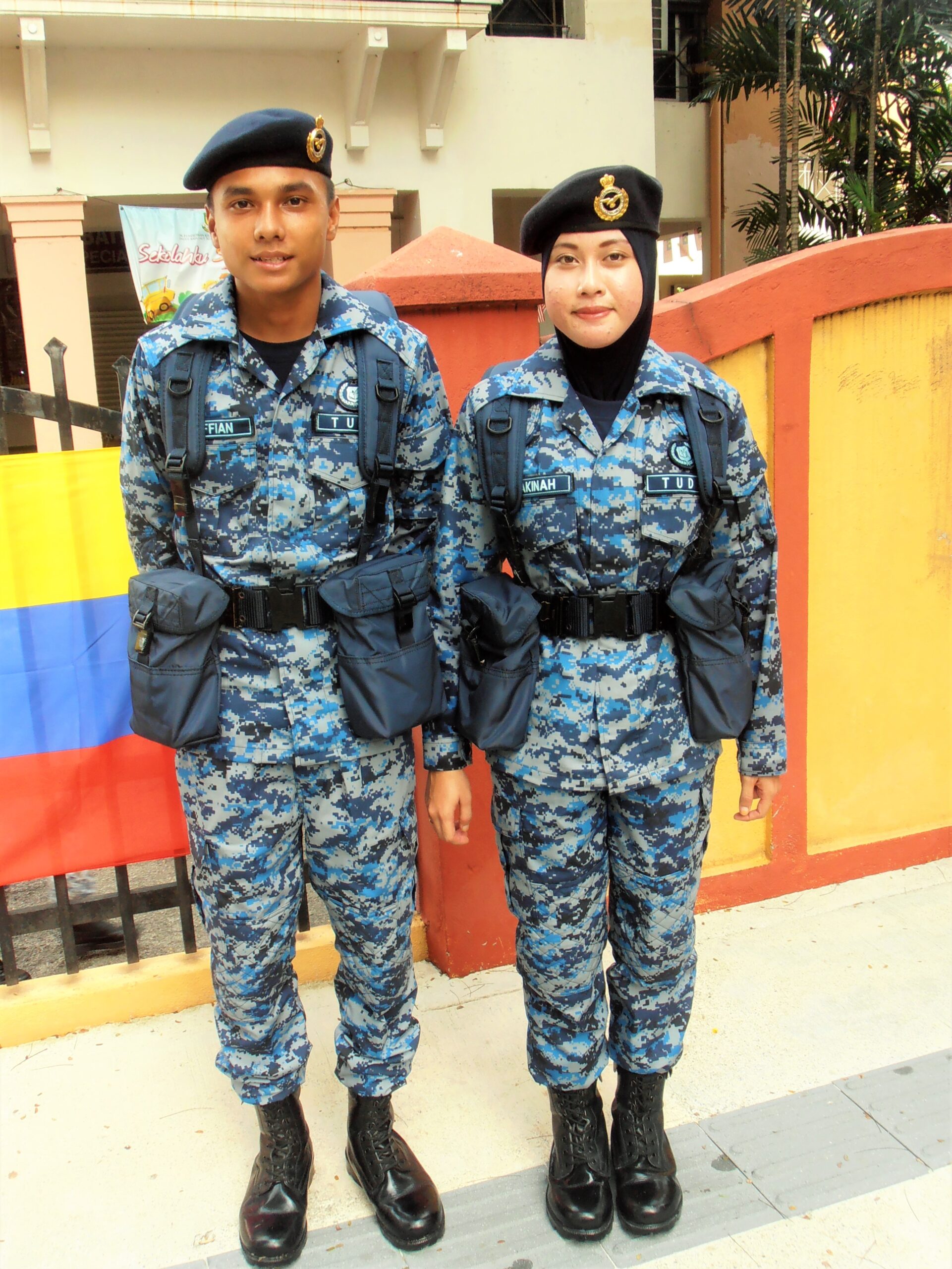
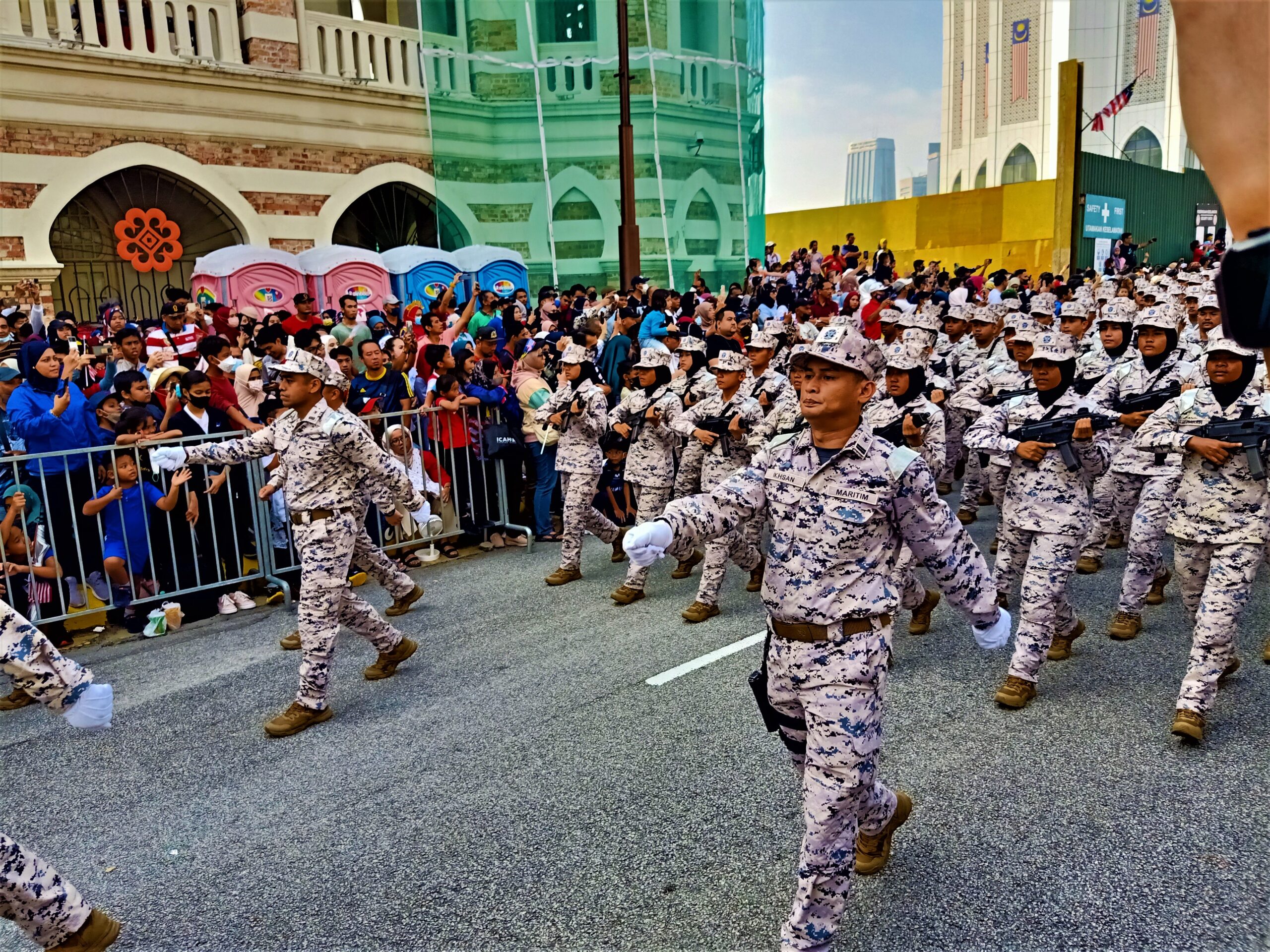
The result is a country that wears at least six camouflage patterns at once, and colour now tells you the service before the shape tells you the country. A pale grey digital in a photograph is a sailor. A blue-grey one is air force or coast guard, and the cut of the uniform usually settles which. Green pixels are army. The only place where the old logic survives intact is the forest itself, where the army’s woodland digital and the civilian patterns printed for it continue the argument that began with a brushstroke in 1969.
How to read a Malaysian uniform
Three markers do most of the dating. Long, soft strokes of dark green and black over khaki mean the 1970s or 1980s, and possibly a territorial or state unit wearing it long after the army had moved on. Broad horizontal bands with hard edges mean the tiger stripe, which dates a photograph between 1994 and roughly 2013. Small squares mean the digital era, and from 2013 onward the colour of those squares identifies the service. A uniform that mixes two of the three is usually a photograph taken during a transition, which is exactly where the most interesting images are.
What the Malaysian case shows
A jungle nation’s camouflage is not only a question of how green the forest is. Malaysia changed pattern when the cloth failed, when a service needed to look like itself, and when printing technology made a new kind of repeat possible. The pattern that lasts is the one the industry can reproduce consistently, which is why a stripe survived twenty years and a better-looking mottled design did not survive two.
For collectors and for anyone choosing a pattern to wear, that makes Malaysia unusually rewarding. The country offers three clearly different generations of design, a family of service colourways built on one digital grammar, and a special forces tradition that borrowed from the Americans and the British whenever the national pattern did not fit the job. It is a small case that contains most of the arguments in modern camouflage: contrast against subtlety, national identity against foreign proven design, and the printer’s tolerance against the soldier’s comfort.
The American lineage behind PASKAL’s woodland is covered in our study of the ERDL leaf pattern, and the digital family that Malaysia joined in 2013 sits with other national pixel designs in the digital and pixelated camouflage category. Garments in the Malaysian tiger stripe and in the digital patterns are printed to order in the MegaCamo shop.
