
Camouflage History
Finnish M05: One Boreal Landscape, Sixty Years of Camouflage
Few armies have so consistently built a single camouflage idea for so long. Finland has spent sixty years refining one national approach, building season- and terrain-specific camouflage patterns, tuned for summer, winter, cold and desert. The current version, the M05, looks like it must be a digital pattern. It is not. It is a set of soft, organic blotches taken from photographs of Finnish woodlands, and it is a highly environment-specific camouflage design.
Introduction: the boreal problem
Finland has a specific and unforgiving camouflage problem. Its landscape is a mosaic of boreal forest, birch, pine, spruce, moss, that changes dramatically with the seasons. The same ground that is white in winter is green with pale lichen in summer, grey in the dark days of late autumn, and brown, open and bare in the spring thaw. Add a long frontier shared with a large eastern neighbour, and the need for effective concealment becomes a national security question.
The solution Finland arrived at was not a single “universal” pattern but a family: several colourways of essentially one design, each matched to a season or a terrain. That family has now served for decades, and its latest generation is the M05. This is the story of how it took sixty years to get right.
The ancestor: M62, the “cucumber relish” pattern
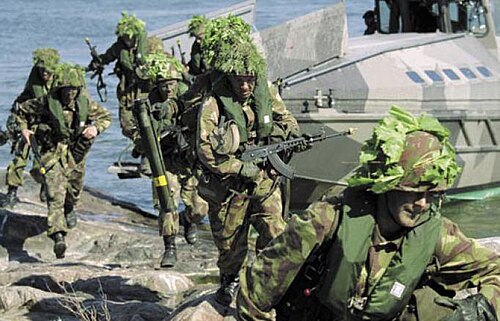
The family begins in the early 1960s, with the M62. The M62 was a three-colour spot pattern, two darker colours on a lighter field, immediately nicknamed by Finnish soldiers kurkkusalaatti, “cucumber relish”, for the way the shapes looked like chopped pickles. Most M62 uniforms were reversible, with a plain white side printed for winter use.
The M62 is not a leaf pattern in the way we think of woodland camouflage today. It is a broad, soft, splotchy design, closer to the mottled “spot” school of cold-war camouflage than to the sharp branch shapes of an American ERDL or a Finnish M05. It served the Finnish Defence Forces for a long time, and in some niches it is still worn, the M62 cut remained popular with the paratroopers of the Utti Jaeger Regiment, where the shape was judged better for parachuting.
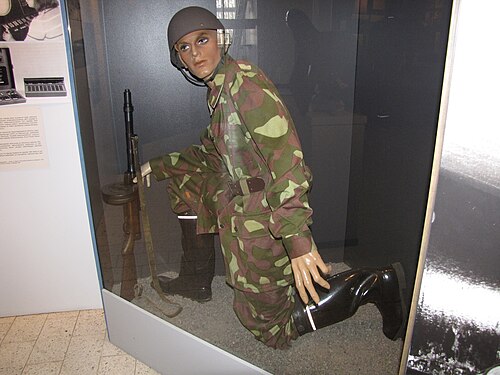
The M91, introduced around 1990, was not a new design so much as a refreshed version of the M62. It used a slightly improved combat-clothing silhouette and a more consistent colouring, but the camouflage motif was essentially a reprint of the M62. A generation of Finnish soldiers trained in this spot pattern, and the M62 and M91 together carried the family into the 2000s.
The M05: a pattern made from actual forests
In the early 2000s the Finnish Defence Forces decided the M62/M91 family had had its day. Rather than adopt a foreign pattern or a generic woodland, they went back to the source: the forest itself.
The M05 Maastokuvio (“terrain pattern” or “landscape pattern”) was built from photographs of Finnish forests, taken by the Finnish Forest Research Institute and then edited digitally by the VTT, the Technical Research Centre of Finland, to produce a four-colour pattern representative of the woodland. A dark grey was added to the mix to represent the shadowed depths of the forest. The design is credited to Pekka Vilhunen, and the pattern was registered in Finland on 31 May 2007.
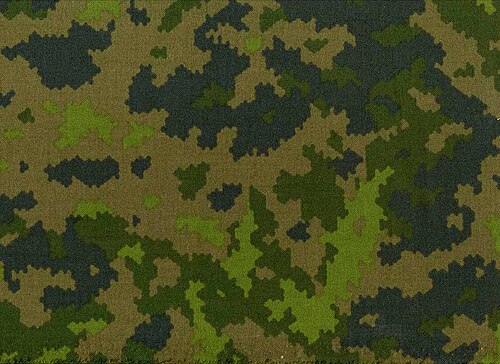
The crucial thing about the M05 is that it is not a pixelated pattern. It looks digital at a distance because the small, irregular blotches read as pixel blocks when print-screened; but zoom in and there are no straight edges and no pixels. It is a soft, organic, disruptive pattern, a camo made of dense moss, shadow and lichen growth rather than of computer-generated squares. This is the single most common misconception about the M05, and worth setting straight.
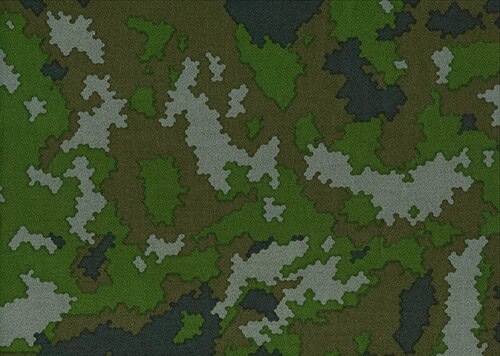
The M04 desert uniform fielded from about 2003; the M05 woodland (Maastokuvio) pattern was adopted and issued around 2007 (registered 31 May 2007; sources differ slightly on the issue year). It was judged significantly better than the M62 and M91 it replaced.
One design, four environments
The real genius of the M05 is that it is not one pattern but a coordinated family, all cut from the same design and re-coloured for a specific season or terrain. Collectively the family is known in Finnish as M05-maastokuvio the “M05 terrain pattern”, and it comes in four issued variants plus an unissued urban design (five if the urban pattern is counted), each with its own Finnish name:
- Maastokuvio (also Metsäkuvio, the woodland/terrain pattern), four colours, dark grey, olive green and apple green on a lighter grey-green base. This is the temperate forest base pattern for summer and open terrain, and the standard Finnish Defence Forces pattern. A dark grey was worked in to stand for the shadowed parts of the forest.
- Pakkaskuvio (frost / cold-weather pattern), the woodland with the light green swapped for grey, suited to the pale, colourless late-autumn and wintery forest. It is printed on the Pakkaspuku, an insulated and weatherproof cold-weather suit.
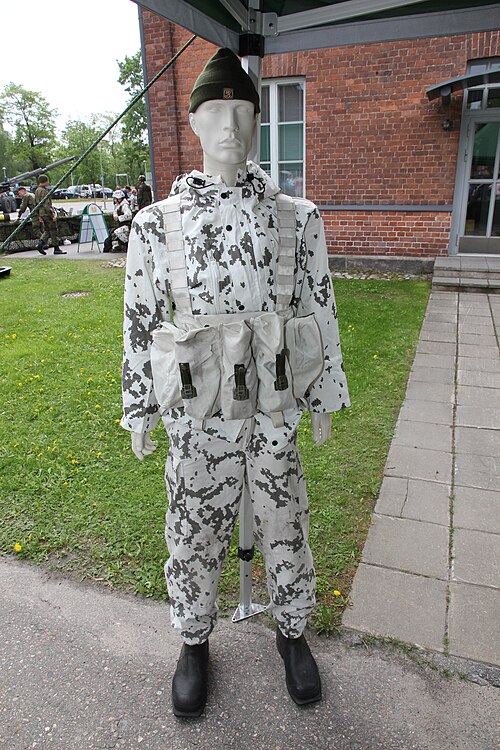
- Lumikuvio (snow pattern), a two-colour version of the same design, dark green on white, printed on a snow oversuit worn over the combat clothing. In dense snow it is remarkably effective. The helmet cover is reversible between the woodland and snow patterns.
- M04 Hellepuku / Hellekuvio (heat-weather / desert pattern), officially designated M04, not M05: this is the desert pattern, developed before the rest of the family. Its prototype (designated K2004) was trialled with Finnish troops on the UN mission in Eritrea in 2003, and the production version, dark green and light brown on a sandy base, was used in Afghanistan and on UN deployments, issued in both a heavier twill and a lighter ripstop.
- Kaupunkimaastokuvio (urban terrain pattern), a grey-brown design developed by the Finnish Defence Forces for built-up areas, but not yet issued on clothing or equipment.
A word on naming, because it trips people up. M05 is the family; the base green pattern is the Maastokuvio (or Metsäkuvio). The desert variant is official M04, even though it is usually sold alongside the M05s. And the patterns are variegated with rounded, organic shapes, they are not “digital” or pixelated in the CADPAT/MARPAT sense, though they are often mistaken for it. Terms like “talvikuvio” (winter pattern) that appear on commercial shops are retailers’ shorthand for either the Pakkaskuvio or the Lumikuvio, not a separate official design.
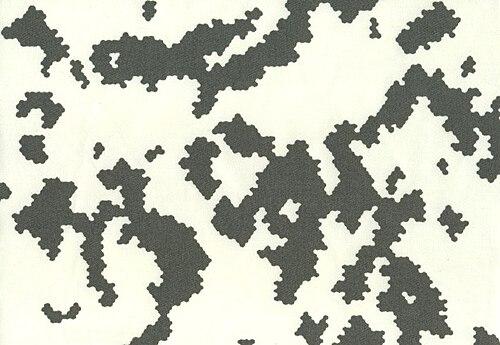
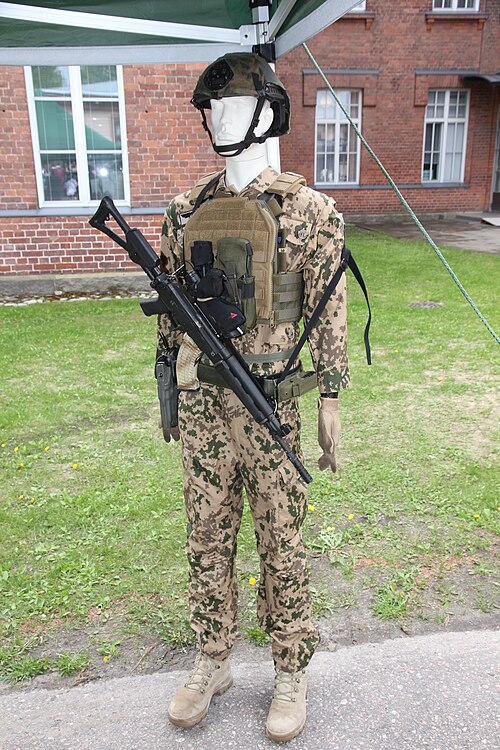
A grey-brown urban pattern was also developed at the same time but was never worn on clothing or equipment. The family, in its various forms, precisely mirrors the Finnish seasons rather than chasing a single universal solution.
Using the pattern: strength and limits
Being environment-specific has advantages and costs. In the right terrain the M05 performs very well. A fresh, clean M05 Maastokuvio blends into the flat, near-neutral light of a winter and late-summer Finnish landscape. Reports from the field, and from specialist observers, describe the pattern working best in flat light on the kind of open, low-contrast forest where Finland does much of its training.
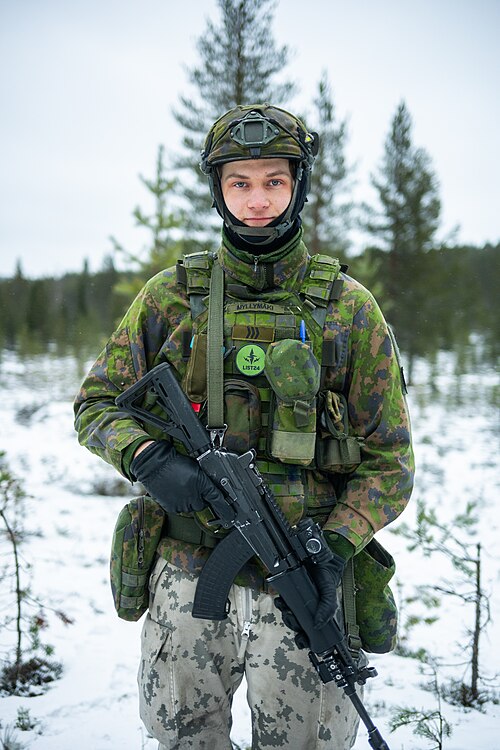
There is a more honest limit, too. The pattern is coloured with dyes that lose their punch quickly in the field. A faded, dusty M05 uniform against bright white sand recovers poorly in harsh, grazing light, a familiar complaint in arid environments, and the reason the desert variant exists. Observers have noted that the M05 flourishes in flat, even light and struggles in hard, high-contrast sun.
A licensing decision with consequences
For years the M05 design was licensed by the Finnish Defence Forces. In 2016 that licence expired and was not renewed, which made the pattern openly available to the public and to commerce. The move was significant: it meant the Finnish armed forces were comfortable enough with the design to let the commercial world use it freely, and the civilian and outdoor market in Finland embraced the M05 with enthusiasm.
Less comfortable is the pattern’s international history. Finland’s press has alleged that Russia copied the M05 for its “Yagel” (lichen) pattern, a four-colour Russian pattern remarkably similar to the Finnish woodland. Finland’s newspapers raised the claim, and it was covered by international media during the Russian campaign in Georgia in 2008. Russia disputed the claim, and no copying has been documented. It is important to state this as an allegation and a claim, not as a proven fact; the resemblance is documented, the copying is not.
The future: M05 lives on
The M05 family is far from retired. In 2022 the Finnish Army chose a supplier for the Finnish version of the Nordic Combat Uniform, the M23, and the M23 will use the M05 family of patterns. So the M05 is a new pattern, not a descendant of the M62 spot design, only the M62 and M91 share a motif. What persisted for sixty years was Finland’s approach to camouflage, and the M05 family continues as the standard Finnish pattern into the 2020s and beyond.
Why the M05 matters
The M05 matters for two reasons. First, it is a rebuttal to the received idea that modern camouflage must be digital. The most effective camouflage is not about pixels; it is about matching the environment, and the M05 does that with organic blotches built from real photographs. Second, it is a model of how a small state with a very specific environment can build a tailored, season-by-season camouflage family that lasts for decades, rather than adopting a generic foreign pattern that works everywhere and nowhere.
In short: sixty years, one landscape, one idea. And the M05 is its best expression so far.
Explore the Finnish M05 on MegaCamo
MegaCamo’s Finnish M05 woodland collection brings this boreal pattern to modern apparel, made to order. The wider Finland country page gathers the M05 cold, snow and M62 variants alongside the full range.
