
Camouflage History
Swedish M90: The Splinter Pattern That Turned a Cold War Airfield Design Into a National Symbol
Sweden spent decades as one of the last Western armies still fighting in plain olive green. When it finally adopted camouflage, it did not copy a foreign pattern, it shrank a design originally painted on fighter jets and tanks down to the scale of a soldier. The result, the M90, is a large, sharp, geometric pattern built not to hide a man at ten metres but to break up his silhouette across a kilometre of Nordic forest. The Swedes call it Lövhögen, the leaf pile, and after thirty years it has become a national emblem.
Introduction: the last army in olive green
Look at a cold-war photograph of Swedish infantry and the first thing you notice is the plain green. While Britain, France, the United States and Germany spent the 1950s and 1960s experimenting with disruptive patterns, the Swedish Armed Forces kept their soldiers in a single colour, a forest-green field uniform for summer and a grey one for winter. Sweden, a neutral country that had not fought a war since 1814, was in no hurry.
Yet by 1990 the force had one of the most recognisable camouflage patterns in Europe. The story of how it got there, and why the design started life on vehicles and aircraft rather than on uniforms, is one of the most unusual adoption stories in the history of military camouflage. It is also a lesson in what happens when a deliberately defensive small state decides to build its own pattern.
How a vehicle pattern became a soldier’s uniform
The camouflage that eventually became the M90 did not begin on a drawing board for clothing. It was developed in the 1970s at Sweden’s defence research agency, the Försvarets forskningsanstalt, better known by its abbreviation FOA. The FOA work focused on vehicles, aircraft, nets and tarpaulins rather than soldiers, the sort of equipment a defensive, dispersed force needs to hide against a heavily armed neighbour.
The reasoning had everything to do with Sweden’s cold-war strategy. Facing the Soviet Union, Sweden planned to disperse its aircraft and armour across small rural strips and hardpoints, where the machines would have to survive on the ground. If the planes were going to hide in the forest, they needed the right paint. The resulting pattern was sometimes nicknamed “FOA” or, on the AJ-37 Viggen fighter, the “Viggen camo”.
Toward the end of the 1980s, the design was scaled down to be printed on fabric. The FOA pattern was reduced by a proportion of roughly 1:66 to create a print for the new field uniform. That reduction is the single most important fact about the M90: the pattern’s distinctive geometry, the large, angular, sharply edged shapes, was not invented for clothing but inherited from the way a camo looks when you paint it across the side of an aircraft or a tank. At 1:66 the motif repeats at a size that suits the distances of a Nordic battlefield rather than a city street.
What the M90 looks like and why
The M90 is a splinter pattern, a family of camouflage built from angular, fragmented shapes rather than soft, organic blobs. In the standard form it uses green shades on a background that reads as khaki or a muted green. The overall effect is a set of large, clean, high-contrast patches.
Sources differ on the exact number of colours. Camopedia describes fragments of dark green, dark olive green and moss green on a khaki background. Some commercial references list four colours including a dark near-black. What every account agrees on is the character of the design: it is large-scale, geometric, and deliberately built to break up a human or vehicle outline rather than to imitate foliage.
The scale is the point. As Swedish camouflage experts have explained, most patterns are designed for engagement distances of tens of metres, but the M90’s large shapes are intended for forest and mixed terrain at distances in the order of a kilometre. It works by making a moving figure merge into the blocky structure of a landscape, not by pretending to be a leaf.

The M90 was also treated to reduce its visibility in the near-infrared, a standard requirement for late cold-war uniforms that is easy to overlook.
The M90 family: more than one uniform
In service the M90 is part of a family of field uniforms with separate letters after the name. The system is called Fältuniform 90 field uniform 90. The letters indicate the purpose:
- M90 / FU90 the standard forest pattern and general-purpose uniform.
- M90P / FU90P P for pansar, armour. A heavier cut with reinforced elbows and knees, issued to armoured-crew and mounted troops.
- M90H / FU90H H for helikopter. A variation with a high-visibility orange interior.
- M90K / FU90K K for öken, desert. A tan and khaki re-colouring of the same pattern.
- M90L / FU90L L for lätt, light. A lighter fabric with roll-up sleeves for summer.
- M90TR / M90TR BE TR for tropik, tropical. Versions for jungle and, in the BE form, for desert, the latter including a smock for cold desert nights.

A version for snow and arctic conditions also exists, printed as an oversuit. Note here that the informal names “M90 woodland”, “M90 desert” and “M90 snow” are common in the press and commercial world; the official designations are simply M90 (standard), M90K (desert) and the winter versions. The M90 family remains the standard uniform of the Swedish Armed Forces today.
An unintended national symbol
What makes the M90 more than just a technical achievement is what happened after adoption. A pattern that was originally engineered to hide dispersed Cold-War machines from Soviet reconnaissance became, over three decades, a genuine emblem of Swedish identity.
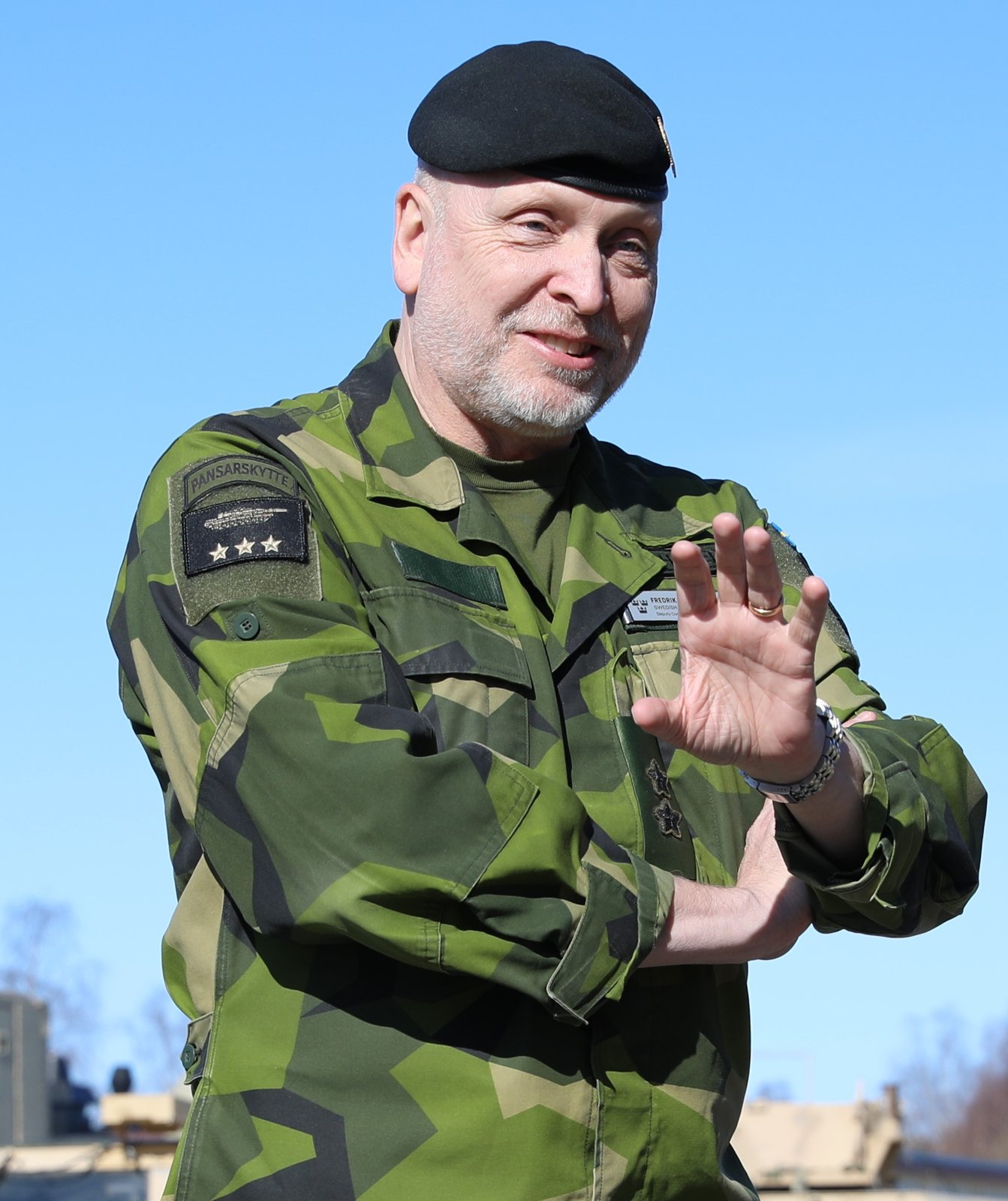
Its nickname, Lövhögen, means “leaf pile”. The name is affectionate and universal, there is a sense in which the country adopted the pattern the way other countries adopt a flag. It appears not only on military kit but on civilian clothing, bags, and design products. For a pattern born of a defensive, careful, neutral state, that is a remarkable second life.

There is a practical side to that fame. Because the M90 was not registered as a protected design until late 2020, commercial reproduction ran largely unchecked for years. The Swedish armed forces did register a protected version in 2020 (design-registration 2020/0062, which added the three crowns mark to the print). Some Swedish commentators have publicly worried that this proliferation, while commercially profitable for the pattern’s admirers, risks both a symbolic dilution and a practical security problem, the pattern is easy to obtain and could, in principle, be worn by people who should not be mistaken for Swedish troops.
M90 in the field and abroad
The M90 saw peacekeeping use from the mid-1990s, appearing with the Swedish contingent of the IFOR mission in Bosnia-Herzegovina in 1996. The desert M90K became the standard for Swedish troops deploying to arid theatres, and was photographed in Afghanistan in 2006.

The M90K is also the pattern Swedish soldiers wore during exercises at the US National Training Center in California in 2007, where a Swedish detachment took part alongside a CV90-40C armoured vehicle in M90, a reminder that the desert variant and the vehicle-derived pattern are two sides of the same design.
One point worth making plainly, because it is often misunderstood: the M90 is essentially a Swedish pattern. No other military is documented as adopting it as standard. The Nordic Combat Uniform project, which began in 2017, does standardise the procurement of uniforms between Sweden, Norway, Finland and Denmark, but each country keeps its own camouflage, and Sweden keeps the M90.
Myths and clarifications
“The M90 is a pixel or digital pattern.” Not at all. It is a large-scale splinter; there are no pixels anywhere near it. This is a common confusion with the later Scandinavian digital patterns, especially the Finnish M05.
“The M90 was designed as a uniform pattern first.” It was not. It is a 1:66 reduction of the FOA vehicle and aircraft pattern developed for a dispersed-airfield strategy.
“Sweden copied a German World War II pattern.” The Swedish developers studied German second-world-war designs, and the M90 belongs to the same splinter family. But it is a home-grown adaptation to a specific Swedish problem, not a direct copy.
“It is a weak pattern because it does not work close-up.” It was never meant to be judged that way. Its strengths and its limitations both follow from its large scale; it is designed for the distances of Nordic forest and mixed terrain, not for a street in a city.

Why the M90 still matters
The M90 matters because it is a case study in camouflage as a solution to a specific national problem. Sweden faced a strategy of dispersal against a powerful neighbour, asked how to hide aircraft and vehicles, and got a pattern. The same pattern, scaled to a soldier, went on to hide people, and then became a symbol.
It is also a caution about “universal” camouflage. The M90 does not pretend to work everywhere; it is tuned to one terrain and one set of distances. In an age that has chased multi-environment patterns, the Swedish decision to build something large, sharp and local, and to stand by it for thirty years, is quietly instructive.
Explore the Swedish M90 on MegaCamo
MegaCamo’s Swedish M90 collection brings this Nordic splinter pattern to modern apparel, made to order. The wider Sweden country page gathers the full range of Swedish camouflage patterns.
