
Camouflage History
Spanish M09: The “Digital” Camouflage That Isn’t
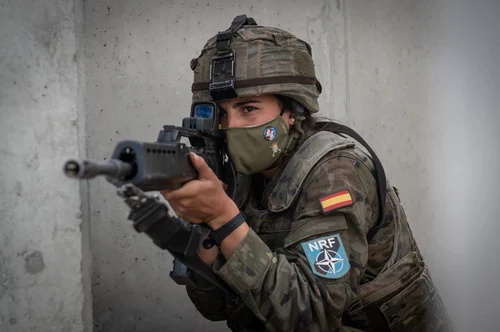
When the Spanish army revealed its new camouflage in 2009, the press described it as a “digital” pattern. It looked the part, rectangular, blocky, modern. Yet the M09 is not a digital pattern in the way the Canadian CADPAT or the American MARPAT are. It is a close relative of MultiCam, redesigned and recoloured to match the faded look of the uniforms Spain had been wearing for decades. It is the story of a country that adopted the newest camouflage concept, quietly, on its own terms.
Introduction: the pattern that looks digital but isn’t
In December 2009 the Spanish army unveiled two new camouflage patterns intended to replace the “leaf” pattern the country had used since the 1980s. On the surface they looked like the wave of pixelated digital patterns that had swept through NATO after Canada’s CADPAT and the American MARPAT. The new Spanish design was called “pixelado”, pixelated. It looked blocky and modern.
But the M09 is not really a digital pattern. Its shapes have rectangular edges, but they are not made of small pixels. In essence the M09 is a close, recoloured copy of MultiCam: Camopedia describes it as copied directly from Crye Industries’ MultiCam with re-coloration, and Joint Forces News calls it Spain’s “digital MultiCam”. On the analysis of that source it is close, too, to the experimental Scorpion pattern from which MultiCam descends, essentially MultiCam stripped of its vertical “twiglet” elements, but what is documented is the MultiCam family rather than a proven Scorpion lineage. That distinction is the heart of this story, and it is a useful correction to the way the Spanish “digital” was reported.
Before the M09: the Spanish leaf years
The M09 did not come from nowhere. Spain had a long, locally distinctive camouflage tradition. The country fielded the M59 Rocoso, a “rocky” amoeba pattern from around 1960, and the M60 Boscosos woodland variant. Then, around 1982, Spain adopted the Leaf or “Hoja” pattern, a derivative of the American ERDL and M81 lines that became the standard Spanish uniform in 1985-86 and remained in service until 2009.
When Spain entered NATO in 1982, its camouflage began to converge with Western trends, but it kept a local character. The Leaf pattern was used for decades, and it is the key to understanding the M09: when the army designed the new pattern, it deliberately tuned the colours to match the sun-faded appearance of those old leaf uniforms. The new pattern, in other words, was built to fit seamlessly with the equipment and look the army already had.
The M09 family: two versions, six colours
The M09 comes in two main forms:
- M09 boscoso (wooded), a six-colour pattern: pale olive green (dominant), stone grey, pale earth, black, light sand and a reddish brown.
- M09 árido/urbano (arid/urban), a subdued four-colour version in sand, stone grey and reddish brown on a tan background, for desert and urban use.
Both forms are built from the MultiCam-derived rectangular geometry rather than from true pixel matrices. The arid/urban version has a particularly interesting construction: its fourth colour comes from printing a light tone over a dark one, rather than from a third roller.

From the leaf to MultiCam
The M09 is best understood as a bridge. It replaced the American-derived leaf pattern with a MultiCam-derived design, but kept the whole thing resolutely Spanish by tuning the colours to the country’s own palette. It is the latest expression of a nation that adopted new camouflage ideas but made them local.
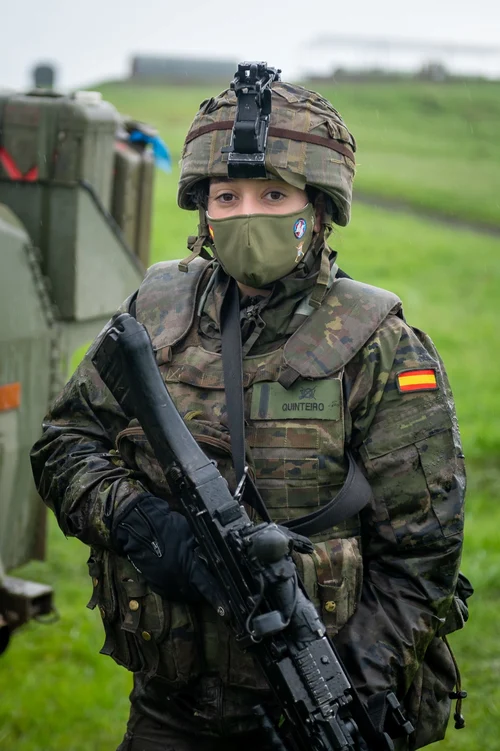
Things have not stopped there. In recent years elements of the Spanish special forces have been documented wearing true MultiCam, and the army has tested genuine MultiCam as a potential replacement for the M09. The parachute brigade acquired a batch of MultiCam uniforms in 2025. The trend runs from the M09’s recoloured MultiCam toward the real thing, a fascinating reversal, where a country that based its “digital” pattern on MultiCam now moves toward MultiCam itself.
The M09 in operations
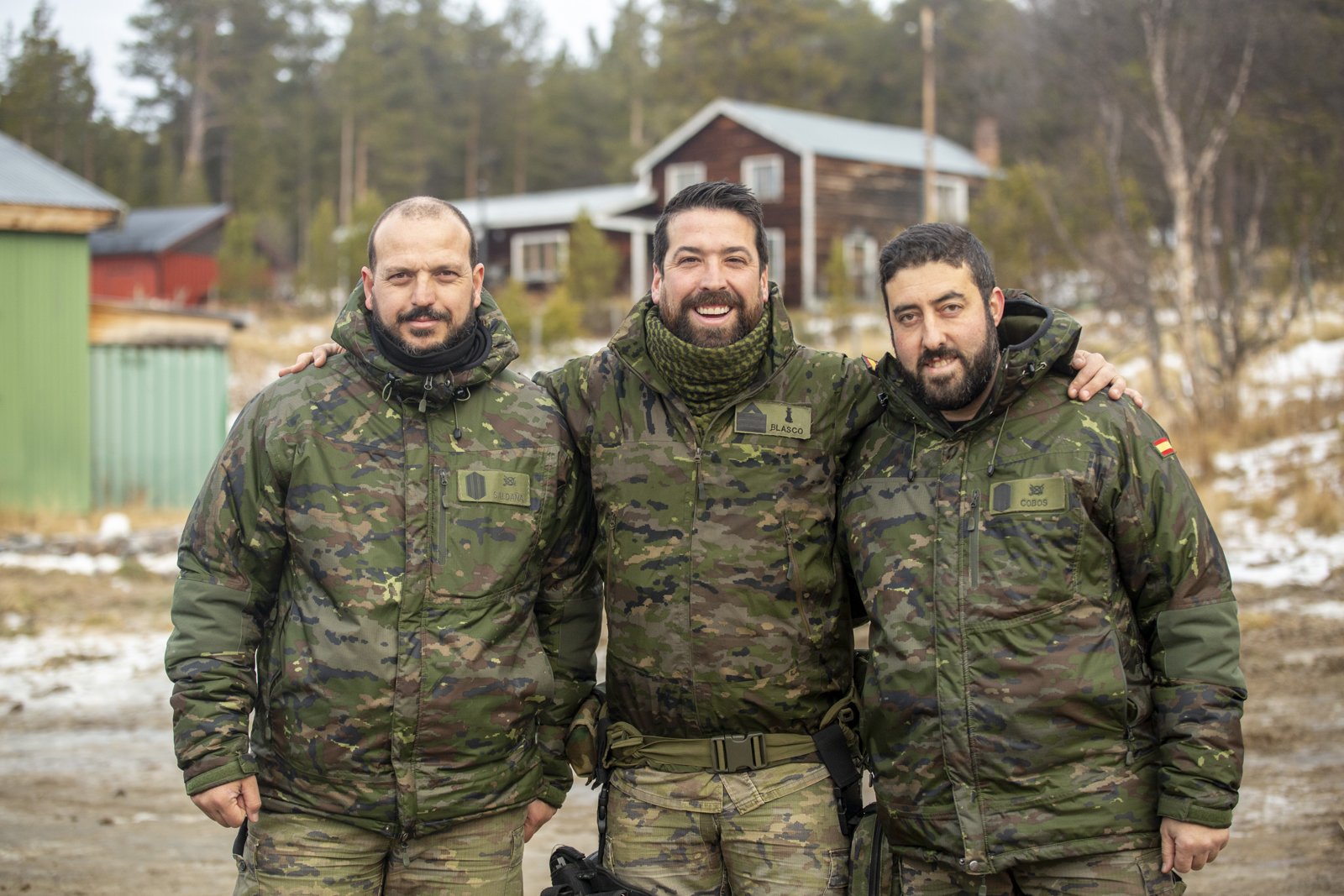
The M09 has been worn by Spanish troops on NATO exercises and deployments across Europe. Spanish soldiers have been photographed in the pattern during exercises in Latvia, Norway, Estonia and Romania, and it has become a common sight in the alliance’s joint drills.
The GEO: the police’s own elite
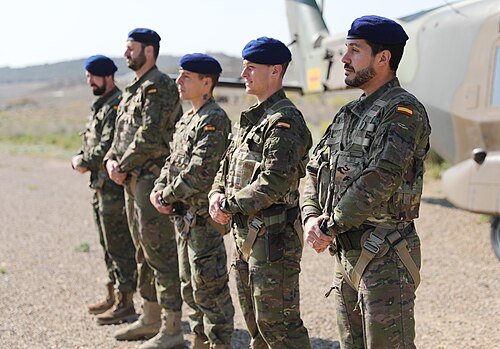
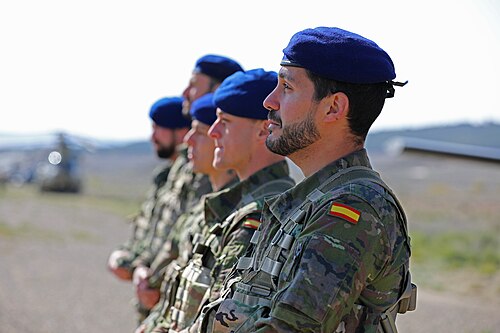
Separate from the army, the Spanish national police has its own elite unit, the GEO, the Grupo Especial de Operaciones. It is worth a clarification here, because a common mistake links the GEO to the Guardia Civil. It does not. The GEO belongs to the Cuerpo Nacional de Policía, the Spanish national police.
The GEO has historically worn black operational kit, and more recently a “Multicam Black” design. It is a parallel story to the army’s: an elite unit moving through the multi-camouflage family, in this case the dark black-blended version of MultiCam.
Why the M09 matters
The M09 matters because it corrects a common misunderstanding. “Digital” camouflage is not a single thing, it is a broad idea, and some patterns that look digital are really something else. The M09 looks like a pixel pattern but is a recoloured MultiCam. Understanding that distinction is genuinely useful.
It is also a case study in national camouflage identity. Spain took the newest global camouflage trend, reshaped it to fit its own terrain and its own faded uniforms, and then, in a final twist, began to move toward the original design it had based its pattern on. The M09 sits at the centre of that arc.
Explore the Spanish M09 on MegaCamo
MegaCamo’s Spanish M09 digital collection brings this MultiCam-derived pattern to modern apparel, made to order. The wider Spain country page gathers the M09 boscoso and desert variants alongside the full range.
