
Camouflage History
UCP: The $5 Billion Camouflage That Taught the US Army What “Universal” Can’t Mean
For fourteen years, the most powerful army in the world dressed its soldiers in a camouflage pattern that many of them hated and that its own scientists repeatedly showed to be among the worst options available. The Universal Camouflage Pattern (UCP) was meant to be the one pattern that worked everywhere. Instead it became a case study in how procurement, testing, optics and politics can combine to produce a uniform that hides nothing but the process that created it. This is the story of UCP, what really happened, which criticisms are fair, and which myths exaggerate.
Introduction: the pattern that defined a generation of soldiers
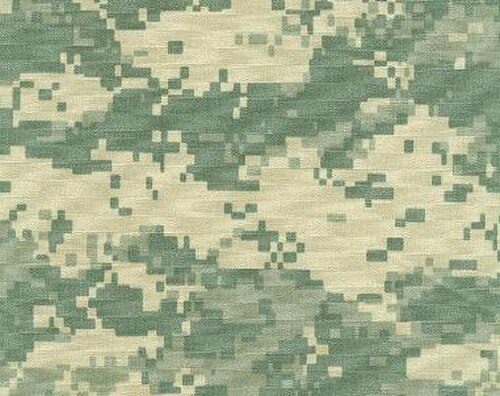
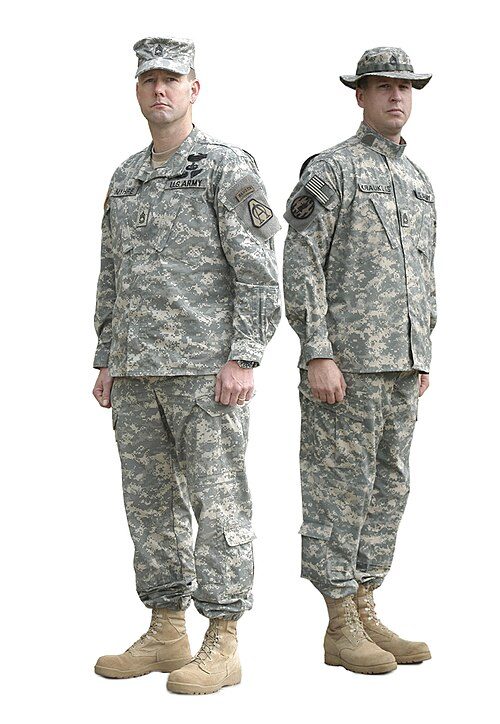
If you served in the US Army between 2005 and 2019, you wore the Universal Camouflage Pattern. The UCP, the pale grey-green pixelated pattern of the Army Combat Uniform (ACU), was issued to every soldier, from basic training to Afghanistan. It was the most visible uniform change in the American army in a generation, and it became one of the most criticised.

The pattern’s palette is minimal: tan, grey and sage green, officially named Desert Sand 500, Urban Gray 501 and Foliage Green 502. Notably, it contains no black at all. The Army’s stated reasoning was that black is a colour rarely found in nature, and that pure black viewed through night-vision goggles can appear extremely dark and create an undesirable high-contrast image. The design intent was “universal”: one pattern that would work in woodland, desert, urban and everything in between, replacing the era of separate woodland and desert uniforms.
The trials: how the Army picked a winner (and then didn’t pick it)
The UCP did not emerge from nowhere. Between May 2001 and June 2004, the US Army ran an extensive research programme, the Universal Camouflage Trials, at its Natick Soldier Center. Three design families were developed in 2002: All-Over Brush, Track and Shadowline, each in four terrain-specific colourways. Fifteen evaluations took place at locations across the United States.
The trials were rigorous by the standards of the day:
- Phase I (late 2002) soldiers rated patterns on blending, brightness, contrast and detection. Shadowline was eliminated, along with the urban colourways of All-Over Brush.
- Phases II and III (2003) patterns were modified and tested alongside a contractor-developed design, Scorpion, created with Crye Precision. Near-infrared (NIR) night testing produced a crucial result: black, medium grey and medium tan were the only colours with acceptable NIR performance.
- Phase IV (2004) the four remaining patterns, Desert Brush, Woodland Track Mod, Scorpion Mod and Urban Track, were tested in woodland, desert and urban environments, on full ensembles.
The results were clear. Desert Brush received the best overall daytime rating. Scorpion won in woodland but did worse in desert and urban. Urban Track was best at night. Natick ranked the finalists: Desert Brush first, Woodland Track Mod second, Scorpion third, Urban Track fourth.
And then the Army introduced… a pattern that was none of these. The UCP that entered service in 2005 was, according to pattern comparisons published by camouflage specialists, essentially a three-colour version of the Marine Corps’ MARPAT pattern, which specialist analysis itself treats as a derivative of the Canadian CADPAT. This MARPAT/CADPAT reading is a visual interpretation from the camouflage community, not an account the US Army has ever documented, the Army’s own stated lineage ran from the Urban Track pattern with black removed. Independent analysis, notably by camouflage specialist Guy Cramer (HyperStealth), found that account incorrect. No evidence has been produced that the final UCP configuration itself underwent proper field testing before adoption.
This is the core of the UCP story: a well-run trials programme produced clear winners, and the pattern that was actually adopted was not the one the tests had selected. The science was not the problem; the decision path was.
In the field: what the soldiers saw
The reaction was not slow in coming. Soldiers serving in Iraq and Afghanistan questioned the UCP’s effectiveness from early on. The grey-green pixels blended poorly with the greens of the Afghan valleys and the browns of the Iraqi deserts; in photographs, US soldiers in UCP often stand out against the terrain they are supposed to disappear into. Service members described the pattern as endangering missions and lives.

The criticism was not just anecdotal. Between March 2007 and March 2009, the Natick Soldier Center ran a Photo-simulation Camouflage Detection Test, pitting UCP against other multi-environment patterns. UCP fared poorly. The pattern’s own designers’ institute had produced the evidence against it.
Congress steps in
The dissatisfaction reached Washington. In 2009, Congress passed a bill ordering the Department of Defense to “take immediate action to provide combat uniforms to personnel deployed to Afghanistan with a camouflage pattern that is suited to the environment of Afghanistan.”
In the interim, the Army tested two replacements in-country: “UCP Delta”, a variant that added coyote brown, tested with elements of the 4th Infantry and 82nd Airborne Divisions; and MultiCam, the commercial pattern developed by Crye Associates from their original Scorpion design of 2002. MultiCam was quickly selected and issued to troops deployed to Afghanistan, under the designation Operation Enduring Freedom Camouflage Pattern (OEF-CP). For the first time since 2005, US soldiers in the main theatre wore something other than UCP.
The $5 billion figure: fact and context
The most famous number attached to UCP is five billion dollars. The headline comes from a 2013 Daily Beast article, “The Army’s $5 Billion New Uniform Already Being Replaced”, and has been repeated ever since. It is best understood as a widely reported estimate of the total cost of the UCP programme across uniforms and equipment over its service life, not an official Army accounting figure. The underlying point, that the Army spent enormous sums on a pattern it then had to abandon, is well documented; the precise figure should be treated with appropriate caution.
The replacement: OCP
In 2014 the Army finally announced the end. On 31 July 2014 it formally chose a modified version of the original Scorpion pattern, Scorpion W2, as the new Operational Camouflage Pattern (OCP), a multi-environment pattern with a genuinely earth-toned palette. OCP uniforms began reaching soldiers in summer 2015. UCP uniforms were no longer authorised after 1 October 2019, though the pattern survives on some body armour, cold-weather overgarments and older equipment.
As the Army discarded UCP, a second life opened: several US State Defense Forces adopted the pattern for their own use, and it remains in limited service around the world, documented users include the Indian Air Force (which adopted a similar pattern in 2022), Indian special forces for urban operations, Serbian anti-terrorist units, the Chilean Air Force, Ukrainian units, Chadian commandos, and many others, often as surplus or clone patterns.
Separating the real criticisms from the myths
UCP is one of the most mythologised patterns on the internet. Here is what the evidence actually supports.
Real: the pattern was adopted over the trial winners. The trials favoured Desert Brush; the adopted pattern was a three-colour digital design with no documented field testing of the final configuration. The mismatch between the science and the decision is documented in Natick’s own reports and specialist analysis.

Real: it performed poorly in its main theatres. The Natick photo-simulation test and the in-country experience in Iraq and Afghanistan are consistent: UCP was out-performed by other patterns in most environments.
Real: soldiers and Congress reacted. The 2009 congressional directive is a documented fact.
Real: the “universal” premise was the design flaw. No single pattern can optimally conceal a soldier in every environment. The trials themselves had started from terrain-specific designs precisely because of this; the shift to a “universal” requirement is where the programme went wrong.
Myth: “UCP was the worst camouflage ever made.” Not supported. The pattern was poor in green and brown environments, but it was acceptable in urban, overcast and some arid settings, which is why it persisted in niche uses. The problem was the promise of universality, not absolute uselessness.
Myth: “UCP was never tested at all.” The trials tested related patterns extensively. What was not tested was the final adopted configuration, an important distinction.
Myth: “The removal of black was an absurd mistake.” It was a decision with a documented technical rationale (NIR performance), even if the result was a washed-out pattern. Blaming the colour alone oversimplifies a procurement failure.
What UCP teaches us
Fourteen years and several billion dollars after its introduction, UCP is gone from the Army’s wardrobe. Its legacy is threefold.
First, it is the canonical example of a broken decision chain. Good trials, clear winners, and then a different pattern anyway. The lesson is not about camouflage; it is about procurement integrity.
Second, it redefined how the world thinks about digital camouflage. UCP’s failure did not discredit digital patterns, CADPAT, MARPAT, and later OCP are digital or semi-digital and work well. It discredited the idea that one digital pattern can be universal.
Third, it produced the modern American system. The OCP that replaced it, and the entire generation of multi-environment patterns that followed, exists because of the UCP lesson. In a dark way, the $5 billion was tuition.
Explore UCP gear on MegaCamo
The pattern’s story lives on in the market. MegaCamo’s US UCP collection offers the pattern on modern apparel, made to order:

- UCP Men’s Fleece Hoodie
- US UCP Camouflage Sports Mesh T-shirt (XS to 5XL) and the UCP Delta version
- US UCP Digital Camouflage Neck Gaiter
Browse the United States country page for the wider American range, from ERDL descendants to AOR and modern patterns.
