
Camouflage History
Bulgarian Splinter: From German Splittermuster to National Standard
Bulgarian splinter is a foreign label. It is what collectors, illustrators and surplus dealers outside Bulgaria call a family of angular camouflage prints that a Bulgarian soldier would simply have recognised as his service camouflage, and it is a convenient name rather than an official one, because no published source, Bulgarian or foreign, records an established state designation for the pattern.
What is not in doubt is where the drawing came from and how long it served. The Bulgarian splinter line descends from the German splinter print of the 1930s, and it stayed in Bulgarian service in one form or another for roughly four decades, ending as the universal camouflage of the Bulgarian armed forces in the 1990s. That is the shape of the story: a German graphic system, re-cut in Bulgaria generation after generation, quietly promoted from specialist kit to national uniform.
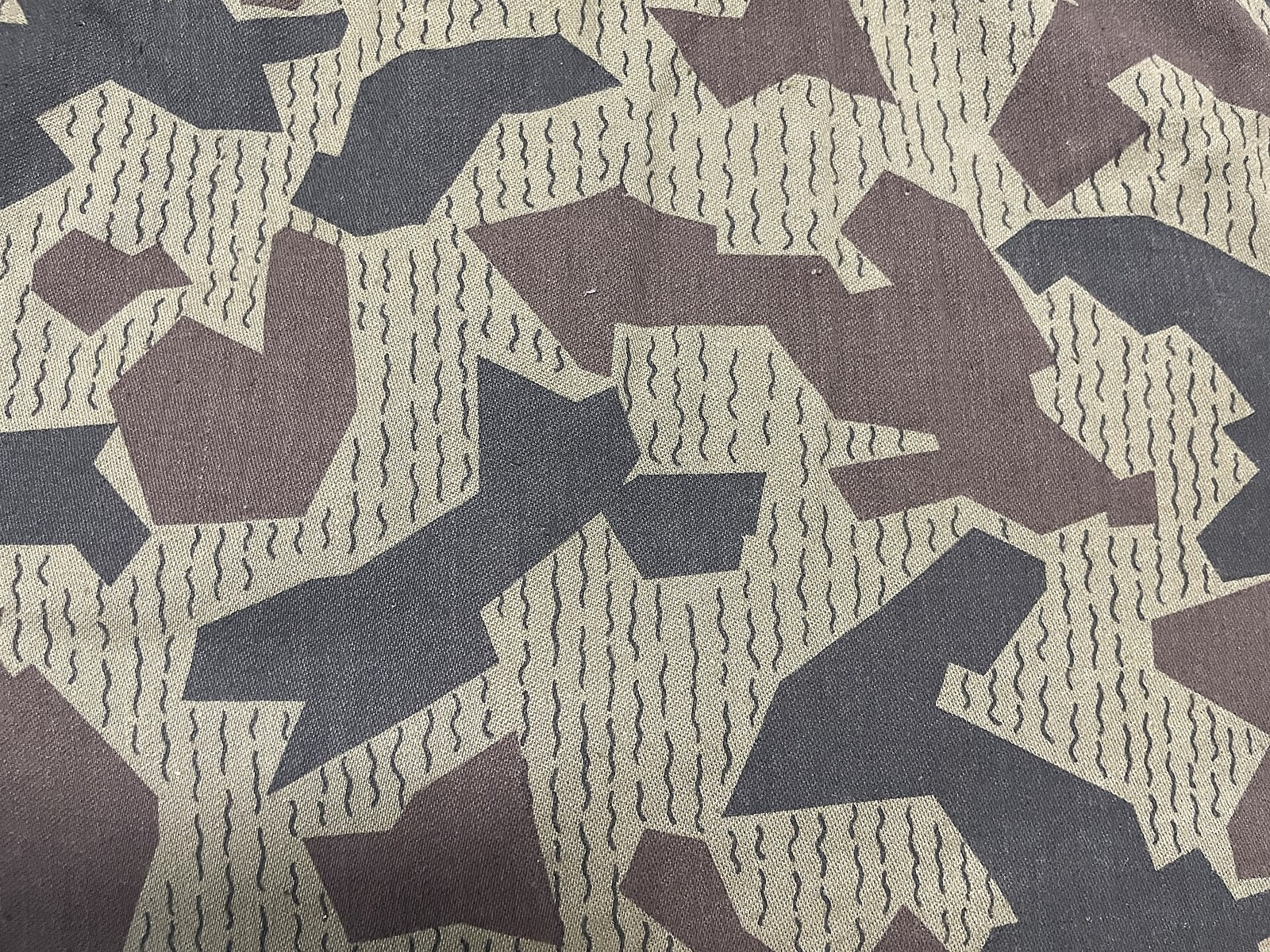
That promotion is the interesting part, and it is also the part that is hardest to document. Bulgaria did not publish the paper trail that other Warsaw Pact states eventually released: no located decree, no order number, no inventory designation fixes the date of any of these generations. What follows is built from three kinds of evidence, and it is worth naming them before they are used. First, secondary reference works that describe the Bulgarian pattern sequence, principally Camopedia’s country entry, together with the English Wikipedia article on Splittertarnmuster. Second, a small amount of period documentation, above all United States Army and Navy recognition material that shows what Bulgarian troops were wearing and when. Third, the testimony of people who own the garments, which is often the most detailed evidence available and is also the least formal.
The German print, and the two versions of it
The German army began printing a multi-colour splinter camouflage on its shelter quarter, the Zeltbahn 31, from 1931-32. The print combined several flat colours, a light ground, greens, browns, as sharply angular shapes with thin, wavy lines running across them, and it was designed to be seen from a distance rather than admired at arm’s length. Behind the pattern lies the same lineage traced in MegaCamo’s account of Splittertarn, the Heer Splittermuster 31: a tent that turned into a camouflage system because everyone who used the tent wanted the rest of their kit to match it.
The naming history matters more here than it does in most pattern articles, because Bulgarian nomenclature (or the absence of it) repeats the German story. In the documentation of 1931 the print was simply the Buntfarbenaufdruck 31, the “coloured print of 31”, applied to the Zeltbahn. The Heeres-Splittermuster 31 designation, and the collector shorthand “Splinter A”, came later. Anyone using a model number for the German original should say which one they mean and on whose authority.
The second German version is the one that matters most to Bulgaria. From about 1941 the Luftwaffe printed a denser splinter camouflage for its parachute troops, applied to the parachutist smock known to collectors as the Knochensack, and designated Luftwaffen-Splittermuster 41, “Splinter B” in collector usage. It is generally described as busier and higher-contrast than the army print, with the shapes pulled tighter together. When Soviet-bloc and post-Soviet patterns are charted as families, this print is the node that Bulgarian camouflage hangs from, and the wider context of the German system is set out in MegaCamo’s German World War II camouflage, explained.
By August 1943 United States intelligence was publishing a recognition sheet for German parachutist clothing that included a camouflaged coverall, which places the printed airborne coverall of the splinter family in the field early in the war. It is an illustration, so it proves what a recognition office chose to draw, but the existence and the date are documented.
The Bulgarian connection
How did the German print reach Bulgaria? The account repeated in the secondary literature is that Bulgarian parachute troops were trained and equipped with German airborne material, including the Luftwaffen-Splittermuster 41 coverall, during the war years. The failure of the sources to converge on anything firmer than that is worth stating plainly: no published source is a Bulgarian wartime order, depot record or dated photograph that names the pattern as German-supplied.
The link is therefore an attribution of secondary sources and collector testimony rather than an established fact of issue. What can be said without hedging is that the two things plausibly met in the same places at the same time, German-printed airborne clothing, and a small Bulgarian parachute establishment, and that the first Bulgarian camouflage print is described in the reference literature as “thought to have been used during the Second World War or shortly thereafter”. That wording is the source’s own caution, preserved rather than sharpened into a date.
The first postwar print
The earliest Bulgarian pattern in the sequence is an angular splinter very close in graphic logic to the German original: green and brown or reddish-brown shapes on a khaki ground, with the thin streak lines carried over. The shades vary a great deal between surviving pieces, which is normal for early production with mixed dye lots and is often the first thing a collector notices, two coveralls of the same generation can look like two different patterns.
Two cautions belong here. The first is chronological: this generation has no reliable date, and the collector chronology that assigns it a year is presented by its own author as very approximate. The second is genealogical and is the rule for the whole article: this is a design relation, not a repeat identity. The Bulgarian printers re-cut the print. Shapes sit at different densities, the ground colours differ, and the streak lines are drawn to different standards of sharpness, differences that the next forty years of Bulgarian production would make progressively more obvious.
The 1951-52 variation
Around 1951-52 the first real divergence appears. This variation is described as a three-colour print produced with different screens from the earlier generation, and it is notable less for its colour than for its cut: the garments follow a Soviet reconnaissance pattern and are made in a light cloth. The pattern is being treated, in other words, as work clothing for a specific job rather than as a general issue item, specialist kit, made for men who needed to sit still and observe.
That framing is the thread running through the whole Bulgarian sequence. For more than three decades the splinter print belongs to soldiers with a reason to be invisible: airborne troops, reconnaissance, and later special operations and intelligence. Its gradual migration to the general soldier is a postwar story that accelerates only at the very end.
The coverall of circa 1953
The version of about 1953 is the one most often seen in collections, and it is the generation that Bulgarian splinter is usually recognised by. It is described as closer to the wartime German original in its drawing but much less crisp in execution: green and brown splinter shapes printed coarsely on a light olive ground, with wavy rain streaks. It was worn as a coverall, a one-piece garment pulled over the uniform, and principally by airborne troops, which is exactly the population that German wartime practice had already associated with printed coveralls.
Two details about this generation are almost entirely collector knowledge, and should be labelled that way. The first is that 1953 is the only generation whose garments carry a sewn-in date, which is why the chronology of the entire family tends to be anchored on it. The second is that two coverall cuts circulate, differing in whether the hood is buttoned on, whether there are rear thigh pockets, and whether there is a belt; the same collectors who describe the two cuts also argue about whether the difference is chronological at all, with an “officer’s version” explanation offered as an alternative. Neither point is a documented state specification.
The 1960 plate is why this generation can be discussed without leaning entirely on collectors. American military intelligence was circulating an identification handbook on the armies of the Eastern Bloc whose Bulgarian section included winter camouflage and a parachutist. Read at full resolution, the sheet carries less than that summary suggests: the camouflage drawn on it is a plain white winter suit, and the only printed item on the plate is the helmet cover worn by the parachutist. It therefore does not attest a printed coverall of the splinter lineage, and it dates neither the print nor the generation; what it shows is that a camouflage uniform was worth drawing in an American identification handbook by 1960.
Sharper edges: the version of circa 1959
The version of about 1959 repeats the shapes of the preceding generation with one visible change: the edges of the splinter shapes are much better defined, and the print reads as more deliberate. Production is said to have continued until the late 1960s. The sources diverge slightly here: the reference work gives the end of production as approximately 1968, while another account gives the middle of the 1960s. The discrepancy is reported rather than resolved.
By the end of this generation’s run the pattern has been in Bulgarian hands for something like two decades, in at least four print versions, without ever becoming the uniform of the ordinary soldier. It is still kit for airborne and reconnaissance troops. The step change comes from somewhere else entirely.
Frogskin, and the other rain prints
About 1968 a genuinely different pattern appears: Zhabezhka kozha, “frogskin”, a print of bright green and brown spots on a grey ground, applied to the same coverall garments and associated with airborne and chemical troops, with border guards also named, though the reference source itself notes that accounts of the final users contradict each other. This is a Bulgarian period name for a Bulgarian pattern, and it is the one clear case in this story where a local designation survives.
One warning, because the vocabulary is treacherous. “Frogskin” in English is also, and more famously, the name of an American amphibious pattern of 1942. The two have nothing to do with each other beyond being spotted prints, and the shared word has generated a good deal of confusion in surplus listings. The Bulgarian print is the one that Bulgarian sources call frogskin.
The same period also produced a “rain drop” pattern, documented only on coveralls for special operations and probably used briefly. It belongs in the article as a sibling rather than as a splinter variant: it is the same family instinct, spots and streaks, printed for concealment, applied with a different basic unit. It is not a generation of the splinter line, and treating it as one would inflate the sequence. The distinction between a family and a lineage is the subject of MegaCamo’s How camouflage is classified, and it does real work here.
A related claim deserves to be handled carefully. Collectors have asserted that the Bulgarian frogskin is essentially identical to the Czechoslovak jehlic print in its shapes. That claim is reported here and not adopted: it rests on visual comparison of surviving pieces, and the position taken here is that a design relation is not the same thing as a repeat identity, and that identity requires a repeat measurement that nobody has published.
1979: separated shapes, two seasons, and an export
The version of about 1979 is the point at which the print visibly modernises. Dark green and dark brown shapes sit noticeably tighter on a grey-green ground, and, the detail most often cited, the splinter shapes no longer touch each other. The print is produced in summer and winter garments. Its users remain specialists: airborne troops, intelligence, special forces.
The 1979 generation is also the one with the widest reach, because Bulgarian-made splinter material is reported in Afghanistan in the 1980s. The evidence here is indicative rather than primary: reference sources record the presence of a Bulgarian-manufactured splinter print in Afghan hands, and no Bulgarian export document has been located. It is reported as such.
1991: the soldier’s own camouflage
The last version, of about 1991, closes the circle. Dark green and dark brown shapes sit on an olive ground, and the rain streaks are a little finer than in the previous generation. The decisive change is not graphic but administrative: this is the version distributed across the Bulgarian armed forces generally. A print that had been specialist equipment since the Second World War became, at the end of the line, the camouflage of the Bulgarian soldier as such, and then stopped. Service is usually given as ending around 2002.
Two things are worth saying about the dating here, because the documentation is not clean. Reference sources and the commercial reproduction catalogue of a Sofia pattern workshop both place the last generation at 1991 and its universal issue in the same period; that is two sources agreeing. One English-language summary instead describes a bright three-colour pattern issued army-wide in 1997. That date is not treated as established fact. It may describe a re-print, a partial issue, or an error, and the material available does not decide between those possibilities. The uncertainty is stated rather than resolved.
Why the numbering is wrong
Anyone who searches for this pattern will meet model numbers. Splinter “46”, “51”, “79”; a “Model 1953” coverall; a “Bulgarian 1979 splinter” in a pattern illustration. Most of this numbering belongs to the surplus trade and to pattern illustration, and it is not documented Bulgarian state nomenclature. The published sources are explicit on the point, and the generations are set out by period, the first postwar print, the 1951-52 variation, the version of circa 1953, the version of circa 1959, the 1979 generation, the 1991 version, and no model number is invented for any of them.
The same discipline applies to names. “Bulgarian splinter” and “Bulgarian splittertarn” are external descriptions. “Zhabezhka kozha” is a period Bulgarian name, but for the frogskin print, not for the splinter line. The 1991-versions terminology used by a reproduction workshop, “Splinter 1991”, is a commercial label of the present, useful for ordering fabric and meaningless as an inventory reference. And the designer? No published source names one. The honest sentence is that the pattern has no documented author, not that it was produced by a nameless military engineer.
The end of the line
The lineage does not fade, it changes family. Bulgaria joined NATO in 2004, and a five-colour DPM became the standard pattern, a British-family disruptive print, described in MegaCamo’s account of British DPM serving until 2018, when the Ministry of Defence unveiled a set of pixelated patterns, two of them on German flecktarn and Tropentarn palettes and a third in a grey palette for the air force. The splinter drawing, after roughly four decades as the Bulgarian soldier’s print, was gone from the inventory.
The changeover was not instant. At the Novo Selo training area in 2004, the year the DPM arrived as the standard pattern, Bulgarian soldiers were still on the ranges in the older print.
It is worth noticing how the Bulgarian line compares with the other European splinter that became a national symbol. Sweden’s M90 also turned a splinter geometry into national camouflage, but out of a different design tradition and with a different outcome, as set out in the article on Swedish M90. Two countries, two splinter identities, no repeat relationship between them, which is exactly why the family and lineage vocabulary matters.
Bulgaria’s postwar camouflage derives from the German splinter print and passed through a documented sequence of generations before becoming general issue, which the published descriptions agree on. The finer chronology is softer: no Bulgarian decree, order or inventory number and no dated archival photograph of Bulgarian troops in a specific print has been located.
Clothing and accessories in this pattern are in our catalogue: Bulgarian Splinter.
