
Camouflage History
Izlom, Skol and Skol-M: Three Names, One Family?
Three names for one piece of printed cloth, and a trap built into the question: the names are not three synonyms, they are not three patterns, and at least one of them does not belong to this drawing at all. Izlom and Skol are Russian names that circulate on a single angular camouflage print, and most sources that mention them treat the two words as interchangeable. “Skol-M” is the third name in the title, and it is the one that does not behave: no published source documents a camouflage pattern by that name. What is documented is a near-homonym, SKOLM, which the reference literature attaches to a different Russian drawing from the reed family.
The honest answer to the question in the title is not yes and not a simple no: two of the three names are layers of naming placed on one motif by different communities, and the third points at another lineage altogether.
What follows is an identification article rather than an arbitration, and it does not name a winner between the readings, because no document produced here can.
What the name problem looks like
A collector or surplus dealer looking for this print meets a vocabulary problem before a pattern problem. Sellers in Russia list it under one word, sellers in the West under another, a reference encyclopaedia lists two illustrated entries for it, and a 2017 blog post proposes a third reading in which one entry is the original and the other a brand name.
The three names form a nebulous set of designations, often treated as synonyms without proof, and that reputation is fair. The two standard mistakes run in opposite directions: that Izlom and Skol are exactly the same motif, or that Izlom is the original and Skol a copy. Neither is established by any document.
The geometry of the print
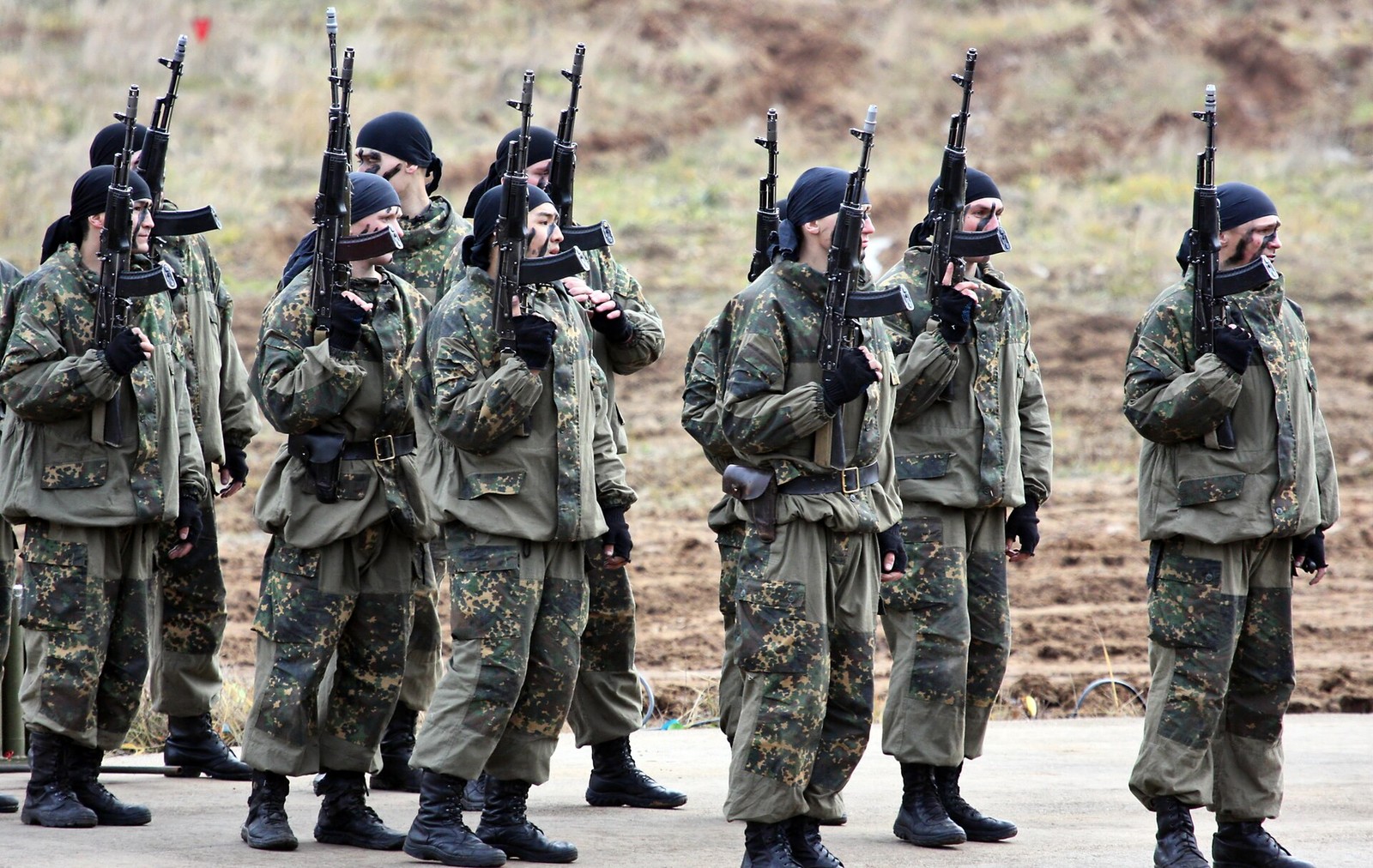
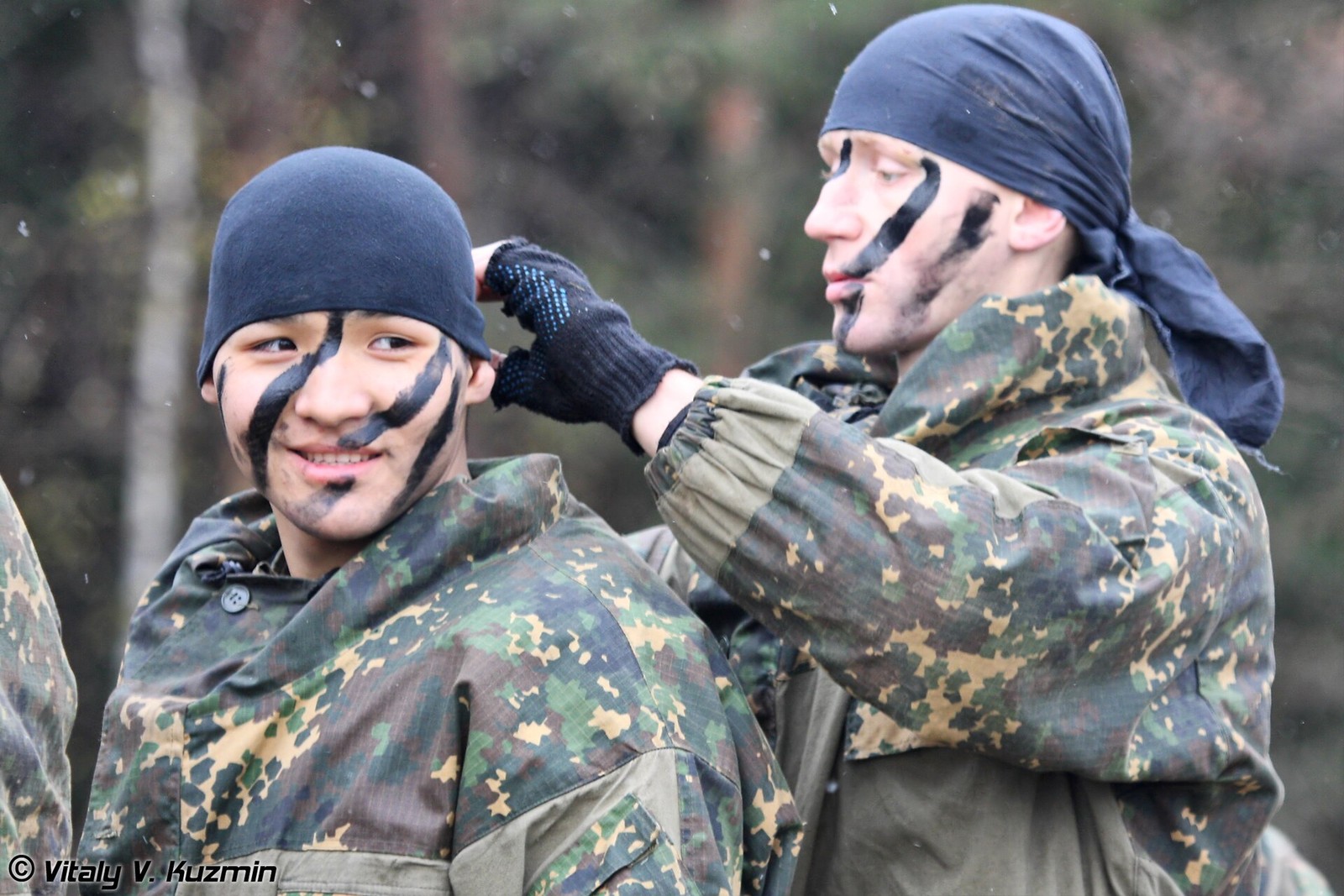
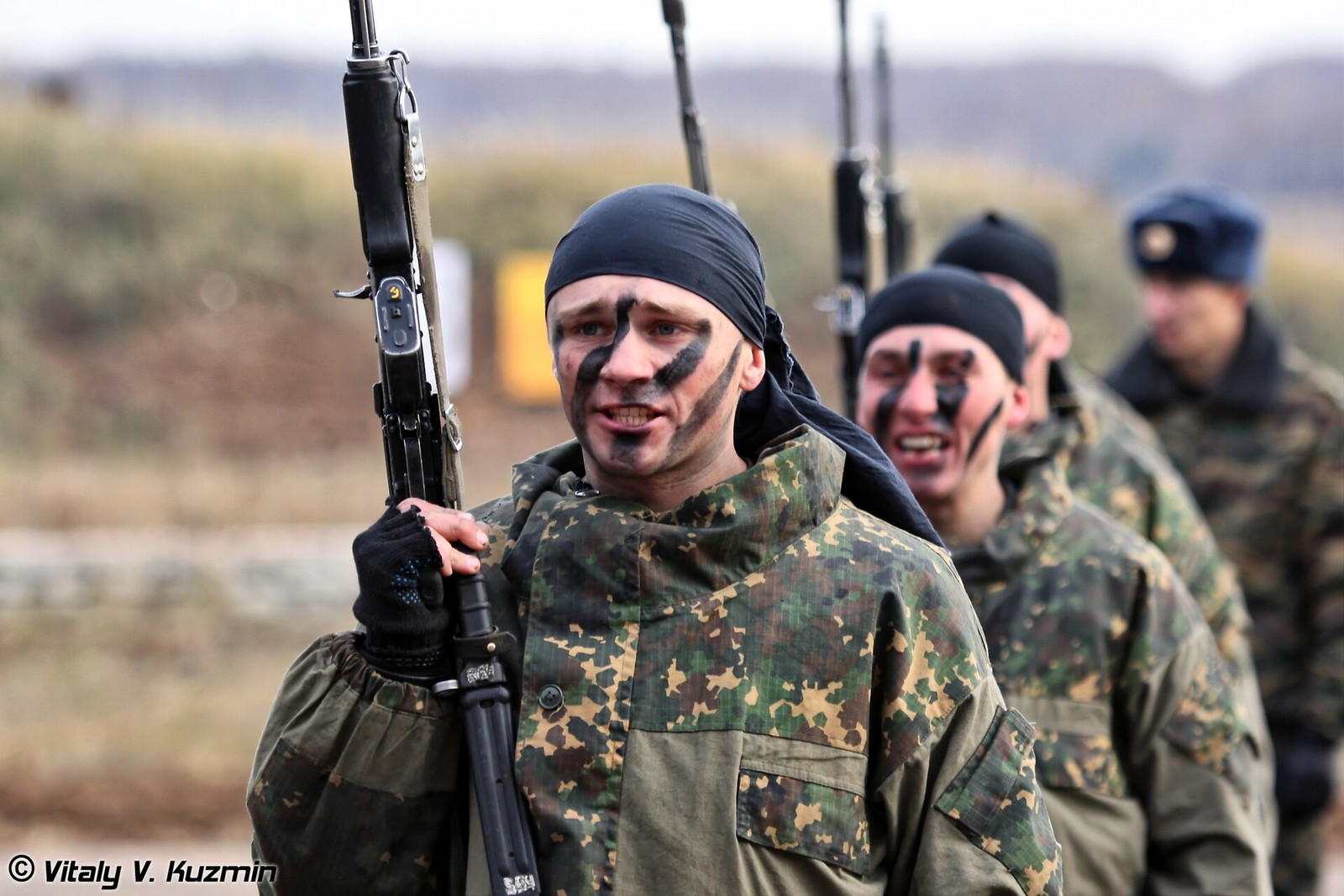
There is one criterion the specialist sources share, and it is visual rather than administrative. The print is built from small angular shapes – lozenge-like and shard-like forms with straight edges and pointed corners, gathered into irregular masses rather than spread evenly. The Western description of 2017 uses the phrase “angular lozenge shapes” and contrasts them directly with the rounded blobs of German Flecktarn.
That contrast is the most useful diagnostic available and it is also its own limit. The Flecktarn comparison separates this print from one of its neighbours. It does not separate Izlom from Skol, because every source that describes the geometry describes the same geometry for both words.
On colour, the working description in the Russian commercial literature is a set of pale green, dark green, grey-green, brown and black, with a documented drift towards mustard yellow in the pale green plate depending on the manufacturer. These describe garments, not measurements. The hexadecimal values that circulate online are third-party samples, and any article that prints them should say so. This one prints none, because a colour list does not identify a drawing: the shape of the shapes does.
For the wider vocabulary that distinguishes a motif from a family from a lineage, and for why a shared palette is the weakest possible basis for an identification, see MegaCamo’s account of how camouflage is classified.


Documented photographs of the print come from two events: Interpolitex 2010 in Moscow, where the 33rd Special Purpose Detachment Peresvet of the Internal Troops is shown, and a single frame from 2012 that is not reproduced in this article. No file in the free record documents this print under the name Skol, which is a statement about the documentation rather than about the pattern’s existence.
Layer one: the Russian commercial names
In the Russian commercial literature the pattern is one motif with two names, and the literature says so in as many words. The surplus trade’s encyclopaedia entries are titled in compound form – “Kamuflyazh Izlom (Skol)” – and state that the camouflage is also found under the name “Skol”, or appears under the different names “Skol” and “Izlom”. One entry calls it flatly a commercial Russian development whose second name is Skol.
Both words work the same way as metaphors, which is the mechanical reason they coexist. Izlom means a fracture, a break in a line or a surface. Skol means a chip or splinter – the piece knocked off stone, glass or ice. Both describe light broken into fragments through a canopy, and both are the kind of figurative label that Russian camouflage naming produces routinely, as set out in MegaCamo’s explainer on Soviet and Russian camouflage nomenclature. Their coexistence is not a scandal; it is what this naming system does.
Real users picked up both words early: a Russian hunting forum in June 2011 writes the formula “SKOL, also known as Izlom”, the way a synonymy is expressed in a market rather than a regulation, and English-language coverage followed with the same equivalence.
Manufacturers can be named where the sources name them. Magellan is documented as a producer, with fabric from Chaikovsky Textile, and a shirt in the pattern appears in an archived 2015 store listing. Modox is documented as the company that carried the name Skol: the word appears in its catalogue of camouflage types archived on 24 January 2009, the earliest archived commercial appearance of either name. Izlom appears in the archived record only later, in a 2015 snapshot.
That earlier appearance is not earlier invention. Russian commercial web archives from the 1990s and early 2000s are sparse, and the gap between a 2009 capture and a 2015 capture measures the archive, not the pattern’s history. Nothing here supports the claim that Skol came first.
Layer two: how the West re-cut the names
The Western reading was crystallised in November 2017 by the collector blog Strikehold, in a post about a Modox pattern. In that account the pattern Modox sells as Skol, and a variant spelling seen elsewhere, Sklon, are both presented as commercial copies of an original and “official” Izlom, which the post says was “apparently” developed for the Russian military and the MVD by SPOSN. The word “apparently” matters and is preserved here rather than smoothed away: it signals that the blog is relaying a third-party attribution, not reporting a document. The same post is nevertheless the source of the geometric criterion applied below.
Notice what has happened between the two layers. The Russian commercial frame makes Izlom the principal name and Skol a second name on one drawing; the Western frame makes Izlom the original pattern and Skol a brand applied to it. It is the same pair of words with the values inverted, and it happened because Western collectors met the pattern through sellers who each stamped their own name on the cloth.
The attribution itself has a check available. A Russian manufacturer, SSO/SPOSN, sells garments in this colourway and describes the print as developed in the mid-1990s for Russian force structures, without naming a designer – while on the same page attributing other patterns to itself explicitly and with dates, including a pattern dated 2009 and seasonal colourways dated 2002. That contrast is the best indication available that the company does not claim authorship of this one. It is an argument from silence, and it is presented as such.
Two adjacent word-traps belong in this layer: “Izlom universal” is a colourway label rather than a separate pattern, and “Sklon” is also the name of an unrelated product in a MultiCam palette.
One page, two entries, no geometric criterion
The split at the centre of the question is visible on one page. Camopedia’s country entry for Russia carries two separate illustrated entries – one for Izlom, one for Skol – and gives no geometric criterion for telling them apart. The Izlom entry says the pattern was “reputedly developed as early as 1997 but only brought into production around 2004”, and that it is “documented in use by some reconnaissance units of the Armed Forces, as well as MVD special forces units”. The Skol entry calls it “the commercial pattern here” and adds that it “has also seen use among reconnaissance units of the Armed Forces”.
Three things follow. First, the word “reputedly” is the source’s own caution: a 1997 development date is a rumour the reference work declines to certify. Second, the two user descriptions are near-identical, which is what one would expect if the entries describe one drawing. Third, and most important, the source that creates the split supplies no means of making it. Listing two entries is not the same as demonstrating two patterns.
The two entries are therefore best read as an observation about the reference literature, not as proof that a garment must be one or the other: no published measurement or design document sits behind the distinction.
The third name: SKOLM, and the reed family it belongs to
The plan’s third name is “Skol-M”. No published source documents a camouflage pattern called Skol-M: English- and Russian-language material, Wikimedia Commons, the Commons category tree and the Russian-language encyclopaedia give no pattern by that name, and no alternative spelling yields one either.
The documented near-homonym is SKOLM, and it is attested clearly. Camopedia’s section on the camouflage of the Russian internal troops, in its discussion of the reed pattern, records, in its own words, that “later a grey version called SKOLM (night owl)” was produced. That term belongs to the kamyshovy risunok – the reed drawing, today called podlesok – whose colourways are named by colour: green, brown and grey. The drawing was introduced around 1995 for the MVD, originally in a green version and a blue or urban version, with the grey version, SKOLM, following later. It is built from vertical reed and leaf-like streaks, not an angular lozenge, and it shares no geometry with the pattern under discussion.
So the three names in the title behave in a specific and slightly awkward way. Two of them, Izlom and Skol, are naming layers placed by different communities on one drawing; the third, read as the attested SKOLM, belongs to a different family altogether. That is why “One Family?” receives a qualified no: not because SKOLM would be an unrecognised variant of the lozenge, but because the third name sits in a lineage of its own.
One alternative cannot be excluded: “Skol-M” could be a rare commercial or internal label – a house code, a colourway name – that has simply never been indexed. Nothing in the published record attests such a label, and MegaCamo’s standing rule applies: no third pattern is invented to satisfy a headline.
What “Skol-M” is not
The negative case deserves stating in full.
- It is not a documented Russian military designation. Neither name appears in a defence ministry nomenclature in the published record.
- It is not a documented variant of the angular pattern. No source describes a variant distinguished by that suffix, or by any other marker that would separate it from the base print.
- It is not the same thing as SKOLM. The attested SKOLM is a grey reed-family drawing for internal troops; the similarity is orthographic.
- No photograph of it is in the public record. A photograph of a reed-family garment under a caption about Skol-M would create exactly the kind of false identification the distinction is meant to prevent.
- It is not resolved. If a reader has seen a listing labelled Skol-M, the accuracy available here is that the label is unattested in the sources located, and an unattested label is an open question, not an error to be corrected by guesswork.
Adjacent names that are not this pattern
- Kamysh and podlesok – the Russian reed drawing, one design known under both terms, introduced in the mid-1990s for the internal troops. This is the reed family, to which SKOLM belongs.
- The “blue Izlom” label. Izlom was also produced in a blue colourway, shown above beside the green one. The name should not be stretched to other grey-blue Russian prints, such as those of the reed and tiger families, which are different drawings.
- Sumrak and the other SSO patterns. These circulate in the same market and share the angular instinct without being the same drawing.
- The Soviet leaf family – KLMK and Berezka – is often confused with the reed patterns on the way to confusing either with this one. MegaCamo’s account of Soviet leaf camouflage untangles those two; the principle here is the same, that a shared instinct for organic shapes is not a shared lineage.
Status: a commercial pattern worn by force units
Ask what this pattern officially is and the sources split into two camps quoted against each other for years. One position, taken by a Russian technical article in 2016, is that the print is commercial and not officially in the catalogue, producing a “3D” effect in the eyes of its advocates and accepting only its original colourways. The other, taken by the Western collector literature in 2017, describes it as an official pattern of the army and the MVD. Camopedia documents use by reconnaissance units of the Armed Forces and by MVD special forces without claiming a regulation.
There is a reading that reconciles them: a commercial design, sold openly and widely adopted by special purpose and internal troops units, with no published regulation making it issue. It preserves both facts without choosing a side.
The same caution applies to dates. A manufacturer’s colour page places the design’s origin in the mid-1990s for Russian force structures; the reference work writes “reputedly as early as 1997”; production is given as beginning around 2004. The earliest firm dates are the archive capture of the name in a Modox catalogue in January 2009, the photographed units of 2010 and 2012, and the Western reading of 2017. Everything before 2004 is attribution.
Civil use is easier to see: airsoft and hunting in Russia from about 2004, then collector and video-game circulation, where the names fused into the compound “Skol-izlom” printed on Western listings. That compound is a shop label, not a third pattern. Usage in the Donbass from roughly 2014 to 2018 is reported; a claim that the pattern became the official camouflage of the Kyrgyz armed forces is attributed to a single source and is not treated here as established.

Flecktarn resemblance without a paper trail
The comparison with German Flecktarn is the most common thing written about this print in English, and it is legitimate in one direction and unsupported in another. As a geometric comparison it is sound: Flecktarn is built from rounded, soft-edged blobs in dense clusters, this drawing from straight-edged angular shapes with pointed corners, and side by side they read differently at close range and similarly at distance, which is why buyers confuse them on small product photographs. MegaCamo’s account of Flecktarn sets out how the German print was developed.
As a statement of descent it is not documented. No design document, patent or named German manufacturer connecting the two has been produced by any published source, and words like “sibling” and “derived from” appear in the literature as descriptions rather than findings. The same trap is discussed in the account of Danish M84, another spot pattern whose resemblance to Flecktarn is real while its history is entirely its own.
How to read a seller’s label
What a buyer needs is not a verdict but a checklist. Six questions, in order, sort almost every listing that uses these names.
- What is the geometric unit? Straight-edged angular shapes with pointed corners, or rounded blobs, or reed and leaf streaks. This is the first filter and it does the most work: two of the three answers eliminate this pattern before any name is read.
- Which naming frame is the seller in? A Russian listing that writes “Izlom (Skol)” treats the two words as one name; a Western listing selling a “Skol” product and calling Izlom the original works in the frame created by sellers and collectors. Both are coherent; the seller’s frame explains the label, it does not certify the cloth.
- Is this a pattern name or a colourway? “Izlom universal” and similar compounds are colour or range labels, not separate drawings.
- Is the status claim sourced? “Official” and “military issue” appear constantly in listings and are contradicted by the Russian technical literature. Ask for the document. Dates deserve the same treatment: 1997 and the mid-1990s are attributions, not records.
- What does the photograph actually show? A photograph proves that cloth was worn at some time; it identifies the cloth only if the caption’s writer identified it, and sellers’ captions are the least disinterested layer of the record.
- Does the word look like this pattern but belong somewhere else? SKOLM, Sklon and plain Skol are traps in different ways: one letter moves the reader into another family, another product, or an unrelated homonym entirely – the word Skol also names a beer brand and a place name, and Commons’ category for it holds no camouflage material at all.
Nothing on a label answers the question of paternity, and the reason is structural: three separate roles exist and three candidates occupy them. Creation is attributed by a Western blog to SPOSN, on its own word “apparently”. Manufacture is documented for Magellan, with fabric from a named mill. Naming is documented for Modox, which carried the word Skol in its catalogue. Collapsing the three roles into one sentence produces the very confusion the names already cause.
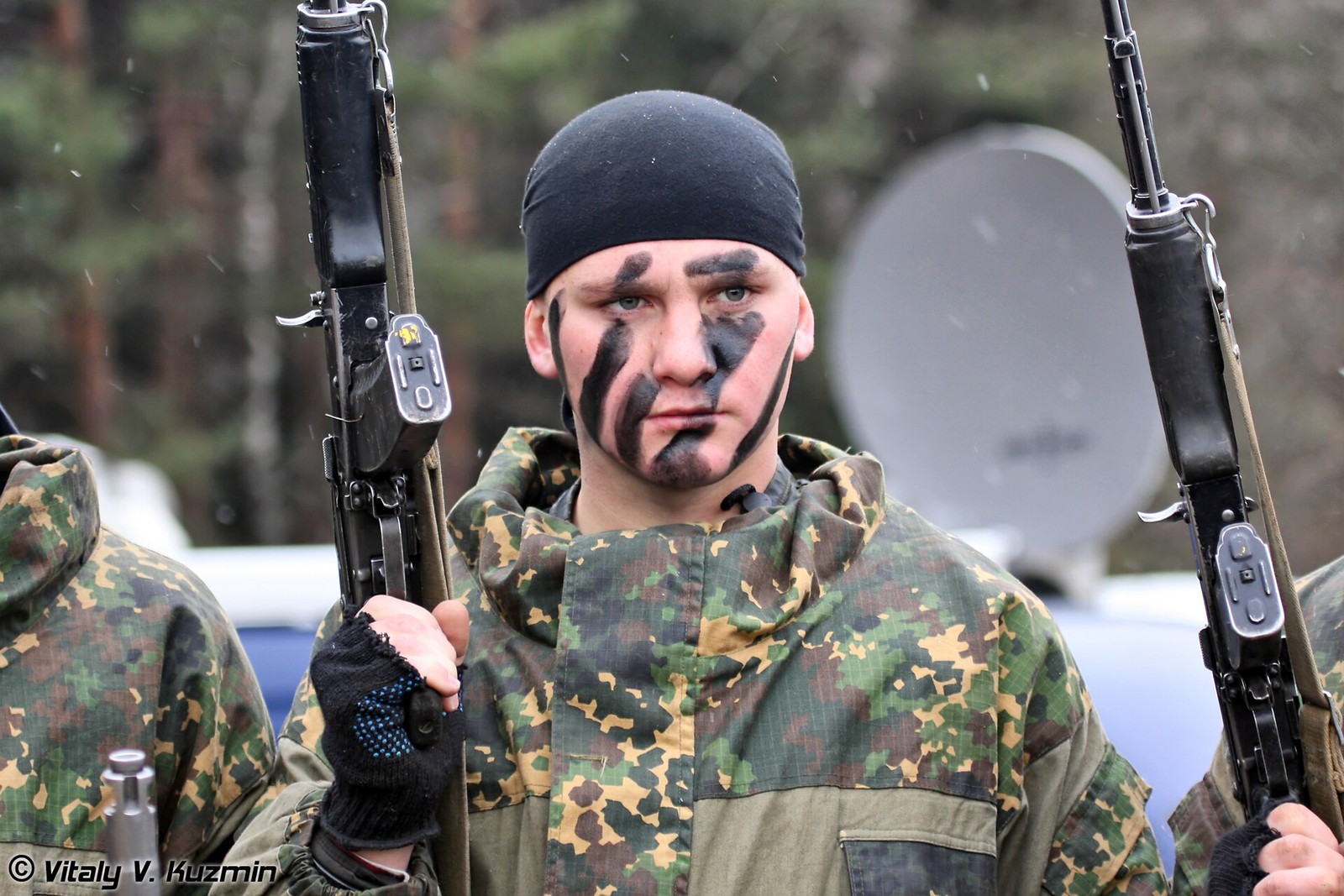
All photographs here are by Vitaly V. Kuzmin, CC BY-SA 4.0, via Wikimedia Commons. Where the photographer’s watermark is present in the original file, it must remain visible in any reuse.
Clothing and accessories in this pattern are in our catalogue: Russian Izlom.
