
Camouflage History
French Daguet: The Camouflage of the First Gulf War
In September 1990 France renamed its military contribution to the Gulf crisis Opération Daguet. A daguet is a young stag, a male deer in its second year, called a brocket in English, and the word has since become the ordinary label for a camouflage pattern: the desert variant of the Camouflage Centre-Europe, the broad-banded print that French troops were wearing when they crossed into Iraq in February 1991. That sentence is accurate, and it is also the trap this article exists to disarm. The pattern takes its name from the operation. The pattern did not come from the operation.
The cloth is older than the war. The desert variant of the Camouflage Centre-Europe was drawn and introduced in the closing years of the 1980s, and the sources consulted here disagree about the year. It was worn in Saudi Arabia and Iraq by a provisional division that was itself named after the operation, and it outlived that division by three decades, through Afghanistan, Djibouti and the Sahel. What follows is the genesis of the pattern, the hundred hours of ground war that fixed its reputation, and the point at which the record of it stops being evidence and becomes assumption.
A pattern named after a young deer
Three formulations recur wherever this print is described. It is “commonly known as” the Daguet pattern; it is “communément appelé camouflage Daguet”; it is a pattern “nicknamed” after the operation. What the name does not carry is any of the apparatus a regulation designation would bring with it: no nomenclature number, no technical specification, no entry into service under that name. The word behaves like a nickname that has won outright: it is how surplus dealers, collectors and reference works now name the drawing, and it entered the vocabulary because of where the drawing first appeared in quantity.
The operation that lent the name was assembled in stages, and the stages matter for anyone dating the pattern. Iraq invaded Kuwait on 2 August 1990. On 9 August 1990 President Mitterrand announced the dispatch of the aircraft carrier Clemenceau to the Gulf, and the naval movement under the name Opération Salamandre was launched the following day, 10 August, with a detachment of the 5th Combat Helicopter Regiment aboard; the ships left Toulon on 13 August and reached Abu Dhabi by 22 August. The English-language account places the trigger on 14 September 1990, when Iraqi forces entered the residence of the French ambassador in Kuwait, and the renaming “soon after” that; the French-language account dates the succession of Daguet to Salamandre to 23 September. The two sources disagree by nine days, and this article does not arbitrate between them.
The land component was created in September 1990 as a provisional division of the Force d’action rapide, the division Daguet, under General Jean-Charles Mouscardès, who took command on 22 September 1990. Mouscardès was medically evacuated on 8 February 1991 and General Bernard Janvier took command in his place. Over the whole operation the French commander was General Michel Roquejeoffre of the Force d’action rapide, and the division fought on the extreme left of the allied line under the tactical control of the United States XVIII Airborne Corps.

The pattern before the name
Everything the reference material agrees on about this print is structural. It is the desert variant of the Camouflage Centre-Europe, and the CCE is itself a band pattern: the same graphic idea, broad horizontal passages of colour, no small disruptive detail, moved onto a desert palette. The English-language description is “broad horizontal tan and brown stripes on a sandy background”. Camopedia records sparse horizontal bands of brown and tan on a sandy ground and counts the print as a three-colour desert pattern, while descriptions written for a general readership usually speak of two tones over a sand ground. The prudent formulation covers both readings without inventing a fourth: bands of brown and fawn over a sandy ground.
That inheritance is the strongest editorial fact in the pattern’s favour and the reason MegaCamo’s account of the Camouflage Centre-Europe is the essential companion to this article. A reader who knows the woodland CCE can predict the desert variant before seeing it: the drawing is not a new invention under desert colour, it is the same skeleton of bands re-coloured. The break is in the palette and the expanse of unprinted ground, not in the grammar of the shapes.
Dating is where the sources part company, and the honest report is a range rather than a year. The English-language article on the pattern gives two answers on one page: 1988 in the section that describes the drawing, 1989 in the account of its introduction. Camopedia dates the print to about 1990. That last date falls after the Iraqi invasion of Kuwait, and it is the reason the pattern should not be read as one made for the war. The dates on offer allow an origin before the invasion only if the earlier ones are right, about 1990 is compatible with it, while the two dates in the 1980s place the pattern in store before the crisis. What the evidence does support is narrower and more useful: the drawing belongs to the closing years of the 1980s, and the operation supplied the pattern’s name rather than its existence.
Morphologically the print belongs to the band families, not to the spot patterns and not to the pixel patterns, the three-way division that MegaCamo’s explainer on how camouflage is classified sets out. The distinction is not academic. It is the fastest way to place an unknown garment or a grainy photograph on the correct side of a comparison, because the logic of a band pattern is legible at distances where a fine spot pattern collapses into a single tonal value. The bands here are wide enough to be read on a soldier photographed from thirty metres with a 1991 film camera, which is exactly what the surviving photographic record asks of them.

One claim attached to the cloth does not survive the standard applied here. The French-language account of the division reports that some personnel understood their first desert uniforms to have been treated against infrared detection by imbibition with carbon black, and attaches no source to the statement. Nothing consulted for this article corroborates it: it is recorded here as an unsourced assertion, and nothing more.
The division that carried the name
The force that made the pattern famous was assembled quickly, and not in one piece. The French-language account records roughly 4,000 men in the division in the autumn, 12,000 at the end of January 1991, and 14,708 at the start of the ground offensive on 24 February. The English-language account gives 12,500 for the land forces and 18,000 for all French services, and notes that France fielded the second-largest European contingent. The numbers describe different things, a division, a land component, a national effort, and they are not in contradiction once that is said. They are, however, a reminder that “the French in the Gulf” was not one body of men in one uniform at one moment.
Its texture is documented and worth keeping. The core came from the Force d’action rapide, the 6th Light Armoured Division and the 4th Air Mobility Division, and units were formed around the nucleus of a metropolitan regiment with detachments from others: 57 regiments were involved in one way or another (the English-language account gives “more than 25 regiments” for the division itself). The division was all regulars, with no conscripts sent. Alongside it stood a joint staff of around 350, an air component based at Al-Ahsa and a ground-to-air section with five Crotale launchers.
The mission was narrow and named in advance: the road junction and air base at As-Salman, some 150 kilometres inside Iraq, reached through two intermediate objectives called Rochambeau and Chambord. The division advanced in two groupings, Natchez on the west and Montcalm on the east. It crossed the border on 24 February 1991 at 07:00 without opposition; the air base was taken in the afternoon of 25 February, the village on the morning of 26 February, and the French account treats the mission as complete in 48 hours. The captured total recorded for the operation is 2,956 prisoners, 20 tanks of T-55, T-62 and Type 69 type destroyed and two T-72 taken intact, 114 trucks and 26 artillery pieces destroyed, and some 700 tonnes of munitions seized.
The cost is reported in figures that do not quite agree, and both sets deserve printing. Two French soldiers were killed in action on 26 February 1991 at 16:00 UTC at Fort As-Salman, Sergeant Schmitt and Corporal-chief Éric Cordier of detachments of the 1st Marine Infantry Parachute Regiment designated CRAP (the French abbreviation is not expanded in the sources consulted), by unexploded American submunitions. Over the whole operation the English-language account gives nine dead and the French-language account ten. The two men named above are in both totals, which means the discrepancy concerns other, non-combat deaths, several of which occurred before the fighting began: a soldier of the force, a maréchal des logis-chef in the French account, killed in a car accident in Saudi Arabia on 13 November 1990, and a lieutenant killed in the crash of his Mirage F1-CR on 7 December 1990, the French account calling the flight a training sortie and the English one a reconnaissance mission. Eight soldiers of the 1st Infantry Regiment were wounded on the “Texas” road near As-Salman on 12 March 1991, after the ceasefire, while moving along that route; neither account consulted gives the cause.
After the ceasefire
The pattern’s best-documented public appearance belongs to the weeks after the fighting. Through March 1991 French units took part in ceremonies in Kuwait City, including the reopening of the city’s beaches to civilians, and the photographs made there by U.S. service photographers are, for the purposes of this article, the strongest free evidence of what the desert variant looked like as issued cloth in the year it was named. The operation left a battle honour, rendered Koweït 1990-1991 in French (the English-language account gives “Kuwait 1990–91”), with several regiments, and it left the pattern in place as the service’s desert dress.

What the pattern is not
The desert variant is easy to confuse with its contemporaries, and the confusions run in three directions. The American desert pattern of the same war was assembled from small coloured spots, so its texture is granular where this one is striped. The British desert variant belongs to the brushstroke family, whose logic is the short diagonal stroke rather than the continuous band; MegaCamo’s history of British DPM follows that lineage. The digital generation that arrived in the 2000s is built from pixel arrays, and it fails in a different way at a distance. Nor is it the grid the U.S. military fielded in the same war for wear over their desert uniforms, a different problem, a different answer, treated separately by MegaCamo in its account of Desert Night Ops. None of the three is the French print, and a 1991 photograph of a coalition line can contain all of them at once, which is why a caption that identifies a pattern needs a reason beyond the theatre it was taken in.
There is a fourth thing this pattern is not, and the distinction is worth stating because photographs invite the mistake. The subject here is the uniform print. Vehicle camouflage in the French force of 1990-91 is a separate question, governed by different drawings and different specifications, and no photograph in this article’s set shows a vehicle closely enough to discuss it. A reader who sees a sand-coloured armoured car in the background of a 1991 frame is looking at equipment, not at the pattern named after an operation.
The cleanest visual comparison available from the free record is later and less dramatic. In early March 2013, during a desert combat training course in Djibouti, a U.S. Navy officer was photographed talking with French Marines of the 5th Marine Regiment. The American officer is in a digital green pattern, the French Marines in the desert variant, and the two are close enough in the frame for the difference in logic to be read without commentary. That single image does more for a reader learning to distinguish band, spot and pixel than any number of words.
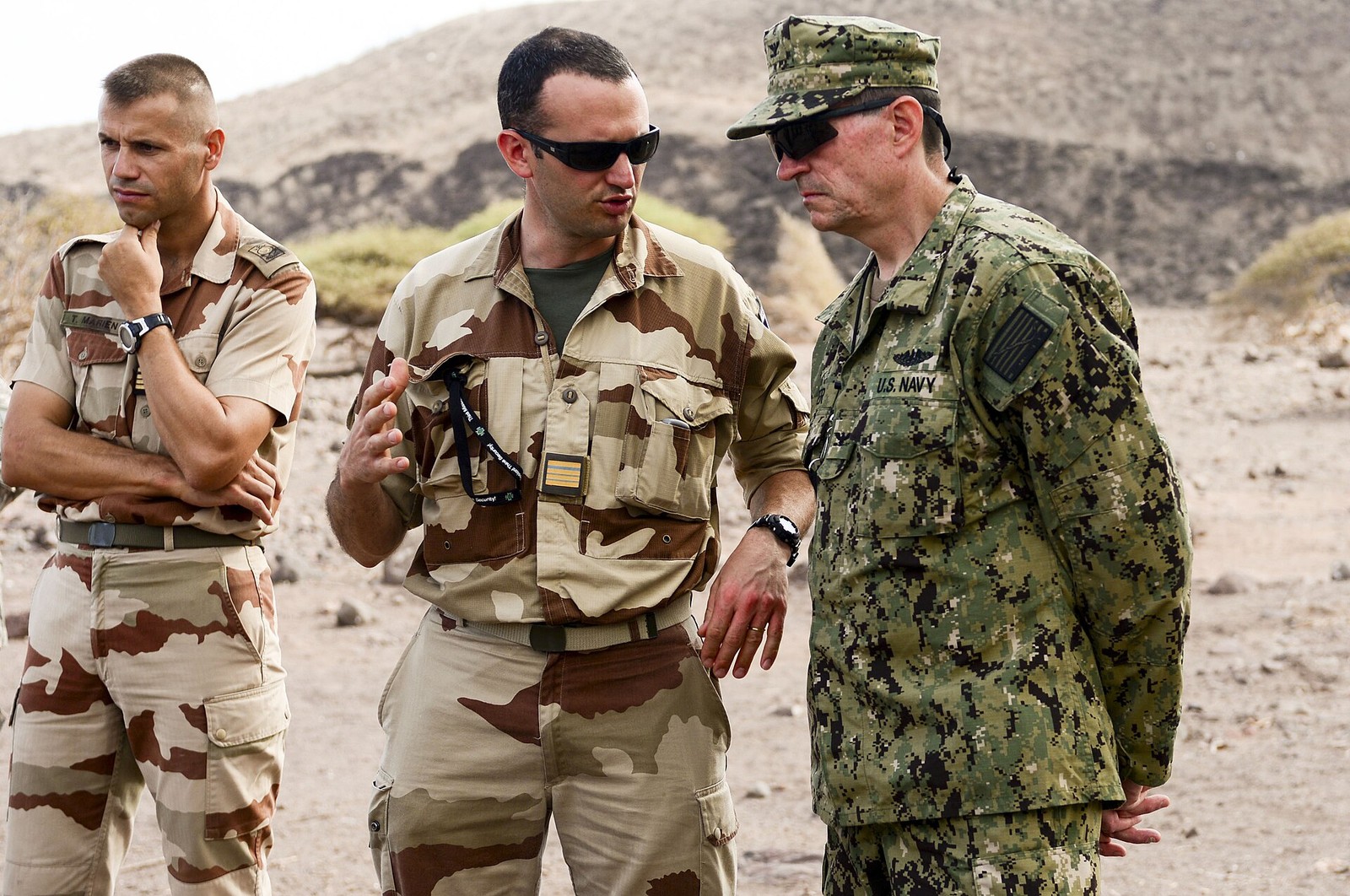
A note on the older pattern’s own detail is honest to add here. The plates that circulate as “official colours” for this print are digital reconstructions, and the colour values printed from them are not measured from cloth. The band widths, on the other hand, survive reproduction better than colour does, which is why the descriptions in this article lean on the geometry and decline to give hexadecimal values. A pattern is identified by the shape of its shapes; a palette is the weakest available evidence, as the classification explainer linked above argues at length.
Afghanistan, Djibouti and the Sahel
The pattern’s second career is longer than its first and better photographed. Between 2012 and 2017 the French desert variant appears in the free record in at least four distinct settings, and taken together they show a print that was never replaced in the desert role during that period.
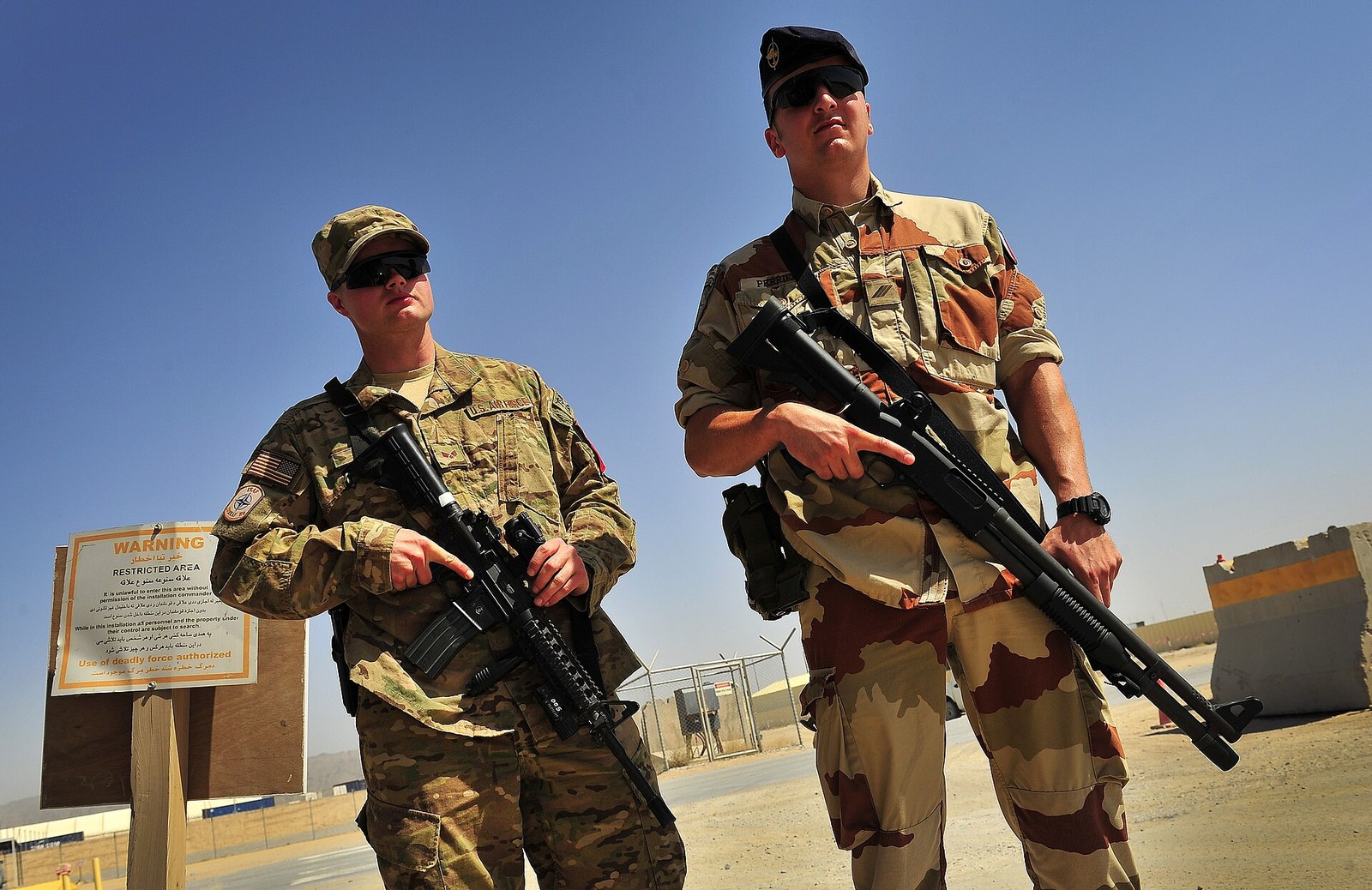
In June 2012, at Kandahar Airfield in Afghanistan, a French Air Force security forces member of Detachment 3/3 was photographed beside a United States Air Force airman while both conducted base defence tasks. The Frenchman wears the desert variant; the American wears a different camouflage entirely. It is the strongest of the late images for the question of what was actually issued to a French serviceman on duty two decades after the Gulf War, because the frame is full-length, high resolution and captioned with a unit rather than a place.
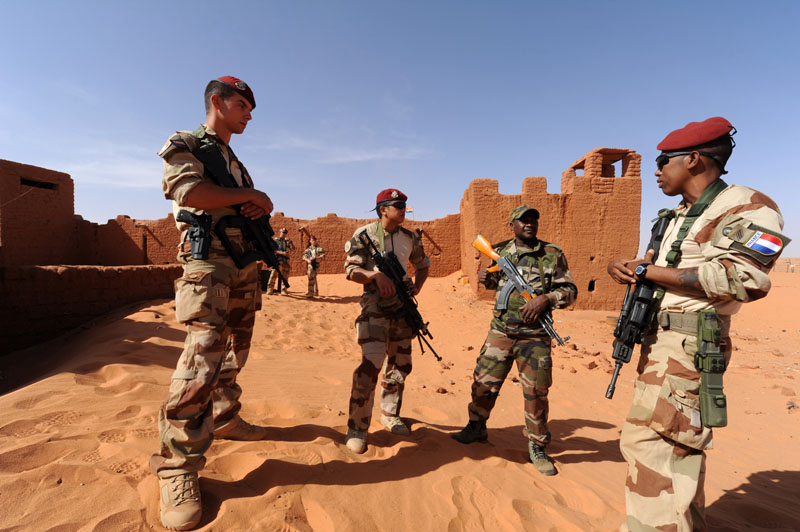
In the Sahel the record is denser and the pattern is doing the job it was drawn for. In November 2014, at Fort de Madama in northern Niger, French paratroopers of the 3rd Marine Infantry Parachute Regiment were photographed in discussion with Nigerien soldiers of the 24th combined-arms battalion; the French garments show the bands clearly across several figures, and the picture is a reminder that the desert variant was worn in the desert proper rather than in a parade ground approximation of it.
The Mali photographs extend the coverage into the years of Operation Barkhane, which began in 2014. One frame from 4 November 2017 shows a dog-handling team integrated into a combat group, the pattern visible on sleeves and trousers. A second, published by France 3 Grand Est, shows French and Malian soldiers walking through the bush north-east of Gao, seen from behind; it carries a television channel’s logo burned into the frame, which is why it was set aside rather than reproduced here.
One limit on all of this deserves stating plainly. These photographs establish who was wearing the print, where and when. They do not establish that the drawing stayed identical across fifteen years of production, the reference material consulted describes the design as evolving while the colours remained reasonably constant, and it does not date the changes. Nor do they settle the pattern’s life abroad: the English-language source that lists other users of the pattern relies on entries cited to a reference work not consulted directly here, so this article reports the claim as reported and stops there.
The pattern at home
The desert variant became a national signature in a single morning in July 2013. On 14 July, at the Bastille Day parade on the Champs-Élysées in Paris, the contingent marching as Operation Serval wore the desert pattern in the capital, and free photographers were at the roadside in numbers. Two frames from that parade are reproduced here: a colour guard of the 92nd Infantry Regiment, and a closer group from the 1st and 21st Marine Infantry Regiments carrying their unit fanions. Between them they show how the print reads at two distances, as a formed body of troops, and as a group close enough for the bands to be counted against each other.

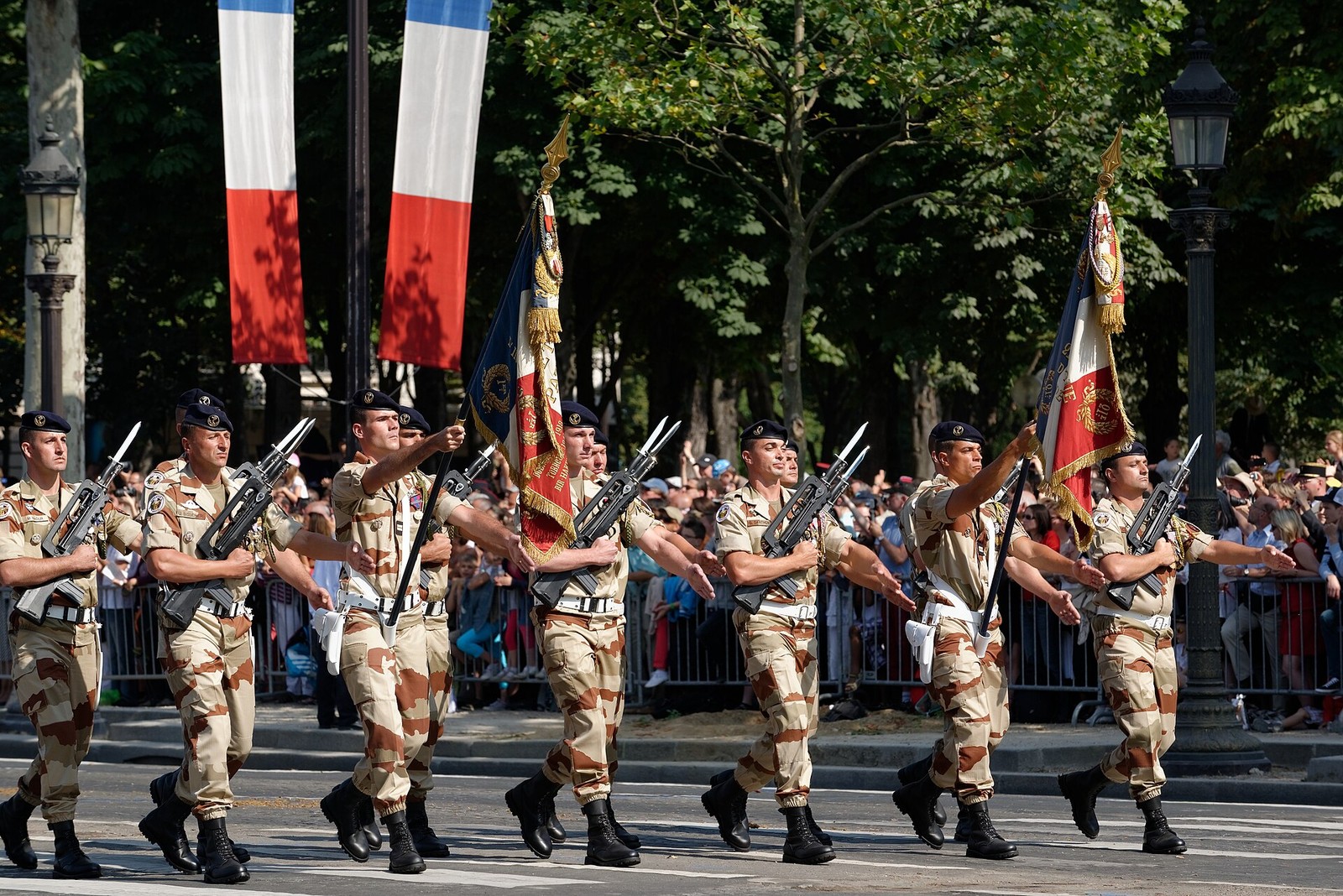
What the parade made visible is the pattern’s double status. In the field it is a working print with a narrow job; a few metres away on a Paris avenue it becomes an identifier, in the way that France’s earlier emblematic draw, the French Lizard, has long been for an earlier generation. Both are French and both are banded, and they belong to different wars, which is why a listing that says “French camo” without more has told a buyer almost nothing.
That double status is also where the name settled. “Daguet” is not a word the French army uses in the field to ask for a garment; it is the word the market uses to find the drawing, and it works because the operation’s name attached to the pattern in the minds of everyone who saw the war on television. The pattern is offered in the MegaCamo catalogue under French Daguet, grouped by garment rather than by drawing, for readers who want to see the print on modern equipment after reading about it in the record. For what that phrase means in practice, what “made to order” means at MegaCamo explains the sizes, timelines and pattern variations.
Reading the pattern in the photographic record
The photographs gathered for this article support a short list of conclusions and refuse a longer one, and the discipline is worth making explicit because the temptation to overread a 1991 frame is strong.
One absence in the free record should be named, because a reader will otherwise assume it is an oversight: there is no freely licensed flat photograph of this pattern, no piece of desert cloth photographed square to the camera under neutral light. The reason is administrative rather than editorial: the French Army photographs of the pattern that circulate on Wikimedia Commons sit under the French Licence Ouverte and are not used here. The same category also holds a digital plate of the pattern filed as Camouflage Daguet (couleurs officielles), whose licence record contradicts its own file text: it is released by its author as his own work under CC0 while its name and description present it as the official colours of the pattern. The photograph reproduced above is a 1991 field frame in which the uniform occupies only part of the image, and a field photograph is not a colour reference.
The same caution applies across the decades. Comparing a 1991 frame with a 2017 frame raises questions, did the ground darken, did the bands narrow, that these sources cannot answer, since printing, film stock, scanning and digital processing all move colour. This article compares geometry across the decades and declines to compare tone.
What is nonetheless readable from the record, and usefully so, is the scale of the drawing. In every colour frame in which the print is at readable scale, the bands run wide and horizontal, uninterrupted by any micro-pattern, and they remain legible on a soldier photographed at conversational distance in 2013 and in 2017 exactly as they do in 1991. That continuity is the pattern’s defining trait and the reason a reader who has looked at three of these photographs can identify a fourth without being told.
Desert-pattern garments and accessories are grouped in the MegaCamo catalogue under French Daguet, for readers who want to see the drawing on modern kit after reading about what the record does and does not settle.
