
Camouflage History
French Tundra and the Chasseurs Alpins: Camouflage for Snow and Rock
Most camouflage patterns are asked to hide a soldier in one kind of landscape. France’s pale mountain pattern is asked to hide one in two at once: the white of a snowfield, and the darker interruptions, rock, scree, exposed earth, conifer and larch, that break that white into a mosaic. It is also a pattern frequently confused with something much simpler, a plain white over-suit pulled on over ordinary uniform. The two are not the same object, they are not issued for the same job, and they do not fail in the same way.
This is an account of an extreme-environment camouflage and of its limits: what a printed snow-and-rock pattern can be made to do with colour and geometry alone, and what no cloth can do for the soldier wearing it. The pattern is called Tundra in English-language reporting and Toundra in French listings, it has been worn for two decades by France’s alpine infantry and by the mountain units of French special operations, and it is an odd object in the camouflage world, a snow pattern that is not white, a service uniform rather than an over-white, and a national pattern whose current official designation for its four-colour version has never been established publicly.

The unit the pattern was drawn for
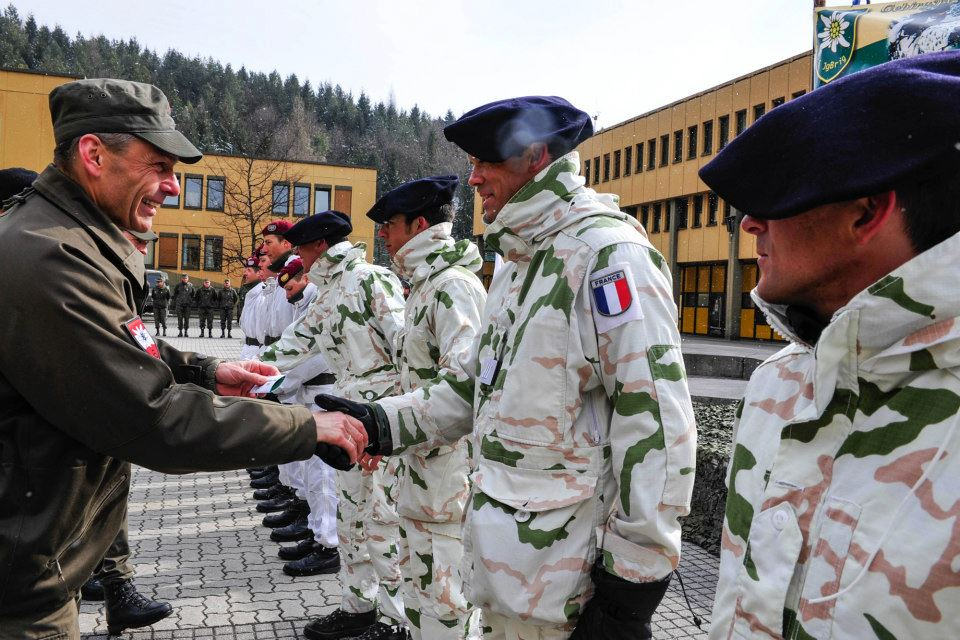
The chasseurs alpins Alpine Hunters, were created on 24 December 1888 from twelve of the thirty-one chasseurs à pied battalions then in existence, and they have been France’s mountain infantry ever since: light troops raised in the Alps and trained to move, fight and live above the tree line. The battalions in service are the 7e BCA at Varces near Grenoble, the 13e BCA at Chambéry and the 27e BCA at Cran-Gevrier near Annecy, and since 1999 they have sat inside the 27e Brigade d’Infanterie de Montagne, France’s mountain infantry brigade. They are informally known as les diables bleus, the Blue Devils, and their dress mark is the wide, soft beret, the tarte des Alpes worn by French mountain troops generally, with the exception of the engineers of the 2e REG.
The pattern exists because of what those battalions are asked to do. Their training runs through climbing, ski mountaineering and summer and winter mountain leadership, traditional skills include igloo construction and sleeping out at temperatures close to freezing, and the specialised mountain commando groups, the groupes de commando montagne, sit inside the same world and were among the units that later took the pattern up for winter exercises. A unit that climbs, skis and bivouacs in alpine winter conditions is not looking for a garment it wears only while standing still in the open; it is looking for clothing it can live in for days.
One caution applies to everything below. The English Wikipedia article on the Chasseurs Alpins carries Wikipedia’s own “needs more citations” banner, and its paragraph on the pattern rests on a Flickr photoset and an Army video rather than on a doctrinal publication; it is used here only as a secondary source, and only for the kind of organisational fact a unit’s own history would confirm.
What “Tundra” actually is
The clearest public description of the pattern comes from field reporting by Bob Morrison in Joint Forces News in March 2022. It records Alpine Tundra as “the third standard camouflage pattern of the French Armed Forces” after Camouflage Centre-Europe (CCE) and the desert Camouflage Daguet, worn “for many years in a three-colour version by Alpine and Special Operations troops in snowy theatres”. That single sentence is the frame for the whole subject: the pattern is not an improvisation bolted onto a cold-weather deployment, it is one of the three standard patterns of the French Army, and it has a snow job alongside two temperate and desert siblings.
The colours are documented at two stages. The original three-colour version carries “irregular green and pink shades on a white background”. The four-colour version recorded in the field adds “a very light grey shade to introduce more depth”. The reporter gave his own approximate visual equivalents and was careful to present them as approximations rather than measured valuesforestgreen and peachpuff for the secondary pattern, gainsboro for the fourth shade. Those are descriptions of a photograph, not colour specifications, and no measured palette has been published.

The specialist reference literature names the design and attributes it. Camopedia’s page on the French Republic records that specialised mountain units attached to the Commandement des Opérations Spéciales have worn a four-colour pattern designed for operations in the Alpine regions of France and in snow-covered landscapes elsewhere; that the pattern was designed by the British manufacturing company Arktis; and that the design “known as Tundra” blends “olive green and pinkish-tan shapes on a pure white background with off-white/eggshell white shapes interspersed”, with the honest addition that those off-white shapes are very difficult to make out in photographs.
Field reporting is a little softer on authorship: Devon company Arktis “were heavily involved in developing and supplying” the original three-colour pattern. That is not the same statement as “designed by”, and both formulations are carried here without being merged. The same reporting notes that Arktis sells three-colour Tundra smocks, shirts and trousers commercially.
The last contribution in this section is a materials note of uncertain value. Wikipedia states that the current winter uniform consists of Tundra camouflage “made in 50/50 ripstop”, created for the Chasseurs Alpins and later adopted by other French units such as the mountain commando groups for winter exercises. “50/50” is not expanded, so the fibre composition of the cloth is not established by that source, and no specification document was found.
A pattern with two names and no public nomenclature
For a national pattern, Tundra has an unusually unsettled name, and the unsettled part matters more than usual because two different credible sources describe the same March 2022 deployment differently.
- Toundra is the French form, used in the French equipment listing that records it as a snow camouflage dress worn by mountain troops such as the 27e BIM.
- Tundra is the English-language form, used in field reporting and in the specialist reference literature, and it is also the commercial name: Arktis’ own store sells a Tundra collection including “C103 French SF Winter Trousers – Tundra”.
- Tundra 4 is a provisional working label, invented by the reporter who described the four-colour version, who stated explicitly that none of the soldiers he questioned could give him an official name for it.
- Zone Enneigée (ZE) is the name the specialist reference literature gives to a snow design of the mountain infantry brigade, first observed during the same March 2022 NATO exercise, incorporating “the same shapes as CCE” but with dark olive green, light tan or sand, and light grey shapes on a pure white background.
- Camouflage Centre-Europe Hiver (CCEH) appears, as far as the sources consulted show, only in a commercial blog. That page also describes a 2024 update to the pattern and “advanced materials designed to scatter infrared light”. Nothing of the kind appears in the field reporting, the reference literature or the French listing, so the label is not repeated here as a designation.
What those entries amount to is a real disagreement about the four-colour pattern of spring 2022. One reading is that it is an updated Tundra, printed with an additional roller; the other is that it is a CCE-derived design for the mountain brigade, with CCE’s geometry and a snow palette. Both were written by people looking at French soldiers in Norway in the same month. This article therefore carries both names and asserts no official one. Anyone who needs a single designation for the 2022 pattern is looking for something the public record does not yet contain.
The French equipment listing adds one more distinction worth noting for anyone following the thread: it carries the pattern and a plain “Camouflage Neige” / tenue camouflage neige as separate line items, which is the institutional habit of treating the printed pattern and the plain snow dress as different objects. The same listing attributes manufacture of the Toundra pattern to a named company, but without a footnote and with no corroboration anywhere else consulted, so that attribution is not carried as a fact here.
Snow, rock and the problem of a two-tone landscape
An alpine winter is not a white room. It is a high-contrast mosaic: snow is among the brightest surfaces a soldier can stand on, and against it anything mid-toned or dark reads immediately as a shape. A soldier who solves that problem by being uniformly white has solved the snowfield and created a new problem, because flat white has no mid-values with which to dissolve into the rock, the scree, the exposed earth or the dark trunks that interrupt the white in almost every real position.
That contrast is the design argument for a printed snow pattern over a plain white layer, and it is legible in the palette. The white ground addresses the majority surface. The green shapes are the darkest elements, conifer, shadowed vegetation, wet rock. The pinkish-brown shapes occupy the mid-tones: darker than snow, lighter than the greens, at the values a broken snowfield actually shows. The intent of the fourth shade, in the words of the field reporting, was to “introduce more depth”, an explicit statement that three values were not enough. That reading of the palette is a reading of a colour description, not the result of a detection trial; the design logic is documented, the performance is not.
The same logic has a second consequence. A soldier in printed snow clothing is dressed in the pattern, not dressed and then covered by it: he works, sits, sleeps and rides in it. What he cannot do is switch the pattern off when the environment changes under him, which is why over-whites exist, and why the French items seen in service in 2022 are not over-whites.
What the pattern does
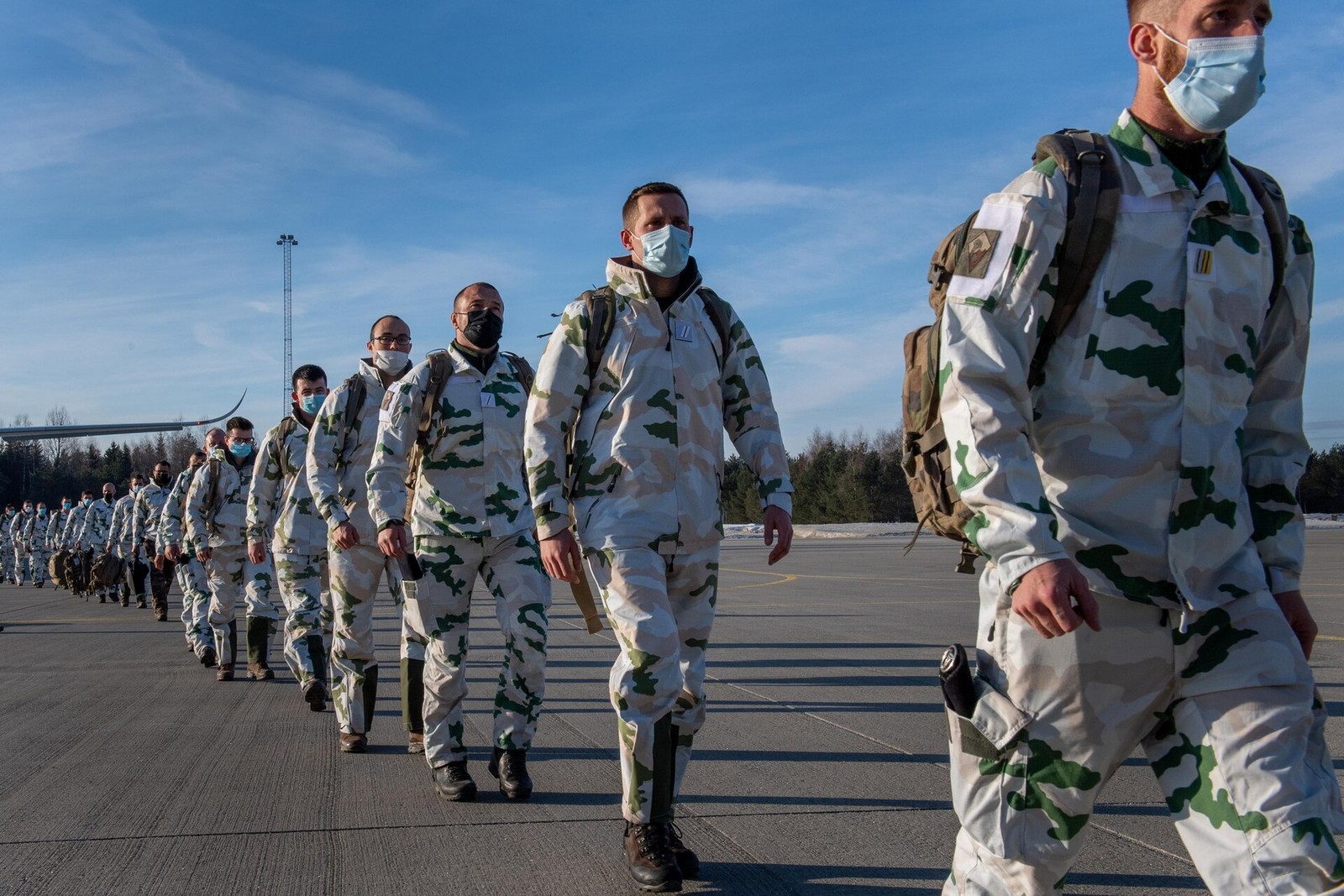
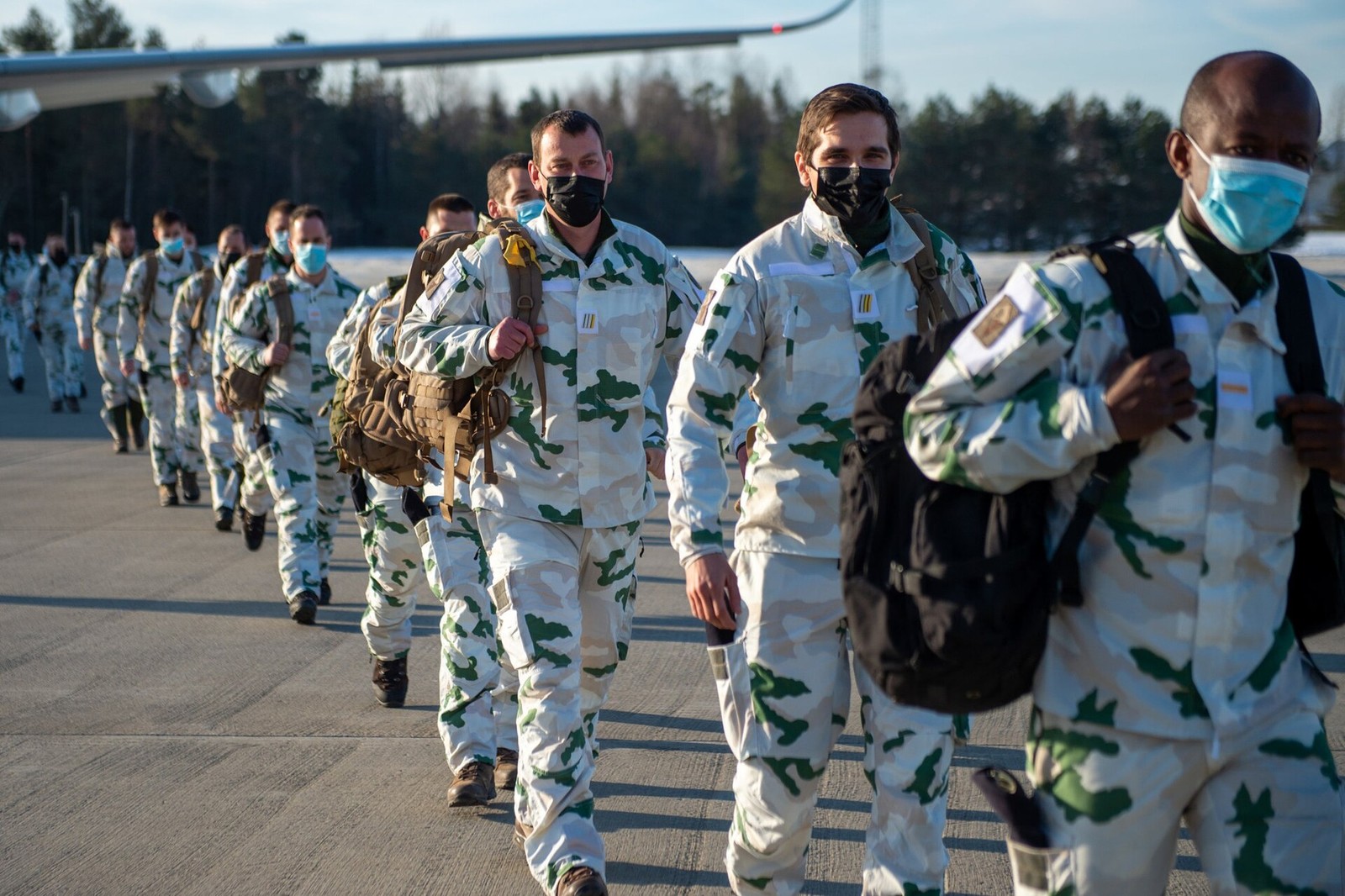
- It is issued as clothing. The items recorded in service in March 2022 are combat jackets and trousers, described in the field reporting as explicitly “not lightweight extra outer layers as used by many armies for deployments in snowy theatres”. This is the single most useful fact about the subject, because it separates Tundra from the plain white over-suit at the level of what the soldier is actually wearing, not at the level of appearance.
- It carries three values in the original print and four in the later version, which is more tonal information than any single-colour white layer can carry.
- It is worn at unit scale on real deployments, not by isolated specialists: the March 2022 photographs show the four-colour snow dress across a formed body of troops arriving in Norway for Exercise Brilliant Jump.
- It spread beyond the Chasseurs Alpins, having been created for them and later adopted by other French units such as the mountain commando groups for winter exercises, with special operations mountain units wearing it first from around 2004.
What the pattern does not do
A camouflage pattern is best described by its refusals, and this one has a long list of them. Each item below is either documented by a source or read straight off the photographs retained for this article, and the two categories are kept apart.
- It does not replace France’s other patterns. Tundra is one of three standard patterns alongside CCE and Daguet, and nothing in the record presents it as a universal answer to every environment. A pattern designed for snow and rock is a pattern designed for the mountain fraction of one country’s territory and a narrow slice of its deployments.
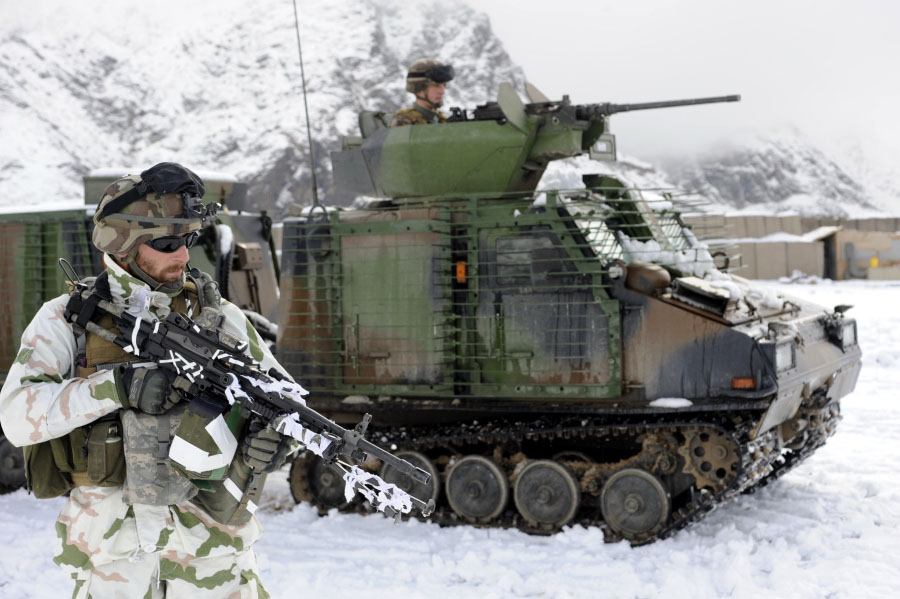
- It does not cover the soldier’s whole signature. In the photographs of a mountain commando of the 13e BCA and of a two-man team on the exercise the source files name “Stéphane 2012”, the pale suit contrasts sharply with the equipment worn over it: helmet, plate carrier and magazine pouches stay dark green, and the weapon stays dark. The same split is visible in the 2009 photograph of a mountain troop in front of a tracked armoured vehicle, where the suit is pale and the weapon and vehicle are not. A pattern on the uniform is not a pattern on the silhouette.
- It does not read in every light. The fourth shade is so light that, in the words of the reporter who first described it, “under some conditions the camera hardly registers it”, though the more sensitive eye does. Three shades out of four is what a great many published photographs of this pattern are actually showing.
- It does not stay colour-stable. Over roughly fifteen years, slight differences in colour have been recorded between Tundra batches and between garment types, and the white ground can become discoloured in the wash when colours leach from other garments, which has more than once produced the false impression of an extra colour in the pattern. Colour read from a photograph of this pattern, or from a garment with a laundry history, is not evidence about the pattern.
- It does not do anything documented about heat. The only claim found about infrared or thermal behaviour comes from a commercial page selling camouflage-themed goods, and it is not corroborated by the field reporting, the reference literature or the French listing. No measured infrared or thermal performance data for this pattern was found at all.
- It does not conceal against a non-snow background, and it is not meant to. The March 2022 photographs taken on an airfield apron show the pattern’s overall pale, low-contrast appearance at distance and each wearer’s outline still reading against tarmac. The pattern is matched to a snow-and-rock mosaic; a car park is not one.
- It does not replace full white in the highest mountain. On this point the only available evidence is enthusiast testimony, not documentation: a participant in a French-language collectors’ forum writes that where there is only snow and frost, troops wear la blanche complète the complete white, while the printed pattern is used in snow-and-vegetation zones. That testimony is consistent with the way the two objects are listed separately in the French equipment listing, but it is testimony, and it is labelled as such here.

France does not have one snow pattern
The most persistent error in English-language write-ups of this subject is to treat Tundra as “the French snow camouflage”. France has more than one, and at least one of them comes from a completely different design line.
The specialist reference literature records that the 13e Régiment de Dragons Parachutistes wears a snow camouflage pattern that is technically a commercial design, produced by the German company Tac-Gear. It is a derivative of the Danish m/84 pattern, itself derived from the German flecktarn design, and it carries black and olive green blotches on a pure white background. That is a Danish-German lineage, not a French alpine one, so a photograph of a French soldier in snow camouflage may show something with no design relation to Tundra at all. Both ancestors are covered on this siteDanish M84 and Flecktarn.
France also produces colour variants of its main pattern that are not snow patterns, and they are worth knowing about because they are regularly mistaken for something issued by the Army when the wearer is not army: the reference literature records a grey CCE colourway used by the Groupes d’Intervention de la Police Nationale, and two blue colourways, one flecktarn-based, one woodland-based, worn by the FORAD opposing-force cadre at the CENZUB urban training centre. CCE itself, its lineage and its relation to the American woodland pattern are set out in this site’s history of Camouflage Centre Europe.
Then there is the programme meant to replace the whole family. In May 2022 the French Ministry of the Armed Forces announced a bariolage multi environnement (BME) pattern, developed by the Service du Commissariat des Armées with the Section Technique de l’Armée, in six colours including a brun terre de France shade, with some triangular shapes and slightly pixelated contours, heavily influenced by American MultiCam and British MTP, the latter covered on this site in its own account of the British Multi-Terrain Pattern. The French listing of army equipment records an order for 400,000 F3 BME garments with 6,000 delivered by the end of 2024. Whether the snow layer of French uniform survives the programme as Tundra, Zone Enneigée or something else is not established by any source consulted, and this article does not guess.
Reading a Tundra photograph
Photographs of this pattern circulate more widely than documents about it, so it is worth setting out what can and cannot be read from one.
- Start with the ground. The pattern has a white base; shapes in olive green and pinkish-tan sit on it. The specialist reference literature also describes off-white and eggshell-white shapes interspersed among them, and warns that they are very difficult to make out in photographs. If you can see only two shapes and a white ground, that is not necessarily a two-colour print.
- Do not date a garment by how pale it looks. The fourth shade is often invisible to the camera, batch and garment-type differences have been recorded over fifteen years, and laundering can discolour the white ground in ways that mimic an extra colour. Paleness is not stratigraphy.
- If the geometry is blocky and striated like CCE but the palette is snow, a source may call the design Zone Enneigée. If the geometry is organic and snow-pale without CCE’s blocking, sources call it Tundra. Expect the same 2022 photographs to be captioned either way.
- If a suspected French snow suit carries black and olive blotches on white, it is not this pattern at all: that is the Danish m/84 lineage recorded for the 13e RDP.
- If a garment is flat white with no shapes in it, it is not a pattern. It is a white over-suit, and the two are listed separately in the French equipment record.
- On the garment side, the Wikimedia Commons description of one of the photographs in this article identifies the garments as an Arktis B102 smock and C103 trousers, the kind of detail that separates a genuine commercial item from a modern copy carrying the right print on the wrong cut.
- And keep the medium in its place. A press photograph can establish that a pattern was in service, on a given day, worn by identifiable people, which is exactly what the March 2022 photographs do. It cannot establish colour values, and it cannot settle which print variant was on a given soldier’s back.
A short timeline
| Date | What the record supports |
|---|---|
| 24 December 1888 | French mountain troops created from twelve of the thirty-one chasseurs à pied battalions |
| 1999 | The Chasseurs Alpins become part of the 27e Brigade d’Infanterie de Montagne |
| Around 2004 | Three-colour Tundra first appears in photographs of specialist troops on exercises in Alpine France; special operations units wear it first; the date of formal acceptance for service was not pinned down by the reporting that established this |
| April 2020 | Commons file documents French Alpine Hunters of the 27e BCA hauling supply sledges in Norway, described by the uploader as Exercise Cold Response 2020 |
| 9–17 March 2022 | French troops arrive in Norway for Exercise Brilliant Jump (BRJU22) and Cold Response 2022; the four-colour version is photographed on a chasseur of the 13e BCA inside the Arctic Circle on 17 March |
| 21 March 2022 | An unconfirmed report states that the new four-colour waterproof alpine garments were developed by the French Army with W. L. Gore; the outlet itself notes it could not confirm this with the company |
| May 2022 | The Ministry of the Armed Forces announces the bariolage multi environnement pattern, six colours, developed by the SCA with the STAT |
| 2024 | A commercial page claims a 2024 update to the pattern (not corroborated); the French listing records 6,000 F3 BME garments delivered by the end of the year |
| 16 January 2026 | French Alpine Hunters photographed with Danish soldiers in Greenland during an Arctic endurance mission, in the French snow dress |
Tundra among the alpine and boreal answers
European armies that train in snow have produced very different answers to the same problem, and Tundra is easier to place once they are named. Switzerland built one of the most complex Cold War camouflage systems in Europe in its alpine print; Austria produced an alpine “stone” pattern and a winter suit beside it; Finland and Sweden answered the boreal problem with patterns designed for a landscape that is dark for much of the year and only sometimes white. Each is covered on this site in its own rightSwiss Alpenflage, the Austrian “stone” pattern, Finnish M05 and Swedish M90. Tundra is the distinctive answer in that company: rather than issuing a mid-tone mountain pattern and adding a white layer when snow arrives, the French solve the white in the print itself and keep the result as ordinary combat clothing. The vocabulary for comparing designs of this kind is set out in this site’s explainer on how camouflage is classified, and earlier French tradition in the subject has its own article in the history of French Lizard.
Pieces cut in this family sit in the MegaCamo catalogue under French Tundra and French Chasseurs Alpins Tundra useful for reading the pale ground and the green and pink-brown shapes at full size, on cloth rather than through a screen. A shop shelf is not a source: the category names are trade groupings, and nothing on them should be read as evidence about what the French Army issues or what it calls its own pattern.
