
Camouflage History
Estonian 2006 Pixelated: The ESTDCU and Its Desert Twin
In the second half of 2006 the Estonian Defence Forces took a pixelated field uniform into service. It came in two colourways at once: a greenish four-colour version drawn for the Estonian climate, and a sandy three-colour version for dry, open ground. Specialists and the surplus trade know the family as the ESTDCU, and, since a 2020 article by Bob Morrison in Joint Forces News as the M06 ESTDCU, M06 standing for model 2006.
The date is real, and it is also the most misread thing about the pattern. 2006 is the year of introduction; it is not the year the Estonian army changed clothes. The complete conversion of the regular force is documented as having happened in 2011 and 2012, and the first batch of the woodland version, a lighter-toned one, produced in limited quantity, is placed around 2008 and described as going mainly to the Kaitseliit, the volunteer Defence League. In between, reserve units kept wearing a round-spotted green pattern whose design is described in Estonian sources as unchanged since 1992.
There is a second surprise, pointing the other way. The first pixelated uniform actually issued to Estonian troops on operations appears to have been the desert version, worn by an infantry platoon sent to Iraq in late 2005, before the woodland version had replaced anything at all. That claim rests on a single secondary source which could not be corroborated during this research, and it is labelled as such wherever it appears below. It is worth reporting anyway, because it quietly reframes the desert twin as something closer to the first twin.
What Estonia actually put into service
Two garments entered service under the 2006 decision, and they are not two colourways of one print in the casual sense. The ordinary field uniformtavavälivorm is a four-colour pixelated design on a green ground. The desert uniformkõrbevorm is a three-colour pixelated design on a sand ground. Same graphic family, same hard-edged square blocks; different number of colours, different base tone.
Both are what most readers now call digital camouflage, and the local vocabulary says so: digilaik and digimuster mean “digital spot” and “digital pattern”. The pattern they displaced is described in Estonian sources as the ümarlaiguline muster, the round-spotted pattern: soft organic green blobs with none of the square geometry that came afterwards. Its ancestry is Soviet. The stocks Estonian units were wearing in the early 1990s included TTsKO, afghanka, KLMK and KZS material left in warehouses when the Russian troops departed, alongside Estonian-produced TTsKO variants made from about 1990, with a green-dominant version standardised in 1995.
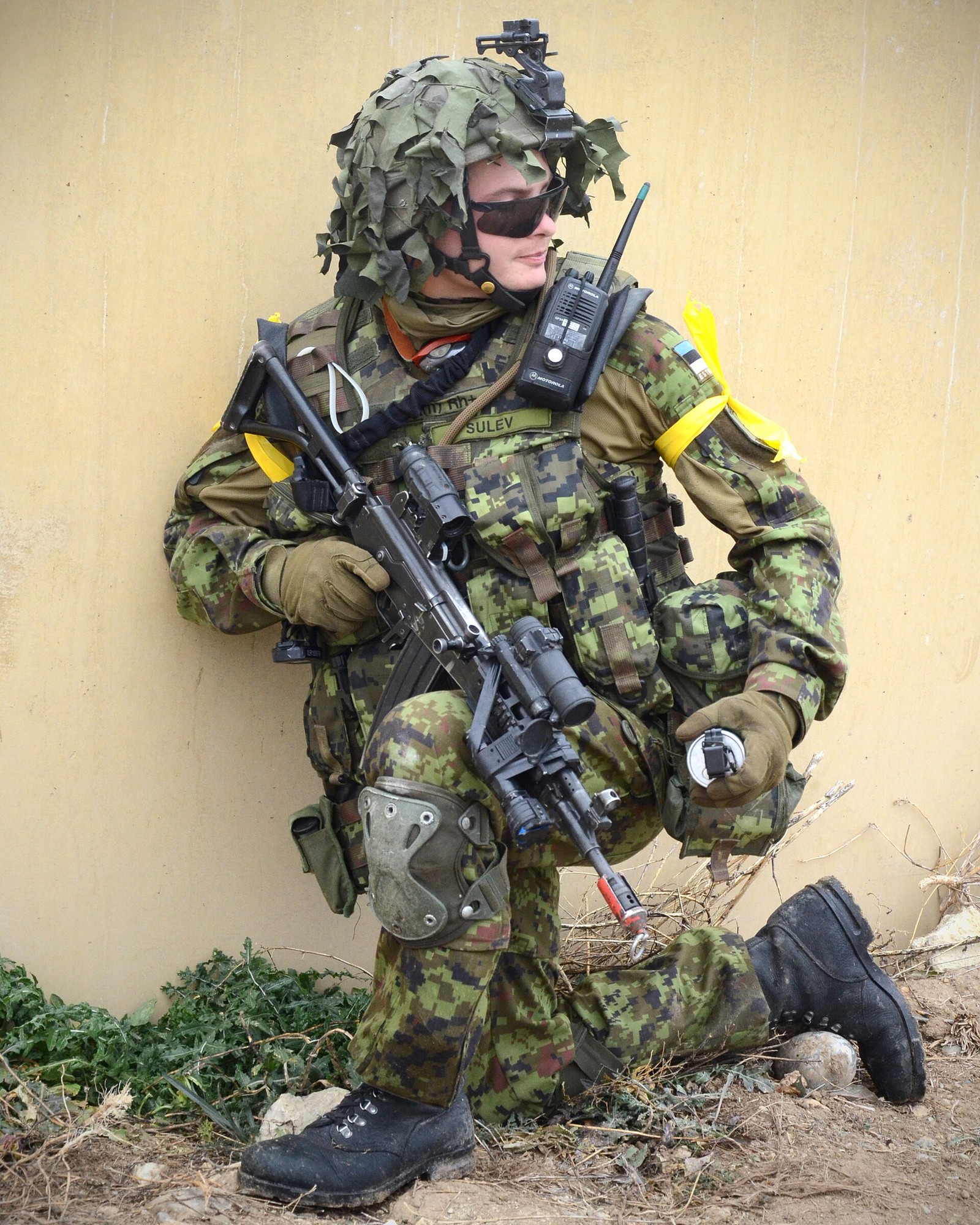
A field photograph records a garment in the light of its moment and does not by itself settle which colourway is on show; where the reading of an image is uncertain, the identification is given as a reading rather than asserted.
The colours are in a government regulation
The most useful document about this pattern is not a design-office drawing or a manufacturer’s catalogue. It is an annex to an order of the Estonian Minister of Defence, number 51 of 23 October 2013, on the description of the service uniform and the procedure for issuing it, published in Riigi Teataja. Annex 5, “Colour and colour design of the uniform”, fixes the palette in textile Pantone references, and it does so separately for the two variants.
| Variant | Base colour | Second colour | Third colour | Fourth colour |
|---|---|---|---|---|
| Ordinary field uniform (tavavälivorm), four colours | Callista Green 18-0324 TPX | Military Olive 19-0622 TPX | Aztec 18-1130 TPX | Black Coffee 19-1111 TPX |
| Desert uniform (kõrbevorm), three colours | Sesame 15-1215 TPX | Aztec 18-1130 TPX | Charcoal Gray 18-0601 TPX |
Two things follow from reading the annex rather than the summaries of it. The first is that the regulation also publishes a drawing of each variant’s colour composition, so the designs are printed in the instrument itself and not merely described in it. The second is that the brown called Aztec, 18-1130 TPX, appears in both lists. It is the single thread running through the family.
The date on that order deserves a caveat: it is from 2013, seven years after the uniform entered service and one year after the regular force finished converting to it. It is the earliest official codification of these colours that this research located, and no adoption document from 2006 was found. The annex says what the two variants were required to match; it does not say what was printed in 2006.

That photograph is the article’s reference for the desert variant, and it is a reference of a specific kind: a whole garment on display in a case, under artificial light, on a mannequin, not a colour-calibrated swatch. The block structure and the colour relationships are legible; the exact tone depends on the lights and on the camera. Treat any comparison against a garment in hand as approximate, and prefer the Pantone references above when precision matters.
Reading the two variants in the field
The number of colours is the fastest way to separate the two Estonian variants, and the fastest way to confuse them with somebody else’s uniform.
- The woodland uniform carries four colours: a Callista Green ground, Military Olive, Aztec brown and Black Coffee. The near-black reads as a distinct tone rather than as shadow.
- The desert uniform carries three: a Sesame beige ground, the same Aztec brown, and Charcoal Gray. There is no green in it, and no black.
- Aztec brown is common to both, which makes it a marker for the family rather than for either variant.
- Everything else, pixel size, density of small elements, overall texture, is close enough between the two that colour, not geometry, is what to read first.
On this site’s own terms these are two patterns in one lineage rather than one pattern in two colourways, the distinction between morphology, family and lineage being the one set out in the classification article. Europe in the mid-2000s had several such lineages under way at once: Finland’s M05 is a contemporary, so is Russia’s EMR Digital Flora, and none of them is a copy of another.

The desert frame is not a fabric close-up, and it does not pretend to be one. For the weave itself this article uses two other images: the detail crop of the woodland sleeve reproduced above, where the square blocks are resolved at close range, and the exhibition garment photographed on its own, which shows the pattern without the degradation of a field photograph. Reading a colour count off a full frame is reasonable. Measuring a colour off one is not, and in the desert frame the fact that the uniform is specifically the Estonian kõrbevorm rather than a similar desert garment from another coalition wardrobe is a reading of the photograph, not a documentary confirmation.
The desert twin
Desert camouflage is where the documentation thins out, so it is worth separating the claims one by one.
The firmest is also the simplest: when Estonia’s pixelated pattern was introduced in 2006, a desert version was introduced with it. The country literature describes it as sparse dark brown and grey spots on a sand ground, and as replacing the desert uniforms Estonian contingents had been using for deployment. That earlier kit was not pixelated at all. It was a smooth-edged tricolour “amoeba” desert pattern introduced in the 2001–2004 period and worn in Iraq and Afghanistan, alongside American six-colour and three-colour desert surplus that the first contingents took to Iraq. Different graphic idiom, same job.
The second claim needs a health warning. Estonian-language material places the first issue of the pixelated pattern in the desert colourway rather than the woodland one: an infantry platoon, ESTPLA-12, leaving for a peacekeeping mission in Iraq in late 2005, equipped with a yellow-toned pixelated uniform whose dark grey and dark brown elements were intended to suggest gravel and its shadows. The same account adds that the cloth was bought in Lithuania and the garments sewn in Estonia. This rests on one secondary source, and the newspaper article behind it could not be retrieved. It is reported here as an attribution, not as an established fact. It also sits awkwardly beside the country literature, which dates the desert introduction to 2006; the two reconcile if you separate issue for a named mission in late 2005 from general introduction in 2006, but the record does not make that reconciliation explicitly.
What is not in doubt is the desert uniform’s purpose. It is a deployment garment. Estonian contingents served in Iraq and in Afghanistan, in Helmand province from 2006 onwards, and the desert variant is what those rotations were issued.
The desert pattern did not stop at Afghanistan. A platoon, ESTPLA-36, is documented in a three-colour M06 Desert ESTDCU on its first patrol at Gao, in Mali, on 5 May 2020, in a photograph credited to the Estonian Ministry of Defence and to Rain Järv.
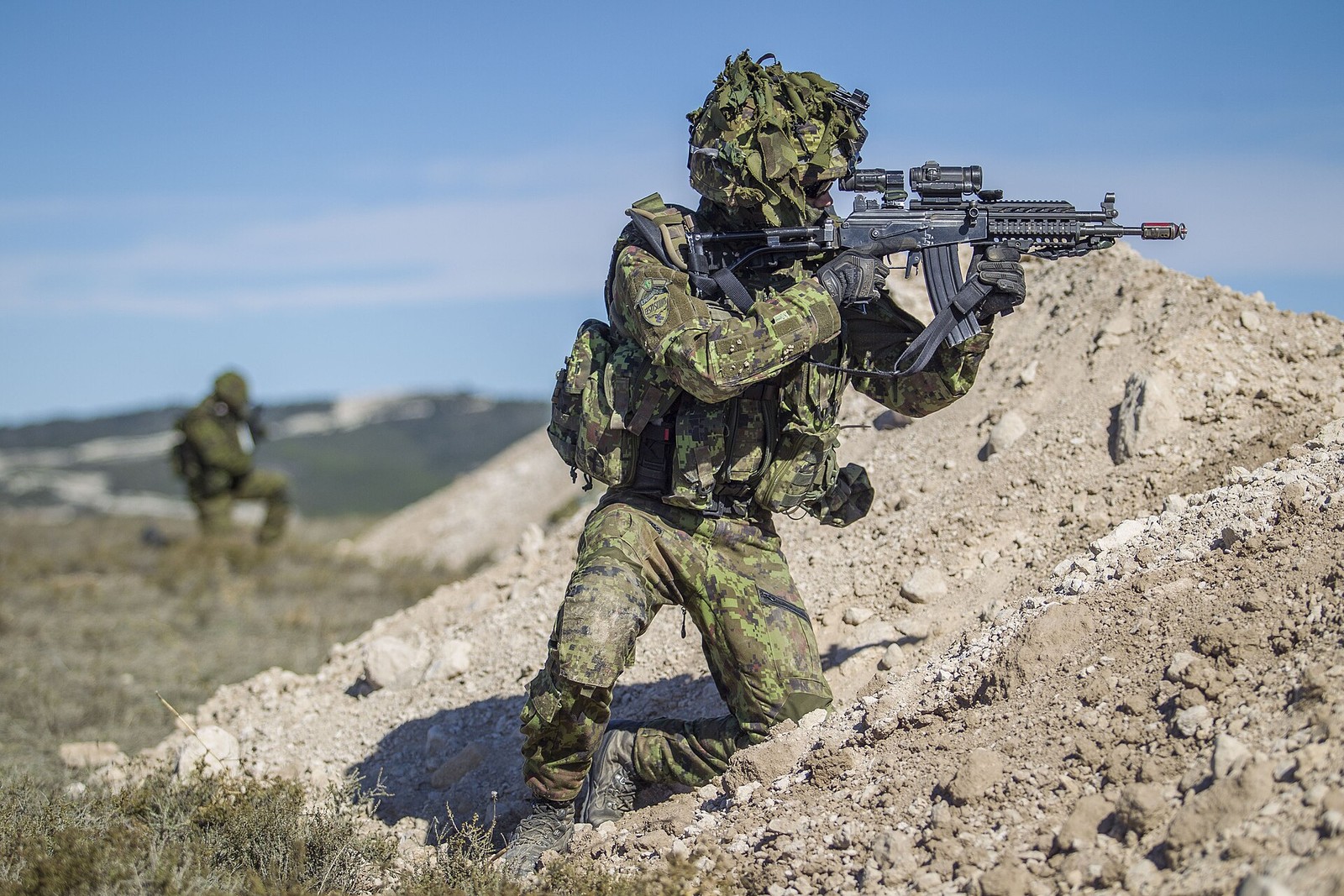
Those two frames are deliberately paired, because they make opposite points. The first was taken on a range at Erbil in northern Iraq in May 2025, where Estonian personnel were photographed in a light-ground pixelated uniform: arid ground, the desert variant in theatre, which is what a deployment garment is for. The second was taken on Spanish soil during NATO Exercise Trident Juncture 2015, and the Estonian troops in it wear the temperate version. Bob Morrison, who covered the exercise, noted that an Estonian scout was wearing the temperate uniform on arid ground where it was less effective, and observed that the desert variant would probably have been issued had the troops been deploying rather than training. That is a claim about issue logic, attributed to him, and it is the clearest illustration of how a desert pattern works in a small army’s inventory: it exists for named deployments, and it does not come out of the stores merely because the ground happens to be dry.
One consequence is worth spelling out for anyone hunting Estonian desert kit. The variant has never been the country’s general-issue uniform; it is issued against a deployment, which is one reason it is rarer than the woodland version. The archival record of its early years is also thin: images of the first generation are few, official captions rarely name the pattern, and no freely licensed photograph of the 2005 Iraqi issue could be located. That gap is a fact about the record, not an invitation to fill it with a better photograph of the wrong uniform.
2006 was an introduction, not a general issue
The difference between a pattern entering service and a pattern being issued to the force is the key to this subject, and Estonia is a clean example of it.
The pattern entered service in the second half of 2006; the previous uniform stayed in the field for years afterwards. The documented sequence is stepwise: a first trial batch of the woodland version in 2005; testing by a group of six Estonian observers, MOT-1, in northern Afghanistan before 2006; service entry in the second half of 2006; a first lighter-toned production batch around 2008, in limited quantity and going mainly to the Defence League; a snow pattern tested around 2009 and then brought into the supply system for some units; and the complete conversion of the regular force in 2011 and 2012, accompanied by a revision of the uniform’s cut. Only then had the round-spotted pattern genuinely left the field for most wearers.
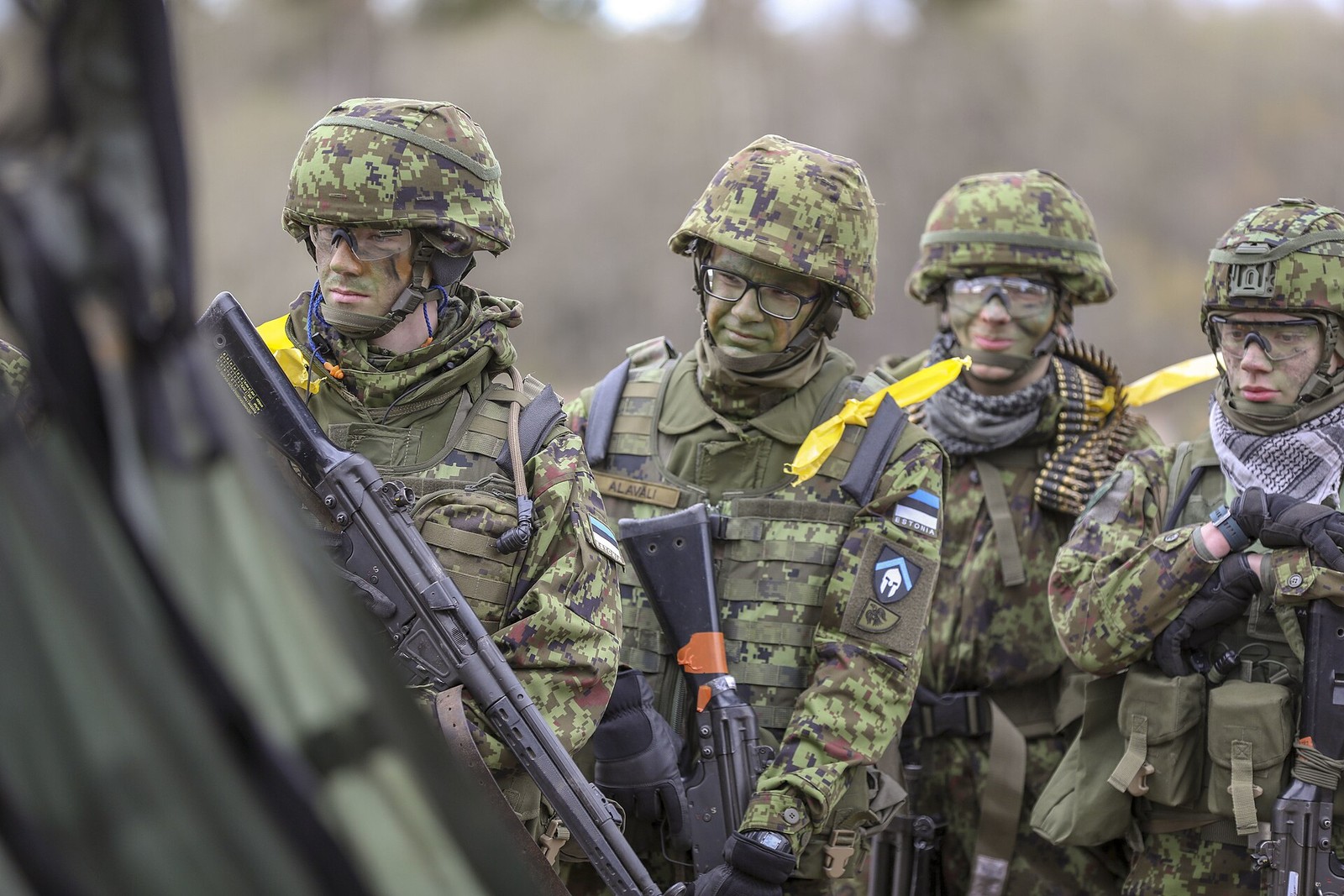
The Defence League is the formation named in the accounts of that slow rollout, which is why this frame is here. It documents the user rather than the 2008 delivery: nothing in the image establishes which batch of uniform is being worn, and no such claim is made. The date in the caption is the honest limit of what the picture shows.
One disagreement belongs here rather than in a footnote. The English-language encyclopaedia entry states in its infobox that the pattern has been in service since 2007, while the body of the same entry describes first trials in 2005 and adoption in 2006, and the Estonian-language account places service entry in the second half of 2006. The infobox contradicts its own article. The formulation used here, trials in 2005, service entry in the second half of 2006, generalisation across 2011 and 2012, is the one the sources support in common.
Why the old stocks survived so long
The reserve explains most of it, and the arithmetic is blunt.
Estonia’s defence model rests on a small standing force backed by a large reserve. The figures in circulation are roughly 8,200 active personnel, including some 4,000 conscripts, against around 230,000 reservists, of whom about 38,800 are counted in the rapid-response category and some 80,000 as having received training. Those are quoted as the reference source’s figures, not as verified current totals; force-structure numbers move, and they should be re-checked before being reprinted.
Hold those proportions in mind and the slow conversion stops looking like a procurement failure. Re-equipping a force of eight thousand is a purchase; re-equipping a reservoir many times that size, all at once, is a different order of expenditure. The existing stocks were neither worn out nor operationally obsolete: they were in an older pattern, and they worked. The country literature is direct about the consequence, recording that the new uniform’s real implementation was slow, with many reserve units continuing to use the old camouflage stocks as their service uniform.
A third factor is easy to undervalue. Reserve formations train periodically, so their kit wears slowly: a uniform carried for a few weeks a year stays serviceable far longer than a front-line soldier’s. That extends the life of a superseded pattern well beyond the life of a combat uniform, and it explains why Estonian surplus in the older round-spotted pattern has reached the market in quantity while its pixelated successor arrived later and in smaller volume.
That frame, taken on a training lane in Latvia in 2014, illustrates why the woodland variant was specified as it was. The pattern entered service in a country whose training grounds are forest, and the account of its design ties it to the Estonian climate as well as to tropical woodland. A force that trains in that environment does not need the conversion to be instant for it to be correct; it needs it to be complete before the old pattern becomes a liability rather than a shade difference. On the evidence available, that is roughly what happened between 2006 and 2012.
There is also no successor waiting. The pixelated uniform is still in service in both variants; the special-operations command and some police units have used MultiCam since around 2012, and no replacement for the ESTDCU itself has been announced. A pattern with no replacement programme has no reason to leave a warehouse quickly.
The CADPAT question
No subject in Estonian camouflage writing attracts more heat than the relationship with the Canadian pattern, and the honest answer is narrower than either camp would like.
The two designs look alike, and the resemblance is not a coincidence of the eye alone. The country literature describes remarkably strong similarities with the Canadian pattern; the English-language encyclopaedia entry calls the resemblance extreme; and the Estonian-language account goes further, stating that the Canadian pattern served as the model for the development of the Estonian design. That is a documented claim of design influence from a national-language source, and it should not be waved away.
What is not documented is identity. The Estonian print does not reproduce the Canadian one: there is no shared specification, licence or drawing, and the two prints differ in ways observers have described. In Bob Morrison’s comparison, the Estonian temperate pattern is built on a dominant light green with olive as the principal secondary colour and only minor amounts of a reddish brown and of black, and across large areas of printed cloth it reads as less linear than CADPAT, using more light green and less black; the Canadian pattern, on the same reading, uses a less reddish brown. Close relatives, visibly distinct prints.
That combination, influence asserted, identity not established, is not a contradiction, and stating both is the only defensible position. Two NATO members in the same decade, with much the same published research available to them, could hardly avoid resemblance once one of them had broken the ground. MegaCamo’s account of CADPAT treats it as the pattern that opened the international digital wave. Opening a wave is not the same as designing every member of it.
One cataloguing trap is worth being honest about. A photograph of a coalition awards ceremony at Erbil Air Base in May 2025, with several desert and woodland pixelated uniforms in the same room, is catalogued under both the Estonian pattern and the Canadian one, which is precisely why it proves so little. It is a coincidence of deployment, not evidence of design lineage, and the frame is not reproduced in this article for that reason: two uniforms sharing a room is not two prints being compared.
Names, makers, and what the acronym is worth
Three names are in circulation for one pattern, and none of them is a regulation.
- ESTDCU is glossed as Estonian Digital Camo Uniform in the English-language encyclopaedia entry, as Estonian Digital Combat Uniforms in the country literature, and as Estonian Digital Camouflage Uniform by the specialist article that gave the pattern its M06 prefix. The acronym is not settled, which is a fair warning against treating it as a designation.
- M06 ESTDCU, “model 2006”, comes from that specialist article and is the most useful form for identifying an item in a description or a listing.
- The only official names located are the two Estonian ones: tavavälivorm for the ordinary field uniform and kõrbevorm for the desert, both used in the 2013 ministerial order.
The designer attribution deserves the same care. Both the country literature and the English-language encyclopaedia entry state that the pattern was developed by Andres Lüll under contract with the Estonian Defence Forces Logistics Centre, but on the encyclopaedia entry that sentence carries a “citation needed” tag, and no Estonian institutional source confirming the name was found during this research. It is given here as an attribution, not as an official fact.
Manufacturing is documented with a date attached, which is a limit rather than a detail: the pixelated jackets and trousers in service are described in Estonian material of 2011 as production of the Estonian company OÜ Imprek 93. That establishes a maker as of 2011, not that the firm was the exclusive supplier or that it held that role in 2006. The one clear manufacturing fact from the 2005 desert issue points a different way again: cloth bought in Lithuania, garments sewn in Estonia.
For a buyer, the practical summary is short. The woodland four-colour uniform is the common one; the desert three-colour uniform is the scarce one, issued against deployments. The difference between them is one colour, one base tone and one dark element, and the Aztec brown runs through both. The resemblance to a Canadian uniform is a real observation about the look of the cloth, not a shortcut to the identity of the item in your hands. Items in this family sit in MegaCamo’s Estonian 2006 pixelated category, and a shop is not a source: nothing there should be read as evidence about the pattern.
