
Camouflage History
Sumpfmuster 43 and 44: Germany’s Late-War “Marsh” Patterns
Two patterns, almost the same colours, overlapping dates, and a name that changes depending on who is writing: Sumpfmuster 43 and Sumpfmuster 44 are among the least clearly explained camouflage designs of the Second World War. They are also among the most collected, which is why so much of what circulates about them comes from item listings rather than from official documents.
The German word contracts Sumpf (marsh, swamp, bog) with Muster (pattern) or Tarn (camouflage). English-language dealers render it as “marsh pattern”, “swamp camo”, or the trade’s “Tan & Water 43” and “Tan & Water 44”. What the names describe is a printed camouflage made in Germany for equipment and camouflage clothing of the Wehrmacht from 1943 on, and, in a further-developed form, taken up by the Bundesgrenzschutz (the West German federal border guard) from 1952 and worn into the 1980s.
This article looks at the two late-war variations the way they survive: on actual objects, a reversible rayon smock with a Berlin maker’s code, a Vienna-made smock with a face veil in the hood, a paratrooper jump smock that was marked, dated and never issued, rubberised anti-gas trousers. What follows separates what those objects prove from what collectors’ shorthand claims.
The name problem comes first
Almost every mistake made about these two patterns starts with naming. No wartime document, order, or official designation has turned up that names a pattern “Sumpfmuster 43” or “Sumpfmuster 44”. The two labels are the working language of collectors, dealers and reference pages. The German-language encyclopedia entry on Sumpftarn describes the object simply: a camouflage pattern manufactured in Germany for equipment and camouflage uniforms of the Wehrmacht from 1943, used in further-developed form by the Bundesgrenzschutz from 1952 into the 1980s. It does not hand down a numbered pair of official patterns.
That matters for how you read any page about them, including this one. When a German dealer’s listing of a rubberised anti-gas trouser says the pattern “is also known as Sumpfmuster 44” and was “developed from 1943/44”, that is a dealer’s framing, not an archive citation. When an English-language overview divides the family into “Sumpfmuster 43” and “Sumpfmuster 44” with tidy issue windows, that division is a description that has hardened into a convention. Useful, the objects really do differ, and the differences are visible. Official: no. Nothing in the surviving evidence supports treating 43 and 44 as catalogue numbers signed off by a supply office.
Where the pattern came from
The story that the marsh pattern descends from the army’s pre-war splinter print is consistent across the secondary literature. Germany’s first mass-produced camouflage, introduced around 1931 as Buntfarbenaufdruck 31 and renamed Heeres-Splittermuster 31 around 1935, was the main army pattern from 1932 to 1945, printed on shelter quarters, helmet covers, smocks and parkas. The Luftwaffe adapted it in reduced scale in 1941 as Splittermuster 41 the print used on the paratroopers’ Knochensack jump smock.
The marsh pattern is described as growing out of that lineage. The English-language overview at The Garrison Militaria frames Sumpfmuster 43 as “a widely used pattern derived from the Splittermuster 31” in which the original geometry survives only in weakened form: shapes “more blurred and faded”, over a base that is “beige or a kind of tan” with maroon and dark green printed over it. The same overview describes Sumpfmuster 44 as developed from the 43 with “almost identical colours”, but with the geometric shapes now gone entirely.
Treat that as the literature’s account, not a documented chain of design decisions. No specification, proof sheet or printing order for either variation appears in the published record. The claim is worth stating because it is the most repeated one in the field, and because it does describe something a reader can see: a print that keeps the light ground of the splinter family while losing its sharp corners.
A related but distinct claim concerns the garment rather than the print. The fjm44 reference calls the 43 smock an “evolution of the hoodless Splittertarn smock issued to a lot of soldiers in the Großdeutschland division”. That is a statement about a cut, not the same statement as “the pattern descends from the splinter pattern”, though the two are often written as one. The two prints are distinct drawings.
The 43 pattern on real objects
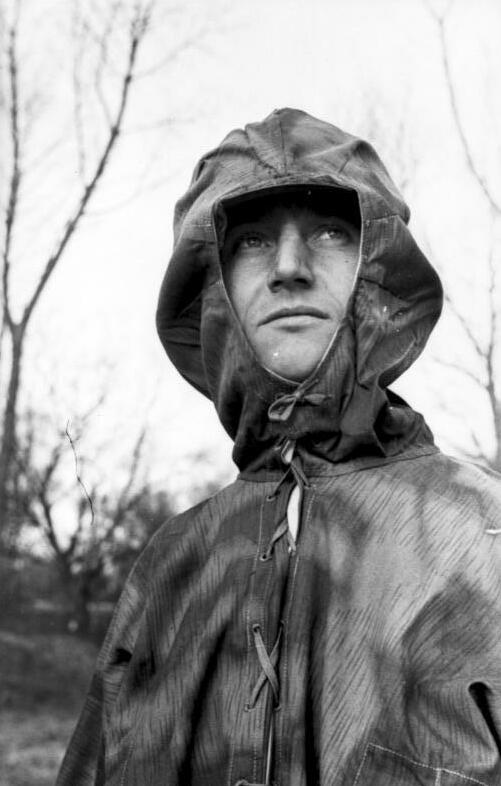
The clearest description of a 43-piece comes from a smock documented with its maker’s marking. The fjm44 reference records a Heer camouflage smock in Sumpfmuster 43, marked RBNr 1/0250/, a code the page attributes to a producer in Berlin, in size 2. The material is recorded as reversible rayon printed on one face, with the inside left in the natural colour of the rayon. The page notes that the garment was reversible for wear in winter, and adds the honest caveat that period images of that winter wear are very scarce.
Two details are worth holding on to. The first is the marking itself: a maker’s code stamped on the garment puts a real, dateable object in a real production context, and these codes differ from one smock to the next. The second is the nickname. The page notes that this smock “is often referred to as the sniper smock”, before explaining that it is in fact an evolution of the hoodless splinter-pattern smock. The label describes how the garment was used and collected, not what a supply office called it.
The 43 print also turns up on garments that are not smocks. A US dealer’s listing for an original pair of reversible winter trousers describes them as “Marsh 43 (Sumpfttarnmuster)”, in nearly unused condition, with the camouflage print in dark, somewhat muted colours and the storm-flap fabric in brighter colours. That listing also records something significant about survival: the trousers carry no markings of any kind. Late-war output is not always conveniently stamped.
Taken together, the 43 material here is a small, consistent set: reversible rayon garments printed on one face, a Berlin maker’s code on the documented smock, no markings at all on the winter trousers, and a print described as floating between the old splinter geometry and the fully rounded print that followed. Nothing in these objects fixes an issue date.
The 44 pattern on real objects
The 44 material is better documented in one respect: more of it survives with stamps.
The fjm44 reference records two Heer smocks of this type, reversible rayon printed on one face with the same natural-coloured reverse, both marked RBNR 0/1001/0219 a code the pages attribute to an unidentified producer located in Vienna. One is listed in size I or 1; the other, in size II or 2. Two features matter. The first is the pattern description: the page states that this smock “is executed in ’44 Sumpftarn which has more round edges then the ’43 Sumpftarn which has hard edges in the pattern”. The second is a piece of tailoring that is hard to fake and easy to date: the smock has a thin rayon veil in the hood, to camouflage the face in wear. On the surviving objects and documents, a veil of that kind does not appear as a general-issue feature of the earlier smock: it reads as late-war sniper tailoring. No surviving order or manual mentions the veil.
The most precisely marked object in the group is a paratrooper’s jump smock, the Knochensack in Sumpfmuster 44. Its markings are recorded as IIb – R.b.Nr. 0/1337/0015 – X44, its year as 1944, its maker as unidentified. The reference notes that two different colours are visible on the two back panels, a surviving trace of the printing process, and then states the fact that gives the object its weight: the smock was never issued, and the breast eagle is sewn on as originally made. This is a finished late-war garment that went into storage instead of onto a soldier, exactly the object that lets a reader study a print as printed, without the fading and repair of field wear.
The 44 print also appears beyond smocks. A German dealer’s archive records a Luftwaffe reversible winter jacketWendetarnjacke in size 2 with Sumpftarn outside and white inside: a winter-reversible garment in which only one face carries camouflage. A separate German dealer listing documents a Wehrmacht anti-gas trouser in the marsh pattern: rubberised, camouflaged outside, dark green inside, without stamps, straps missing, holes present. That listing adds a general point about late production, official stamps were frequently absent from 1944 on, which should be read next to the unmarked winter trousers described above. Absence of markings in this family is normal, and cannot be used as evidence against a piece.
Telling 43 from 44 on an actual piece
 |
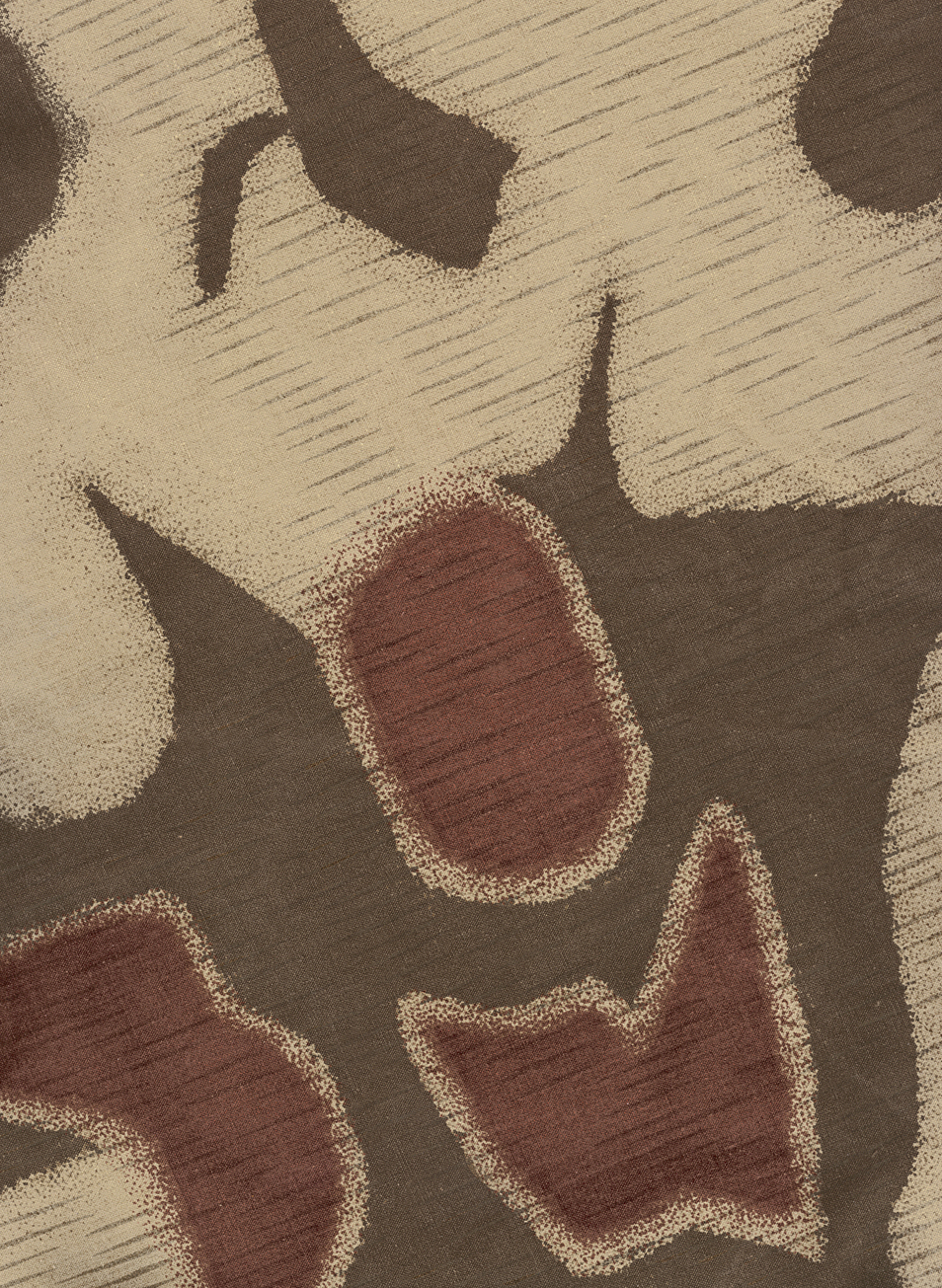 |
If you want to sort a real garment, the distinction that circulates is about the edge of the printed shapes. Side by side, the 43 is described as the harder-edged of the two and the 44 as the softer, rounder one. The fjm44 reference makes the point twice, once from each side: the 43 smock page says its example has “more hard edges then the ’44 Sumpftarn which has soft edges in the pattern”, and the 44 page says its example has “more round edges then the ’43 Sumpftarn which has hard edges”.
That is the whole of the practical rule, and it should be presented for what it is: a descriptive convention used by people who handle these garments, not a specification. Treating it as a bright line invites errors. Registration varies between print runs, two panels of the same garment can differ, as the Knochensack record notes, and fading blurs exactly the edge quality being assessed. The rule works best alongside two things that are more objective: the colour of the ground and the density of the overlay printed on it, and the construction of the garment a rayon reversible smock, a rubberised trouser, a field jacket printed on one face, or a jump smock. Of the four questions, construction survives best, and it is the one most often skipped.
The palette is described consistently, a light beige or tan ground with maroon and dark green printed over it, with one encyclopedia summary noting the splinter scheme’s colour dominance switching to green in the marsh print. Between 43 and 44, the differences are structural rather than chromatic. As the shapes round off, the print loses the last of the angular splinter geometry; one published overview argues that the fully rounded 44 became less recognisable to the eye as a result, a plausible reading of a print designed to break up a silhouette rather than to draw the eye to hard shapes. That reading is an interpretation, not a measurement.
Who actually wore it
The evidence is set out piece by piece rather than as a tidy issue list.
Army smocks, including sniper garments. The two marked reversible rayon smocks in the reference material are both recorded as Heer items, one from a Berlin producer and one from a Vienna producer, and the 44 smock carries the hood face veil. Both pages tie the garment type back to the hoodless splinter-pattern smock widely issued in the Großdeutschland division. The objects establish that the pattern was printed onto army smocks in at least two production locations, and that a face-veil version existed by the 44 stage. They do not establish a branch-wide rule. The “sniper smock” nickname attaches to the family, the 44 smock’s face veil supports it, but the smock type was not made for snipers alone.
Paratroopers. A Knochensack jump smock in Sumpfmuster 44 exists, marked and dated 1944, and was never issued. A sibling entry in the same reference covers a second 44 jump smock under a different maker’s number, which indicates the garment was not a single prototype.
Luftwaffe field divisions. Camopedia states that production of the 44 design “appears to have been limited to parachutist jump smocks and Luftwaffe Field Division jackets, thus leading some collectors to refer to this design as Luftwaffe-Sumpfmuster”. Note the languageappears to have been limited: a hypothesis, not an issue record, and one that sits awkwardly beside the marked Heer smock from Vienna described above. What the dealer-documented jackets add is narrower: field-division jackets printed on the outer face only exist, and were traded. Some listings under the same heading are openly sold as reproductions, which is reason to read this category carefully.
Anti-gas equipment and winter clothing. Rubberised anti-gas trousers and reversible winter garments in the marsh print are both recorded, utility items, suggesting a print applied across a late-war range of protective and cold-weather kit rather than reserved for one elite garment.
Helmet covers, bandoliers, and “some Waffen-SS”. The same overview also lists helmet covers, paratrooper smocks, bandoliers and some field jackets in Sumpfmuster 43, and notes that some Waffen-SS soldiers were seen wearing garments in the pattern. That is as far as the evidence goes: an observation by a collector-oriented overview, not an issue record.
What can be said with confidence is narrower than the popular summary and more useful: the marsh pattern was a Wehrmacht-era print that reached army smocks, a marked paratrooper jump smock, field-division jackets, gas-protection and winter clothing. Writing it up as “the pattern of the army”, or as the property of any single branch, misstates the evidence. Its real signature is that it was printed onto whatever late-war garment programme needed camouflage, exactly when German industry was least able to be consistent about it.
After 1945: the border guard keeps the marsh
The marsh pattern’s most durable afterlife has nothing to do with the Wehrmacht. In a further-developed form it was adopted by the Bundesgrenzschutz from 1952, and it remained in use into the 1980s according to the German-language reference. Objects in that later form are comparatively easy to find, well photographed, and frequently confused with wartime pieces, which is precisely why they are useful here.
The post-war record of the marsh print is well documented by the objects’ own photographers. A field cap in the print is described by its photographer as a Bundesgrenzschutz cap in use until 1976, and the same photographer’s descriptions of his own digging trousers and field cap, both from BGS stocks, record that the uniform was produced in that form until 1976. Those dated objects are a useful corrective to any idea that the pattern’s story ends in 1945: the print was worn on real ground, for real work, for three more decades, by people who had no idea they were carrying a late-war design forward.
The two statements about the end of its service do not quite match, production in that form until 1976, service into the 1980s, and this article carries both rather than picking a winner.
Outside Germany, two comparisons are regularly made and only one is worth making. The Austrian Steintarn the “stone” pattern printed on Austrian shelter quarters, is described by Camopedia as probably influenced by the Sumpfmuster, in an entry that distinguishes early and late versions of the Austrian print. “Probably influenced” is the correct register: a resemblance and a plausible transmission, not a documented lineage. The second comparison, with Hungarian post-war camouflage, is best used the other way round. Hungarian camouflage development produced its own pattern in 1949 and a standardised uniform in 1990, and the family resemblance to German marsh prints has led to the two being merged in casual summaries. They should not be: a similar palette and a similar softness of shape do not make a Hungarian print a German one. Where the two are mentioned together, the purpose should be to prevent the merger, not to repeat it.
The German Federal Archive holds dated, credited Second World War negatives of snipers and soldiers in camouflage smocks, taken on the western front in 1943 and in Russia in June 1943 (its file “Russland, Soldat in Tarnjacke”, 21 June 1943), but none of its captions names the print. Identification by appearance alone is weak, because the pre-war splinter print also carried a fine speckled overlay on a light ground. The firmer route runs through the objects: a marked smock, a printed field jacket or a piece of gas-protection clothing carries a maker’s code, a production place and a date range, and the absence of markings on an item proves nothing about when it was made.
For the wider German picture, see German World War II Camouflage, Explained and the Splittertarn article on the Zeltbahn that started the family. For the marsh pattern’s post-war European cousins, see the Austrian “stone” pattern and Flecktarn. For how pattern families are sorted in the first place, see How Camouflage Is Classified. Marsh-pattern items are grouped in our catalogues for Sumpfmuster 43 and Sumpfmuster 44.
