
Camouflage History
M05 Desert and Snow: One Pattern System, Three Climates
Finland’s service camouflage is usually described as a woodland pattern with a few climate variants tacked onto it. The order of events is the opposite. The desert uniform came first, in 2004, because Finnish troops were already deploying to hot, arid countries on peacekeeping missions and had no proper hot-weather kit to wear. The woodland pattern grew out of the design work done for that desert kit and entered service later in the decade. Frost and snow followed from the same drawing board, not from separate design programmes.
The interesting question is not what the colourways look like. It is what kind of object the family is. Finland did not assemble a set of unrelated prints, one per climate, each with its own shapes and procurement history. It built one vocabulary of shapes, changed the palette, and took advantage of that decision in ways a disparate family cannot: reversible helmet covers that answer two climates with one item, a single commercial ecosystem that appeared when military exclusivity lapsed in 2016, and a test record in which improvements were claimed against the previous generation of patterns rather than against a sibling colourway.
This article deals with the desert, frost and snow colourways and with the system logic that ties them together. The woodland colourway has its own account on MegaCamo, Finnish M05: One Boreal Landscape, Sixty Years of Camouflage. What is argued here is the relationship between the climates, and why that relationship is worth more than the individual prints.

What the reference literature says the family is, and what it is not
The most useful statement about the post-2003 Finnish patterns is a correction. Camopedia, describing the whole group, calls it a variegated pattern and adds that it is often mistaken for a pixelated pattern. The distinction is not pedantry. Finland never adopted a digital design; the blotches are irregular organic shapes, and they read as pixels only in the small, heavily compressed photographs that circulate on surplus listings. The same confusion afflicts other armies, and MegaCamo’s account of Spanish M09 examines another pattern whose popular name promises a digital structure it does not have.
Four colourways are in service, and the naming runs in two layers: a Finnish common name and an English rendering used by the sources. The table uses the names as the sources use them, because the naming is part of the subject.
| Colourway | Finnish name in the sources | English rendering in the sources | Role in the system |
|---|---|---|---|
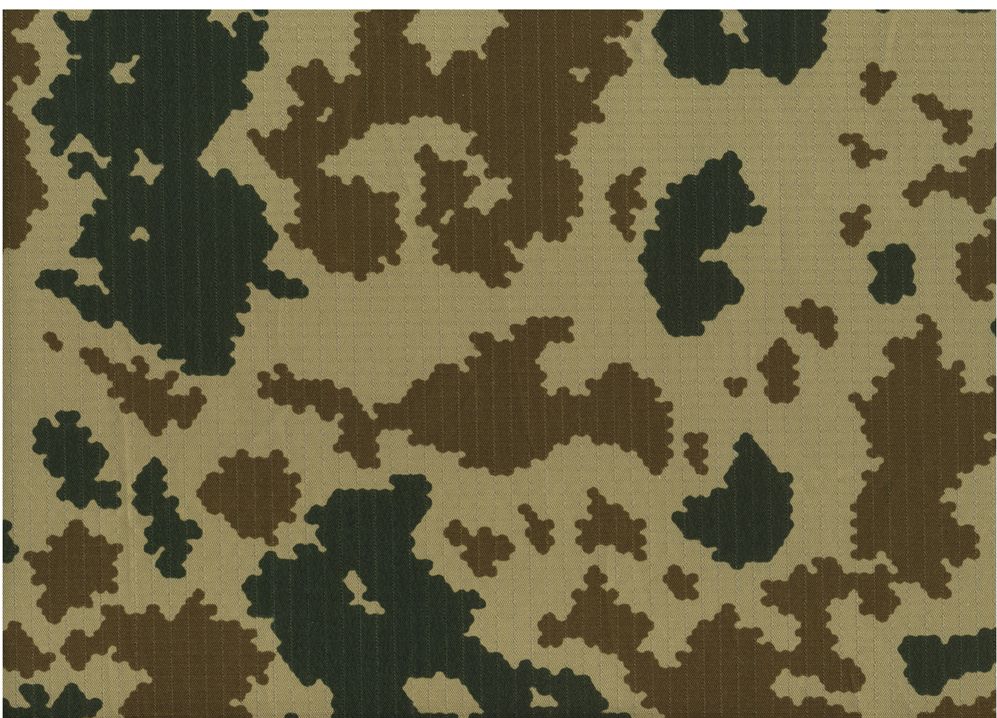
| Desert | aavikkokuvio, nicknamed hellekuvio | desert camouflage, hot weather uniform M2004 | first of the new family issued, 2004 |
| Woodland | M05 Maastokuvio, also metsäkuvio | woodland or forest pattern | standard temperate pattern of the Finnish Defence Forces |
| Frost | M05 Pakkaskuvio | frost pattern, cold season pattern | cold and inclement weather kit |
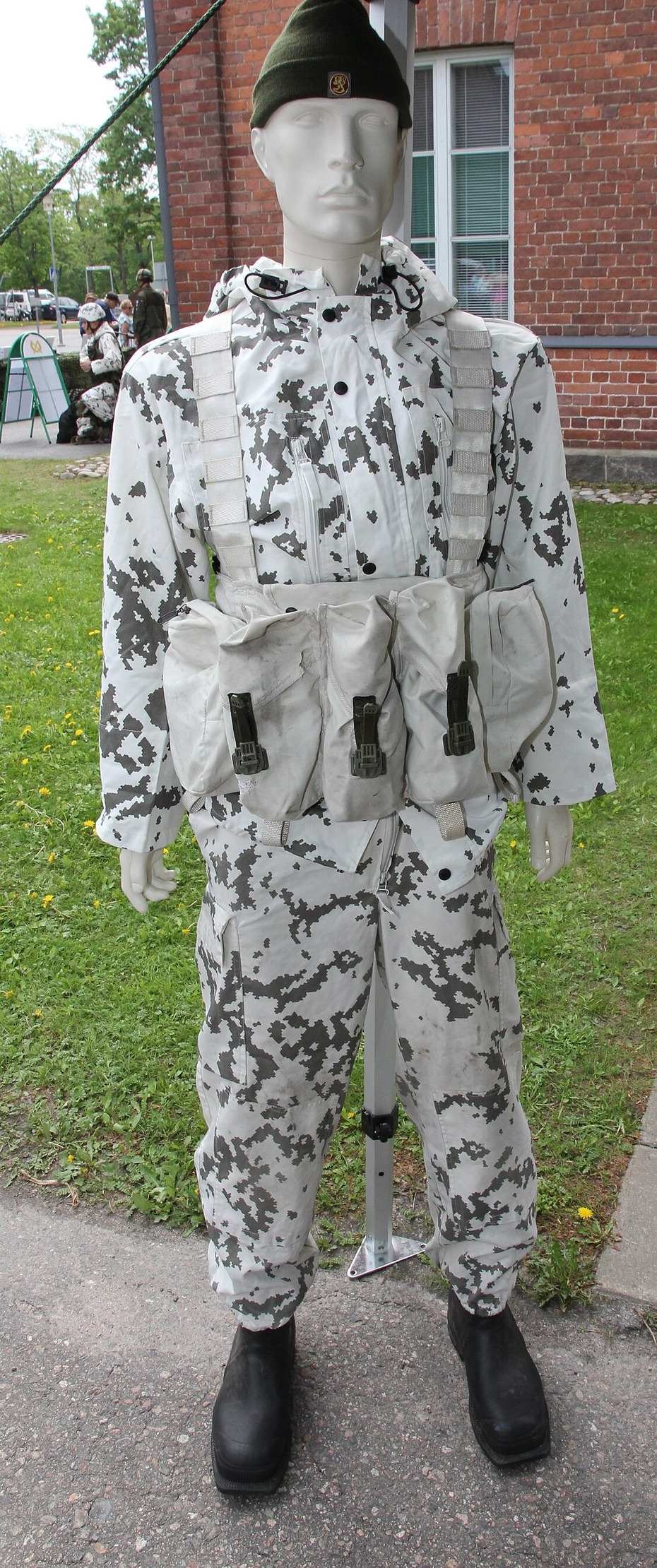
| Snow | M05 Lumikuvio | snow pattern | snow suit and helmet cover |
The older generation belongs here as one sentence of context, because the new family was measured against it. The M62 of about 1962 was a three-colour spot pattern, nicknamed kurkkusalaatti, cucumber relish, and most of its uniforms were reversible to solid white. The M91 combat uniform of 1990 was in practice an M62 reprint with more consistent coloration, and it was not widely used as a field uniform until the early 2000s.
The woodland colourway came out of photographs of real forest
The design method is documented for the forest colourway, and it explains why the later variants are re-colourings rather than new drawings. To begin the pattern, the Finnish Forest Research Institute took photographs of several different Finnish forest types. At the Technical Research Centre of Finland those photographs were combined into a single four-colour design. Dark charcoal grey was then added to create the impression of shadow cast by trees. The result was tested repeatedly with small modifications and judged markedly better than the M62 and M91 patterns.
Two things follow for the argument here. The geometry originates in environmental sampling rather than a designer’s invention, so later variants remain consistent with the family’s own logic when they keep the shapes and change the colours to match a different landscape. And the evidence about the desert pattern’s place inside the family is a statement about design work, not about repeat identity: the specialist account of the desert clothing says the forest pattern was based on the design work done for the desert pattern. What the two colourways share is design work, not a mathematically identical repeat: this is a shared system, never one motif simply printed in different inks.
The desert uniform is the oldest member of the family
The desert kit exists because of an operational gap, and the gap came before the pattern. Testing of the new uniform series with its new camouflage began in 2003 and issue began the following year. The reason for starting with desert was that Finnish troops were deploying to hot, arid countries on peacekeeping operations, including the mission in Ethiopia and Eritrea, with no proper hot-weather equipment.
The 2003 test kit carries its own label, K2004, and was used by Finnish crisis-management forces in the United Nations mission in Eritrea. The two sources differ in how they treat it: the reference work treats K2004 as the prototype design for the new series, produced in desert coloration, while the Finnish-language account notes that K2004-patterned kit was heavier than the later M04 kit. Both statements can be true of related but not identical objects, and the article keeps them apart rather than merging them into one garment.
The desert colourway was issued in 2004 as what the reference literature calls the M04 Hellepuku, the hot weather uniform M2004, in two fabric types at once, a heavier twill and a ripstop. Its documented items are the hot-weather suit, shorts, hat, field cap, helmet cover and boots. Its documented users are the crisis-management forces in Afghanistan under ISAF, the operation in Chad, MINURCAT in the Central African Republic and UNIFIL II in Lebanon, plus Finnish United Nations military observers in hot-climate operations.
The most recent development is domestic. The Finnish Army announced on 22 May 2023 that desert-patterned kit was being introduced into conscript training in some units. That announcement is known here through the Finnish Wikipedia article’s citation of the Army’s own news service; the primary page was not read in the course of writing, and it is reported with that limitation attached.

The desert pattern and the naming problem around it
The desert colourway is the family member whose designation is least settled, and a reader who meets M04 and M05 in the same listing deserves to be told why. The Finnish Wikipedia article notes that the desert pattern has been called M04, and marks that sentence itself with a request for a source, adding that its patterns otherwise correspond to those of the M05 items. The reference work calls the kit the M04 Hellepuku and its pattern hellekuvio. Commercial and collector usage splits three ways, between M04 desert, M04 Hellekuvio and M05 desert.
The honest formulation is that the designation is not cleanly documented in the sources consulted. This article therefore uses the reference work’s name, M04 Hellepuku, when it needs a single label, and says where that label comes from. The distinction between an official designation, a period name, a commercial name and a collector’s name is the one set out in MegaCamo’s explainer on how camouflage is classified, and the desert name is a case study in why those categories should not be collapsed.
The nickname is more informative than the designation. Hellekuvio, the heatwave pattern, describes what the colourway is for, and that is characteristic of the whole family: the names say what the cloth is meant to do in a light and a landscape, not who drew it or which agency signed it off.


Frost: the same geometry with the green taken out
The frost colourway is the clearest demonstration of how the family works, because it is defined by a subtraction. The Finnish-language account states that Pakkaskuvio uses the geometry of the woodland pattern with the bright green replaced by grey, grey being the more common colour in the Finnish autumn and winter landscape. The reference work describes the frost palette as black, moss green and grey blotches on an earth-tone base, and lists the frost jacket, frost trousers and fur hat among the items carrying it.
Nothing about that operation requires a new design. The shapes had already been validated against the older generation; the colour that fails in the cold season was removed and replaced by the one that dominates it. This is a long way from the way camouflage families are usually described in collector writing, where variants are treated as separate patterns with separate lineages. Here the variant is a documented adjustment to one variable, and the sources say so in as many words.
Snow: two colours, and a documented working distance
The snow colourway, Lumikuvio, is described in the Finnish-language account as a two-colour version of the forest pattern. Its purpose is stated with unusual precision for camouflage literature: the pattern breaks up the fighter’s profile and makes him disappear at a distance of a few tens of metres in light snowfall. That figure describes light snowfall, not a blizzard or a bare white field, and it is a working distance rather than a claim of invisibility.
On colour, two descriptions have to be kept side by side. The reference work describes the snow pattern as dark green variegated blotches on a white background. The official plate reproduced in the Finnish design-protection decision shows an off-white ground with grey-green blotches, considerably softer than a saturated green. Both are reported here rather than averaged: cloth in service is printed in production runs whose inks shift, and a flat plate from a document is not a colour-calibrated sample of an issued suit. The kit carrying the colourway is documented as the snow suit and the reversible helmet cover, which is where the family’s design logic becomes visible in equipment rather than in colour.

The reversible cover is the strongest single piece of evidence
The item that settles whether this is a system or a family of cousins is a helmet cover. The M05 helmet cover is documented as reversible, with one face in the woodland colourway and the other in snow; the M04 helmet cover is likewise documented as reversible, with one face in woodland and the other in desert. A quartermaster ordering one cover for two climates is making an assumption about the cloth, and the assumption is that the geometry is shared.
That is a design argument rather than a quotation from a Finnish Defence Forces document, and it is presented as one. Its force comes from the alternative: if the desert and snow colourways were independent drawings with their own blotch vocabulary, a two-faced cover would print two unrelated patterns on one piece of fabric and would look like two different covers on the same helmet. The existence of the item, described as it is in the sources, is the practical reason this article treats the colourways as re-runs of one design rather than as separate patterns that happen to come from the same country.

Why a declined system works better than a disparate family
The subject brief asks why one motif re-declined performs better than a family of unrelated patterns. Six answers are available from the record, and they operate at different levels.
- The variable is the palette and the constant is the geometry. A user moving between climates, or a unit issuing kit across a season, learns one set of shapes, and the reading of the pattern does not change when the colours do.
- Reversal is only possible on a shared geometry. The two-faced helmet covers exist because the pattern on one face is the same drawing as the pattern on the other, and the arrangement reduces the number of items in the chain rather than adding to it: one cover, two climates.
- The palette reasoning is environmental rather than decorative. The charcoal grey in the woodland pattern was added to suggest the shadow cast by trees; the grey in the frost pattern replaced a green that fails in late autumn and winter; the white ground of the snow pattern answers snowfall. Each change can be explained by the landscape it serves, which is what makes the family a system rather than a range.
- The order of development was climate-first, not homeland-first. The desert kit of 2004 precedes the woodland pattern most people treat as the family’s origin, and it was designed for missions in Eritrea, Chad, the Central African Republic and Lebanon. A family assembled by adding expeditionary variants to a national pattern after the fact would show the opposite sequence.
- Performance was measured against the previous generation, not against a sibling. The woodland design was tested repeatedly and judged markedly better than the M62 and M91 patterns it replaced. A disparate family invites the softer claim that one colourway suits its own climate; a system invites the harder claim that the new drawing beats the old drawing, and the Finnish record makes the harder claim.
- The system held together when military exclusivity ended. The four patterns were originally licensed by the Finnish Defence Forces and were not releasable to the public; in 2016 that licence expired and was not renewed, and commercially available versions appeared, while clothing printed in the patterns remains controlled by the Ministry of Defence. The result is one geometry circulating in civil use in three climates, the woodland, desert and snow colourways, rather than three unrelated market patterns competing for the same buyer.
The comparison that gives the argument its edge is American. The United States Army’s Universal Camouflage Pattern set out to answer the climate question once, with one palette meant to work everywhere, and was recalibrated at considerable cost after operational experience; MegaCamo’s account of UCP sets out that history. The British answer sits between the two: Multi-Terrain Pattern tried to serve several terrains inside a single set of colours, blending brown and green into one drawing. Finland chose a third route, keeping the drawing and giving each climate its own colours, which accepts that more than one palette is needed and confines the variation to the part of the design that carries no identity.
Dates that do not line up
Two dates are attached to the woodland pattern’s arrival and should not be merged. The specialist account of August 2020 states that the Finnish Defence Forces rolled out the new pattern in 2005 while continuing to wear M91 kit, in service since the 1990s, into the 2010s. The Finnish-language account states that the first M05 items were taken into service during 2007, replacing M91, which remained in use in the meantime. Adoption and fielding are different events, and both formulations are compatible with a pattern approved in the middle of the decade and issued as items were manufactured. This article therefore writes about the middle of the 2000s and reports the two years with their sources.
The 2016 change carries a similar framing difference. The reference work describes it in licensing terms: the patterns had been licensed by the Finnish Defence Forces, were not releasable to the public, and in 2016 the licence expired and was not renewed, after which commercially available versions appeared while Ministry of Defence control of clothing printed in the patterns continued. The Finnish-language account frames the same event as a decision by the Defence Forces to release the pattern for civil use. The net effect is the same, and the difference is reported rather than resolved.
The counter-argument, stated honestly
The strongest objection to the system argument is that a shared geometry also shares its failures. If the blotch scale is too fine or too coarse for a given observation distance, or if the value contrast between the two lightest colours collapses under a particular light, then a system multiplies that error across every climate instead of confining it to one colourway. A family of independent drawings, whatever its costs in supply and recognition, gives each climate its own chance to be designed correctly. The Finnish record answers this objection only partly, with the test results against M62 and M91 and with the working distance recorded for the snow pattern. It does not answer it with published trials per terrain, and no such trials were located.
A national pattern system is also not the same thing as uniformity in the field, and the Finnish case says so itself. The reference work records that Finland’s special operations forces have been documented using MultiCam since at least 2015, alongside other non-indigenous patterns. The family covers the bulk issue of a conscript army and its kit; it is not a claim that every Finnish operator wears it.
Two resemblance claims deserve reporting with both halves intact. After 2008, Finnish newspapers raised the possibility that a Russian pattern marketed under the name Jagel was a copy of the Finnish design, and the story was reported internationally in December 2008. The comparative study drawn on by the collector literature concluded that the Russian pattern cannot be called a direct copy of M05, while calling a Chinese pattern a direct copy of Flecktarn in the same assessment. The allegation and the conclusion belong together, and neither is a finding of this article. On Luxembourg, the Finnish-language account heads its section with a copy claim, while the underlying reference page describes a pattern whose summer weight resembles an M05 colourway. Resemblance is what the record supports, and resemblance is what is written here.
One further variant circulates without documentation. The Finnish-language article states that a grey-brown urban version of the pattern was developed but not used in clothing or equipment, and flags that section as lacking sources; a Finnish retailer’s listing counts five variants rather than four. The claim is reported with its uncertainty attached, and the urban version is not treated as an issued colourway.
For a reader holding a garment, the system leaves a usable test. Look at the ground colour first, because that is the variable: white for snow, sand for desert, green and earth for woodland, grey and earth for frost. Then look at the shapes, because they are the constant, and if they read the same as the woodland pattern the reader has found a colourway rather than a new pattern. Then check the item, because the family is specified as kit, and a reversible cover with woodland on one face and snow on the other is the family’s logic in a single piece of cloth.
