
Camouflage History
Overwhites: Snow Camouflage and the Winter Problem
White clothing is the oldest camouflage a soldier can put on, and the one armies have never quite solved. A century of snow camouflage, from Alpine smocks to pixelated overwhites, and why the white suit is always a provisional answer.
Snow camouflage looks like the simplest problem in the subject. The ground is white, so the soldier should be white too. Yet snow camouflage has been issued, withdrawn, redesigned and reissued for more than a hundred years, and no army treats it as a uniform. It is stored as an accessory, worn over the uniform, and taken off again when the wearer leaves the snow. That provisional status is the story of the garment family known in English as overwhites.
Why snow is the hardest background to disappear into
Snow is bright, flat and unstable. A white garment matches clean snow under an even light, which is the condition it was designed for. Real winter terrain is rarely that generous. Tree trunks, hedgerows, rock outcrops, tracks, exhaust stains and meltwater all interrupt the white, and the light changes through the day. A suit that blends perfectly at noon on an open field stands out at the edge of a wood or against a ploughed track, where the background is dark.
The second problem is that white clothing is only the outer layer of a soldier who carries a great deal of equipment that stays green, black or brown. Weapons, webbing, boots, helmets, radios, ammunition pouches and body armour do not turn white with the weather. The result is a white silhouette broken by dark shapes, which is often more conspicuous than a camouflage pattern that has dark shapes of its own. This is the reason patterned snow camouflage exists at all.
The first answer: a white garment over everything
Winter camouflage entered military photography during the First World War, in the mountains. Ski patrols and mountain units on the Alpine front, on both the Italian and the Austro-Hungarian sides, wore white smocks, hoods and capes over their field uniforms, and wrapped their equipment where they could. The garments were improvised rather than issued: white cotton, bed sheets, and any cloth that could be cut into a smock. The principle they established has not changed since. Snow camouflage is worn over the uniform, so that it can be put on when the snow starts and taken off when it ends.

The same improvisation returned in 1939. Finnish troops fought the Winter War in white cotton snow suits, a garment the army had already taken into service in the 1930s, and the snow suit became one of the defining images of that conflict. In Norway in April 1940, Norwegian units in the Narvik area wore a white snow camouflage smock over their grey field uniform. Nordic armies had learned that white clothing was not a specialist item for elite troops but a basic requirement for anyone who intended to fight between November and April.
1939 to 1945: improvised white, by the million
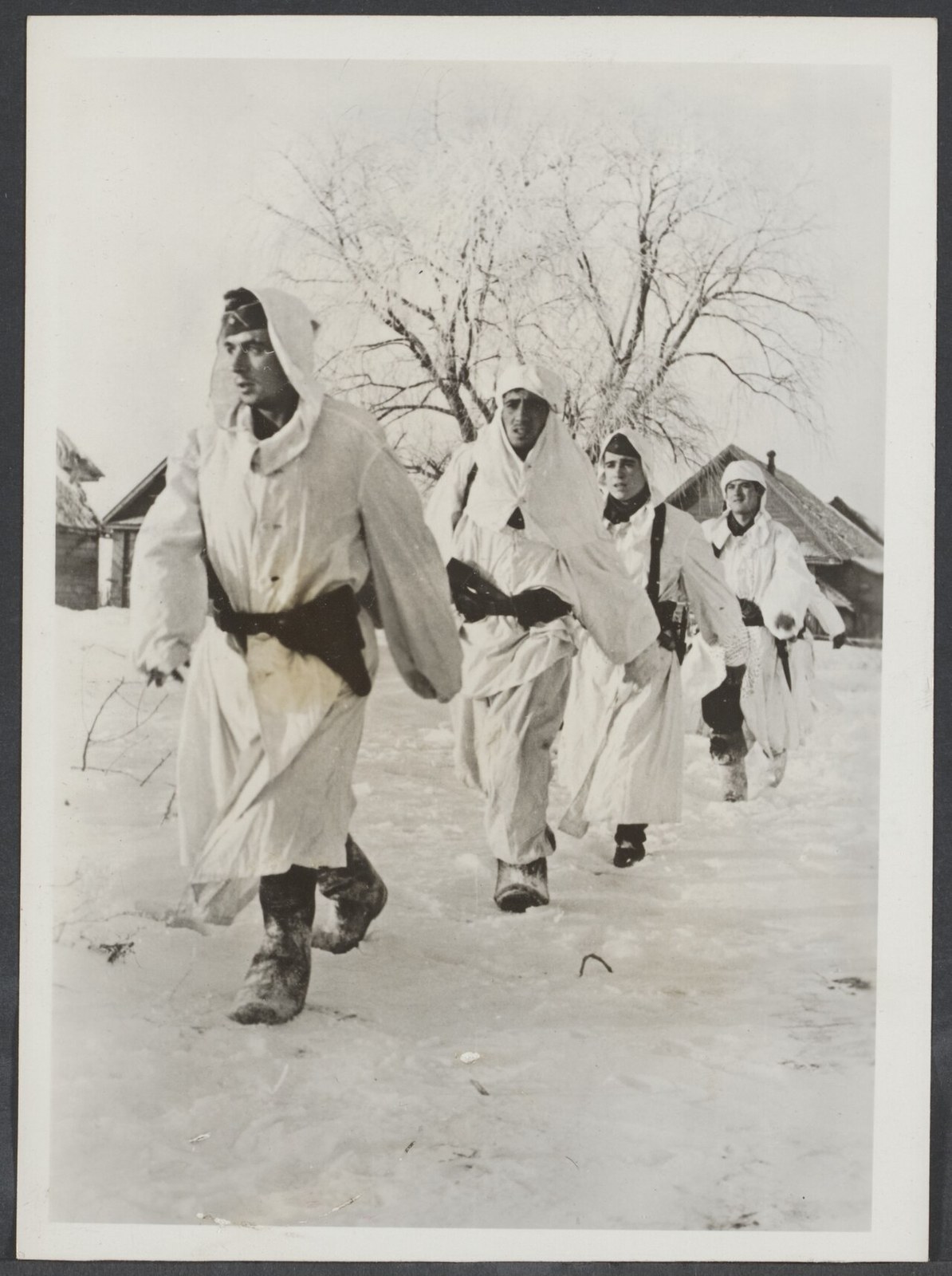
The Second World War turned snow camouflage into a mass item. On the Eastern Front the first winter of the German campaign produced the largest improvisation in the history of the subject: white sheets, whitewash, captured stocks and whatever could be cut into a coverall were pressed into service to hide men and vehicles against snow. Photographs taken by German war correspondents in the winter of 1941-1942, such as the reconnaissance detachment below, show long white smocks worn over everything else, with the soldier’s silhouette flattened into a single white shape.
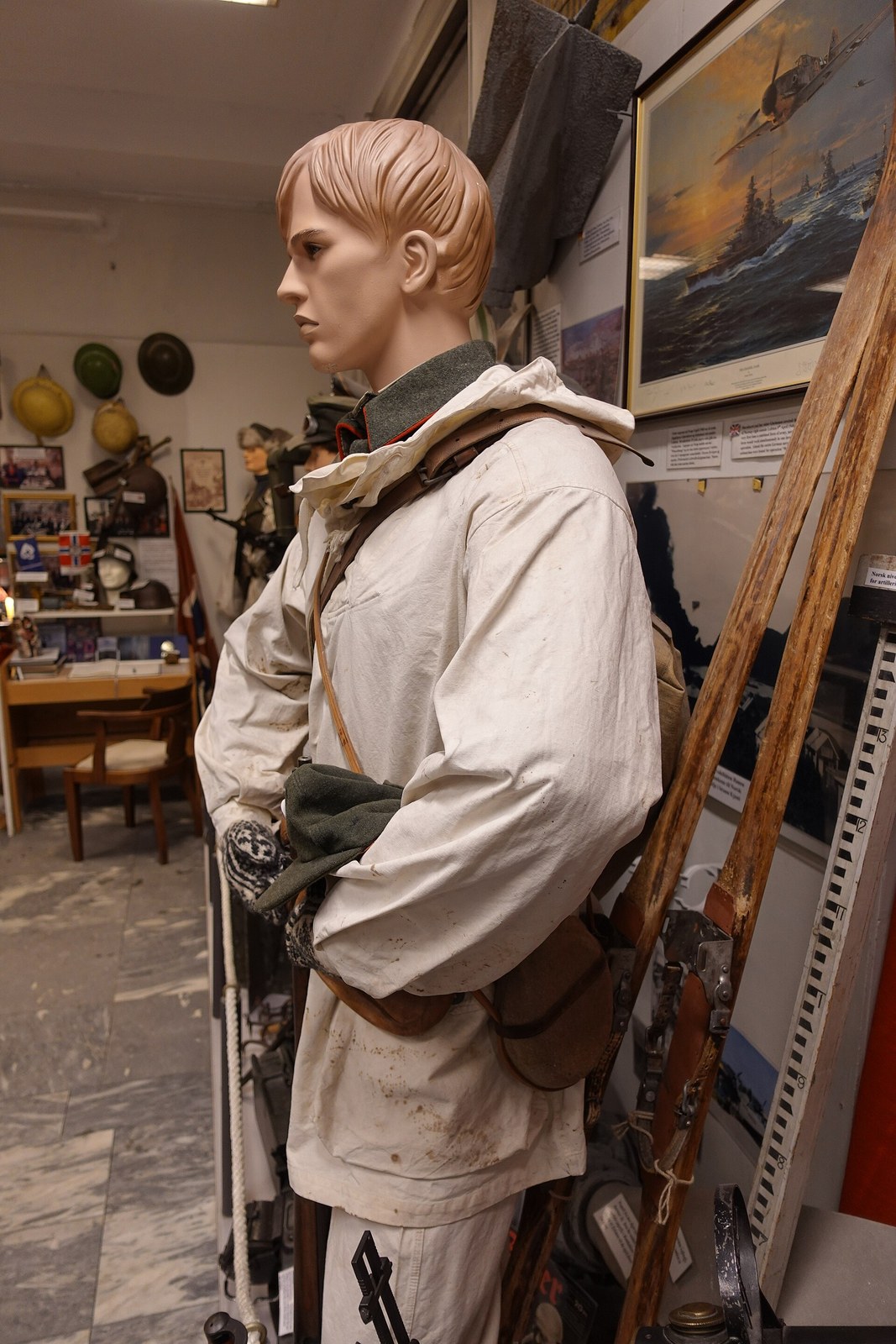
Issue followed improvisation. Padded white winter suits, worn over the uniform and cut for movement rather than for parade, reached German troops in the East, and the same logic appeared in every army fighting in the cold: a garment whose only purpose was to make the wearer resemble the ground, with no rank, no branch colour and no insignia to give him away. The museum piece below is a German padded winter camouflage suit of the type that replaced the sheet in the field.
British and Commonwealth units received white two-piece snow suits for the winter campaigns of 1944-1945, and they were used by infantry, airborne troops and snipers in the Ardennes. The photograph below shows the type in use: a sniper of the 6th Airborne Division, in a hooded white suit with a scoped rifle, in January 1945. American forces used the same idea under the name overwhites, a white over-garment worn on top of the combat uniform, and the word has since covered most plain white snow suits in English usage.

After 1945: white on patrol
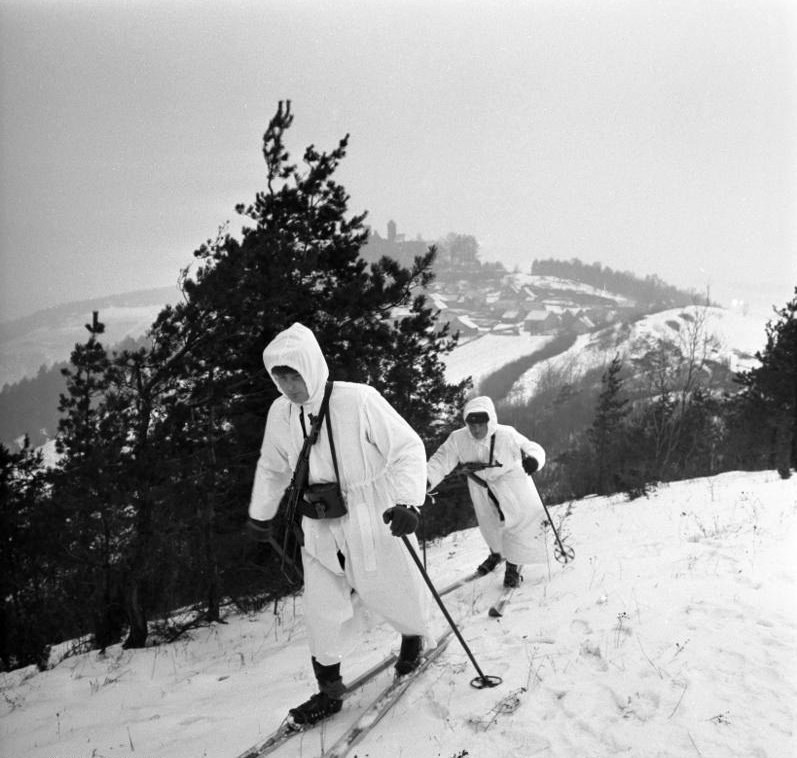
In the Cold War, snow camouflage left the battlefield and moved to the border and the exercise area. Armies that patrolled snow covered ground in peacetime kept white winter suits in store for exactly the same reason as before: a man in field grey or olive green is a moving dark object on a white surface. The photograph below shows a patrol of the East German border troops in winter camouflage suits in Thuringia in 1965, wearing the same answer as the Alpine ski patrols fifty years earlier, white cloth with a hood.
When white is not enough: patterned snow camouflage
Patterned snow camouflage starts from a different premise. Instead of matching the ground itself, it breaks the outline of the wearer, on the assumption that a man in winter terrain will be seen against snow, against dark trunks and against shadow, often in the same minute. The printed snow patterns that appeared in the middle of the twentieth century answered that question by covering a white ground with dark marks, which read as texture rather than as a plain white shape.
The same reasoning can be found in vehicle camouflage. The United States Army’s MERDC field paint system of the 1970s, named after the Mobility Equipment Research and Development Command, defined a set of paint combinations for vehicles according to terrain and season. Two of them were for snow: a snow combination for open terrain, and a snow combination with trees and shrubs that kept a substantial green element in the scheme. A separate arctic scheme was plain white. The distinction is the whole argument of this article in miniature, white alone is right on open snow, and something else is needed as soon as vegetation appears.

Snow, temperate with trees and shrubs

Snow, open terrain
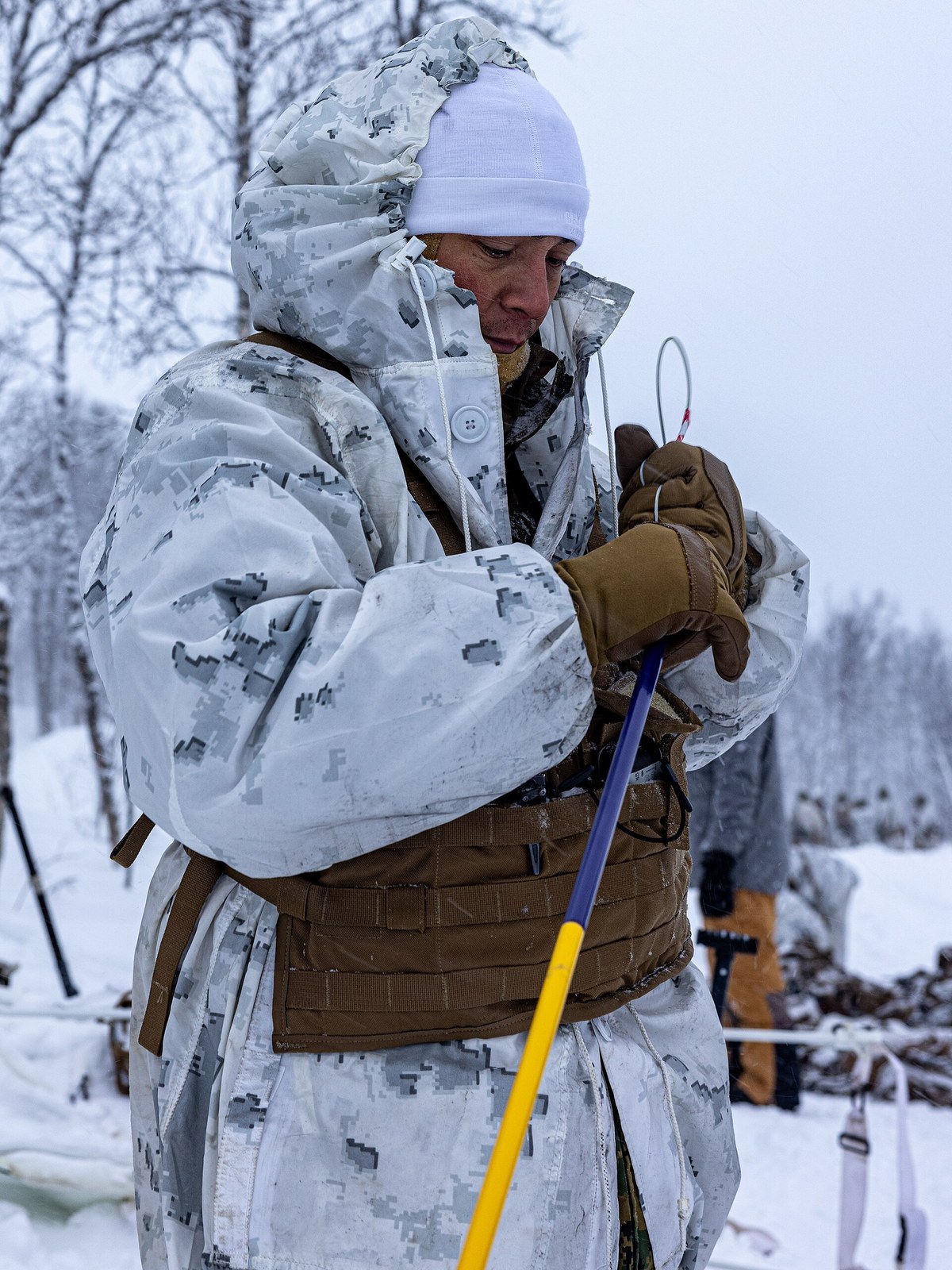
Digital camouflage reached the snow as well. White and grey pixels allow a pattern to blur the edge of a garment at short range without printing large dark shapes that would stand out on open ground. The United States Marine Corps photograph below, taken during cold weather training in Norway in February 2024, shows overwhites in a pixelated white and grey pattern rather than plain white cloth, a direct descendant of the digital patterns that appeared in the 1990s and 2000s.
National systems followed their own landscapes. Finland’s M05 has a dedicated snow version inside the same pattern family, and France’s Tundra pattern was drawn for the mixed snow and rock of the Alps rather than for open fields. Both are covered in detail elsewhere on this site: M05 Desert and Snow and French Tundra and the Chasseurs Alpins. The Finnish woodland version is described in Finnish M05.
Why the compromise survives
Snow camouflage is still issued as an accessory, and the reason is practical rather than doctrinal. A white suit is the only camouflage a soldier can put on and take off during a patrol. Winter operations rarely take place in continuous snow: a patrol crosses a white field, enters a wood, follows a road, passes a village where an armed man in white would be alarming rather than concealed, then returns to the field. The overwhite is designed for that sequence. It is put on when the snow begins and removed when it ends.
The cost is that the garment is only worn when the conditions match, which means that most of the time an army equipped for snow is still fighting in green or brown. White cloth also shows dirt from weapons, exhausts and meltwater, and it wears at the knees and elbows faster than a printed pattern that hides stains. Reversible garments, white on one side and a woodland colour on the other, are the usual industrial answer, and they remain common in winter clothing to this day.
There is also the equipment problem, which no pattern can solve completely. A soldier in white still carries a dark rifle, dark webbing and dark boots, and his tracks in fresh snow are visible from the air and from any elevated position. Snow camouflage buys time and distance. It does not make a patrol invisible, and the armies that use it most, the Nordic ones, treat it as one element of winter discipline alongside movement, light and noise rather than as a solution on its own.
Reading snow camouflage in the field
Snow camouflage is easy to identify once the family is clear. Five markers separate the types:
- Plain white. The oldest and still the most common form, from the First World War smock to modern overwhites. It matches clean snow on open ground and depends on the wearer staying out of cover that is not white.
- White with printed shapes or spots. A white ground interrupted by dark spots, leaves or branches, intended for terrain where snow and vegetation alternate.
- Pixelated white and grey. Digital snow patterns drawn to break the outline at close range, printed on garments and on overwhites alike.
- Reversible winter garments. One side white, the other a woodland colour, so the same item serves before and after snow cover establishes itself.
- Winter vehicle schemes. Paint combinations that keep part of the green palette on a white background, following the same logic of open ground against vegetation.
Three rules follow from the same reading. White works best on open, clean, evenly lit snow. Patterned snow camouflage is a response to mixed terrain, not an improvement on white in an open field. And nothing in the family is permanent: the garment goes on over the uniform and comes off again, which is why it is stored, issued and counted as equipment rather than worn as dress.
Snow camouflage at MegaCamo
MegaCamo prints snow camouflage patterns on garments made to order, from national winter patterns to fictional snow designs. A few entry points:
- German Schnee Snowfleck Camouflage Quilted Bomber Jacket, a printed snow pattern close to the German winter tradition.
- German Snow Flecktarn Schneetarn Camouflage Hooded T-Shirt, the snow side of the German spot pattern family.
- Finnish Arctic Snow Camouflage Quilted Bomber Jacket, the snow version of the Finnish national pattern.
- French Winter Snow Chasseurs Alpins Tundra v2 Camouflage Quilted Bomber Jacket, for the snow and rock landscape of the Alps.
- Belgian Jigsaw Snow Lightweight Hooded T-Shirt, a painted snow jigsaw pattern in the Belgian tradition.
Related reading on camouflage history and winter gear: Flecktarn, the German spot pattern, German World War II camouflage, and Soviet Leaf camouflage for the other great spotting tradition of the period.
Snow camouflage will keep changing because the winter problem keeps changing. A white suit solved the open field, printed patterns answered the treeline, and pixelated overwhites now answer the camera as much as the eye. What has not changed in a century is the status of the garment: it is put on over everything else, it is worn for as long as the ground is white, and then it comes off again.
